Why Your Bank Account Is More Secure Than Your Email (And What That Means)
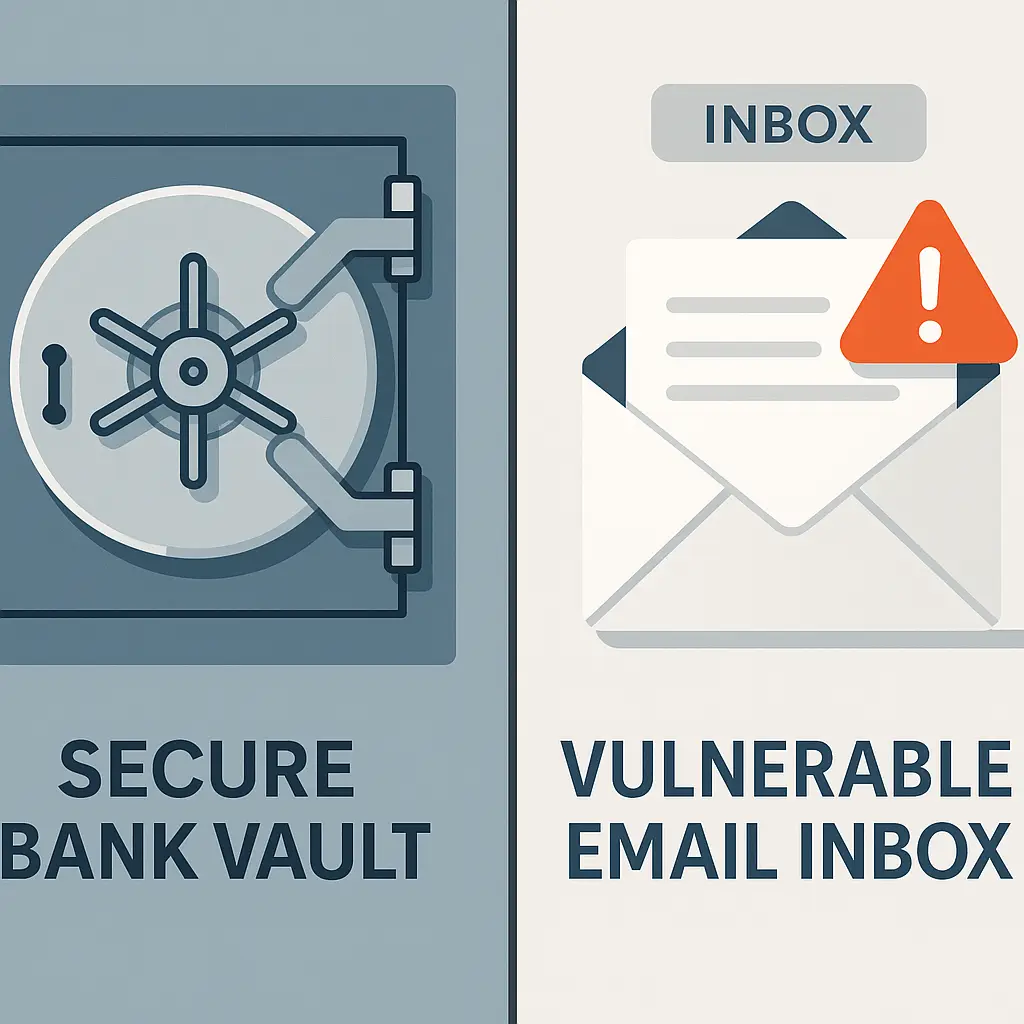
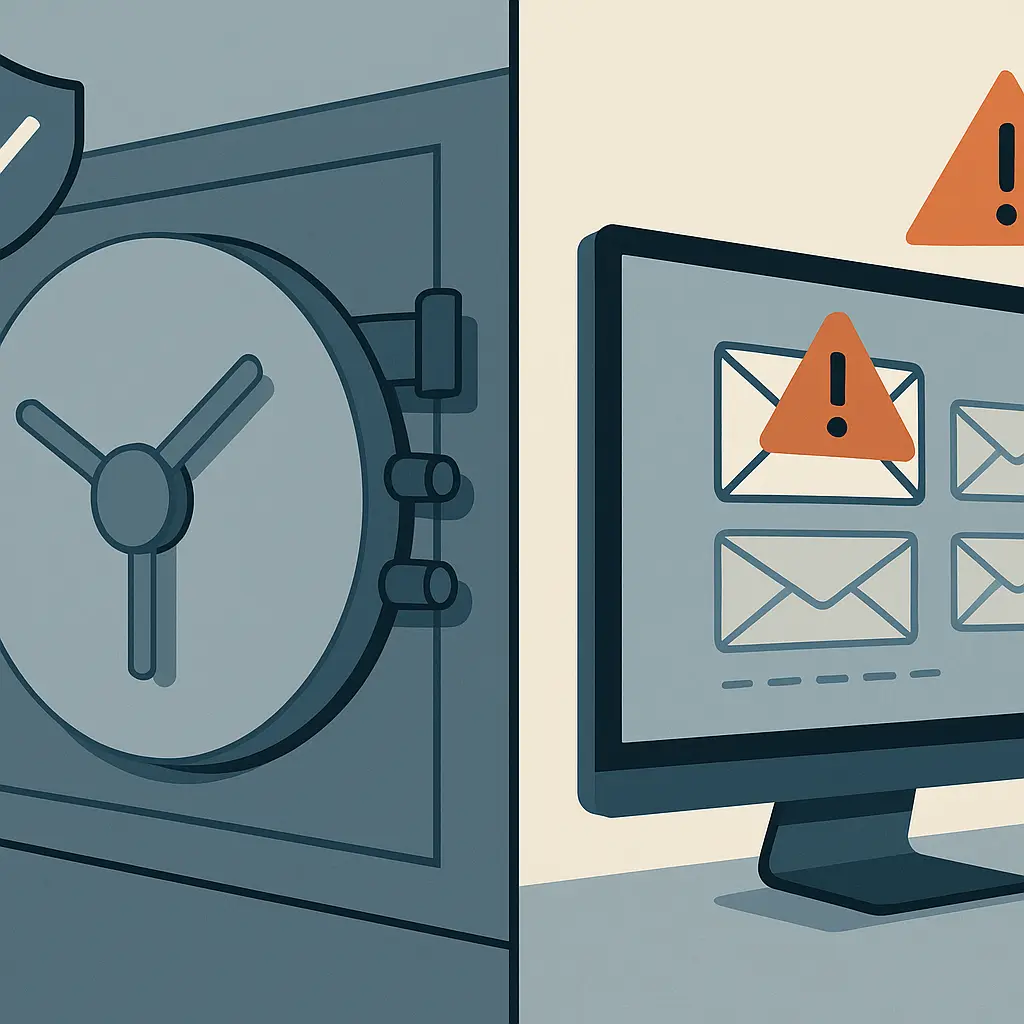
Your bank account is more secure than your email. Not because banks are inherently better at technology, but because they operate under different constraints, face different threats, and carry different liabilities.
This isn't about reassuring you that banking is safe. It's about understanding why the security models differ, what that means for how you protect each one, and why losing access to your email is often worse than losing access to your bank.
The Core Difference: Fraud Detection vs. Access Control
Banks and email providers both authenticate you when you log in. Both use passwords, both offer two-factor authentication, both encrypt your connection. But what happens after you log in is where the models diverge.
A bank monitors every transaction you make. When you swipe your card at a gas station in Nevada three hours after using it at a grocery store in Ohio, the bank's fraud detection system flags the geographic impossibility. When someone tries to wire $5,000 from your account to a new recipient, the bank applies velocity checks, device fingerprinting, and behavioral analysis before allowing the transfer.
Email doesn't do this. Once you're authenticated, you can send anything to anyone. You can forward your entire inbox to an external address, delete every message, change your recovery settings, and trigger password resets on every account you own. The email provider will not intervene. There's no transaction limit, no behavioral baseline, no fraud team reviewing suspicious activity in real time.
Banks assume fraud will happen and build systems to catch it. Email assumes you are who you say you are and lets you do what you want.
Transaction Limits and Reversibility
When you make a purchase with a debit card, federal regulations cap your liability at $50 if you report the fraud within two business days. Credit cards go further: the Fair Credit Billing Act limits your liability to $0 for unauthorized charges. Banks eat the cost.
This creates an incentive structure. Banks invest in fraud prevention because they're on the hook when it fails. They implement daily withdrawal limits, require additional verification for large transfers, and maintain 24-hour fraud hotlines because every successful attack costs them money.
Email has no equivalent. If someone accesses your account and uses it to reset passwords, send phishing emails, or intercept sensitive documents, the email provider faces no financial liability. You can report the compromise, you can regain access if you still control your recovery phone number, but there's no regulatory framework that makes the provider responsible for what happened while someone else was in your account.
The Consumer Financial Protection Bureau handles complaints about banks. The Federal Trade Commission tracks fraud reports. Both agencies have enforcement power. Email falls into a regulatory gap. It's communication infrastructure, not a financial service, so the protections don't apply.
The Email-as-Skeleton-Key Problem
Here's the structural vulnerability that makes email more dangerous than banking: your email is the recovery mechanism for everything else.
When someone compromises your bank account, they can steal money. When someone compromises your email, they can reset the password on your bank account, your investment accounts, your retirement accounts, and every other service you use. Email access is access to the entire graph of your digital life.
In Sherlock Holmes, Watson keeps a revolver in his desk drawer. It's not the most dangerous weapon in London, but it's the one that opens the door to everything else. Email is that revolver. The danger isn't what it does directly. The danger is what it unlocks.
Banks know this. That's why most financial institutions now send transaction alerts via SMS or app notification instead of email, why they require you to call from your registered phone number to make certain changes, and why they increasingly treat email as a secondary channel rather than a primary one.
But most people still use email as their primary recovery method for everything. Password reset links go to email. Verification codes go to email. Account statements go to email. If an attacker gets in, they have a blueprint of your financial life and the tools to exploit it.
What Banks Do That Email Doesn't
Banks use device fingerprinting. When you log in from a new device or location, they notice. They compare the browser, operating system, IP address, and connection patterns against your historical behavior. Anomalies trigger additional verification steps.
Email providers do this too, but they apply it inconsistently. Google will sometimes ask you to verify a login from a new device. But once you're in, there's no ongoing monitoring of what you do. You can delete years of correspondence, export everything to a third party, or change your security settings without triggering any alerts.
Banks use velocity limits. You can't withdraw $10,000 from an ATM in one transaction even if you have $50,000 in your account. You can't wire money to ten different recipients in an hour even if each transfer is legitimate. The system imposes friction because friction prevents certain classes of attack.
Email has no velocity limits on high-risk actions. You can send 500 emails in ten minutes. You can add a forwarding rule that copies every incoming message to an external address. You can change your recovery phone number, recovery email, and password in the same session. These are all actions that, in a banking context, would trigger holds and manual review.
Banks maintain audit logs that you can access. Most institutions let you review recent transactions, see where your card was used, and download statements that show every debit and credit. If something looks wrong, you have the data to investigate.
Email providers keep logs, but they don't surface them in a useful way for most users. Gmail's "Last account activity" link shows IP addresses and access times, but it doesn't tell you what someone did while they were logged in. You can see that someone accessed your account from Romania, but you can't see which emails they read, which they forwarded, or which password resets they triggered.
The Regulatory Gap
The Federal Trade Commission's Consumer Sentinel Network tracks fraud reports. In 2024, imposter scams, identity theft, and online shopping fraud topped the list. Email compromise shows up in the data, but it's categorized as a pathway to other fraud, not as fraud itself.
This matters because it shapes how companies allocate resources. Banks face regulatory scrutiny, regular audits, and potential enforcement actions if their fraud prevention fails. Email providers face reputational risk and user complaints, but no regulator is measuring their performance on account takeover prevention.
The Consumer Financial Protection Bureau provides guidance on what to do if you're a victim of financial fraud. The process is standardized: report it to your bank, file a police report, dispute the charges, freeze your credit. There's a clear escalation path.
Email compromise has no equivalent process. You can report it to the email provider, you can change your password, you can review your account settings. But there's no federal agency tracking how often this happens, no standardized recovery process, and no legal framework that makes the provider responsible for helping you undo the damage.
Why Email Compromise Is Worse Than Bank Compromise
If someone steals $5,000 from your bank account, you file a dispute, the bank investigates, and in most cases you get the money back. The process takes time, it's stressful, but the outcome is predictable.
If someone compromises your email and uses it to reset your passwords, intercept your tax documents, and impersonate you to your contacts, the recovery process is open-ended. You have to identify every account that was accessed, reset every password, notify every contact who might have received a phishing email, and rebuild trust with services that now flag your account as compromised.
The financial loss might be comparable. The time cost and psychological cost are not.
Banks also segment risk in ways that email doesn't. Your checking account is separate from your savings account. Your credit card is separate from your mortgage. If one account is compromised, the damage is contained.
Email is a single point of failure. One password protects everything: your correspondence, your contacts, your calendar, your cloud storage, your password reset links. There's no segmentation, no compartmentalization, no way to limit the blast radius.
What This Means for How You Protect Each One
The security model shapes the threat model. Banks are optimized to detect fraud after it happens. Email is optimized to prevent unauthorized access in the first place.
This means your email password matters more than your bank password. If someone gets your bank password and tries to drain your account, the bank's fraud detection will likely catch it. If someone gets your email password, they can operate undetected for days or weeks.
Use a password manager for both, but prioritize email. Make your email password long, unique, and stored nowhere else. Enable two-factor authentication on email before you enable it on anything else. Your email is the recovery mechanism for everything, so securing it is the highest-leverage action you can take.
Consider using a dedicated email address for financial accounts. If your primary email is the one you give to every website, every newsletter, and every signup form, it's the one most likely to end up in a breach. A separate email for banking, taxes, and investment accounts reduces the attack surface.
Review your email's recovery settings. If your recovery phone number is a landline you no longer use, or a mobile number you've since changed, update it. If your recovery email is an old account you no longer check, remove it. Attackers use stale recovery settings to regain access after you've locked them out.
Enable login alerts. Most email providers can notify you when someone logs in from a new device or location. Turn this on. It won't stop an attack, but it will tell you one is happening.
The Structural Advantage Banks Have
Banks benefit from centralized oversight. The Federal Deposit Insurance Corporation insures deposits, the Office of the Comptroller of the Currency regulates national banks, and the Consumer Financial Protection Bureau enforces consumer protection laws. This creates a baseline level of security that applies across the industry.
Email has no equivalent. Google, Microsoft, and Apple each implement their own security measures, but there's no regulatory floor, no mandatory audit process, and no enforcement mechanism when things go wrong.
Banks also benefit from fraud insurance and reserve requirements. They're required to maintain capital reserves that can cover losses from fraud, and they carry insurance that kicks in when those reserves aren't enough. This doesn't make fraud impossible, but it does mean the bank has a financial cushion that absorbs the impact.
Email providers have no such requirement. If a wave of account takeovers happens, they can improve their security in response, but they're not required to compensate users for the damage.
The Intersection: Where Email Becomes the Bank Attack Vector
The most common path to bank fraud isn't breaking into the bank's systems. It's compromising the email account that controls access to the bank account.
Phishing emails that mimic bank alerts are one vector. Attackers send fake fraud alerts, fake account verification requests, or fake security updates. The emails link to sites that harvest your credentials or install malware.
But the more insidious attack is the one that starts with email compromise and works backward. An attacker gets into your email, searches for the word "bank," finds your account statements, identifies which institutions you use, and then triggers password resets. The reset links go to the email they now control. They click the links, set new passwords, and lock you out.
This is why the FTC warns about imposter scams that start with email access. Once someone controls your inbox, they can impersonate you to customer service, intercept verification codes, and bypass security questions by reading your correspondence.
Banks can detect unusual transactions, but they can't detect that someone else is reading your email. That's outside their visibility. The fraud shows up later, when the attacker uses email access to move money.
What You Can Do
Secure your email first. Use a password manager to generate a unique password. Enable two-factor authentication. Review your recovery settings. Set up login alerts.
Segment your accounts. Use one email for financial services, another for everything else. This limits the damage if one account is compromised.
Monitor your bank accounts, but don't rely on the bank to catch everything. Check your transactions weekly. Set up alerts for large purchases or transfers. The bank's fraud detection is good, but it's not perfect.
Review your email regularly for signs of compromise. Look for emails you didn't send, forwarding rules you didn't create, or login activity from locations you don't recognize. Most email providers surface this information if you know where to look.
Understand that email is the higher-value target. Attackers know this. That's why phishing emails outnumber fake bank websites, why email compromise is the first step in most identity theft cases, and why securing your inbox matters more than securing any individual account.
The Asymmetry That Matters
Banks are more secure than email because they have to be. They face regulatory oversight, financial liability, and reputational risk that email providers don't. They invest in fraud detection, transaction monitoring, and customer support because the cost of not doing so is measurable and immediate.
Email operates under different constraints. It's infrastructure, not a service. It's free for most users, which means the business model doesn't support the same level of hands-on fraud prevention. And it's decentralized in the sense that no single entity is responsible for making sure your email stays secure.
This doesn't make email providers negligent. It makes them rational actors operating under different incentives. Understanding that asymmetry is the first step toward compensating for it.
Your bank will catch most fraud attempts. Your email won't. Plan accordingly.
Related reading: