Tax preparer fraud: how to vet your accountant before filing
Tax season brings out scammers who pose as preparers, promise huge refunds, and disappear after filing. Some steal your refund directly. Others fabricate deductions that trigger audits years later, leaving you with penalties and legal liability. The IRS reports that fraudulent tax preparers cost taxpayers millions annually through refund theft, identity theft, and fabricated returns.
The problem isn't subtle. Fake preparers operate storefronts, advertise online, and build reputations in communities before vanishing. They exploit the complexity of tax law and the urgency of filing deadlines. Most people discover the fraud months or years later when the IRS sends a notice about unpaid taxes or a missing return.
Here's the step-by-step process to verify credentials, recognize fraud patterns, and protect yourself before you hand over your Social Security number and financial documents.
The fraud mechanism: how fake preparers operate
Tax preparer fraud follows predictable patterns. The preparer promises an inflated refund, often before reviewing your documents. They charge a fee based on your refund amount, a percentage rather than a flat rate. They file the return electronically, directing your refund to their account or a prepaid card they control. You receive a portion of the refund, or nothing at all. The preparer disappears.
In other cases, the preparer fabricates deductions, credits, or business expenses to inflate your refund. The return gets processed. You receive the money. Months or years later, the IRS audits the return, disallows the fake deductions, and bills you for the unpaid taxes plus penalties and interest. The preparer is long gone. You're legally responsible for what's on the return, even if you didn't know the numbers were fabricated.
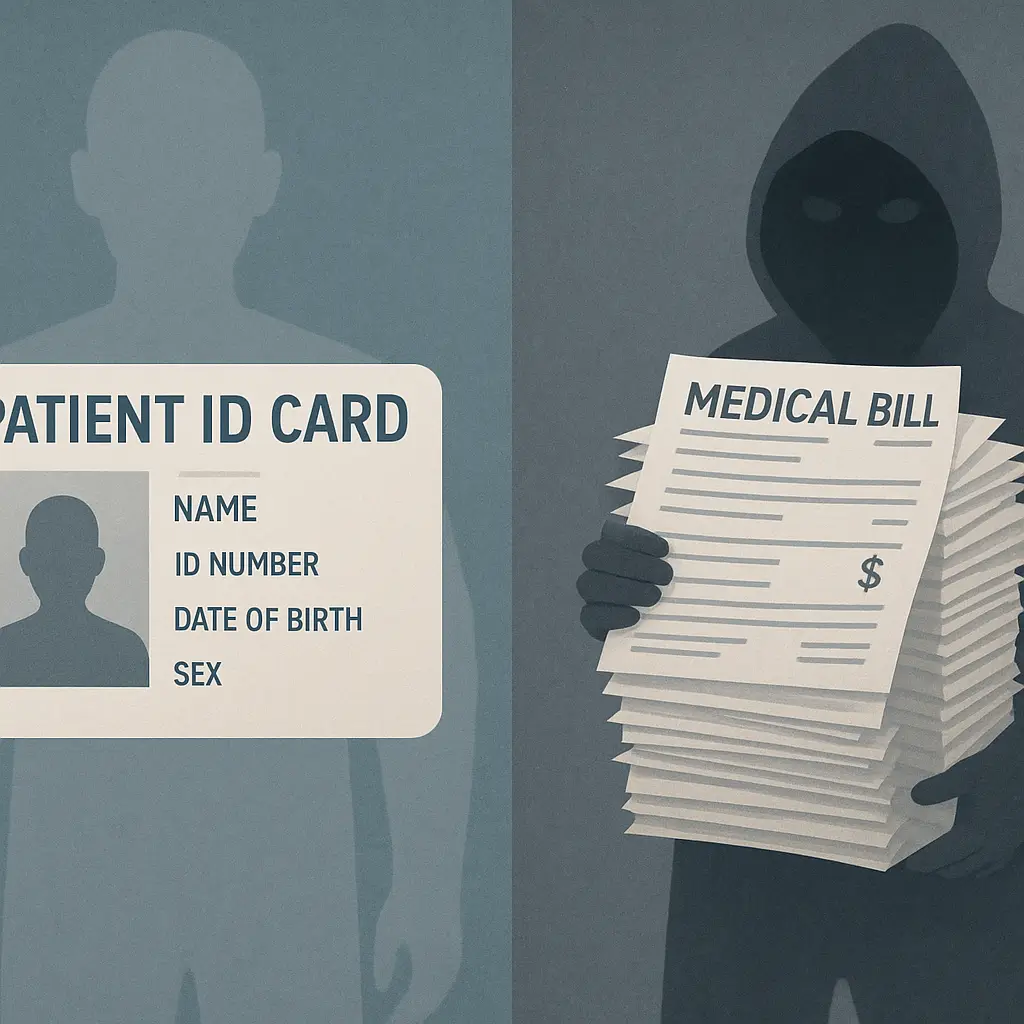
Some preparers use your information for identity theft. They file multiple returns using stolen identities, claim fraudulent refunds, and vanish before anyone notices. Your Social Security number, birthdate, and financial details become tools for ongoing fraud.
The FTC warns that fake preparers often target vulnerable populations, elderly taxpayers, immigrants, people with limited English proficiency, and low-income families eligible for Earned Income Tax Credit. The scam works because it exploits trust, urgency, and the assumption that someone with a storefront and business cards must be legitimate.
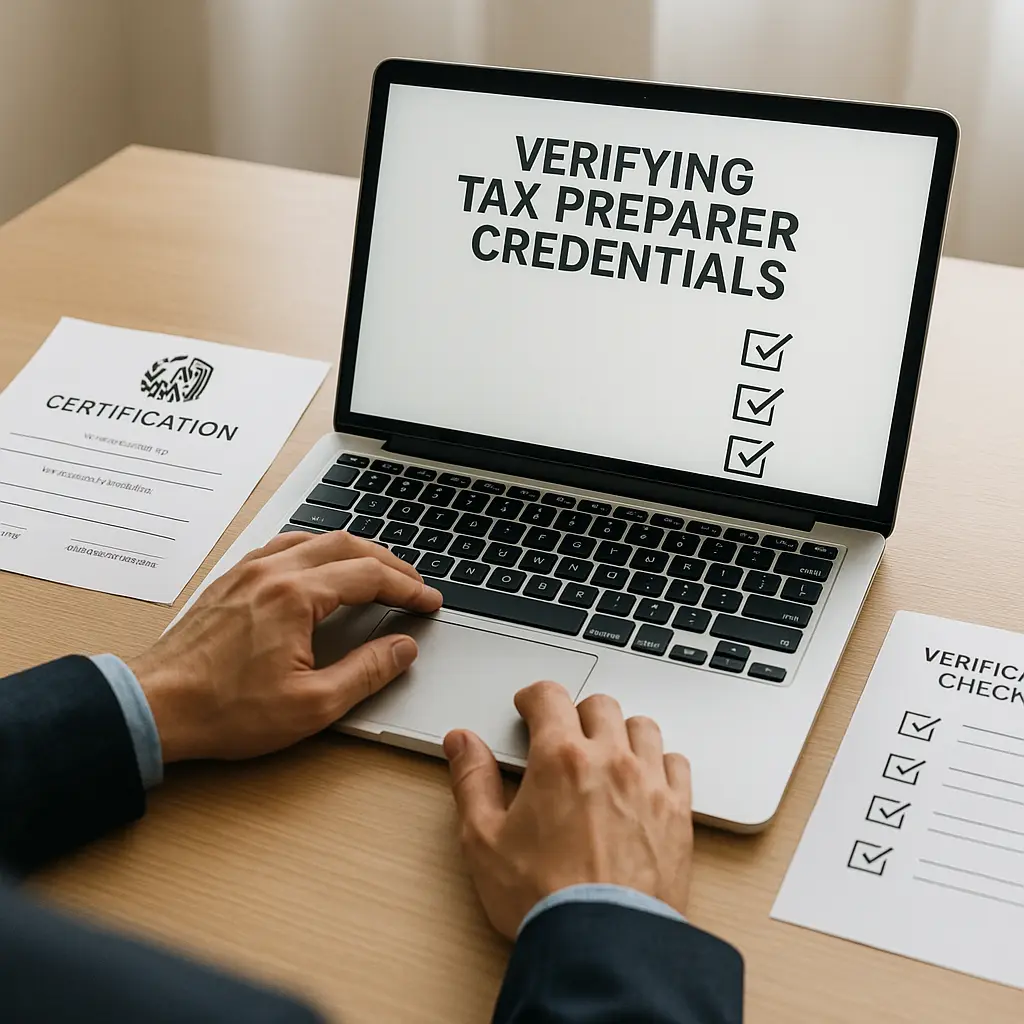
Step 1: Verify the PTIN
Every paid tax preparer must have a Preparer Tax Identification Number (PTIN) issued by the IRS. This is non-negotiable. If someone prepares tax returns for money, they need a PTIN. If they don't have one, they're operating illegally.
Ask for the PTIN before you share any documents. Legitimate preparers provide it immediately. Check the number against the IRS Directory of Federal Tax Return Preparers. The directory lists preparers with PTINs and professional credentials. If the person isn't in the directory, that's a red flag.
The directory shows the preparer's name, city, state, credentials, and any professional designations. It doesn't list preparers who only have a PTIN without additional credentials, which means you're looking for someone with verifiable qualifications beyond the minimum requirement.
If the preparer refuses to provide their PTIN, walk away. If they claim they don't need one because they're "just helping out" or "doing it as a favor," they're breaking the law. The IRS doesn't care about intent. Paid preparation requires a PTIN.
Step 2: Check professional credentials
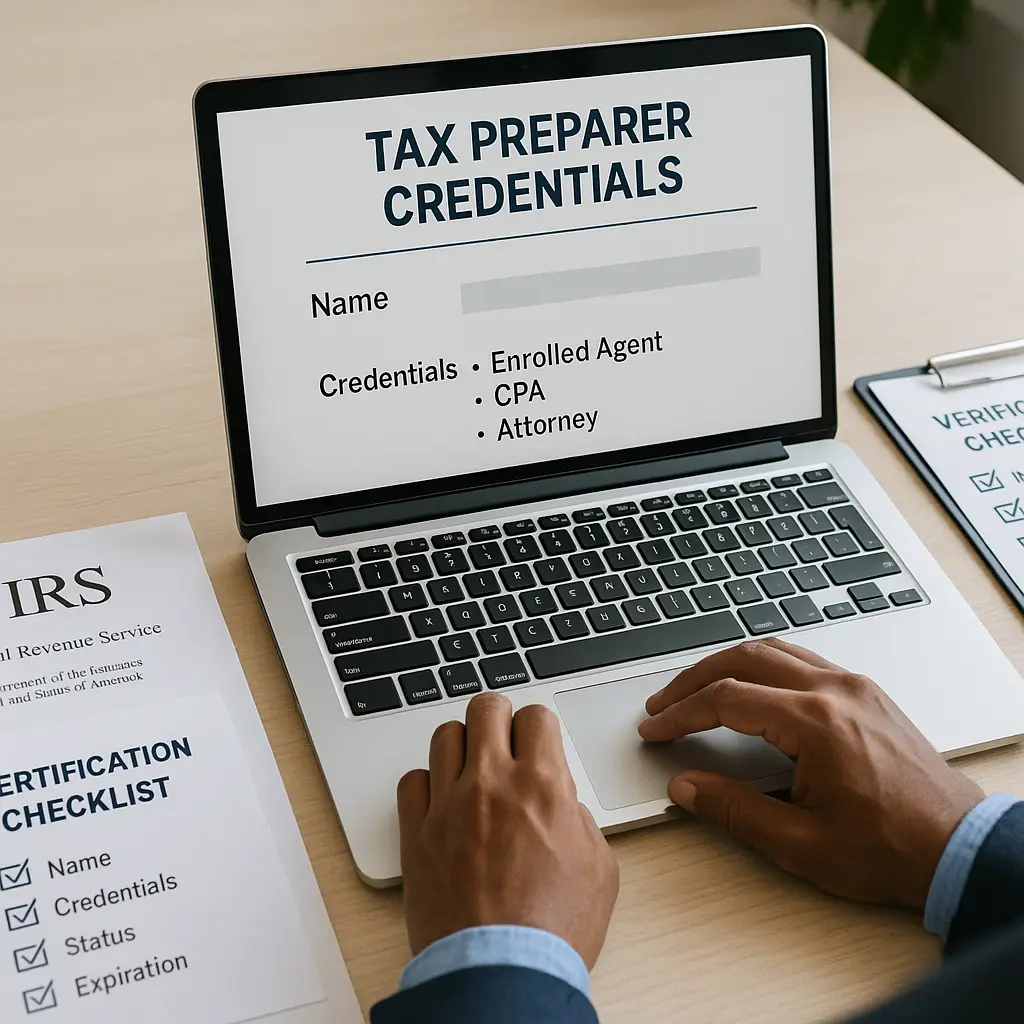
A PTIN alone isn't enough. Look for one of three professional designations: Certified Public Accountant (CPA), Enrolled Agent (EA), or attorney. These credentials require passing exams, continuing education, and adherence to ethical standards. They also grant unlimited representation rights before the IRS, meaning the preparer can represent you in an audit.
CPAs are licensed by state boards of accountancy. You can verify CPA licenses through your state's board website. Search for "[your state] board of accountancy" and use their license lookup tool. Check for active status and any disciplinary actions.
Enrolled Agents are federally licensed by the IRS. The IRS Directory lists active EAs. You can also verify EA status through the National Association of Enrolled Agents, though the IRS directory is the authoritative source.
Attorneys licensed to practice law can also prepare returns. Verify attorney licenses through your state bar association. Most state bars maintain online directories with disciplinary history.
Some preparers hold the Annual Filing Season Program (AFSP) designation, which requires continuing education but doesn't grant unlimited representation rights. AFSP preparers can represent clients for returns they prepared, but only for specific issues. This is better than no credential, but it's not equivalent to CPA, EA, or attorney status.
Avoid preparers with no professional designation. The lack of credentials doesn't automatically mean fraud, but it removes a layer of accountability and expertise. If something goes wrong, you have no professional board to file a complaint with.
Step 3: Look for the signature requirement
The IRS requires all paid preparers to sign the returns they prepare and include their PTIN. If a preparer refuses to sign your return, that's a clear fraud indicator. It means they're avoiding accountability. When the IRS audits the return or discovers fraud, the unsigned return makes it harder to trace back to the preparer.
"Ghost preparers" operate this way intentionally. They prepare the return, print it, hand it to you for signature, and refuse to sign it themselves. They collect their fee and disappear. You file the return. If the IRS questions anything, the preparer has no legal connection to the document.
Legitimate preparers sign every return. They include their PTIN, business name, address, and contact information. They provide you with a copy of the signed return. If the preparer says they'll sign later, or that you should file it yourself, or that signing isn't necessary, leave immediately.
Check the signature block on the return before you sign. It should show the preparer's name, PTIN, firm name, address, and phone number. If any of those fields are blank, don't sign. Demand a corrected version with complete information.
Step 4: Understand fee structures
Legitimate tax preparers charge flat fees based on the complexity of your return. The fee might vary depending on whether you have a simple W-2, self-employment income, rental properties, or investment accounts, but it's a fixed amount agreed upon before work begins.
Fraudulent preparers charge a percentage of your refund. This creates an incentive to inflate the refund through fabricated deductions. If the fee is 20% of your refund, the preparer makes more money by inventing expenses or credits. You get a bigger refund upfront, but you're on the hook when the IRS audits the return and demands repayment.
Percentage-based fees are a red flag. So are vague fee structures where the preparer won't quote a price until after they "see what we can do for you." Legitimate preparers provide written fee agreements before they start work.
Some preparers advertise "guaranteed refunds" or "maximum refunds." These phrases suggest the preparer will manipulate your return to generate a specific outcome, regardless of accuracy. Tax preparation isn't about maximizing refunds. It's about filing an accurate return that reflects your actual income, deductions, and credits.
If the preparer promises a refund amount before reviewing your documents, that's fraud. There's no way to know your refund without seeing your W-2s, 1099s, receipts, and prior-year returns. A preparer who guarantees a number upfront is either guessing or planning to fabricate.
Step 5: Verify refund deposit information
Your refund should go directly to your bank account. You provide the routing and account numbers. The preparer enters them on the return. You verify the numbers before signing. The IRS deposits the refund into that account.
Fraudulent preparers redirect refunds to accounts they control. They might tell you the refund will be "processed through their account" for "faster service" or "to deduct fees." This is fraud. The IRS allows preparers to deduct their fee from your refund through specific programs, but those programs are transparent and require your written consent. A preparer who insists on routing your refund through their account is stealing.
Some preparers use prepaid debit cards or third-party payment processors to capture refunds. They hand you a card, tell you the refund will load onto it, and keep the card credentials. You never see the money, or you receive a fraction of the refund while the preparer takes the rest.
Before you sign the return, check Form 8888 (Allocation of Refund) if it's attached. This form splits your refund among multiple accounts. If you didn't request a split, and the form shows accounts you don't recognize, don't sign. Demand an explanation. If the preparer can't provide one, leave.
Check the direct deposit section on Form 1040. The routing and account numbers should match your bank account exactly. If they don't, the return is wrong. Correct it before you sign, or find a different preparer.
Step 6: Review the return before signing
You are legally responsible for everything on your tax return, even if the preparer made it up. The IRS doesn't care that you trusted someone else. If the return contains fabricated income, false deductions, or fraudulent credits, you owe the taxes, penalties, and interest.
Read the entire return before you sign. Look at every line. Compare the numbers to your documents. If you earned $50,000 in wages, the return should show $50,000 in wages. If you paid $8,000 in mortgage interest, the return should show $8,000 in mortgage interest. If the numbers don't match, ask why.
Check for deductions or credits you didn't claim. If you don't have children, the return shouldn't show Child Tax Credit. If you didn't pay tuition, the return shouldn't show education credits. If you don't own a business, the return shouldn't show Schedule C business expenses.
Fraudulent preparers inflate refunds by inventing expenses. They add fake charitable contributions, fabricate business losses, or claim credits you don't qualify for. The refund looks great. You sign. The IRS processes it. Months later, the audit notice arrives. The preparer is gone. You owe the money.
If the preparer refuses to explain a number, or tells you "don't worry about it," or says "this is how we maximize refunds," don't sign. Demand a line-by-line explanation. If you don't understand something, ask. If the answer doesn't make sense, walk away.
Legitimate preparers want you to understand your return. They explain deductions, answer questions, and provide documentation. They don't rush you. They don't pressure you to sign without reading. They don't get defensive when you ask for clarification.
Step 7: Confirm IRS e-file participation
The IRS authorizes preparers to file returns electronically through the e-file program. Legitimate preparers are IRS e-file providers. You can verify this by asking for their Electronic Filing Identification Number (EFIN). The IRS doesn't publish a public directory of EFINs, but legitimate preparers provide this number on request.
Some fraudulent preparers file returns without authorization. They use stolen EFINs or file through unauthorized channels. The return gets submitted, but the IRS has no record of the legitimate preparer. When problems arise, there's no trail.
Ask whether the preparer will file electronically or on paper. E-file is faster and more secure, but paper filing isn't inherently suspicious. What matters is that the preparer has legitimate authorization to file on your behalf.
If the preparer files electronically, you should receive an acknowledgment from the IRS confirming receipt. This acknowledgment includes your return's submission date and a confirmation number. If the preparer says they filed but you never receive an acknowledgment, the return might not have been filed at all.
Check your IRS account online at IRS.gov. Create an account if you don't have one. The account shows your filing status, refund status, and payment history. If the preparer claims they filed your return but the IRS account shows no record, that's fraud.
Step 8: Watch for pressure tactics and urgency
Fraudulent preparers create artificial urgency. They tell you to file immediately, claim the deadline is closer than it is, or say you'll "lose money" if you wait. Legitimate preparers work with your timeline. They don't pressure you to sign before you're ready.
Tax deadlines are real, but they're public knowledge. The standard filing deadline is April 15 (or the next business day if April 15 falls on a weekend or holiday). Extensions move the deadline to October 15. If the preparer claims you need to file "right now" in February, they're lying.
Some preparers use fear tactics. They tell you the IRS is "cracking down" or that "new rules" require immediate filing. They claim delays will trigger audits or reduce your refund. None of this is true. The IRS doesn't penalize people for filing early or late within the legal deadline.
If the preparer won't let you take the return home to review, that's a red flag. If they insist you sign on the spot, leave. If they say you can't have a copy of the return until after it's filed, refuse. Legitimate preparers provide copies before filing and give you time to review.
Step 9: Check for disciplinary history
Professional licensing boards maintain public records of disciplinary actions. If a CPA, EA, or attorney has been sanctioned for fraud, misconduct, or ethics violations, that information is available.
For CPAs, check your state board of accountancy website. Most boards publish disciplinary actions, license suspensions, and revocations. Search for the preparer's name and license number.
For Enrolled Agents, the IRS Office of Professional Responsibility handles discipline. The IRS doesn't publish a public database of disciplinary actions, but you can file a complaint if you suspect misconduct. The IRS provides guidance on reporting unethical preparers.
For attorneys, check your state bar association website. Bar associations publish disciplinary history, including suspensions, disbarments, and ethics violations.
A clean disciplinary record isn't a guarantee of competence, but a history of sanctions is a warning. If the preparer has been disciplined for fraud, unauthorized practice, or client fund misappropriation, find someone else.
Step 10: Get everything in writing
Legitimate preparers provide written engagement letters that outline the scope of work, fees, deadlines, and responsibilities. The letter specifies what the preparer will do, what you're responsible for providing, and how much it costs.
If the preparer won't provide a written agreement, that's a red flag. Verbal agreements are unenforceable and leave you with no recourse if something goes wrong. Demand a written contract before you hand over documents.
The engagement letter should include:
- The preparer's name, PTIN, credentials, and contact information
- A description of services (e.g., "preparation of 2025 Form 1040 and state return")
- The fee structure (flat fee, not percentage-based)
- The deadline for providing documents and completing the return
- Your responsibilities (providing accurate information, reviewing the return)
- The preparer's responsibilities (signing the return, filing electronically, providing copies)
Keep a copy of the engagement letter, the signed return, and all supporting documents. If the IRS audits your return, you'll need this documentation to show what the preparer did and what you provided.
The cultural reference: Ocean's Eleven and the long con
In Ocean's Eleven, Danny Ocean assembles a team to rob a casino. The heist works because the crew builds trust, exploits assumptions, and disappears before anyone realizes what happened. Tax preparer fraud follows the same structure. The preparer builds credibility through a storefront, business cards, and professional appearance. They exploit your trust and the assumption that someone advertising tax services must be legitimate. They file your return, collect their fee, and vanish before the IRS audits or the refund theft becomes obvious.
The difference is that Ocean's crew targeted a casino designed to absorb losses. Tax fraud targets individuals who can't afford the penalties. The IRS holds you accountable for what's on your return, regardless of who prepared it. The preparer walks away. You're left with the bill.
What to do if you've already used a fraudulent preparer
If you discover your preparer committed fraud after filing, act immediately. Contact the IRS and explain the situation. File Form 14157 (Complaint: Tax Return Preparer) and Form 14157-A (Tax Return Preparer Fraud or Misconduct Affidavit). These forms document the fraud and help the IRS investigate.
If the preparer fabricated deductions or credits, you may need to file an amended return (Form 1040-X) to correct the errors. The amended return won't eliminate penalties or interest, but it stops the problem from compounding.
If the preparer stole your refund, report the theft to the IRS and file a police report. The IRS may issue a replacement refund, but there's no guarantee. Refund theft is difficult to recover because the money often moves through multiple accounts before you realize it's gone.
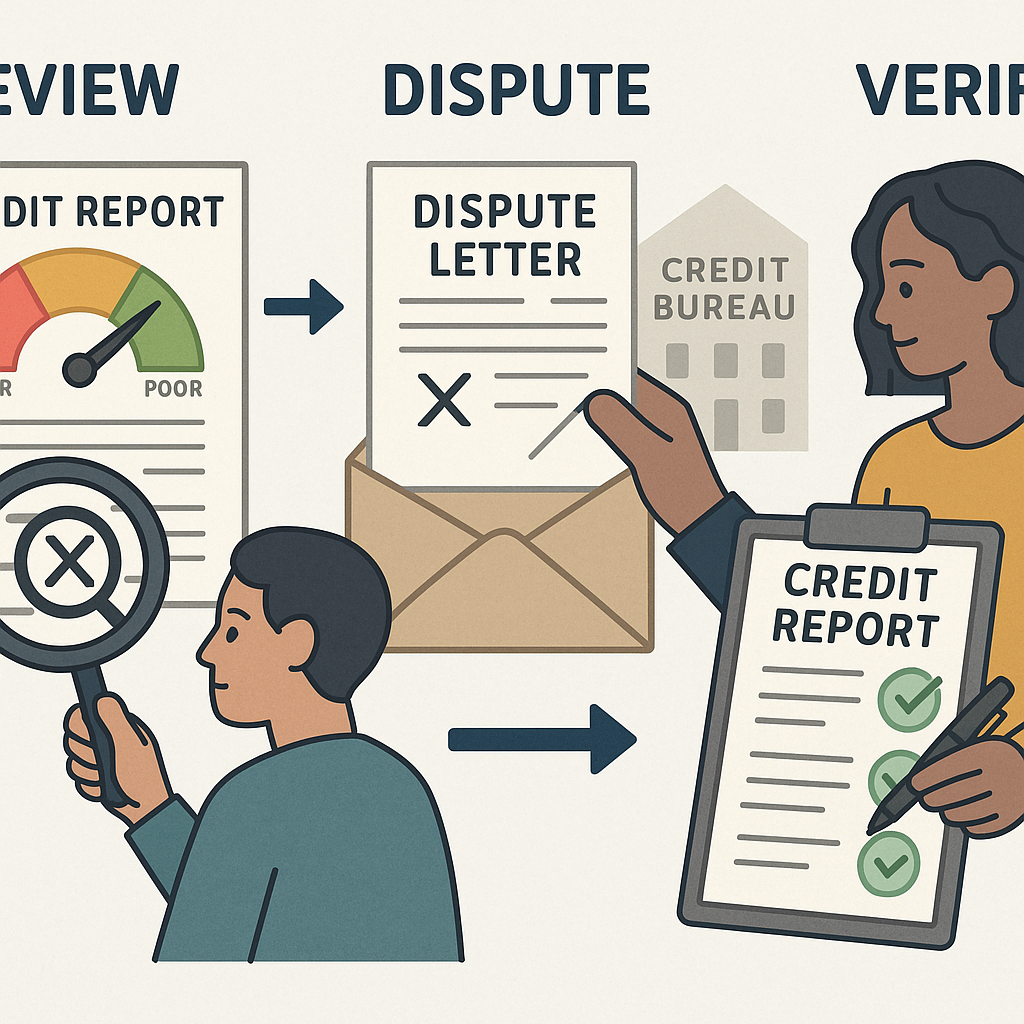
If the preparer used your information for identity theft, place a fraud alert on your credit reports and file an FTC identity theft report. Monitor your credit for unauthorized accounts and tax transcripts for fraudulent returns filed under your Social Security number.
Report the preparer to your state board of accountancy (if they're a CPA), the IRS Office of Professional Responsibility (if they're an EA), or your state bar association (if they're an attorney). Reporting won't recover your money, but it helps prevent the preparer from defrauding others.
Why this matters beyond tax season
Tax preparer fraud isn't just about money. It's about identity theft, legal liability, and years of financial consequences. A fraudulent return can trigger audits, liens, wage garnishments, and damaged credit. The preparer disappears. You spend years cleaning up the mess.
The verification process outlined here takes around 30 minutes. Check the PTIN. Verify credentials. Confirm the fee structure. Review the return before signing. These steps prevent fraud that could cost thousands of dollars and years of legal problems.
The IRS won't forgive taxes owed because you trusted the wrong preparer. The law doesn't care that you didn't know the deductions were fake. You signed the return. You're responsible.
Vet your tax preparer the same way you'd vet anyone with access to your Social Security number, bank accounts, and financial history. Because that's exactly what they are.