Medical identity theft: the silent kind
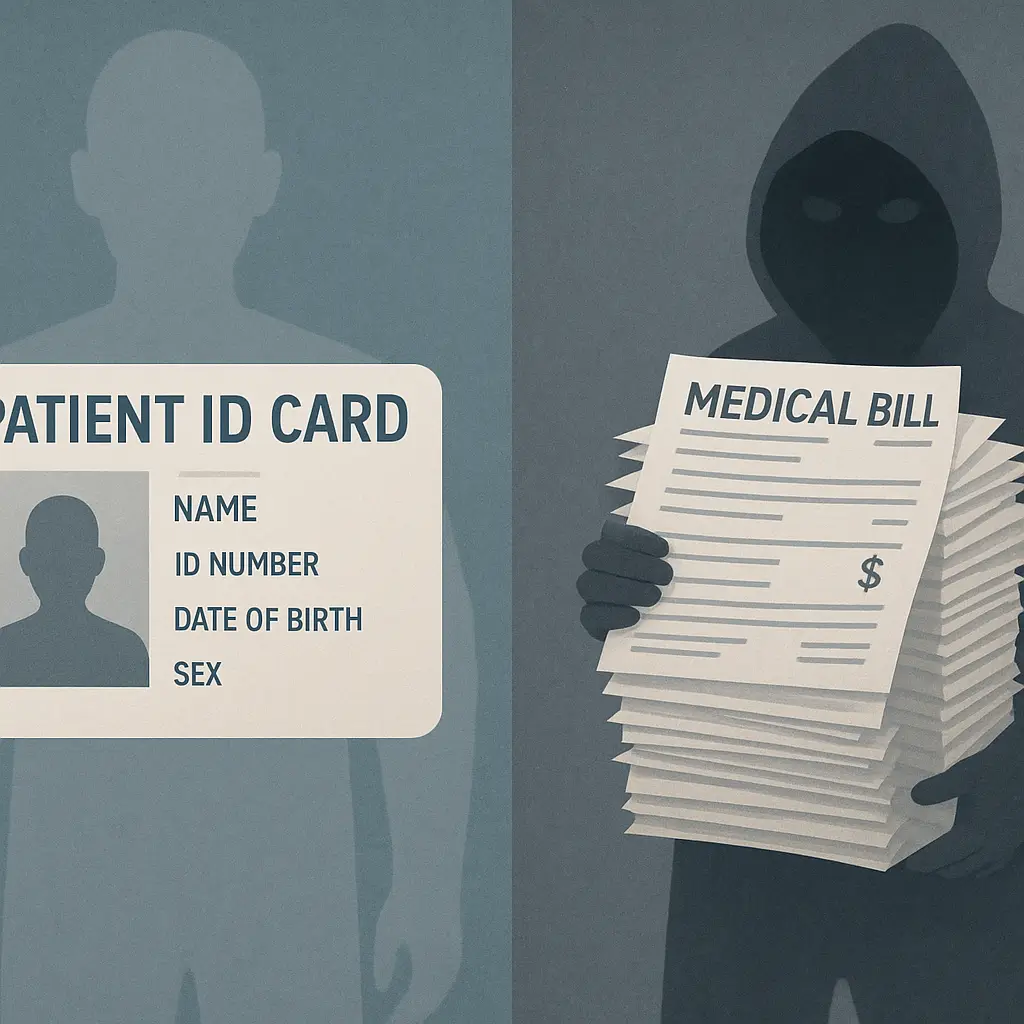
Your credit card gets stolen, you call the bank, they cancel the card, you get a new number. Annoying, but contained. Medical identity theft doesn't work that way.
Someone uses your insurance to get surgery. Their blood type goes in your file. Their allergy to penicillin becomes your allergy. Their diabetes diagnosis attaches to your chart. Then you show up at the ER unconscious, and the doctor treats you based on someone else's medical history.
That's not a billing problem. That's a life-or-death problem.
Medical identity theft is the theft that doesn't just drain your bank account, it corrupts the information doctors use to keep you alive. And unlike credit card fraud, there's no universal "freeze" button, no quick reset, no simple fix. The damage spreads through insurance databases, hospital systems, pharmacy records, and credit reports in ways that take years to untangle.
Here's how it happens, why it's different from every other kind of identity theft, and what you can actually do about it.
What medical identity theft actually is
Medical identity theft occurs when someone uses your personal information, your name, Social Security number, insurance member ID, or Medicare number, to obtain medical services, prescription drugs, or medical equipment. The thief might be a stranger who bought your data on the dark web, a family member who lacks insurance, or a medical professional submitting fraudulent claims.
The fraud takes several forms. Someone uses your insurance card to see a doctor, get a prescription, or undergo surgery. A clinic bills your insurer for services you never received. A pharmacy files claims for medications you never picked up. A medical equipment supplier charges your insurance for wheelchairs, oxygen tanks, or diabetes supplies you never ordered.
Each transaction creates a record. The insurer logs the claim. The provider updates your medical chart. The pharmacy records the prescription. The billing department sends an Explanation of Benefits statement to your address, or to an address the thief changed without your knowledge.
The FTC reports that medical identity theft accounts for around 3-5% of identity theft complaints, but the actual incidence is likely higher. Many victims don't discover the fraud until they receive a bill, get denied for insurance coverage, or find incorrect information in their medical records during a routine visit.
Unlike credit card fraud, where the bank eats most of the loss, medical identity theft creates liability that follows you. Your insurance company may refuse to pay for fraudulent claims, leaving you responsible for bills you didn't incur. Collection agencies pursue you for debts you don't owe. Your credit report accumulates medical debt that tanks your score.
And that's just the financial damage.
Why medical records are different from credit reports
Credit reports track financial behavior. Medical records track your body.
When someone commits credit card fraud, the bank reverses the charges, issues a new card, and moves on. The fraudulent transactions disappear from your statement. Your credit report might take a hit, but you can dispute the entries, freeze your credit, and lock down your accounts. The damage is containable because money is fungible, a dollar stolen can be replaced with another dollar.
Medical records don't work that way. They're permanent, distributed, and designed to follow you across providers to ensure continuity of care. When a thief uses your insurance, their medical information enters your chart. Their diagnosis, their prescriptions, their lab results, their surgical history, all of it gets filed under your name in databases you can't access, can't freeze, and can't easily correct.
A fraudulent diagnosis in your file can lead to denied insurance coverage. If the thief's chart shows treatment for diabetes, your insurer might deny your claim for diabetes care, assuming you've already been treated. If their records indicate substance abuse treatment, you might face higher premiums or outright denial for life insurance. If their blood type is listed as O-negative and yours is A-positive, a transfusion based on the wrong record could kill you.
Correcting medical records is exponentially harder than disputing a credit report entry. You must identify every provider, insurer, pharmacy, and billing service that holds the fraudulent information. You must request copies of all records in your name. You must prove which entries are yours and which belong to the thief, often without knowing the thief's real identity. You must submit correction requests to each entity separately, follow up repeatedly, and verify that the changes actually took effect.
There's no centralized medical record repository. No single agency coordinates corrections across the healthcare system. No standardized dispute process. The Health Insurance Portability and Accountability Act (HIPAA) gives you the right to request amendments to your medical records, but providers can refuse if they believe the information is accurate. Proving that someone else's surgery appears in your file requires documentation, persistence, and often legal intervention.
And unlike credit freezes, which lock down your credit reports in minutes, there's no equivalent mechanism to freeze your medical records. You can't prevent a thief from using your insurance until after the fraud has already occurred. Detection is reactive. Cleanup is manual. Prevention is limited.
How medical identity theft happens
Medical identity theft starts the same way most identity theft starts: with your data. Breaches at healthcare providers, insurers, pharmacies, and billing companies leak names, dates of birth, Social Security numbers, insurance member IDs, and policy numbers. Data brokers aggregate and sell this information. Criminal marketplaces trade it. Phishing emails trick employees into handing over credentials that unlock patient databases.
The Verizon Data Breach Investigations Report consistently shows healthcare among the top sectors for data breaches, with stolen credentials and insider threats driving much of the exposure. Once your data is out, it circulates. Someone buys it. They use it.
The simplest form of medical identity theft is opportunistic: someone without insurance uses your insurance card to see a doctor. They might be a family member, a friend, or a stranger who obtained your information through a breach or theft. They present your card at the clinic, get treated, and leave. The bill goes to your insurer. The medical records go into a file under your name. You find out weeks or months later when you receive an Explanation of Benefits statement for services you didn't receive.
More organized schemes involve clinic operators billing insurers for services never rendered. A fraudulent provider opens a clinic, obtains patient information through breaches or purchases, and submits claims to Medicare, Medicaid, or private insurers for phantom appointments, unnecessary tests, or expensive procedures. The insurer pays. The clinic pockets the money. The victims, whose names and insurance numbers were used, receive bills, collection notices, and corrupted medical records.
Pharmacy fraud works similarly. A thief uses your insurance information to fill prescriptions for controlled substances, expensive medications, or medical equipment. The pharmacy bills your insurer. The drugs get sold on the black market or used by the thief. Your insurance records show prescriptions you never received, which can trigger coverage limits, prior authorization requirements, or outright denial when you actually need medication.
Insider fraud is harder to detect. A medical office employee with access to patient files steals information and sells it, uses it personally, or shares it with accomplices. The employee knows how the billing system works, what claims trigger audits, and how to manipulate records to avoid detection. The fraud can continue for months before someone notices.
The victim usually discovers medical identity theft through one of three paths: an unexpected bill, an insurance denial, or a discrepancy in medical records. By the time you notice, the damage has already spread across multiple systems. The fraudulent claim has been processed. The incorrect medical information has been entered. The debt has been reported to credit bureaus. The cleanup process begins from a position of disadvantage, you're trying to prove a negative, to demonstrate that something in your records doesn't belong to you.
The X-Files problem
In The X-Files, Mulder and Scully spend seven seasons chasing a conspiracy that operates through bureaucratic systems, government agencies, medical facilities, shadow organizations, that leave no clear trail, no single point of accountability, no obvious enemy to confront. The truth is out there, but it's fragmented across a dozen file cabinets in a dozen locations, and no one entity controls the whole picture.
Medical identity theft works the same way. The fraud doesn't live in one place. It's distributed across your insurer's database, the clinic's electronic health records, the pharmacy's billing system, the lab's test results, the collection agency's files, and the credit bureaus' reports. Each entity holds a piece of the fraudulent narrative, but none of them see the whole story. You're the only one who knows the treatment didn't happen, but you're also the one with the least access to the systems that need correcting.
You call your insurance company. They tell you to contact the provider. You call the provider. They tell you to file a police report. You file the report. The police tell you to contact your insurer. You're back where you started, except now you've burned three hours and gotten nowhere.
The conspiracy isn't malicious, it's structural. No one designed the healthcare system to handle identity theft correction. The systems were built to process legitimate claims, not to investigate and reverse fraudulent ones. When you report medical identity theft, you're asking bureaucracies to do something they weren't designed to do: stop, reverse course, verify identity retroactively, and coordinate corrections across multiple independent entities.
And unlike Mulder and Scully, you don't have FBI credentials. You're just someone with a bill you didn't incur and a medical record that isn't yours, trying to convince a dozen disconnected organizations that a mistake happened and they need to fix it.
The truth is out there. But getting everyone to acknowledge it, document it, and act on it? That's the real work.
What actually gets stolen
Medical identity theft isn't just about money. It's about three distinct categories of harm: financial, medical, and identity corruption. Each creates different risks, different cleanup processes, and different long-term consequences.
Financial harm is the most visible. You receive bills for services you didn't get. Collection agencies pursue you for debts you don't owe. Your credit score drops as unpaid medical debt gets reported to Equifax, Experian, and TransUnion. Insurance companies deny claims because your coverage limits have been exhausted by fraudulent charges. You're suddenly responsible for thousands of dollars in medical expenses that have nothing to do with you.
Some victims face even worse financial consequences. If the thief used your insurance for expensive treatments, surgery, chemotherapy, long-term care, your annual or lifetime coverage limits might be depleted. When you actually need medical care, your insurer tells you you've already used your benefits. You're uninsured, effectively, because someone else burned through your coverage.
Medical harm is less obvious but potentially more dangerous. The thief's medical information contaminates your records. Their diagnoses, prescriptions, allergies, test results, and treatment history get filed under your name. When you visit a doctor, they see a chart that isn't yours. They make decisions based on someone else's medical reality.
This isn't theoretical. If the thief's blood type is listed in your file and you need a transfusion, the wrong blood could kill you. If their allergy to a medication appears in your chart, doctors might avoid a drug you actually need. If their history of substance abuse is documented under your name, you might face stigma, denial of pain medication, or assumptions about your behavior that affect the quality of care you receive.
Correcting medical records is a manual, provider-by-provider process. You must identify every clinic, hospital, pharmacy, and lab that holds fraudulent information. You must request copies of all records in your name, a right granted under HIPAA, but one that requires written requests, waiting periods, and sometimes fees. You must review every page, identify discrepancies, and submit correction requests with supporting documentation. And even then, providers can refuse to amend records if they believe the information is accurate.
Identity corruption is the long-tail damage. Medical identity theft creates a false narrative about who you are. Insurance databases, prescription monitoring programs, and healthcare clearinghouses all contain records linking you to treatments, medications, and conditions you don't have. That data persists. It gets shared. It follows you.
When you apply for life insurance, the insurer pulls your medical history. The fraudulent records appear. You're denied coverage or charged higher premiums based on someone else's health conditions. When you apply for disability insurance, the same thing happens. When a new doctor requests your records from a previous provider, the contaminated file transfers. The fraud metastasizes.
And because medical records are designed to be permanent and comprehensive, to protect continuity of care, there's no expiration date. The fraudulent entries don't age off like negative items on a credit report. They stay until you find them and fight to remove them, one record at a time.
Warning signs you're already a victim
Medical identity theft is silent until it isn't. Most victims don't discover the fraud through proactive monitoring, they stumble into it when something breaks. Here's what that looks like.
Unexpected bills are the most common warning sign. You receive a statement from a hospital, clinic, or medical provider for services you didn't receive. The bill might be for a routine office visit, an emergency room trip, lab work, surgery, or medical equipment. The date of service is wrong. The provider is unfamiliar. The charges don't match anything you remember.
Sometimes the bill goes straight to collections. You get a call or letter from a debt collector demanding payment for medical services you never received. The collector has your name, address, and Social Security number. They're pursuing a debt that doesn't belong to you, but proving that requires documentation you don't have.
Insurance denials signal deeper problems. You file a claim for legitimate medical care, and your insurer denies it. The denial letter says you've already received treatment for the same condition, or you've exceeded your coverage limits, or the service isn't covered under your plan because of a pre-existing condition you don't actually have. You call to dispute the denial and discover that someone else's claims are filed under your name.
Explanation of Benefits (EOB) statements are the paper trail. Your insurer mails you an EOB every time they process a claim. The statement lists the provider, the date of service, the procedure codes, and the amount paid. If you receive an EOB for services you didn't get, that's medical identity theft in progress. The fraud might be small, a single office visit, or extensive, months of prescriptions, multiple surgeries, ongoing treatment for a condition you don't have.
Some victims ignore EOBs. The statements are dense, coded, and easy to misinterpret. You assume it's a billing error, a duplicate claim, or something your spouse or child received. But if the date of service doesn't match any appointment you remember, if the provider is in a city you've never visited, if the procedure is for a condition you don't have, those are red flags.
Credit report damage appears later. Medical debt from fraudulent charges gets reported to Equifax, Experian, and TransUnion. Your credit score drops. You apply for a mortgage, a car loan, or a credit card, and you're denied or offered worse terms because of unpaid medical bills you didn't incur. The debt might be in collections, marked as delinquent, or listed as a judgment. Disputing it requires proof that the charges are fraudulent, which means you need documentation from the provider, the insurer, and law enforcement.
Prescription monitoring alerts are less common but more serious. Some states run Prescription Drug Monitoring Programs (PDMPs) that track controlled substance prescriptions. If someone uses your information to fill prescriptions for opioids, stimulants, or benzodiazepines, your name appears in the database. When you actually need a prescription for a controlled substance, your doctor checks the PDMP and sees a history of prescriptions you never filled. They might refuse to prescribe medication, flag you as a potential abuser, or report you to authorities.
Medical record discrepancies surface during routine care. You visit a new doctor, and they pull your records from a previous provider. The file contains diagnoses you don't have, medications you've never taken, surgeries you never underwent. Your doctor asks about your diabetes management, and you don't have diabetes. They ask about your knee replacement, and your knees are fine. The records are wrong, but convincing the doctor, and the system, that the information doesn't belong to you is harder than it should be.
If any of these signs appear, you're not dealing with a billing error. You're dealing with identity theft. The fraud has already happened. The cleanup starts now.
What to do when you discover medical identity theft
Medical identity theft doesn't have a one-click fix. The response is manual, multi-step, and requires documentation at every stage. Here's the process.
Step 1: File a police report. Contact your local police department and file a report for identity theft. Bring any documentation you have, bills, EOB statements, collection notices, credit reports showing fraudulent medical debt. The police report creates an official record of the fraud, which you'll need when disputing charges with insurers, providers, and credit bureaus. Some jurisdictions allow you to file online. Others require an in-person visit. Get a copy of the report and keep it.
Step 2: Report the fraud to the FTC. Go to IdentityTheft.gov and file a report. The FTC's Identity Theft Report is a legal document that you can use to dispute fraudulent charges and correct records. The site walks you through the process, generates a personalized recovery plan, and provides letters you can send to creditors, insurers, and providers. The report doesn't trigger a criminal investigation, it's a tool for victims to document the theft and assert their rights.
Step 3: Contact your health insurer. Call the fraud department at your health insurance company. Explain that someone used your insurance information to obtain medical services you didn't receive. Provide the dates of service, the provider names, and any other details from the fraudulent claims. Ask the insurer to flag your account for fraud, investigate the claims, and reverse any payments made for services you didn't get.
Request copies of all EOB statements for the past 12 months. Review every claim. Identify which ones are legitimate and which are fraudulent. Make a list. Send a written dispute letter to your insurer's fraud department, including the police report and FTC Identity Theft Report as supporting documentation. Keep copies of everything you send.
Step 4: Request your medical records. Under HIPAA, you have the right to request copies of your medical records from any provider. Send written requests to every clinic, hospital, pharmacy, and lab that appears in the fraudulent claims. Ask for complete copies of all records filed under your name. Providers have 30 days to respond.
When you receive the records, review every page. Look for diagnoses, prescriptions, lab results, and treatment notes that don't belong to you. Make a list of discrepancies. Prepare a written request to amend or correct the records, citing HIPAA's amendment provisions (45 CFR 164.526). Include the police report and FTC Identity Theft Report as evidence. Send the request via certified mail with return receipt requested.
Providers can deny your amendment request if they believe the information is accurate. If they deny it, you have the right to submit a statement of disagreement, which gets added to your file. The statement won't remove the fraudulent information, but it documents your objection.
Step 5: Dispute fraudulent charges with providers and collection agencies. If you've received bills or collection notices for services you didn't receive, send written dispute letters to the billing departments and collection agencies. Include copies of the police report and FTC Identity Theft Report. State clearly that the charges are fraudulent, that you did not receive the services, and that you are not responsible for the debt.
Under the Fair Debt Collection Practices Act, you have the right to dispute debts and request validation. Collection agencies must stop collection efforts until they provide proof that the debt is valid. If they can't prove it, they must remove it from your account.
Step 6: Check your credit reports and dispute fraudulent medical debt. Go to AnnualCreditReport.com and request free copies of your credit reports from Equifax, Experian, and TransUnion. Review each report for medical debt, collection accounts, or judgments related to the fraudulent charges.
Dispute fraudulent entries with each credit bureau separately. Use the online dispute process or send written dispute letters via certified mail. Include copies of the police report, FTC Identity Theft Report, and any documentation from your insurer or provider showing that the charges are fraudulent. The bureaus have 30 days to investigate and respond.
If the investigation confirms that the debt is fraudulent, the bureaus must remove it from your report. If they verify the debt as accurate, you can submit a statement of dispute, which gets added to your file.
Step 7: Freeze your credit. Medical identity theft often overlaps with other forms of identity theft. If someone has your Social Security number and insurance information, they might also open credit accounts, apply for loans, or commit tax fraud in your name. Freezing your credit prevents new accounts from being opened without your authorization.
Contact Equifax, Experian, and TransUnion to place a credit freeze. The process is free. You can lift the freeze temporarily when you need to apply for credit, then reinstate it afterward. A freeze doesn't affect your existing accounts, but it stops new fraud cold.
Step 8: Monitor your accounts and records going forward. Medical identity theft cleanup isn't a one-time event, it's ongoing. Continue reviewing your EOB statements every month. Request copies of your medical records annually from all providers. Check your credit reports regularly for new fraudulent medical debt. Set up alerts with your health insurer to notify you of claims filed under your name.
If new fraudulent activity appears, repeat the dispute process immediately. The faster you catch it, the easier it is to contain.
What you can't prevent
Medical identity theft has no universal prevention tool. You can't freeze your medical records the way you freeze your credit. You can't opt out of insurance databases. You can't lock down your health information across the entire healthcare system with a single action.
Your insurance information exists in dozens of places: your insurer's database, every provider you've visited, every pharmacy that's filled a prescription, every lab that's run a test, every billing service that's processed a claim. Each entity stores your data independently. Each one is a potential breach point. And when a breach happens, your information leaks into criminal marketplaces where you have no visibility and no control.
You can reduce your exposure, but you can't eliminate it. Shred documents that contain your insurance information. Don't carry your insurance card unless you're going to a medical appointment. Review your EOB statements every month. Request your medical records annually. Monitor your credit reports for fraudulent medical debt. But none of these actions prevent someone from using stolen data that's already in circulation.
The healthcare system wasn't designed with identity theft in mind. It was designed for speed, efficiency, and continuity of care, assumptions that made sense before data breaches became routine. Now we're stuck with infrastructure that prioritizes access over verification, convenience over security, and data sharing over data protection.
And unlike financial institutions, which have fraud detection systems, chargeback processes, and legal liability for unauthorized transactions, healthcare providers and insurers operate under different rules. They process claims based on the information presented. They don't verify identity at the point of service the way a bank verifies identity when you withdraw cash. They assume the person presenting your insurance card is you.
That assumption is the vulnerability. And until the system changes, until insurers require biometric verification, until medical records become tamper-evident, until fraud detection catches up to the scale of the problem, medical identity theft will remain a risk you can monitor but not prevent.
Why medical identity theft insurance might not help
Identity theft insurance promises to cover the costs of recovering from identity theft: legal fees, lost wages, document replacement, credit monitoring. Some policies include coverage for medical identity theft specifically. But the coverage is narrower than it sounds.
Most identity theft insurance policies reimburse you for expenses, not for fraudulent charges. If someone uses your insurance to get surgery and your insurer refuses to pay, leaving you with a $50,000 bill, the identity theft insurance won't cover that bill. It might cover the cost of hiring a lawyer to dispute the charges, the cost of obtaining copies of your medical records, or the cost of credit monitoring services. But it won't pay the fraudulent medical debt itself.
Some policies cap reimbursement at $10,000 or $25,000. If your recovery costs exceed that amount, and they can, if the fraud is extensive, you're responsible for the difference. Some policies exclude certain types of expenses or require you to exhaust other remedies before they'll pay. Some require police reports, FTC filings, and extensive documentation before they'll process a claim.
And even when the policy pays, it doesn't fix the core problem: your medical records are still corrupted. The insurance might reimburse you for the cost of requesting records and filing disputes, but it won't speed up the correction process. It won't force providers to amend your file. It won't remove fraudulent information from insurance databases. It's a financial cushion, not a solution.
Before you buy identity theft insurance, read the policy carefully. Understand what's covered, what's excluded, and what the reimbursement limits are. Compare the cost of the premium to the cost of the services it covers, credit monitoring, legal consultations, document requests, and decide whether you're better off paying for those services directly if you ever need them.
For some people, the peace of mind is worth the cost. For others, it's an expense that doesn't deliver enough value. There's no universal answer. But don't assume that identity theft insurance will make medical identity theft painless. It won't.
What happens to the thief
Most medical identity thieves don't get caught. The fraud is hard to detect, hard to investigate, and hard to prosecute. Law enforcement agencies prioritize cases with clear financial losses, identifiable suspects, and sufficient evidence to support charges. Medical identity theft cases often lack all three.
When someone uses your insurance card to see a doctor, the provider has no reason to suspect fraud. The patient presents a valid card, gets treated, and leaves. The insurer processes the claim without verifying that the person who received care matches the name on the policy. By the time you discover the fraud, the thief is gone. The clinic has no surveillance footage. The insurer has no biometric data. There's no trail.
Organized medical fraud schemes, clinics billing for phantom services, pharmacies filling fake prescriptions, sometimes get prosecuted, but those cases target the operators, not the individuals whose identities were stolen. The victims are collateral damage. The prosecution focuses on the financial fraud against insurers, not the identity theft against patients.
Even when suspects are identified, prosecution is difficult. Medical identity theft is a federal crime under the Health Insurance Portability and Accountability Act (HIPAA) and the Identity Theft and Assumption Deterrence Act. But proving that someone knowingly used another person's insurance information requires evidence of intent, which is hard to establish. A family member who borrowed your insurance card might claim they thought they were covered under your policy. A stranger who bought your information online might claim they didn't know it was stolen.
And even when prosecutors secure convictions, the penalties are often light. Medical identity theft is treated as a white-collar crime, not a violent offense. Sentences tend toward probation, fines, and restitution rather than prison time. The restitution might cover the insurer's losses, but it rarely compensates victims for the time, stress, and long-term consequences of corrupted medical records.
The thief moves on. You're left cleaning up the mess.
The thing you can actually do
You can't prevent medical identity theft, but you can catch it early. And catching it early is the difference between a few fraudulent claims and a corrupted medical history that follows you for years.
Review every Explanation of Benefits statement. Don't ignore them. Don't assume they're routine. Read them. Check the dates of service. Verify the provider names. Confirm that the procedures listed match care you actually received. If something's wrong, call your insurer immediately.
Request your medical records annually. You have the right under HIPAA to request copies of your records from any provider. Do it. Once a year, send written requests to your primary care doctor, your specialists, your dentist, your pharmacy, anyone who holds records in your name. Review the files. Look for discrepancies. Catch errors before they spread.
Monitor your credit reports. Medical debt from fraudulent charges shows up on your credit report. Check your reports every four months using AnnualCreditReport.com. Look for collection accounts, medical debt, or judgments you don't recognize. Dispute them immediately.
Freeze your credit. A credit freeze won't stop medical identity theft, but it will stop thieves from opening new credit accounts in your name if they've already stolen your Social Security number. The freeze is free, easy to implement, and effective. Contact Equifax, Experian, and TransUnion to place a freeze. Lift it temporarily when you need to apply for credit, then reinstate it.
Protect your insurance card. Don't carry it unless you're going to a medical appointment. Don't share it with anyone. Don't leave it in your car. Don't photograph it and store the image on your phone. Treat it like a credit card, because in the hands of a thief, it works the same way.
Shred documents. Any paperwork that contains your insurance information, member ID, or Social Security number should be shredded before you throw it away. EOB statements, billing notices, prescription labels, shred them. Dumpster diving is still a thing.
Report fraud immediately. If you discover medical identity theft, don't wait. File a police report. Report it to the FTC at IdentityTheft.gov. Contact your insurer's fraud department. The faster you act, the less damage the thief can do.
These actions won't make you immune. But they'll give you a fighting chance to catch the fraud before it metastasizes into something that takes years to fix.