Symmetric vs Asymmetric Encryption: Two Methods, Two Jobs
Encryption scrambles data so only authorized parties can read it. Two methods dominate: symmetric and asymmetric. Each solves different problems. Each has specific strengths. Most secure systems use both.
Here's how they work, where they differ, and when you encounter each one.
Symmetric Encryption: One Key Does Everything
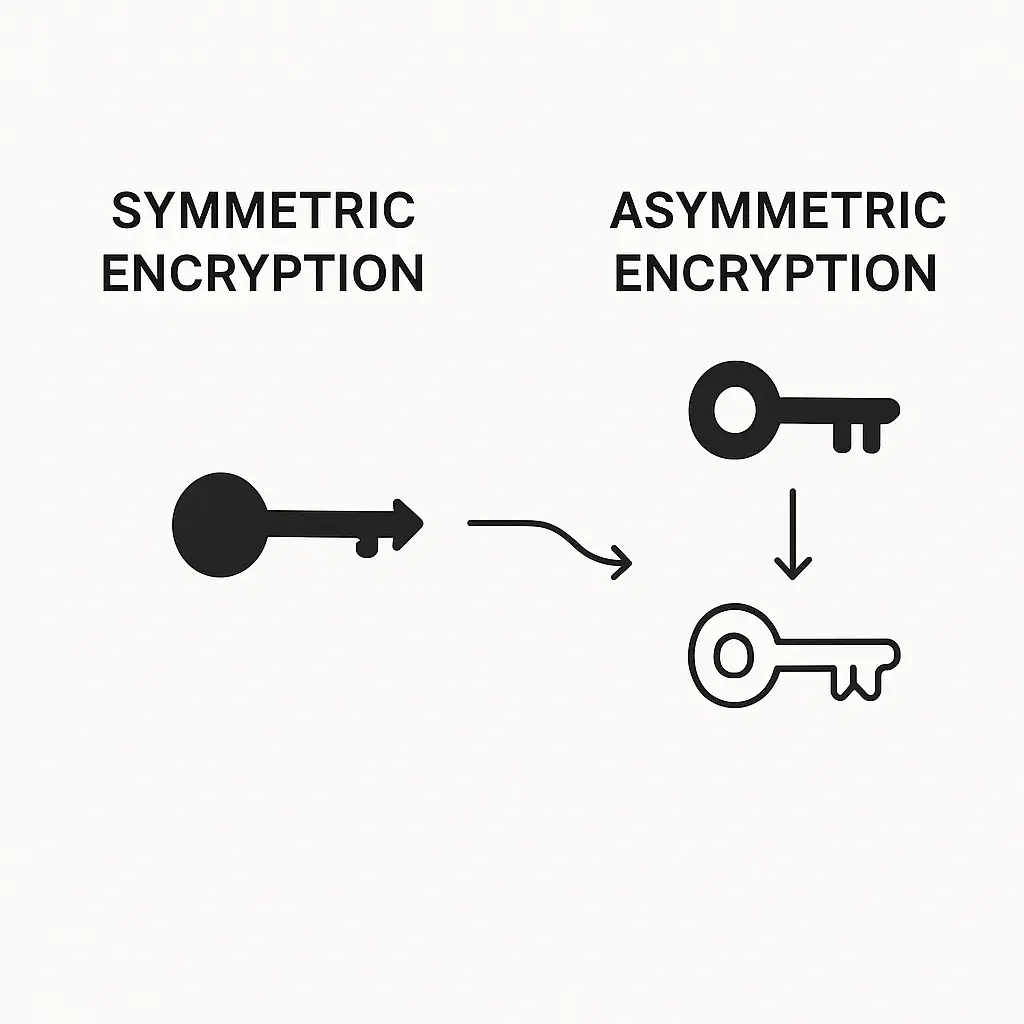
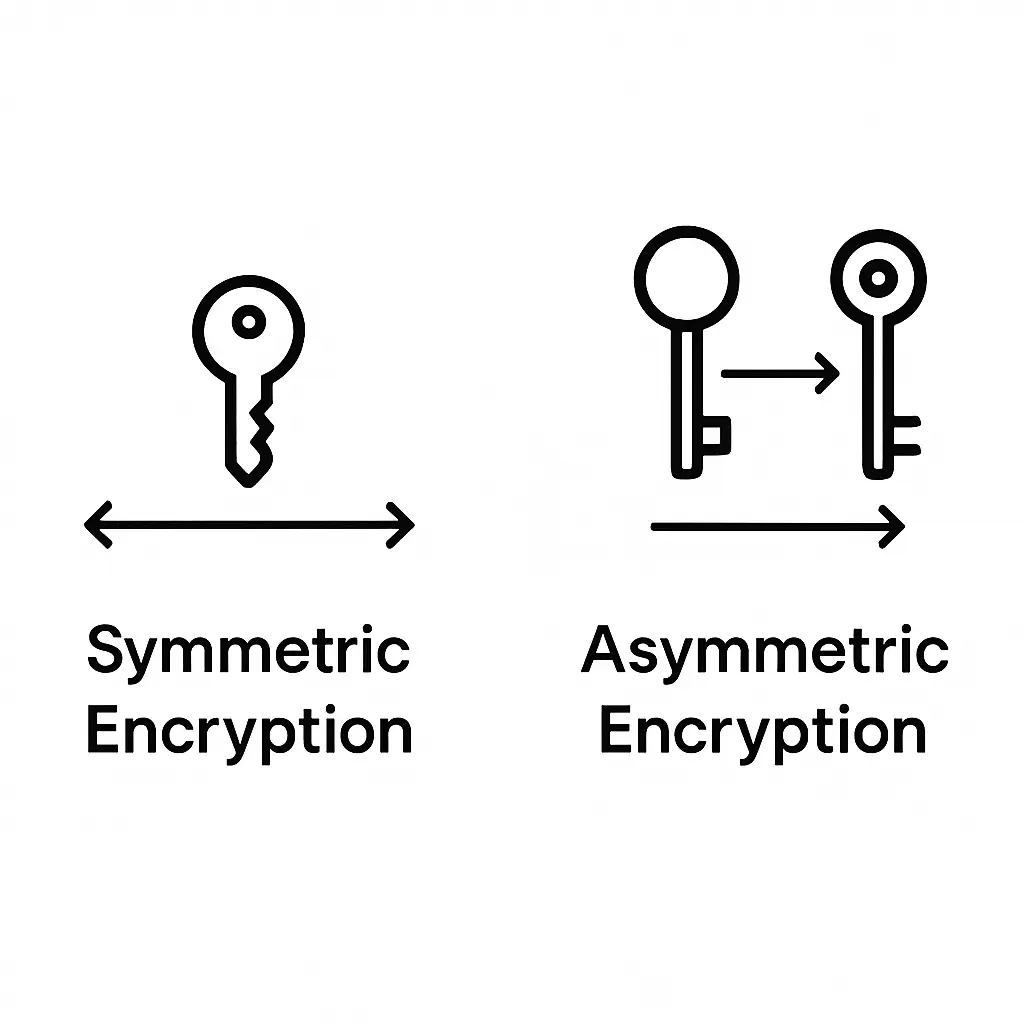
Symmetric encryption uses a single key for both encryption and decryption. You encrypt a file with the key. Someone else decrypts it with the same key. The key is the secret.
The process is fast. Your computer can encrypt gigabytes of data in seconds using symmetric algorithms like AES-256. The math is straightforward: apply the key to the plaintext, get ciphertext. Apply the key to the ciphertext, get plaintext back.
Speed matters when you're encrypting large files, streaming video, or protecting data on a hard drive. Symmetric encryption handles volume efficiently.
The challenge is key distribution. If you encrypt a file and send it to someone, how do you safely send them the key? Email the key and anyone intercepting that email can decrypt your file. Text the key and the same problem exists. The key becomes the vulnerability.
When you encrypt files on your own device, full disk encryption, encrypted backups, password-protected archives, symmetric encryption works perfectly. You're not distributing the key to anyone else. You create it, you use it, you keep it.
The moment you need to share encrypted data with someone else, symmetric encryption creates a coordination problem. You need a secure channel to send the key. But if you had a secure channel, you might not need encryption in the first place.
Asymmetric Encryption: Two Keys, Different Jobs
Asymmetric encryption uses a pair of mathematically linked keys. One key encrypts. The other key decrypts. You can't use the same key for both operations.
The public key encrypts data. You can share this key freely. Post it on your website. Email it to strangers. It doesn't matter who has it. The public key can only encrypt, not decrypt.
The private key decrypts data. You keep this key secret. Only you hold it. Anyone can encrypt a message using your public key, but only your private key can decrypt it.
This solves the distribution problem. You don't need a secure channel to share the public key. The public key is public by design. An attacker who intercepts your public key gains nothing. They can encrypt messages to you, but they can't decrypt anything.
The tradeoff is speed. Asymmetric encryption is computationally expensive. The math behind RSA, ECC, and other asymmetric algorithms requires significantly more processing power than symmetric encryption. Encrypting a large file with asymmetric encryption would take minutes or hours instead of seconds.
Asymmetric encryption excels at small, high-value operations. Encrypting a symmetric key. Signing a document to prove authenticity. Establishing identity at the start of a connection. These tasks don't require encrypting gigabytes of data. They require solving the trust problem.
How the Two Methods Work Together
Most real-world encryption uses both methods in sequence. The combination is called hybrid encryption.
Here's how HTTPS works when you visit a website:
Your browser connects to the server. The server sends its public key. Your browser generates a random symmetric key, called a session key, and encrypts it using the server's public key. The server decrypts the session key using its private key. Now both sides have the same symmetric key, and no one else does.
From that point forward, all data transfers use symmetric encryption with the session key. The asymmetric encryption happened once, at the beginning, to securely exchange the symmetric key. The symmetric encryption handles the rest of the session because it's fast enough to encrypt every HTTP request and response in real time.
This is the standard pattern. Asymmetric encryption solves the key distribution problem. Symmetric encryption handles the bulk data transfer.
The session key is temporary. When you close the browser tab, the session key disappears. The next time you visit the site, the process repeats with a new session key. Even if an attacker records your encrypted traffic and later steals the server's private key, they can't decrypt past sessions. The session keys are gone.
This property is called forward secrecy. It's one reason hybrid encryption dominates secure communications.
When You Use Symmetric Encryption Alone
Symmetric encryption works when you're encrypting data for yourself, not for someone else.
Full disk encryption on your laptop uses symmetric encryption. You create a passphrase. The system derives a symmetric key from that passphrase. Every file on the disk gets encrypted with that key. When you boot the laptop and enter your passphrase, the system decrypts the disk. You're not sharing the key with anyone. The distribution problem doesn't exist.
Encrypted backups follow the same pattern. You encrypt a backup archive with a password. The backup software uses symmetric encryption because it's fast and you're the only person who needs the key.
Password managers encrypt your vault with symmetric encryption. You provide a master password. The password manager derives a symmetric key from that password. Your stored credentials get encrypted with that key. When you unlock the vault, the key decrypts the data. Again, no distribution problem. The key stays on your device.
Symmetric encryption is also common in organizational settings where a trusted authority distributes keys through a separate secure channel. A company might encrypt internal files with a symmetric key and distribute that key to employees through a secure key management system. The key distribution happens through controlled infrastructure, not over the public internet.
When You Use Asymmetric Encryption Alone
Asymmetric encryption appears when you need to verify identity or establish trust without prior coordination.
Digital signatures use asymmetric encryption. You sign a document with your private key. Anyone with your public key can verify the signature. The signature proves you created the document and it hasn't been altered. This works because only you hold the private key.
Software updates use digital signatures. The developer signs the update file with their private key. Your computer verifies the signature using the developer's public key. If the signature is valid, you know the update came from the legitimate developer and wasn't modified in transit.
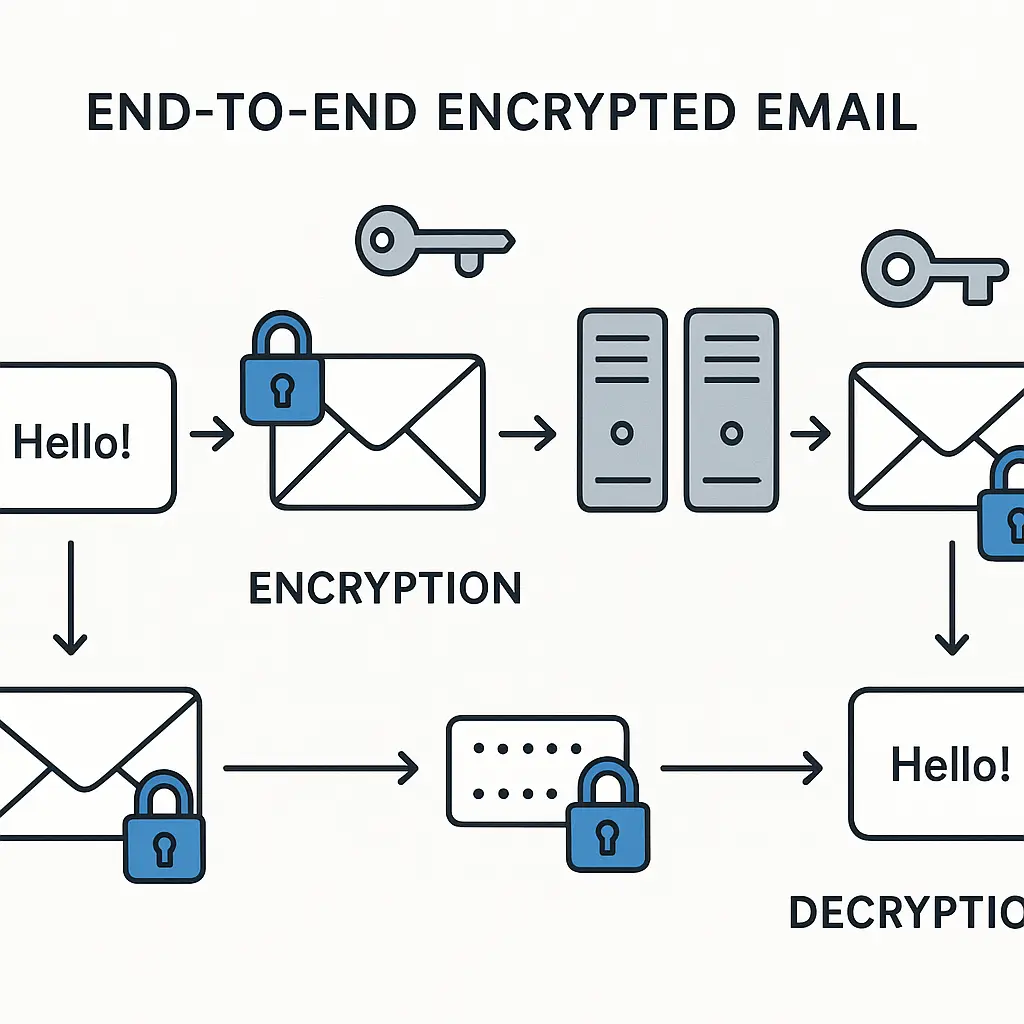
Email encryption with PGP or S/MIME uses asymmetric encryption for the initial key exchange, but the actual email content often gets encrypted with symmetric encryption for speed. The hybrid pattern again.
Cryptocurrency transactions use asymmetric encryption. Your private key signs transactions. Your public key (or a derivative of it) serves as your wallet address. Anyone can send you cryptocurrency by encrypting it to your public key. Only you can spend it because only you have the private key.
The Math Behind the Methods
Symmetric encryption algorithms include AES, ChaCha20, and Twofish. These algorithms apply mathematical transformations to plaintext using the key. The transformations are reversible if you have the key. Without the key, reversing the transformation is computationally infeasible.
AES-256, for instance, uses a 256-bit key. That's 2^256 possible keys. Testing every key would take longer than the age of the universe using all the computing power currently available. The security comes from the size of the key space.
Asymmetric encryption algorithms include RSA, ECC (Elliptic Curve Cryptography), and Diffie-Hellman. These algorithms rely on mathematical problems that are easy to compute in one direction but hard to reverse.
RSA, for example, uses the difficulty of factoring large prime numbers. Multiplying two large primes is fast. Factoring the product back into the original primes is hard. The public key contains the product. The private key contains the prime factors. Anyone can encrypt using the product, but only someone with the factors can decrypt.
ECC uses the mathematics of elliptic curves. The public key is a point on the curve. The private key is a number. Computing the public key from the private key is easy. Deriving the private key from the public key is hard. ECC achieves the same security as RSA with smaller key sizes, which makes it faster.
The computational difficulty of reversing these problems is what makes asymmetric encryption secure. But that same difficulty makes asymmetric encryption slower than symmetric encryption.
Key Sizes and Security Levels
Symmetric and asymmetric encryption require different key sizes to achieve equivalent security.
A 128-bit symmetric key provides strong security. AES-128 is considered secure against all known attacks. A 256-bit symmetric key provides even stronger security, though some experts say the extra bits offer more theoretical than practical protection.
Asymmetric encryption requires much larger keys. A 2048-bit RSA key provides roughly equivalent security to a 128-bit symmetric key. A 3072-bit RSA key approximates a 256-bit symmetric key. ECC keys are smaller: a 256-bit ECC key provides security comparable to a 3072-bit RSA key.
The size difference reflects the underlying math. Symmetric encryption applies transformations directly. Asymmetric encryption relies on mathematical problems with known shortcuts. Those shortcuts mean attackers have more tools available, which means you need larger keys to maintain the same security margin.
Performance Differences in Practice
Symmetric encryption is fast enough to encrypt data in real time. Your laptop can encrypt or decrypt several gigabytes per second using AES. This speed makes symmetric encryption practical for full disk encryption, video streaming, and database encryption.
Asymmetric encryption is orders of magnitude slower. Encrypting a single megabyte with RSA might take seconds. Encrypting a gigabyte would take hours. This is why asymmetric encryption is reserved for small, high-value operations like key exchange and digital signatures.
The performance gap is why hybrid encryption exists. Use asymmetric encryption to solve the key distribution problem. Use symmetric encryption to handle the data.
Key Management: The Real Challenge
Both methods require protecting keys. Lose the key, lose access to the data. Expose the key, expose the data.
Symmetric encryption requires protecting one key. If that key leaks, everything encrypted with it becomes readable. You can't rotate the key without re-encrypting all the data.
Asymmetric encryption requires protecting the private key. The public key can leak without consequence. But if the private key leaks, all messages encrypted with your public key become readable. You also lose the ability to prove your identity through digital signatures.
In practice, key management is harder than the encryption itself. Organizations use hardware security modules, key management services, and strict access controls to protect keys. Individual users rely on password managers, hardware tokens, and encrypted storage.
The weakest link in most encryption systems isn't the algorithm. It's how the keys are stored, accessed, and protected.
When Encryption Fails
Encryption protects data in transit and at rest. It doesn't protect data in use.
When you decrypt a file to read it, the plaintext exists in memory. Malware running on your computer can read that plaintext. Encryption can't protect you from threats on your own device.
Encryption also doesn't protect metadata. HTTPS encrypts the content of your web traffic, but your internet service provider can still see which websites you visit. Encrypted email hides the message body, but the sender, recipient, subject line, and timestamp remain visible.
Encryption assumes the keys stay secret. If an attacker steals your symmetric key or your private key, the encryption becomes worthless. This is why key management matters more than algorithm choice.
Encryption doesn't protect against phishing. If an attacker tricks you into entering your password on a fake website, encryption won't save you. The attacker gets your credentials before encryption enters the picture.
Quantum Computing and the Future
Quantum computers pose a threat to asymmetric encryption. Algorithms like RSA and traditional ECC rely on mathematical problems that quantum computers can solve efficiently. A sufficiently powerful quantum computer could break these systems.
Symmetric encryption is more resistant. Doubling the key size defeats quantum attacks. AES-256 remains secure even against quantum computers.
Researchers are developing post-quantum cryptography: asymmetric algorithms designed to resist quantum attacks. NIST has standardized several post-quantum algorithms. The transition to these new algorithms is underway, but it will take years.
For now, symmetric encryption remains secure. Asymmetric encryption remains secure against classical computers. The quantum threat is real but not imminent for most users.
Choosing Between Methods
You don't usually choose. The software chooses for you.
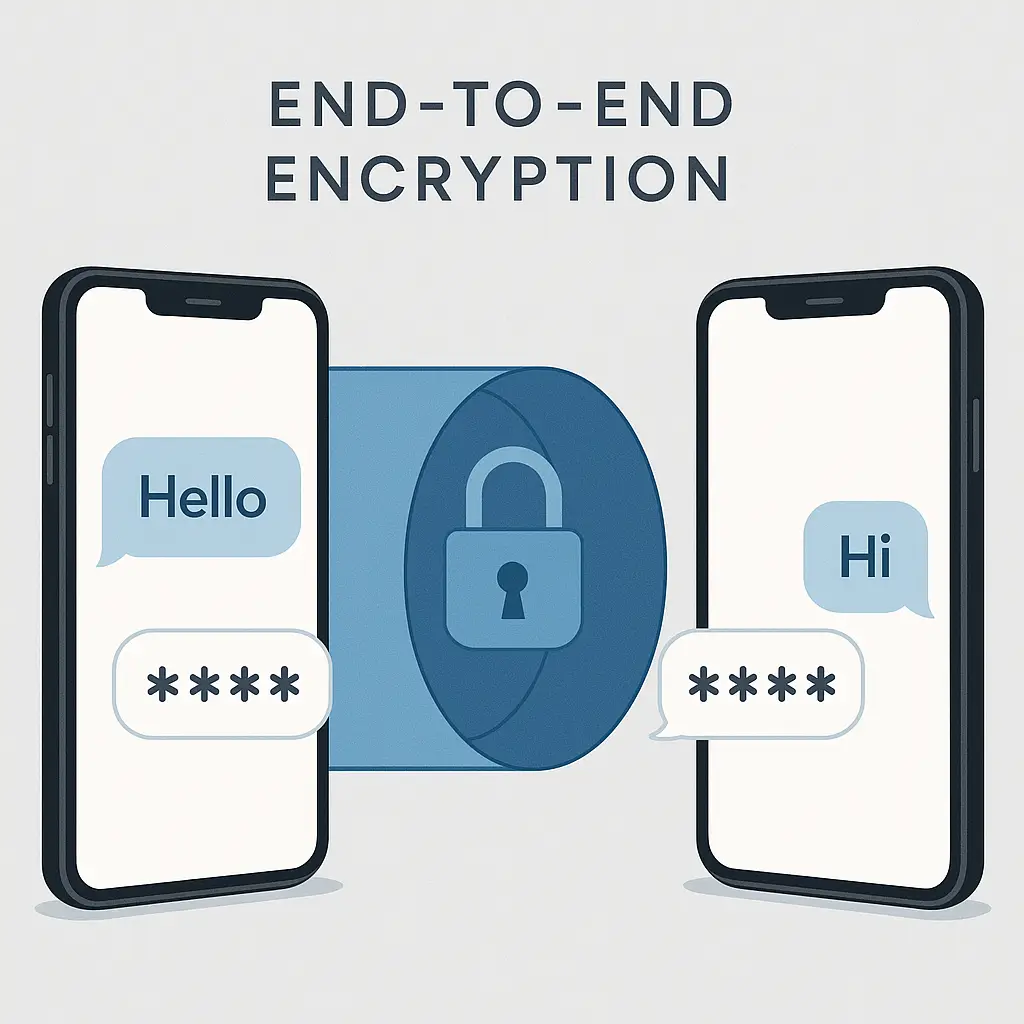
When you enable full disk encryption, the operating system uses symmetric encryption. When you visit an HTTPS website, the browser uses hybrid encryption. When you send an encrypted email, the email client uses asymmetric encryption for key exchange and symmetric encryption for the message body.
Understanding the difference helps you evaluate security claims. A service that promises "military-grade encryption" without specifying the method is being vague. A service that says "AES-256 encryption" is using symmetric encryption. A service that says "RSA-2048 encryption" is using asymmetric encryption, probably for key exchange.
The method matters less than the implementation. Weak key management defeats strong encryption. Poor random number generation weakens both methods. Outdated algorithms create vulnerabilities regardless of whether they're symmetric or asymmetric.
The Practical Takeaway
Symmetric encryption is fast and efficient. Use it when you control both encryption and decryption. Full disk encryption, encrypted backups, and password managers rely on symmetric encryption.
Asymmetric encryption solves the key distribution problem. Use it when you need to establish trust or exchange keys with someone you've never met. HTTPS, digital signatures, and cryptocurrency transactions rely on asymmetric encryption.
Most secure systems use both. Asymmetric encryption establishes the connection. Symmetric encryption protects the data. The combination delivers both security and speed.
You encounter both methods daily. Every HTTPS connection uses hybrid encryption. Every encrypted backup uses symmetric encryption. Every software update signature uses asymmetric encryption. The methods work quietly in the background, protecting your data without requiring you to understand the math.
But understanding the difference helps you make better decisions. When a service promises encryption, you can ask which kind. When you evaluate security tools, you can assess whether the method matches the use case. When you read about encryption vulnerabilities, you can understand which systems are affected.
Encryption isn't magic. It's math. Two different kinds of math, solving two different problems, often working together.