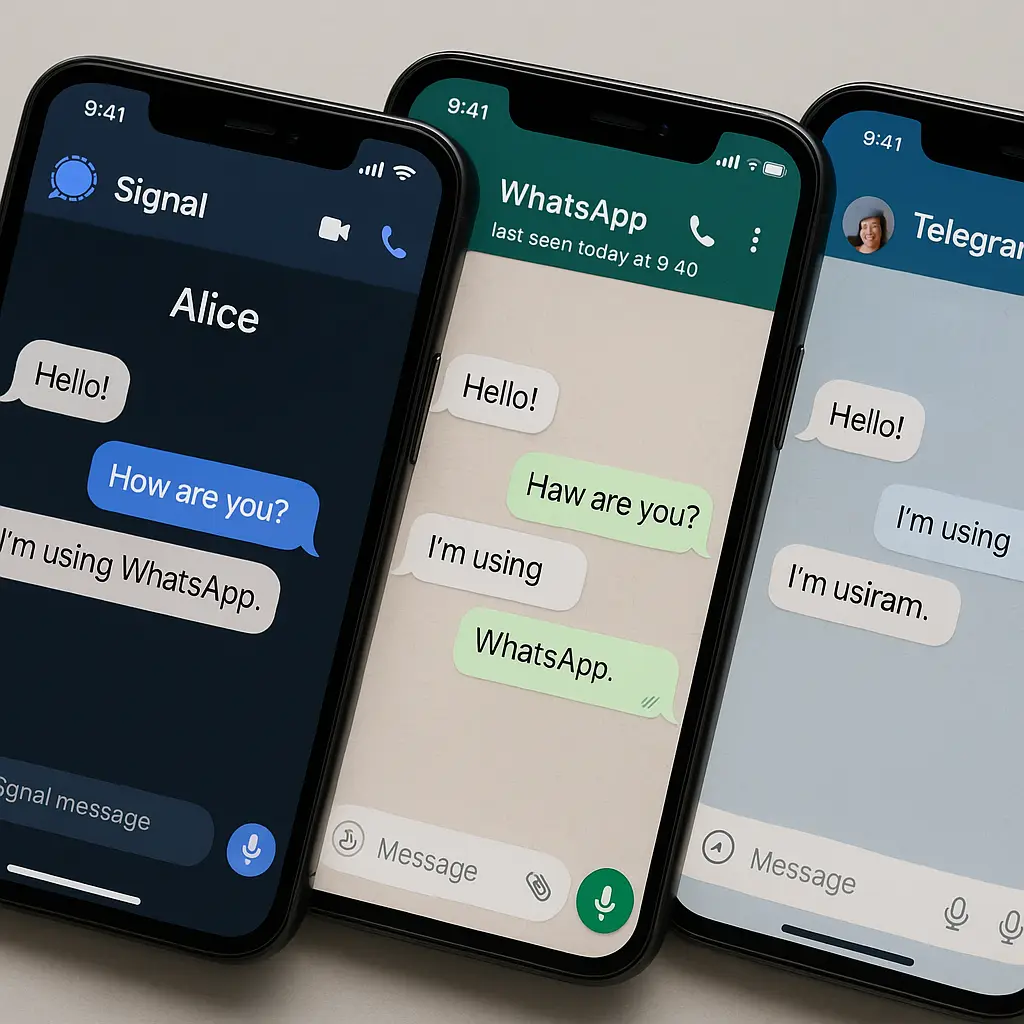
Signal vs. WhatsApp vs. Telegram: Which Messaging App Actually Protects Your Privacy?
You've seen the headlines about data breaches, government surveillance, and corporate tracking. You know your messages aren't as private as the interface suggests. But when you open your phone, you've got WhatsApp, Signal, and maybe Telegram installed, and the practical differences between them aren't obvious.
They all promise encryption. They all look like messaging apps. They all work. So what's the actual difference, and does it matter enough to switch?
The answer depends on what you're protecting and who you're protecting it from. Signal, WhatsApp, and Telegram handle encryption, metadata, ownership, and platform control differently. Those differences create real privacy gaps, or real protections, depending on which app you choose.
What End-to-End Encryption Actually Means
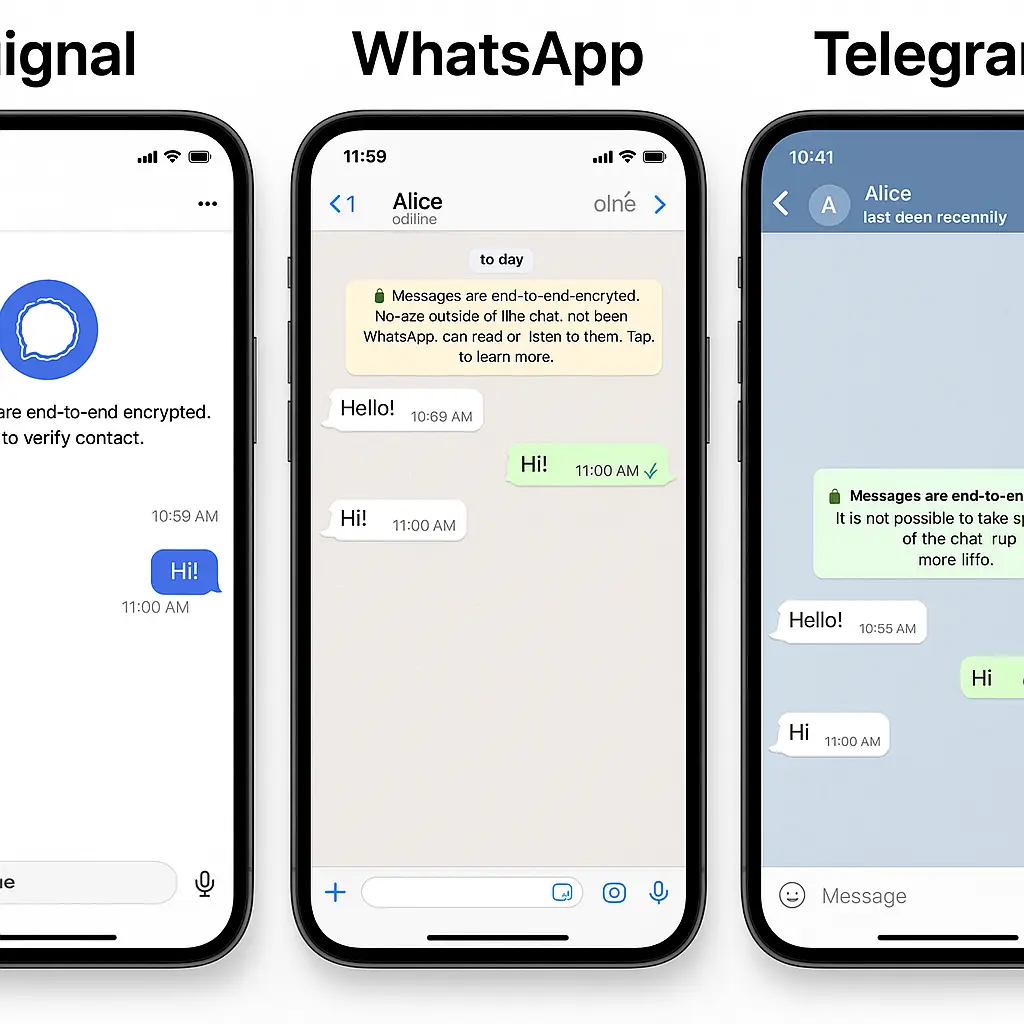
End-to-end encryption scrambles your messages so only you and the recipient can read them. The company running the service sees ciphertext, not plaintext. Even with a warrant, they can't hand over readable messages because they never had them.
That's the theory. The implementation determines whether the protection is real.
Signal encrypts every message, every call, every group chat by default. There's no setting to toggle, no mode to enable. Encryption is the architecture, not a feature.
WhatsApp also uses end-to-end encryption by default, built on the same Signal Protocol. The encryption itself is solid. Meta cannot read your messages. But WhatsApp collects metadata, who you message, when, how often, and from where, and shares that with Meta's advertising systems. The messages stay private. The social graph doesn't.
Telegram is different. Most Telegram chats are not end-to-end encrypted. Your messages sit on Telegram's servers, encrypted in transit and at rest, but readable by Telegram. Only Secret Chats use end-to-end encryption, and they're device-specific. You can't access them on other devices. Most Telegram users communicate without the encryption protection they assume exists.
The EFF's Surveillance Self-Defense guide emphasizes that encryption alone doesn't guarantee privacy, the app's broader data practices determine what actually stays hidden.
Metadata: The Privacy Gap Nobody Talks About
Metadata isn't the message. It's everything around the message. Who sent it, who received it, when, from what device, from what location, how long the conversation lasted, how many participants were in the group, and whether the message was forwarded.
Metadata reveals social networks, behavioral patterns, and relationships. Intelligence agencies have stated publicly that metadata is often more valuable than content because it shows structure, not just words.
Signal collects almost no metadata. It stores your phone number and the last time you connected. That's it. When law enforcement subpoenas Signal, the company hands over timestamps. Not contacts, not groups, not message counts. Just when you last pinged the server.
WhatsApp collects extensive metadata. It knows who you message, how often, what times, from what devices, and where you are when you send. That metadata feeds into Meta's advertising targeting systems. WhatsApp doesn't need to read your messages to know you're shopping for a car, planning a wedding, or coordinating with specific people regularly.
Telegram's metadata collection sits somewhere between Signal and WhatsApp. The company stores your contacts, group memberships, and message history on its servers. That data is accessible to Telegram and, under certain legal jurisdictions, to government authorities.
Ownership and Control: Who Runs the Platform
Signal is a nonprofit funded by donations and grants. It has no investors demanding growth, no advertising business model, no incentive to harvest data. The Signal Foundation exists to build and maintain the app. That's the entire mission.
WhatsApp is owned by Meta. The company bought WhatsApp in 2014 for $19 billion and has since integrated it into Meta's broader advertising ecosystem. WhatsApp doesn't show ads inside the app, but the metadata it collects feeds Meta's targeting systems across Facebook, Instagram, and the web.
Meta's business model is surveillance. WhatsApp's encryption protects your messages, but the metadata extraction serves the same corporate infrastructure that powers targeted advertising. You're not the customer. You're the product being analyzed.
Telegram is privately owned by Pavel Durov, who founded the app after leaving Russia following government pressure over VK, a social network he also created. Telegram operates as a for-profit company funded by Durov's personal wealth and, more recently, through premium subscriptions and advertising in large public channels.
Telegram's governance is opaque. There's no public board, no transparency reports, no clear legal jurisdiction. The company has moved its operations across multiple countries, and its data storage practices are not independently audited. You're trusting one person's commitment to privacy, not a legal or structural safeguard.
Group Chats and Backups: Where Encryption Breaks Down
Signal encrypts group chats the same way it encrypts one-on-one messages. Every participant sees encrypted content. The server sees ciphertext. Even in groups of hundreds, Signal's encryption holds.
WhatsApp also encrypts group chats end-to-end. But WhatsApp's cloud backup feature creates a gap. If you enable iCloud or Google Drive backups, your chat history uploads unencrypted to Apple or Google's servers. WhatsApp's encryption stops at the backup. Apple and Google can read those messages, and law enforcement can subpoena them.
Telegram's default group chats are not encrypted at all. Messages sit on Telegram's servers in readable form. Secret Chats, which use encryption, don't support groups. If you're coordinating with multiple people on Telegram, you're not using encryption.
Platform Lock-In and Portability
Signal ties your account to your phone number, but you can link multiple devices. If you lose your phone, you lose your message history unless you've manually backed it up. Signal doesn't store your messages on its servers, so there's no cloud recovery.
WhatsApp also ties your account to your phone number. You can link devices, but the primary device must stay connected periodically. If you lose your phone and haven't enabled backups, your message history is gone. If you have enabled backups, your messages sit unencrypted on Apple or Google's servers.
Telegram stores everything in the cloud. You can log in from any device and see your full message history. That's convenient. It also means Telegram has persistent access to your conversations, and you can't delete them from Telegram's servers even after deleting them from your device.
In The Fellowship of the Ring, Gandalf tells Frodo that the Ring cannot be unmade by any craft they possess. Telegram's cloud storage model creates a similar permanence, once your messages upload, they exist on servers you don't control, and deletion from your device doesn't guarantee deletion from Telegram's infrastructure.
Voice and Video Calls
Signal encrypts voice and video calls end-to-end. The call routing happens through Signal's servers, but the audio and video streams are encrypted so Signal cannot listen or watch.
WhatsApp also encrypts calls end-to-end using the Signal Protocol. The encryption is solid. But call metadata, who you called, when, and for how long, feeds into Meta's data collection systems.
Telegram's voice and video calls are encrypted, but the company's proprietary protocol hasn't been independently audited to the same extent as Signal's open-source implementation. You're trusting Telegram's claims without the same level of public verification.
Open Source vs. Proprietary Code
Signal's code is open source. Anyone can inspect it, audit it, and verify that the encryption works as claimed. Security researchers have reviewed Signal's implementation extensively. When vulnerabilities appear, they get fixed publicly.
WhatsApp's app code is proprietary, but it uses the open-source Signal Protocol for encryption. The encryption layer is auditable. The rest of the app is not. You're trusting Meta's implementation of data handling, metadata collection, and server-side processing without public verification.
Telegram's encryption protocol is proprietary. The company has published some code, but the full implementation is not open source. Security researchers have criticized Telegram's custom encryption scheme as unnecessary and potentially weaker than established protocols like Signal's.
Legal Jurisdiction and Government Pressure
Signal is based in the United States, subject to U.S. law. The company has fought legal requests for user data and publishes transparency reports showing what it hands over, usually just timestamps. Signal's architecture makes broader data collection technically impractical.
WhatsApp is also subject to U.S. law as a Meta subsidiary. Meta has a history of complying with government data requests. WhatsApp's encryption limits what Meta can hand over, but metadata is fair game. Researchers have found that metadata alone often satisfies investigative needs without requiring message content.
Telegram's jurisdiction is unclear. The company has operated out of Dubai, Berlin, and other locations. Telegram claims it has never handed over user data to governments, but there's no independent verification. The company's opacity makes those claims hard to assess.
Network Effects: Privacy Doesn't Matter If Nobody's There
The most private messaging app in the world is useless if the people you need to reach aren't on it. Network effects matter.
WhatsApp dominates globally with over two billion users. If you're coordinating with family abroad, organizing a work project, or participating in community groups, WhatsApp is often the only option.
Signal has around 40 million users, concentrated among privacy-conscious communities, journalists, activists, and tech workers. If your social circle values privacy and is willing to switch, Signal works. If not, you're messaging yourself.
Telegram has around 900 million users, popular in regions where WhatsApp is restricted or among communities seeking features like large groups, channels, and bots. Telegram's user base is substantial, but its privacy protections are weaker than its reputation suggests.
Switching messaging apps requires convincing other people to switch. That's a social problem, not a technical one. The best app is the one your contacts will actually use.
Practical Threat Models: What Are You Protecting?
If you're protecting casual conversations from corporate data harvesting, Signal beats WhatsApp. Meta's metadata collection feeds advertising systems. Signal's doesn't.
If you're protecting sensitive communications from government surveillance, Signal's architecture makes interception harder. WhatsApp's encryption is solid, but metadata leaks social graphs. Telegram's lack of default encryption makes it a poor choice.
If you're coordinating with people who won't switch apps, WhatsApp is often the only realistic option. Encryption is better than no encryption, even if metadata leaks.
If you're using messaging for convenience features, large groups, channels, bots, cloud storage, Telegram offers flexibility. But you're trading privacy for features. Most users don't realize they've made that trade.
What You Can Actually Control
You can choose which app to use. You can't control what your contacts choose.
You can disable cloud backups in WhatsApp to prevent unencrypted storage. You can enable disappearing messages in Signal to limit message persistence. You can use Telegram's Secret Chats when encryption matters.
You can't control what companies do with metadata. You can't audit proprietary code. You can't force platforms to change their data practices.
The decision comes down to threat model, social network, and what you're willing to trade. Signal offers the strongest privacy protections. WhatsApp offers the largest network. Telegram offers features and cloud convenience at the cost of encryption and transparency.
None of them are perfect. All of them are better than SMS.
The Bottom Line
Signal encrypts everything, collects minimal metadata, and operates as a nonprofit with no advertising model. It's the most private option if your contacts will use it.
WhatsApp encrypts messages but collects extensive metadata and shares it with Meta. It's a reasonable compromise if network effects force your hand, but you're feeding Meta's surveillance infrastructure.
Telegram doesn't encrypt most chats, stores everything in the cloud, and operates with opaque governance. It's convenient, but the privacy claims don't match the architecture.
If privacy is your priority and you can convince your contacts to switch, use Signal. If you're stuck with WhatsApp, disable cloud backups and understand what metadata leaks. If you're using Telegram, know that most of your messages aren't encrypted.
The choice is yours. The tradeoffs are real.