Sextortion Targeting Teens: How the Scam Works and What Parents Need to Know
A 15-year-old receives a friend request from someone who looks like a peer. The profile is real enough, mutual friends, recent posts, normal activity. A few days of messaging later, the conversation turns flirtatious. Then intimate. Then the request for a photo arrives, framed as mutual, normal, private.
The photo gets sent. The tone changes immediately. Now there's a threat: pay money, or the image goes to everyone you know. Your school. Your parents. Your Instagram followers. The list of contacts the sender claims to have is specific enough to feel real.
That's sextortion. It's not new, but the scale and targeting have intensified. The FBI's Internet Crime Complaint Center received over 13,000 sextortion reports involving minors in 2023, with financial losses exceeding $12 million. Those numbers represent reported cases. Researchers estimate the actual incidence is far higher, given that shame and fear prevent many victims from coming forward.
This article explains the underlying mechanism, why the scam succeeds against smart kids, and what parents need to understand about the threat landscape their children navigate daily.
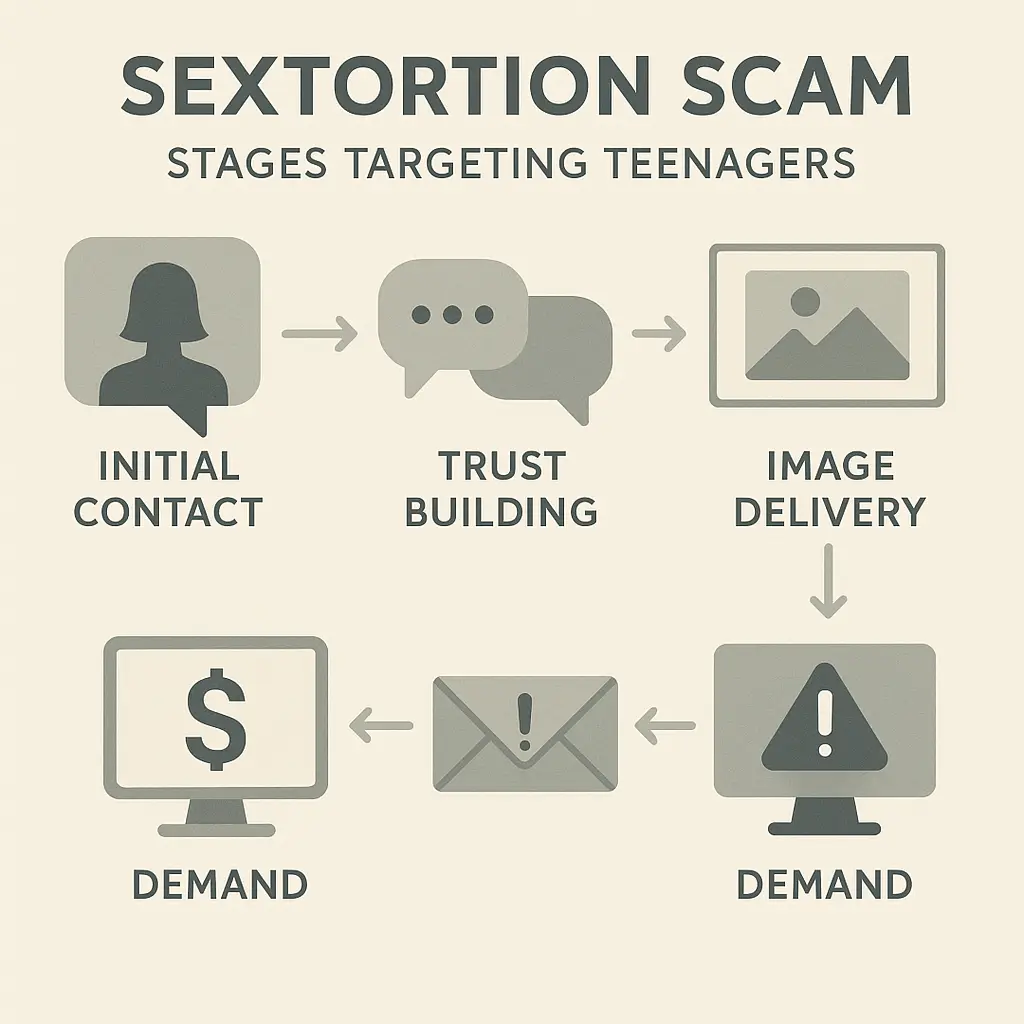
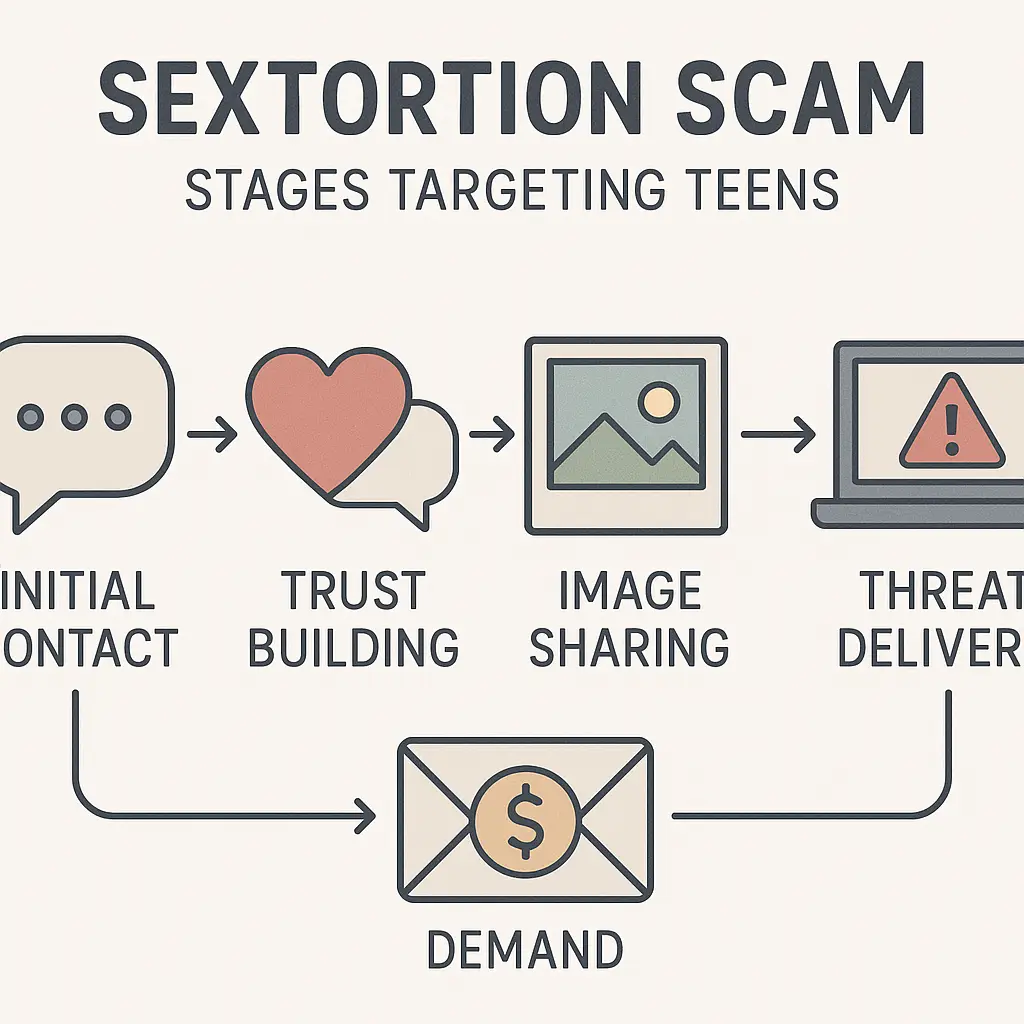
The Mechanism: How Sextortion Works from First Contact to Threat
Sextortion follows a predictable sequence. Understanding the pattern helps you recognize it before it escalates.
Stage 1: Contact and Profile Construction
The operator creates a fake profile on Instagram, Snapchat, TikTok, Discord, or a gaming platform. The profile looks legitimate. It has posts, followers, activity history. Sometimes it's a stolen identity, real photos from someone else's account, repackaged. Sometimes it's AI-generated imagery that passes casual inspection.
The initial contact is a friend request or direct message. The approach is friendly, not overtly sexual. Common openers reference shared interests, mutual friends, school connections, or a compliment about a recent post. The goal is acceptance, not suspicion.
Stage 2: Rapport Building
Once contact is established, the operator engages in normal conversation. This phase can last hours, days, or weeks. The timeline depends on the victim's responsiveness and the operator's patience.
The conversation mirrors typical teen interaction, music, school, friends, complaints about parents, jokes. The operator adapts to the victim's communication style. If the teen uses certain slang, the operator mirrors it. If the teen shares a problem, the operator offers sympathy.
This isn't random. The operator is building trust and gathering information. Every detail the teen shares, school name, friend names, family structure, daily routine, becomes leverage later.
Stage 3: Escalation to Intimate Content
The operator gradually steers the conversation toward romantic or sexual topics. The shift is incremental. A flirty comment. A compliment about appearance. A question about relationships.
Then comes the request for an image. The framing varies:
- "Everyone does this, it's normal"
- "I'll send one if you send one"
- "I really like you and want to see you"
- "It's just between us, I'd never share it"
The request often comes with a reciprocal offer, the operator sends an image first, though it's typically stolen from elsewhere or AI-generated. The goal is to create a sense of mutual exchange and normalize the request.
Some victims comply. Some don't. If the teen refuses, the operator might back off temporarily and try again later, or abandon the attempt and move to the next target. If the teen sends an image, the scam moves to the final stage.
Stage 4: Threat Delivery
The moment the image is received, the operator's tone shifts. The friendly peer disappears. The message becomes a threat: pay money, or the image gets distributed.
The threat is specific. The operator lists contacts, friends, family members, classmates, teachers, often pulled from the victim's public social media connections. The operator may show screenshots of the victim's follower list or friend network to prove they can follow through.
The demand is usually immediate payment via Cash App, Venmo, Zelle, PayPal, or cryptocurrency. Amounts range from a few hundred to several thousand dollars. The deadline is tight, often hours, not days, to maximize panic and minimize the victim's ability to think clearly or seek help.
Stage 5: Ongoing Extortion
If the victim pays, the operator doesn't stop. Payment confirms the victim is compliant and has access to money. The demands continue, often escalating. More money. More images. Threats to release the content anyway unless additional payments arrive.
The cycle continues until the victim runs out of money, tells someone, or the operator moves on to other targets. In some cases, the operator does distribute the images regardless of payment, either as punishment for non-compliance or simply because the original threat was never contingent on payment in the first place.
Why the Scam Works: The Psychology Behind Compliance
Sextortion succeeds because it exploits predictable psychological responses that are especially acute in adolescents.
Developmental vulnerability. Teenagers are navigating identity formation, peer acceptance, and romantic interest, all of which make them more susceptible to attention from someone who appears to validate them. The brain's reward system responds strongly to social approval during adolescence, and the prefrontal cortex, which governs impulse control and long-term consequence evaluation, is still developing.
That's not a value judgment. It's neurobiology. Adults fall for social engineering too, but the specific levers that work on teens are tied to developmental stage.
Isolation and shame. The moment the threat arrives, the victim faces a choice: tell an adult and risk judgment, punishment, or loss of device privileges, or handle it alone and hope it goes away. The scam is designed to make the second option feel safer.
The operator reinforces this isolation by framing the situation as the victim's fault. "You sent the picture. You'll get in trouble. Your parents will be furious. Your friends will find out." The goal is to make the victim believe that seeking help will make things worse, not better.
Immediacy and panic. The tight deadline, pay within hours or the image goes public, triggers a stress response that impairs rational decision-making. The victim doesn't have time to research, verify, or consult. The operator knows this. The pressure is deliberate.
Trust in reciprocity. When the operator sends an image first (even a fake one), it creates a psychological contract. The victim believes the exchange is mutual and private. That belief makes the subsequent betrayal more shocking and the victim more likely to comply with demands to "fix" the situation.
Lack of knowledge about how the scam works. Many teens don't realize that sextortion is a common, scripted scam run by operators who target hundreds of victims simultaneously. They believe the situation is unique, personal, and their fault. That belief increases compliance and reduces the likelihood of reporting.
The Operator's Playbook: What Parents Need to Understand
Sextortion isn't opportunistic. It's industrial. Operators run these scams at scale, often from overseas, targeting dozens or hundreds of victims concurrently.
The profiles are templates. The scripts are refined through iteration. The threats are copied and pasted. The operators don't care about the individual victim. They care about conversion rates, how many contacts turn into image submissions, how many submissions turn into payments.
Some operations are solo. Some are organized groups with defined roles, profile creators, conversation handlers, payment processors. The FBI has documented cases involving networks that operate like call centers, with operators working shifts and sharing target lists.
The financial infrastructure is deliberately opaque. Payments go to accounts that are hard to trace, prepaid cards, cryptocurrency wallets, international money transfer services. Even when law enforcement identifies an operator, recovering funds is rare.
The images themselves often aren't distributed, even when victims don't pay. Distribution reduces the operator's leverage and increases legal risk. The threat is usually enough. But "usually" isn't "always," and victims have no way to know which outcome they'll face.
What to Do When It Happens: Immediate Steps
If your child tells you they're being sextorted, your response in the first ten minutes matters more than anything you do later.
First: do not react with anger or punishment. Your child just told you something that required enormous courage. If your immediate response is to yell, confiscate devices, or blame them for poor judgment, you've confirmed their fear that telling an adult makes things worse. They won't come to you next time.
Say this instead: "Thank you for telling me. You're not in trouble. We're going to handle this together."
Second: stop all communication with the scammer immediately. Do not reply. Do not negotiate. Do not send money or additional images. Block the account, but only after taking screenshots of all messages, threats, and demands. You need evidence.
The scammer will likely create new accounts and try to re-establish contact. Block those too. Do not engage.
Third: document everything. Screenshot every message, every profile detail, every threat. Note dates, times, platform names, account handles. Save the images to a secure location, a password-protected folder on a computer, not the phone. This documentation is critical for law enforcement.
Fourth: report to multiple entities. The FBI's Internet Crime Complaint Center is the primary federal reporting channel. File a report at ic3.gov. Also report to the National Center for Missing & Exploited Children's CyberTipline at cybertipline.org. Report to the platform where the contact occurred, Instagram, Snapchat, Discord, etc. Each platform has a reporting mechanism for exploitation and threats.
Contact your local police department. Bring the documentation. Some departments have dedicated cybercrime units. Some don't. The quality of response varies, but filing a police report creates an official record.
Fifth: do not pay. I know the threat feels immediate and terrifying. I know your child is panicking. Paying does not make this stop. It confirms you're a compliant target and invites escalating demands. The FBI explicitly advises against payment in sextortion cases.
Sixth: secure your child's accounts. Change passwords on all social media accounts. Enable two-factor authentication. Review privacy settings to limit who can contact your child and see their information. Lock down friend lists, follower lists, and post visibility.
Seventh: monitor for follow-up contact. Operators sometimes create new accounts and try again. They may pose as law enforcement, a lawyer, or a "friend" offering to help. Any contact related to the incident should be treated as suspicious and reported.
The Conversation You Need to Have Before It Happens
Prevention is better than response, but prevention doesn't mean banning devices or monitoring every message. It means equipping your child to recognize the pattern before they're in the middle of it.
Talk about the scam explicitly. Describe the sequence: friendly contact, rapport building, escalation to intimate topics, image request, threat. Use the word "sextortion." Explain that it's common, scripted, and not the victim's fault.
Frame it as a scam, not a moral failing. The goal isn't to scare them into never talking to anyone online. The goal is to give them the mental model to recognize the progression and stop it before the image gets sent.
Establish the rule: no intimate images, ever. Not to a boyfriend. Not to a girlfriend. Not to someone you trust. Not even if they send one first. The rule is absolute because once an image exists digitally, you lose control over it permanently.
Explain why: images can be forwarded, screenshotted, stolen, leaked, or used as leverage. The person you trust today might not be trustworthy tomorrow. The relationship that feels private today might end badly next month. The image that feels safe to send right now can resurface years later.
Make it clear: they can tell you anything without punishment. The biggest barrier to reporting is fear of parental reaction. If your child believes that telling you about a sextortion attempt will result in losing their phone, being grounded, or facing anger and blame, they won't tell you.
Say it explicitly and mean it: "If someone ever threatens you online, or asks for pictures, or makes you uncomfortable, you can tell me. You won't be in trouble. I won't take your phone. We'll handle it together."
Then follow through. If they come to you with a smaller issue, someone was creepy in a game chat, someone sent an inappropriate message, respond calmly and helpfully. That builds trust for the bigger issues.
Teach them to recognize the rapport-building phase. The scam doesn't start with a threat. It starts with someone being unusually nice, unusually interested, unusually attentive. If someone they don't know well is asking a lot of personal questions, complimenting them heavily, or steering conversations toward intimate topics, that's a pattern worth noticing.
The question isn't "Is this person real?" The question is "Why is this person investing this much attention in me?" If the answer isn't obvious, the attention is probably not what it appears to be.
Explain that the threat is designed to create panic. The tight deadline, the specific list of contacts, the claim that the image will go to everyone they know, all of that is engineered to make them feel like they have no choice but to comply immediately.
The truth: they do have a choice. The threat is designed to make them forget that. Remind them that if something feels urgent and terrifying and secret, that's exactly when they should slow down and ask for help.
What Doesn't Work: Common Responses That Backfire
Monitoring software. Some parents install apps that log every message, track every app, and send alerts when certain keywords appear. This creates a surveillance environment that damages trust and doesn't actually prevent the scam.
Sextortion conversations don't always use obvious keywords. The rapport-building phase looks like normal chat. By the time the software flags something, the image might already be sent. And if your child knows you're monitoring everything, they'll find ways around it, burner apps, friends' phones, school devices.
Trust and open communication are better defenses than surveillance.
Device confiscation. Taking away phones or tablets as a preventive measure doesn't eliminate the risk. It pushes the behavior onto devices you don't know about, friends' phones, school computers, public library terminals. Your child still has access. You just lose visibility.
Shaming or blame. "How could you be so stupid?" "I told you not to talk to strangers." "You should have known better." These responses shut down communication and increase the likelihood that your child will handle future incidents alone.
The scam works because it's designed to work. Operators are professionals. Your child isn't stupid for falling for a well-executed social engineering attack. Adults fall for phishing emails, tech support scams, and romance fraud every day. Adolescents are even more vulnerable due to developmental factors they can't control.
Assuming it won't happen to your kid. Sextortion targets all demographics. It's not limited to kids who are "risky" or "naive" or "spend too much time online." It targets kids who are social, kids who are lonely, kids who are confident, kids who are insecure. The common factor is access to social media and messaging platforms, which describes nearly every teenager in America.
The Legal Landscape: What Happens After You Report
Reporting sextortion to law enforcement doesn't guarantee immediate action. The reality is complicated.
Local police departments vary widely in their capacity to investigate cybercrimes. Some have dedicated units with training and resources. Some don't. The officer who takes your report might be knowledgeable and helpful, or they might not understand the technical aspects of the case.
Federal agencies, FBI, Secret Service, Homeland Security Investigations, handle cases that cross state or international borders, involve organized networks, or meet certain thresholds of severity. A single sextortion incident involving one victim might not meet those thresholds. A pattern involving dozens of victims does.
The FBI's IC3 aggregates reports and looks for patterns. Your individual report might not result in immediate investigative action, but it contributes to a larger dataset that helps identify networks and trends. That's why reporting matters even when you don't see immediate results.
Prosecution is difficult. Many sextortion operators work from countries with weak extradition agreements or limited law enforcement cooperation. Even when operators are identified, bringing them to trial in the U.S. is a long, resource-intensive process that doesn't always succeed.
That doesn't mean you shouldn't report. It means you should set realistic expectations. The report creates a record. It contributes to intelligence. It might lead to action. But it probably won't result in a quick arrest or immediate resolution.
The Platform Problem: Why This Keeps Happening
Sextortion thrives on platforms designed to facilitate connection. Instagram, Snapchat, TikTok, Discord, gaming platforms, all of them offer direct messaging, friend requests, and profile discovery. Those features enable legitimate social interaction. They also enable predatory contact.
Platforms have implemented safety features, reporting tools, age verification, content moderation, account restrictions. But enforcement is inconsistent, and the scale of the problem exceeds the capacity of moderation teams.
Fake accounts proliferate faster than platforms can remove them. Operators create dozens or hundreds of profiles, knowing some will be flagged and deleted while others survive long enough to make contact. The cost of creating a new account is near zero. The barrier to entry is nonexistent.
Some platforms have introduced features specifically designed to reduce sextortion risk, warnings when an adult messages a minor, restrictions on image sharing in DMs, prompts that ask "Are you sure you want to send this?" These help, but they're not foolproof. Determined operators adapt.
The fundamental tension is that platforms profit from engagement, and engagement requires easy connection. Friction reduces use. Safety features that make it harder to message strangers also make it harder to make new friends, join communities, or expand your network. Platforms optimize for growth, not safety.
That's not an excuse. It's an explanation. The business model and the safety model are in conflict, and the business model usually wins.
The Cultural Reference That Fits: The Social Engineering in Ocean's Eleven
In Ocean's Eleven, Danny Ocean's crew doesn't rob the casino by cracking a vault. They rob it by manipulating people. They create fake identities, build trust, exploit assumptions, and engineer situations where the targets do exactly what the crew needs them to do.
The Bellagio heist works because the crew understands human behavior better than they understand technology. The vault's security is strong. The people operating the vault are the weak point.
Sextortion works the same way. The operators aren't technical geniuses. They're social engineers. They understand adolescent psychology, trust-building, fear response, and decision-making under pressure. They don't need to hack accounts or break encryption. They just need to convince a teenager to click "send."
The defense isn't better technology. It's better awareness of the con.
What Success Looks Like: Building Resilience, Not Perfection
You can't guarantee your child will never be targeted. Sextortion operators cast a wide net. Contact is likely at some point.
Success isn't preventing contact. Success is ensuring your child recognizes the pattern, stops the progression before the image gets sent, and tells you when something feels wrong.
That requires ongoing conversation, not a one-time talk. It requires trust, not surveillance. It requires treating your child as a collaborator in their own safety, not a subject to be controlled.
The goal is resilience, the ability to recognize a threat, respond appropriately, and recover without lasting harm. That's achievable. It requires work, but it's achievable.
Start the conversation today. Use this article as a framework if it helps. Adapt it to your family's communication style. Make it clear that you're a resource, not a threat.
And if it happens, if your child comes to you and says they're being sextorted, remember that your response in that moment determines whether they'll come to you next time. Stay calm. Don't blame. Handle it together.
That's the defense that works.