AI voice cloning: how it works and how to defend against it
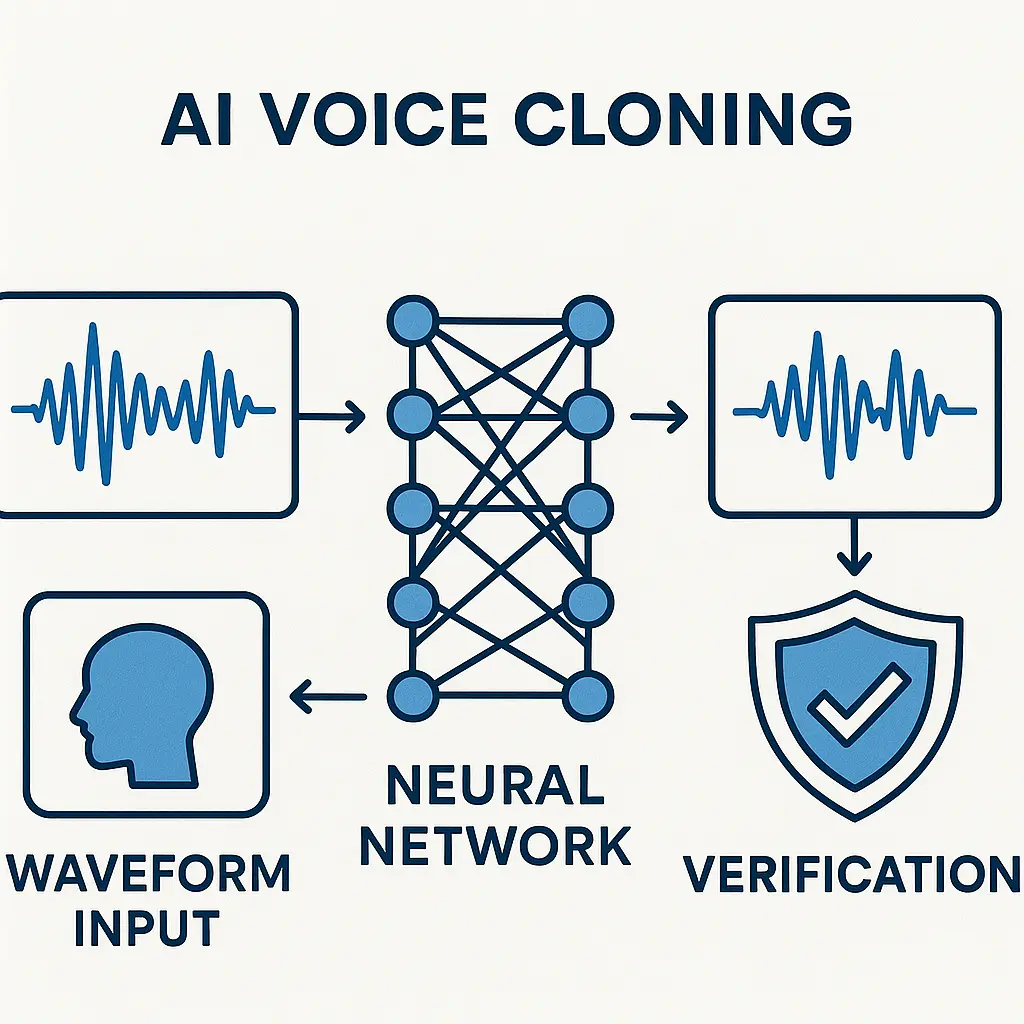
AI voice cloning turns a few seconds of recorded speech into a synthetic voice that sounds like the original speaker. The technology analyzes pitch, tone, rhythm, and pronunciation patterns, then generates new audio that mimics those characteristics. What used to require hours of studio recording and specialized equipment now happens in minutes with publicly available tools.
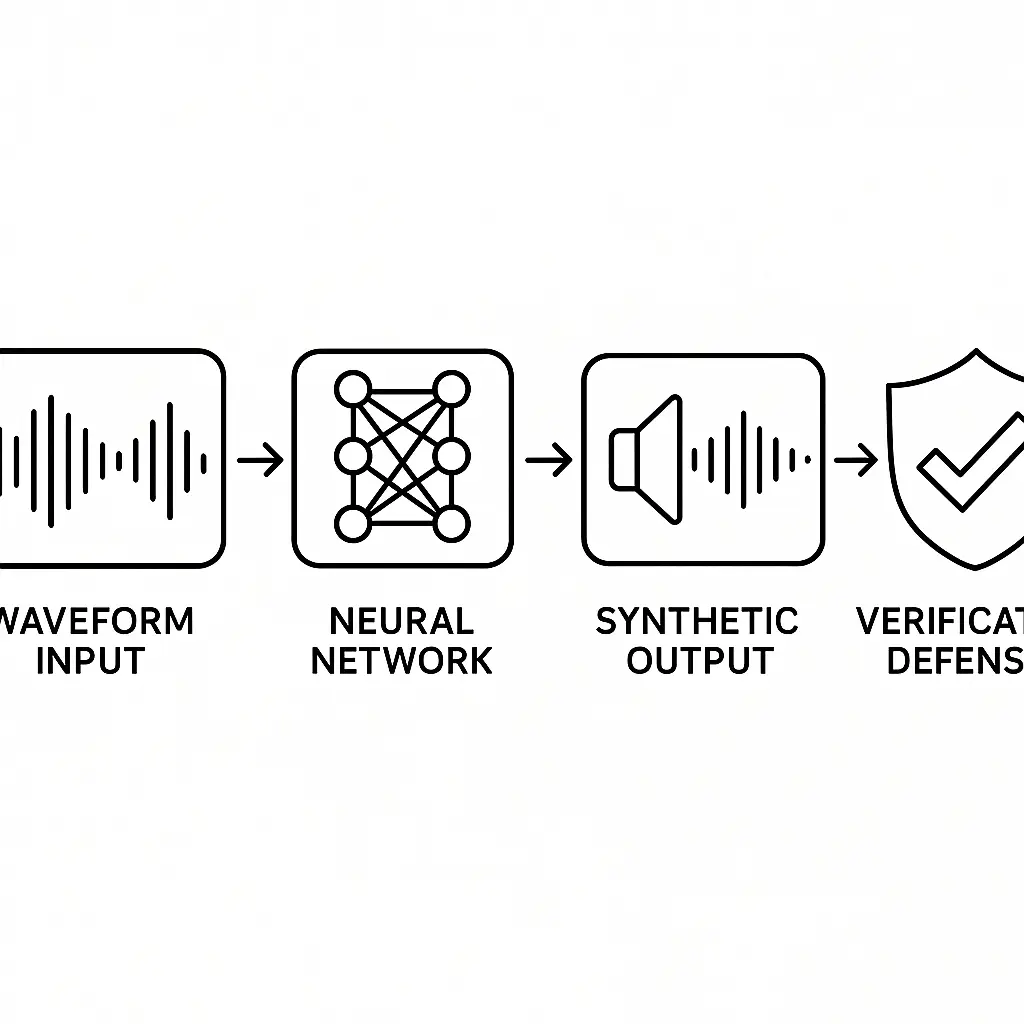
The mechanism works through neural networks trained on massive datasets of human speech. You feed the system a sample of someone's voice. The AI extracts the acoustic features that make that voice distinctive. Then it applies those features to new text, producing audio that sounds like the target speaker saying words they never actually said.
This is not science fiction. The tools exist. They work. Attackers use them in social engineering attacks that bypass traditional verification methods.
Here's how the technology operates, how attackers deploy it, and what you can actually do to defend yourself.
The training process behind voice cloning
Voice cloning AI learns from examples. The training dataset contains thousands of hours of recorded speech from many different speakers. The neural network analyzes these recordings to understand the relationship between text and audio, how phonemes map to waveforms, how pitch changes convey meaning, how different speakers produce the same sounds in different ways.
During training, the AI learns to separate content (what is being said) from speaker characteristics (who is saying it). This separation is the key to cloning. Once the model understands that distinction, it can take new content and apply a specific speaker's characteristics to it.
The process resembles how you might learn to imitate someone. You listen to their speech patterns, notice how they emphasize certain words, how their voice rises or falls, how they pronounce specific sounds. Then you apply those patterns when you speak. AI does the same thing, but with mathematical precision and at scale.
Modern voice cloning models use architectures like WaveNet, Tacotron, or transformer-based systems. The technical details vary, but the core mechanism is consistent: analyze the acoustic features of a voice sample, encode those features into a mathematical representation, then use that representation to generate new audio.
The quality of the clone depends on the quality and quantity of the training data. A model trained on diverse speech produces more natural-sounding output. A model trained on limited data might produce audio with artifacts, unnatural pauses, or odd intonation.
How much audio attackers need
Three seconds of clear audio is enough for some systems. That's not a theoretical minimum. That's what current tools can work with in practice.
Attackers don't need a studio recording. They need any audio where the target's voice is clear and distinct. A voicemail greeting works. A video posted on social media works. A recorded presentation works. A phone call works if the attacker records it.
The audio doesn't need to be long, but it does need to be clean. Background noise, overlapping voices, or poor recording quality reduce the effectiveness of the clone. Attackers prefer samples where the target is speaking alone, clearly, at a normal volume.
Longer samples produce better clones. More audio gives the AI more data to analyze, which improves the accuracy of the feature extraction. A 30-second sample produces a more convincing clone than a three-second sample. But the three-second threshold matters because it makes almost anyone with any public audio presence vulnerable.
Consider what's already out there. If you've recorded a voicemail greeting, posted a video on social media, participated in a recorded meeting, or appeared in any public video, you've provided enough audio for cloning. Attackers don't need to trick you into recording yourself. They just need to find what you've already published.
Some systems require more audio. Around a minute of speech is a common requirement for higher-quality clones. But the trend is toward shorter requirements, not longer. As the models improve, the minimum viable sample shrinks.
The synthesis process that generates fake audio
Once the AI has analyzed the target voice, synthesis happens in two stages. First, the system converts text into a sequence of phonemes (the basic units of sound). Second, it generates audio waveforms that match those phonemes while applying the target speaker's voice characteristics.
The text-to-phoneme conversion is straightforward. The AI uses pronunciation rules and dictionaries to map written words to sounds. This step handles things like stress patterns, intonation, and rhythm. The model predicts how the target speaker would naturally emphasize certain words based on the context.
The phoneme-to-audio conversion is where the voice characteristics get applied. The AI generates waveforms that match the pitch, timbre, and pronunciation style of the target speaker. It adjusts the fundamental frequency (how high or low the voice sounds), the harmonic structure (what makes the voice sound unique), and the temporal patterns (how quickly the speaker talks, where they pause).
The output is a digital audio file. It sounds like the target speaker. It can say anything the attacker wants it to say. The AI doesn't need to understand the meaning of the words. It just needs to produce the sounds.
Some systems add prosody modeling, which controls the emotional tone of the speech. The AI can make the cloned voice sound happy, sad, angry, or urgent. This matters for scams, where emotional manipulation is part of the attack. A panicked voice saying "I need help" is more convincing than a flat, emotionless voice saying the same thing.
The synthesis process takes seconds to minutes, depending on the length of the audio and the complexity of the model. Real-time voice cloning exists but requires more computational power. Most attacks use pre-generated audio, not live synthesis.
How attackers use cloned voices in scams
The grandparent scam is the most common deployment. An attacker calls an elderly person, using a cloned voice that sounds like their grandchild. The fake grandchild claims to be in trouble, arrested, injured, or stranded. They need money immediately. They beg the victim not to tell anyone because they're embarrassed.
The scam works because it combines voice cloning with social engineering. The cloned voice creates initial trust. The emotional urgency prevents verification. The request for secrecy prevents the victim from checking with other family members.
Business email compromise attacks now include voice components. An attacker compromises an executive's email, sends a message requesting a wire transfer, then follows up with a phone call using a cloned voice to confirm the request. The combination of email and voice makes the scam more convincing than either channel alone.
Some attackers use cloned voices in vishing (voice phishing) campaigns. They call employees pretending to be IT support, using a cloned voice of a known manager or executive. They request password resets, access to systems, or sensitive information. The familiar voice reduces suspicion.
Extortion schemes use voice cloning to fake kidnappings. The attacker calls a parent, plays a recording of their child's cloned voice screaming or crying, then demands ransom. The child is not actually in danger. The attacker just needs a voice sample and a script.
In each case, the cloned voice serves the same function: it bypasses the initial skepticism that would stop a scam. People trust voices they recognize. That trust creates a window where verification doesn't happen.
Why traditional voice authentication fails
Voice authentication systems verify identity by analyzing voice characteristics. You speak a passphrase. The system compares your voice to a stored voiceprint. If they match, you're authenticated.
AI voice cloning defeats this mechanism because it reproduces the exact characteristics the system is checking. The cloned voice has the same pitch, timbre, and pronunciation patterns as the real voice. The authentication system can't tell the difference.
Some systems add liveness detection, which tries to verify that a real human is speaking in real time. These systems might ask you to repeat random numbers, speak specific phrases, or respond to unpredictable prompts. The theory is that pre-recorded or synthesized audio can't adapt to these challenges.
But real-time voice cloning exists. An attacker can feed the system's prompts into a voice cloning model, generate the required audio, and play it back. The delay might be noticeable in some cases, but not all systems check for that.
Challenge-response mechanisms help but don't solve the problem. If the attacker has access to the authentication system's prompts (through prior reconnaissance or by simply trying the system), they can generate appropriate responses using the cloned voice.
Voice authentication that relies solely on voice characteristics is vulnerable. Multi-factor authentication that combines voice with other factors (something you have, something you know) is more resistant, but the voice component itself adds minimal security against AI cloning.
The role of deepfakes in voice-based attacks
Voice cloning is one component of a broader category of synthetic media attacks. Deepfake video combines cloned audio with manipulated video to create recordings of people saying and doing things they never did.
In a voice-only attack, the victim hears a familiar voice but doesn't see the speaker. The audio has to be convincing on its own. In a deepfake video attack, the attacker adds visual cues that reinforce the audio. The victim sees what looks like a video call from a known person, hears their voice, and trusts the combination.
Video deepfakes require more technical skill and more source material than voice cloning alone. But the tools are improving. Attackers who want to maximize credibility combine both.
The mechanism is the same as voice cloning: neural networks trained on examples learn to generate new content that mimics the original. For video, the AI learns facial movements, expressions, and how they sync with speech. For audio, it learns voice characteristics. The two systems work together to produce a synchronized fake.
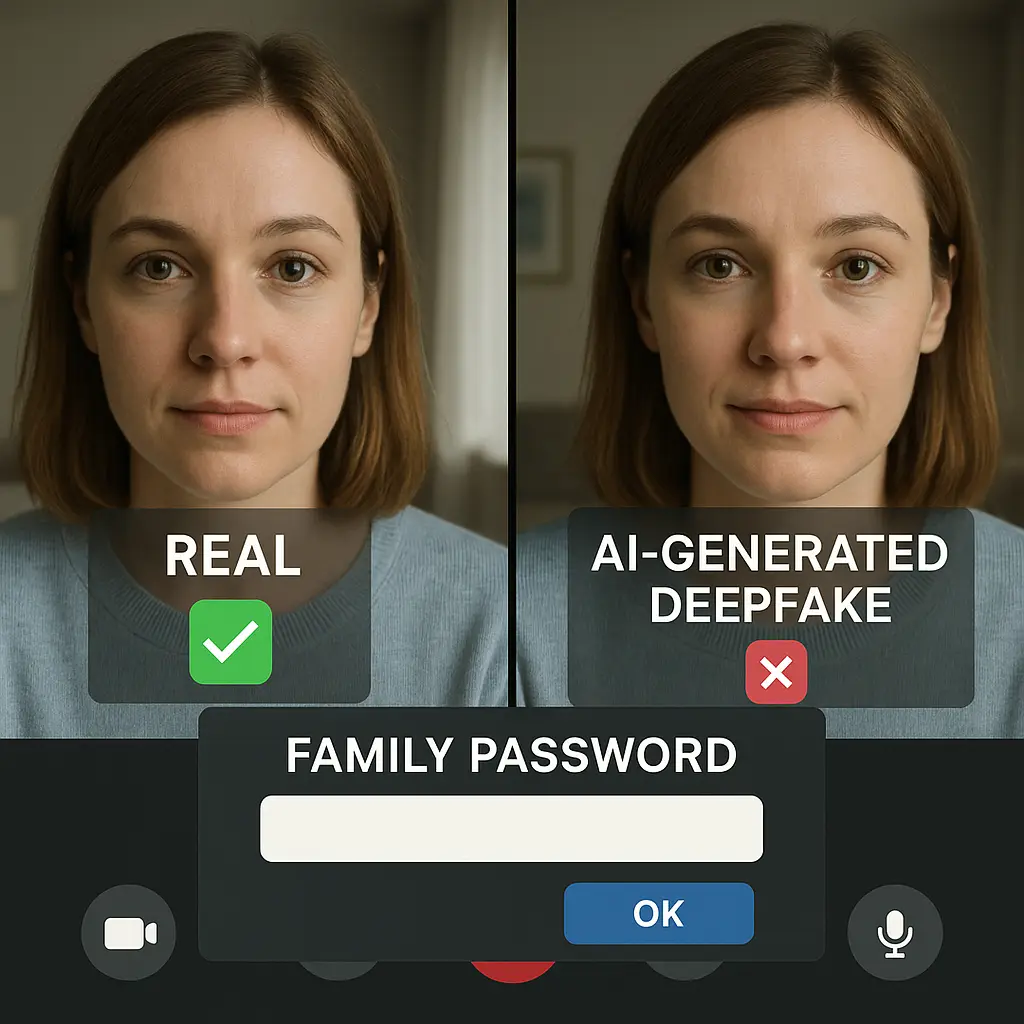
CISA has documented cases where attackers used deepfake video in business email compromise schemes. The attacker schedules a video call with an employee, uses a deepfake of the CEO or CFO, and requests a wire transfer. The employee sees and hears what appears to be their boss making a legitimate request.
The defense is the same as for voice-only attacks: verify through a different channel. If someone requests money or sensitive information over a call (voice or video), hang up and contact them through a known, independent method.
Verification strategies that actually work
Hang up and call back. This is the single most effective defense against voice cloning scams. If someone calls you requesting money, access, or sensitive information, end the call. Then call them back at a number you already have, not a number they provide during the call.
The attacker's cloned voice doesn't help them if you're calling a different number. They can't answer a call to your family member's actual phone. They can't intercept a call to your company's verified contact line.
This works even if you're not sure whether the call is fake. Legitimate callers will understand. Scammers will try to prevent you from hanging up by creating urgency ("There's no time, I need help now") or by providing excuses why you can't call them back ("My phone is broken, this is a borrowed phone").
Ignore the urgency. Real emergencies still exist after you verify. Fake emergencies disappear when you try to confirm them.
Ask a personal question only the real person would know. This works for family and close contacts. The question should be specific, not something an attacker could research. "What did we talk about last Tuesday?" is better than "What's your dog's name?"
The limitation is that attackers who have done reconnaissance might know the answer. If they've compromised email, social media, or other accounts, they have access to personal information. This method adds friction but isn't foolproof.
Verify through a different channel. If someone calls asking for money, send them a text. If someone texts asking for money, call them. If someone emails asking for sensitive information, walk to their desk or call them directly.
The principle is that attackers rarely control multiple channels simultaneously. A voice cloning scam depends on the voice call. If you verify through text, email, or in-person conversation, the scam falls apart.
Establish a family code word. This is a pre-arranged word or phrase that you and your family members use to verify identity in emergencies. If someone calls claiming to be in trouble, they provide the code word. No code word, no money.
This works if everyone remembers the code word and if the attacker doesn't know it. The risk is that the code word gets written down, stored in a compromised account, or shared too widely. But for families worried about grandparent scams, it's a practical layer of defense.
What organizations should tell employees
Train employees to verify voice requests through independent channels. If someone calls claiming to be an executive, a vendor, or IT support, employees should hang up and call back using a number from the company directory, not a number provided during the call.
This applies to requests for wire transfers, password resets, access to systems, or sensitive information. No matter how convincing the voice sounds, verification through a different channel is required.
Establish clear approval processes for financial transactions. No single phone call should be sufficient to authorize a wire transfer. Require written confirmation through verified email addresses, approval from multiple people, or in-person verification for large amounts.
The process should be designed so that attackers can't bypass it even if they have a convincing cloned voice. If the policy requires written confirmation and the attacker only has voice access, the scam fails.
Warn employees about the existence of voice cloning. Many people don't know this technology exists or how convincing it is. If employees understand that voices can be faked, they're more likely to verify before acting.
The warning should be specific. "Attackers can clone voices using AI. If someone calls requesting money or access, verify through a different channel before complying." Generic warnings about "being careful" don't change behavior.
Test the training. Run simulated voice cloning attacks to see if employees follow the verification procedures. This isn't about catching people. It's about identifying where the process breaks down and fixing it.
Some organizations use penetration testing firms to conduct these simulations. Others run internal tests. Either way, the goal is to turn policy into practiced behavior.
The legal landscape around voice cloning
Using someone's voice without permission for fraud is illegal under existing laws. Fraud, impersonation, and theft statutes cover most voice cloning scams. The fact that the voice is AI-generated doesn't create a legal loophole.
The challenge is enforcement. Attackers operate across borders, use anonymous communication tools, and move money through channels that make recovery difficult. The legal framework exists, but practical enforcement lags.
Some jurisdictions have passed laws specifically addressing deepfakes and synthetic media. These laws make it illegal to create or distribute deepfakes with intent to deceive, harm, or defraud. The penalties vary, but the legal recognition of the problem is growing.
The laws generally distinguish between malicious use and legitimate use. Creating a voice clone for fraud is illegal. Creating a voice clone for entertainment, research, or with the subject's consent is not.
The line between legitimate and malicious use depends on intent and consent. If you clone someone's voice to scam their family, that's fraud. If you clone your own voice to generate an audiobook, that's legal. If you clone a celebrity's voice for a parody, that might be protected speech depending on the context.
Enforcement focuses on the harm, not the technology. The voice cloning is the method. The fraud is the crime.
Why detection tools don't solve the problem
Some companies offer AI detection tools that claim to identify synthetic voices. These tools analyze audio for artifacts that AI-generated speech might contain, things like unnatural pauses, inconsistent background noise, or frequency patterns that don't match human speech.
The problem is that the detection tools and the generation tools are in an arms race. As detection improves, generation improves. The latest voice cloning models produce audio that passes current detection tests.
Detection might work on older, lower-quality synthetic audio. It doesn't reliably work on high-quality clones from current models. And it definitely doesn't work well enough to base security decisions on it.
Even if a detection tool flags audio as suspicious, that doesn't tell you what to do. If you receive a call from someone who sounds like your family member, and a detection tool says the voice might be synthetic, you still need to verify. The tool doesn't eliminate the need for verification. It just adds a layer of uncertainty.
The more practical approach is to assume that any voice can be cloned and act accordingly. Verification through independent channels works whether the voice is real or fake. Detection tools don't.
The cultural reference that fits here
In Breaking Bad, Walter White's transformation from chemistry teacher to criminal depends on his ability to inhabit a role that contradicts his established identity. When he adopts the persona of Heisenberg, people who know him struggle to reconcile the voice and mannerisms of the man they recognize with the actions he's taking. The disconnect creates doubt, but not enough to prevent belief.
Voice cloning works the same way. The voice is familiar. The request is wrong. But the familiarity overrides the wrongness, at least long enough for the scam to succeed. You hear your grandchild's voice asking for help, and the part of your brain that wants to help moves faster than the part that wants to verify.
The difference is that Walter White was actually there, making the calls, living the double life. Voice cloning removes the person entirely. The voice is real. The person behind it is not.
What you can do right now
Tell your family about voice cloning. Explain that voices can be faked, that attackers use this in scams, and that verification through a different channel is required for any urgent request.
Establish a verification method. A code word, a callback procedure, a personal question, whatever works for your situation. The method matters less than having one and using it.
Limit your public audio. You can't eliminate your voice from the internet, but you can reduce how much clear audio is publicly available. Voicemail greetings don't need to be your actual voice. Videos posted on social media can be edited to remove or obscure your voice.
This won't stop a determined attacker who has access to private recordings, but it raises the barrier slightly.
If you receive a suspicious call, hang up and verify. Don't let urgency override verification. Real emergencies still exist after you check. Fake emergencies disappear.
If you're targeted by a voice cloning scam, report it to the FTC and local law enforcement. The more data these organizations have about how attackers operate, the better they can warn others.
Voice cloning is not a hypothetical threat. The tools exist. Attackers use them. The defense is verification, not detection. Trust the voice, but verify the request.