Recording video calls without consent: what the law allows and what you can control
Can someone record you on Zoom without your permission? The answer depends on where you live, who's hosting the call, and whether you're on a work call or a personal one. The law is messy, platform policies vary, and what feels like a privacy violation isn't always illegal.
Here's the underlying mechanism: how recording consent works legally, what platforms enforce, and what you can actually control when someone hits the record button.
The legal framework: one-party vs. two-party consent
Recording laws in the United States fall into two categories: one-party consent and two-party consent. These terms are misleading, "two-party" doesn't mean exactly two people; it means all parties. But the labels stuck.
In one-party consent states, any participant in the conversation can legally record without telling the others. If you're on the call, you're a party, and your consent is enough. The other participants don't need to know.
In two-party consent states (sometimes called all-party consent states), everyone on the call must agree to the recording. If even one person objects, the recording is illegal under state wiretapping laws.
Around a dozen states require all-party consent: California, Connecticut, Florida, Illinois, Maryland, Massachusetts, Michigan, Montana, Nevada, New Hampshire, Pennsylvania, and Washington. The rest are one-party states, though the exact list shifts as laws change and court rulings clarify gray areas.
The complication: video calls often cross state lines. If you're in California (two-party) and the host is in Texas (one-party), which law applies? Courts generally apply the strictest standard, the law of the state requiring the most consent. That means if anyone on the call is in a two-party state, the recording should follow two-party rules.
This creates a practical problem: most people don't know where everyone else is calling from. Hosts can't always verify location. The safest legal approach is to assume two-party consent applies and get everyone's agreement before recording. Many don't.
What Zoom and other platforms actually enforce
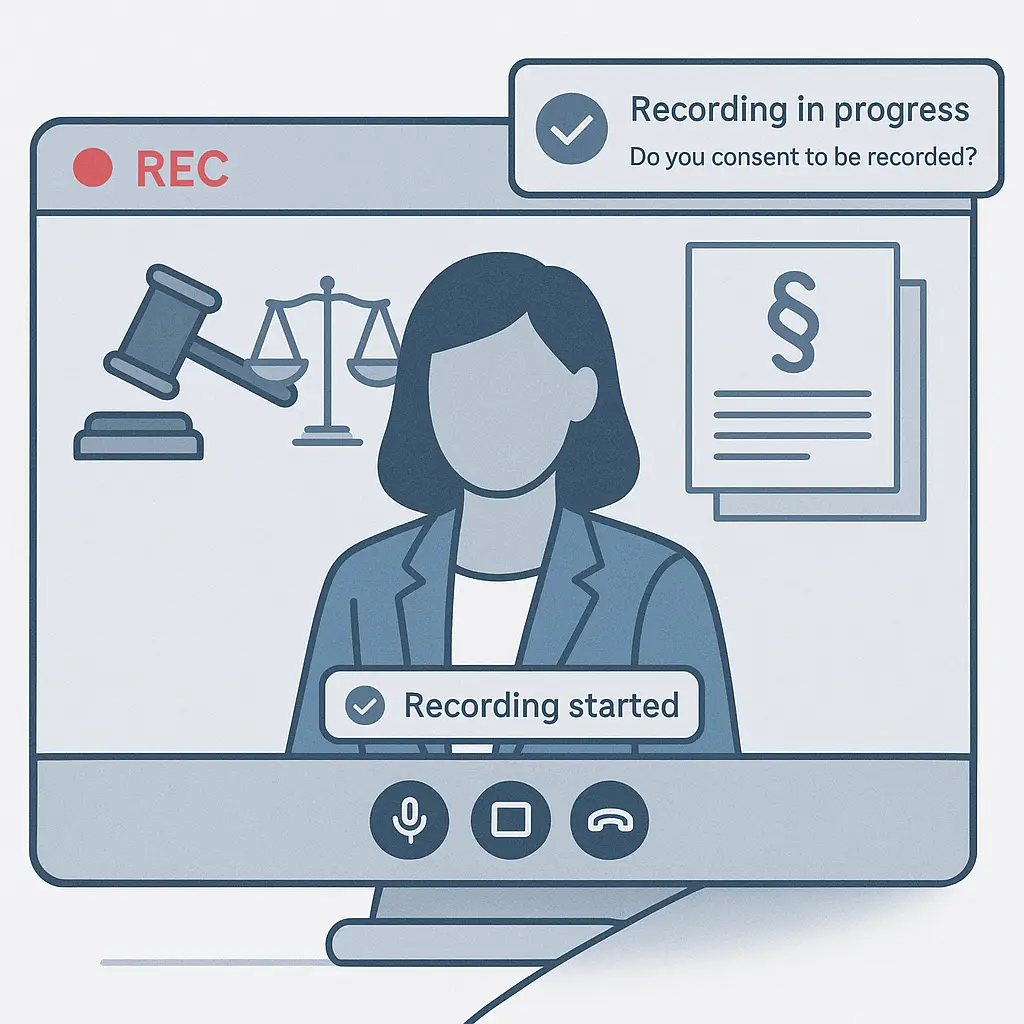
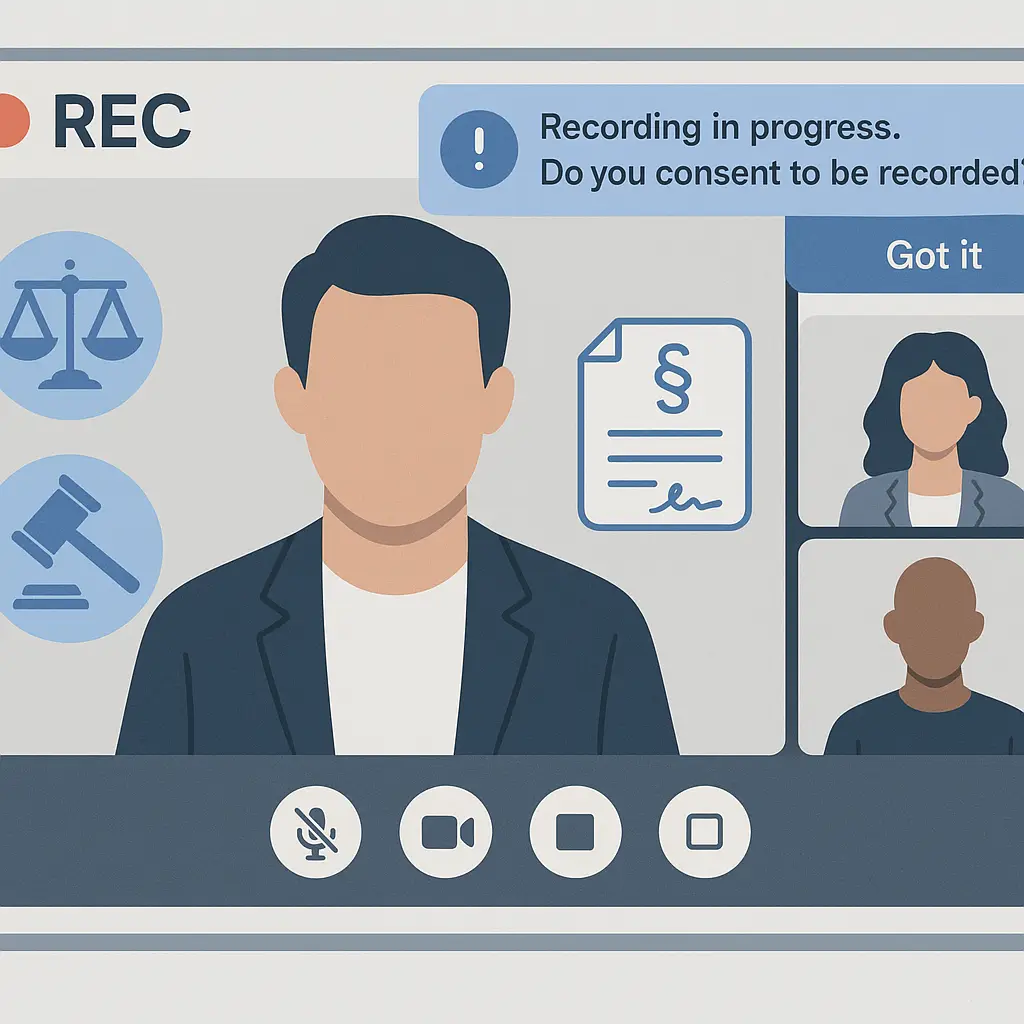
Zoom displays a notification when recording starts. A banner appears on screen, and participants receive an audio alert. The host can't suppress this notification, it's built into the platform.
But notification isn't the same as consent. The banner tells you recording is happening. It doesn't ask for your agreement. In a two-party state, that notification alone doesn't satisfy the legal requirement.
Zoom's terms of service push responsibility to the host. The platform requires hosts to comply with local laws, but it doesn't enforce compliance. Zoom won't stop a recording just because someone on the call is in California. That's on the host to manage.
Microsoft Teams, Google Meet, and Webex work similarly. They notify participants when recording starts, but they don't verify consent. The platforms assume the host knows the law and follows it.
Some enterprise accounts add consent workflows. Before recording starts, the platform might require participants to click "I agree" or automatically drop anyone who doesn't consent. But those features are optional, configured by the organization, and not universal.
If you're on a call and you see the recording notification, you have a few options:
- Ask the host to stop recording
- Leave the call
- Stay on the call, knowing you're being recorded
Staying on the call after seeing the notification might be interpreted as implied consent, depending on the jurisdiction. Courts have split on this. Some say continued participation equals agreement. Others say silence isn't consent, especially in two-party states where affirmative agreement is required.
The legal risk falls on the person doing the recording, not the platform. If someone records you without proper consent in a two-party state, they've potentially violated state wiretapping laws. Penalties vary, some states treat it as a misdemeanor, others as a felony. Civil lawsuits are also possible.
Work calls: what your employer can record
Workplace recording operates under different rules. Employers generally have broader authority to record work-related calls, but the specifics depend on state law, company policy, and whether the call involves external participants.
Many employers disclose recording policies in employee handbooks or IT acceptable-use agreements. Language like "work communications may be monitored or recorded" is common. By accepting employment or using company systems, you've often agreed to those terms.
That agreement doesn't override state wiretapping laws, but it does establish a baseline expectation. If your employer's policy says calls may be recorded, and you're using company equipment or accounts, you have less legal ground to object.
The complication comes when external participants join. If your employer records a call with a client, vendor, or candidate, those people haven't signed the employee handbook. In two-party states, the employer needs their consent too. Some companies handle this with disclaimers in meeting invitations: "This call may be recorded." Others rely on platform notifications.
Courts have generally held that employers can record work calls if they have a legitimate business purpose, training, compliance, quality assurance, dispute resolution. But "legitimate purpose" doesn't eliminate the consent requirement in two-party states. Both can apply.
If you're on a work call and you don't want to be recorded, your options are limited. You can ask the host not to record, but if the company has a business reason, they might refuse. You can leave the call, but that might have professional consequences. You can escalate to HR or legal, but that's a bigger step.
In practice, most workplace recording happens without incident because employees assume it's allowed. The legal violations that surface usually involve external participants who weren't notified or didn't consent.
What happens when someone records without consent
If someone records you without proper consent in a two-party state, they've potentially broken the law. But enforcement is inconsistent.
Criminal prosecution is rare. State prosecutors focus on cases involving harassment, extortion, or commercial espionage, not routine workplace or personal calls. A single unauthorized recording of a Zoom call is unlikely to result in criminal charges unless it's part of a broader pattern of misconduct.
Civil lawsuits are more common. Wiretapping statutes in many states allow individuals to sue for damages if they're recorded without consent. Penalties vary, some states set statutory damages (a fixed amount per violation), others allow plaintiffs to recover actual damages plus attorney fees.
In California, for example, state law allows victims of illegal recording to sue for the greater of $5,000 per violation or three times the actual damages. That creates financial risk for anyone recording without consent, especially in a business context.
But lawsuits require proof. You need to show the recording happened, that you didn't consent, and that the recorder knew or should have known consent was required. Platform notifications complicate this, if Zoom displayed a banner and you stayed on the call, the recorder's lawyer will argue you consented by continuing to participate.
The bigger consequence is often professional or reputational. If someone records a work call without consent and the recording surfaces later, it creates trust issues. Colleagues, clients, or partners might question the person's judgment or ethics. In some industries, unauthorized recording can trigger regulatory scrutiny or professional sanctions.
For most people, the practical risk isn't legal, it's relational. Recording without consent signals that you don't respect boundaries or care about others' comfort. That damages relationships, even if no law was broken.
The cultural reference: Ocean's Eleven and the consent problem
In Ocean's Eleven, Danny Ocean's crew pulls off a casino heist by exploiting trust, timing, and the assumption that people won't question what looks legitimate. The con works because each participant plays their role, and the casino never realizes the rules have changed until it's too late.
Recording without consent operates on a similar principle. The host hits record, the platform displays a notification, and most participants assume that notification equals permission. They don't know the law. They don't realize they can object. They stay on the call because leaving feels awkward or professionally risky.
The con isn't malicious, most people recording Zoom calls aren't trying to deceive anyone. But the dynamic is the same: one person changes the terms of the interaction, and everyone else goes along because the system makes it easier to comply than to resist.
The difference is that Danny Ocean's crew knew they were breaking the rules. Most people recording video calls don't. They assume the platform's notification satisfies the law, or they don't think about the law at all. The consent gap persists because the friction is low and the consequences are distant.
What you can actually control
You can't stop someone from hitting the record button. But you can control your participation.
Before the call:
- Check the meeting invitation for recording disclosures. Some hosts include language like "This meeting will be recorded" in the calendar event.
- If you're concerned, email the host in advance and ask whether recording is planned. If it is, you can decline the invitation or request an alternative format.
- Review your employer's recording policies if it's a work call. Know what you've already agreed to.
During the call:
- If the recording notification appears and you don't want to be recorded, speak up immediately. Say, "I don't consent to being recorded. Can you stop the recording or should I leave the call?"
- If the host refuses to stop recording, leave. You're not obligated to participate in a recorded conversation, even if it's a work call. (Though leaving a work call has professional consequences you'll need to weigh.)
- If you stay on the call after the notification, assume everything you say is being recorded. Adjust your behavior accordingly.
After the call:
- If you believe you were recorded without proper consent, document what happened. Note the date, time, participants, platform, and whether you saw a notification.
- If it's a work call, escalate to HR or legal. If it's a personal call, you can consult a lawyer about whether you have grounds for a complaint or lawsuit.
- In most cases, the practical response is to avoid future calls with that person or organization. Trust is hard to rebuild once someone's demonstrated they don't respect boundaries.
The harder question is what to do when recording is disclosed but you're not comfortable with it. You can ask the host not to record, but they might have legitimate reasons, legal compliance, training, accessibility. You can leave, but that might mean missing important information or damaging a professional relationship.
There's no perfect answer. The law gives you the right to withhold consent in two-party states, but exercising that right has social and professional costs. You're weighing your privacy against the consequences of opting out.
The gaps the law doesn't cover
Recording consent laws were written for phone calls, not video conferences. The statutes focus on audio interception, wiretapping, and most don't explicitly address video.
Courts have generally interpreted wiretapping laws to cover video calls, reasoning that if audio recording requires consent, video recording does too. But the case law is thinner, and some jurisdictions haven't ruled definitively.
The other gap: platform terms of service. When you use Zoom, Teams, or Meet, you agree to the platform's terms. Those terms often include broad grants of permission, allowing the platform to process, store, and transmit your communications. Some terms give hosts the right to record, subject to local law.
That creates a legal tangle. Even if state law requires your consent, the platform's terms might say you've already granted it by using the service. Courts haven't fully resolved how those two frameworks interact.
Then there's the international problem. If participants are calling from different countries, which country's laws apply? The U.S. has one-party and two-party states. The EU has GDPR, which treats call recordings as personal data and imposes strict consent requirements. Canada, Australia, and the UK have their own rules.
Most platforms don't enforce geographic restrictions. A host in Texas can record a call with participants in California, Germany, and Ontario, and the platform won't stop them. The legal risk is real, but enforcement is inconsistent.
The practical result: recording consent on video calls is a patchwork of state laws, platform policies, and social norms, with gaps no one has fully closed.
What's likely to change (and what isn't)
State legislatures occasionally update wiretapping laws to address new technology, but the core framework, one-party vs. two-party consent, has been stable for decades. That's unlikely to change soon.
What might change: platform features. Zoom, Teams, and Meet could add stronger consent workflows, requiring participants to click "I agree" before recording starts, or automatically removing anyone who declines. Some enterprise accounts already have these features. They could become standard.
The other shift: workplace norms. As remote work persists and video calls become the default for meetings, more organizations are formalizing recording policies. Some companies now include recording disclosures in every meeting invitation. Others restrict who can record and require manager approval.
But individual behavior is harder to shift. People record calls for legitimate reasons, accessibility, note-taking, dispute resolution, and the friction to get explicit consent from everyone on a 15-person call is high. The path of least resistance is to rely on the platform's notification and assume that's enough.
The law says it isn't, in two-party states. But the law and common practice have been misaligned for years, and that gap isn't closing fast.
The bottom line
Can someone record you on Zoom without your permission? Legally, it depends on your state. In one-party states, yes. In two-party states, no, but many people do it anyway, either because they don't know the law or because they assume the platform's notification satisfies the requirement.
Platforms notify you when recording starts, but notification isn't consent. If you're in a two-party state and you don't want to be recorded, you need to speak up or leave the call. Staying silent might be interpreted as implied consent, depending on the jurisdiction.
Employers have broader authority to record work calls, but they still need to follow state law and get consent from external participants in two-party states. Most do this through disclaimers in meeting invitations or employee handbooks.
The practical risk of unauthorized recording is mostly relational, not legal. Criminal prosecution is rare, civil lawsuits are possible but require proof, and the bigger consequence is usually damaged trust.
You can't stop someone from hitting record, but you can control whether you participate. Know your state's law, watch for recording notifications, and decide in the moment whether staying on the call is worth the tradeoff.
The law is messy, enforcement is inconsistent, and platforms won't solve this for you. What you can control is your own response when the recording light turns on.