Why Phishing Emails Are Getting Better with AI: Separating Hype from Reality
The headlines write themselves: "AI Makes Phishing Unstoppable." "ChatGPT Writes Perfect Scam Emails." "Security Experts Helpless Against Machine Learning Attacks."
I've spent two decades watching cybersecurity hype cycles. This one follows the pattern. There's a real phenomenon underneath the noise, but the threat isn't what the breathless coverage suggests.
AI-generated phishing is real. Large language models do produce grammatically flawless, contextually appropriate emails at scale. Attackers are using these tools. But the fundamental game hasn't changed as much as the marketing would have you believe.
Here's what's actually happening, what's staying the same, and how to recognize AI-assisted phishing before you click.
The Grammar Argument Falls Apart
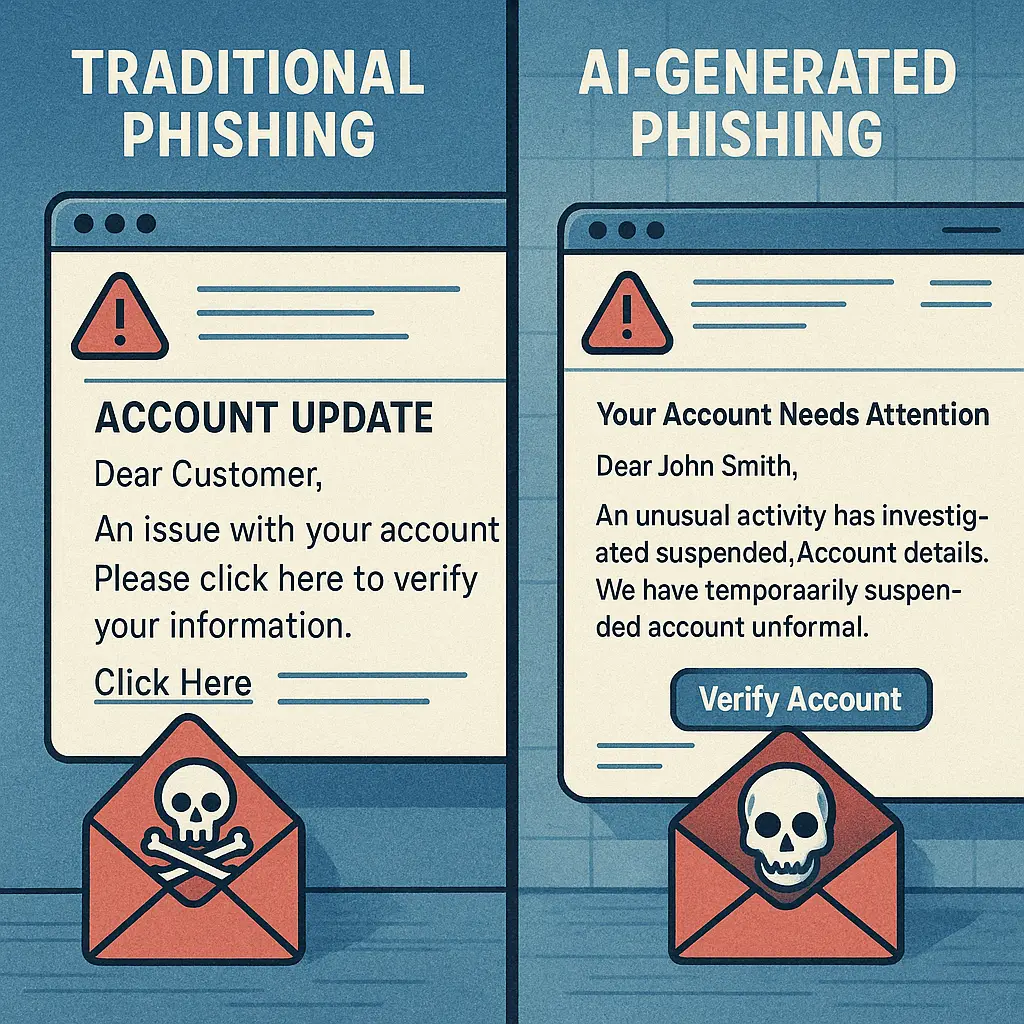
The classic advice for spotting phishing emails relied heavily on obvious errors. Misspellings, awkward phrasing, broken English. These tells existed because most phishing operations ran on volume, not craft. Attackers sent millions of emails through automated systems, often translated through multiple languages, targeting anyone who'd bite.
That model created a natural filter. People who noticed the errors deleted the message. People who didn't notice were, from the attacker's perspective, better targets. The errors weren't bugs. They were features that pre-qualified victims.
AI removes that filter. Language models generate fluent text in any language, with proper grammar, appropriate tone, and context-aware phrasing. An attacker can produce a thousand personalized emails as easily as one generic template.
But here's the reality check: sophisticated phishing emails have always existed. Before AI, skilled human writers crafted convincing messages for high-value targets. Spear phishing and whaling campaigns didn't rely on broken English. They used research, personalization, and social engineering that would pass any grammar test.
AI democratizes that capability. Low-skill attackers now produce what used to require expertise. But if you were already vulnerable to well-written phishing emails, AI hasn't fundamentally changed your risk. It's just expanded the pool of people who can write them.
Volume and Personalization at Scale
The real shift isn't quality. It's scale.
A human attacker writing personalized phishing emails might manage dozens per day. An AI system can generate thousands per hour, each one tailored to a specific recipient using scraped data from LinkedIn, company websites, and public social media.
That personalization used to be the domain of targeted attacks against executives or high-value accounts. Now it's economically viable for anyone. An attacker can pull your job title, employer, recent projects, and colleagues' names, then feed that context into a language model that generates an email referencing your actual work.
This is where the "AI phishing is different" argument has merit. The combination of volume and personalization means you're more likely to receive a convincing fake that references real details from your life. The attack surface expands.
But the defense doesn't change. Personalized or not, phishing emails still rely on the same core tactics: urgency, authority, fear, or curiosity. They still ask you to click a link, open an attachment, or provide credentials. The tells are structural, not grammatical.
What AI Doesn't Change
Phishing succeeds because it exploits human psychology, not technical vulnerabilities. AI makes the bait shinier, but the hook is the same.
Every phishing email, AI-generated or not, needs you to do something. Click a link that leads to a fake login page. Download malware disguised as a legitimate file. Reply with sensitive information. Wire money to a fraudulent account. The attack chain still requires human action.
That action point is where verification stops the attack. An email claims to be from your bank? Log in through the bank's website directly, not through the email link. Your boss requests an urgent wire transfer? Call them on a known number. A vendor says your payment failed? Check your account through the vendor's official site.
These verification steps work regardless of how polished the email is. AI can't fake the URL in your browser's address bar. It can't answer a phone call to your boss. It can't log into your actual bank account to confirm a transaction.
The FTC's phishing guidance emphasizes this point: verification through a separate channel defeats phishing, no matter how convincing the initial message. AI hasn't changed that.
The Cultural Reference That Fits
In Sherlock Holmes: A Scandal in Bohemia, Holmes faces Irene Adler, who outwits him not through superior deduction but by understanding his methods and adapting her behavior. Holmes relies on his established patterns of observation. Adler studies those patterns and uses them against him.
AI-powered phishing works the same way. It studies the patterns of legitimate communication, tone, structure, timing, references, and replicates them with enough fidelity to pass casual inspection. But like Adler's disguise, the replication is surface-level. Holmes eventually recognizes the inconsistency not because the disguise fails technically, but because the underlying behavior doesn't align with the context.
You're not Holmes, but you have context the AI doesn't. You know whether you actually requested a password reset. You know if your company uses that payment system. You know if your boss typically sends urgent requests at 3 AM. The tells aren't in the prose. They're in the situation.
What Actually Changed in 2024-2026
Researchers and security professionals have documented specific shifts in phishing campaigns over the last two years. The changes are real, but they're narrower than the hype suggests.
First, the baseline quality of mass phishing improved. Emails that used to contain obvious errors now read like legitimate business correspondence. This doesn't make them undetectable, but it does mean you can't rely on poor grammar as a first-pass filter.
Second, the volume of personalized attacks increased. What used to be reserved for high-value targets now appears in campaigns against mid-level employees and even consumers. An email referencing your recent Amazon order or your employer's actual project names is no longer a sign of a sophisticated targeted attack. It's the new baseline.
Third, attackers adapted faster. When a defense becomes common knowledge, like checking sender addresses or hovering over links, attackers adjust their techniques within weeks instead of months. AI tools accelerate that adaptation cycle.
But none of these changes break existing defenses. They just raise the stakes for following through on verification steps you should have been taking anyway.
The Tells That Still Work
AI-generated phishing emails may be grammatically perfect, but they still exhibit patterns you can recognize.
Timing and context mismatches. An email arrives claiming your account will be suspended, but you just logged in successfully five minutes ago. Your "bank" sends an urgent alert about suspicious activity, but you haven't used that account in months. The message references a service you don't use or a transaction you didn't make.
Urgency without specifics. Legitimate urgent requests include specific details: account numbers, transaction IDs, case references. Phishing emails use generic urgency: "Your account has been compromised." "Immediate action required." "Verify your information now." The lack of specific, verifiable details is the tell.
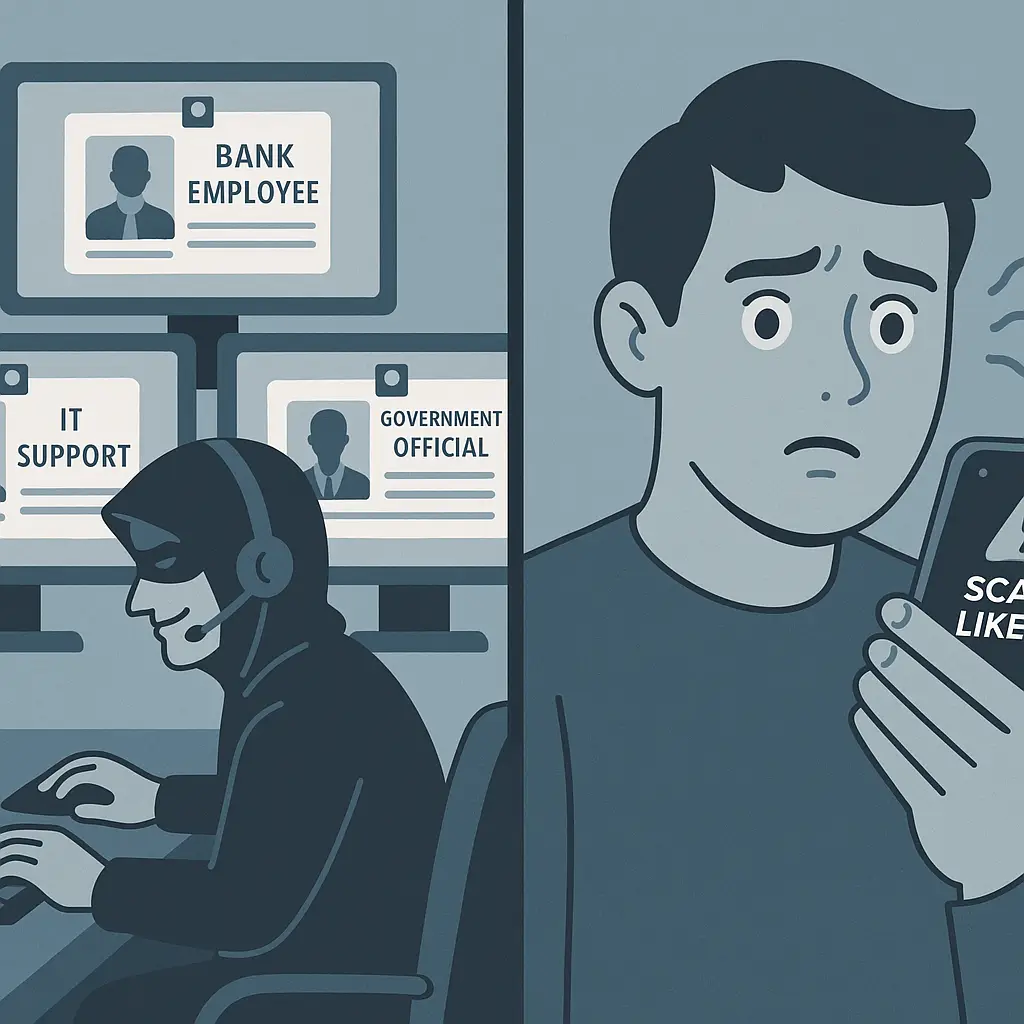
Requests that bypass normal processes. Your IT department emails asking for your password. Your boss texts requesting a wire transfer without following standard approval workflows. A vendor asks you to pay an invoice through a new payment system without prior notice. Organizations have procedures. Phishing emails skip them.
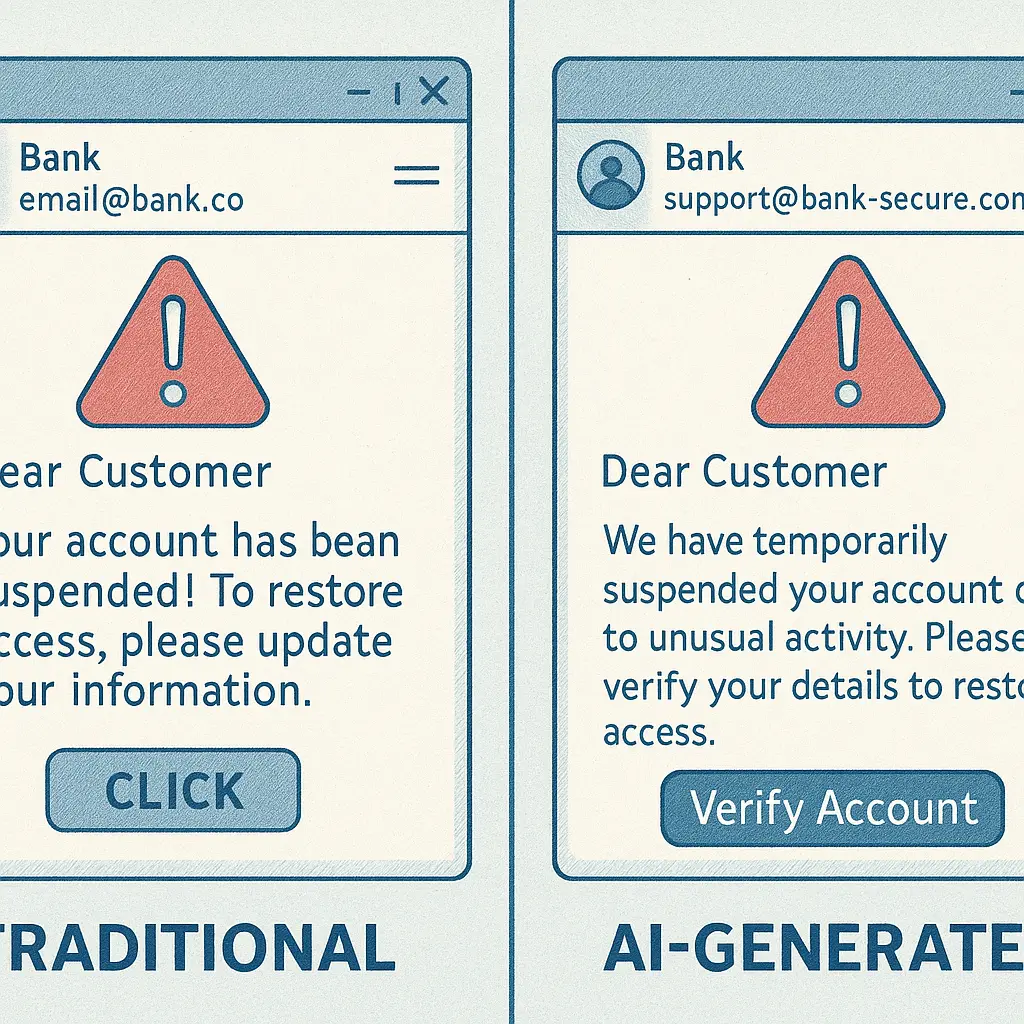
Mismatched sender details. The email claims to be from Microsoft, but the sender address is a Gmail account. The display name says "PayPal Security" but the actual address is a random string at a domain you've never heard of. These mismatches still appear in AI-generated campaigns because the AI writes the message body, not the technical infrastructure.
Links that don't match. Hover over a link before clicking. The displayed text says "microsoft.com" but the actual URL points to "micros0ft-login.net" or an IP address. AI can't override how URLs work. The technical tell remains.
What You Should Actually Do
Your defense strategy doesn't need to change dramatically. It needs to become consistent.
Verify through separate channels. If an email requests action, confirm it through a method that doesn't rely on the email itself. Call the sender using a number from their official website, not from the email signature. Log into your account directly through the service's website, not through an email link. Reply to the sender through a separate email thread, not by hitting reply on the suspicious message.
Enable two-factor authentication everywhere it's available. Two-factor authentication remains the single most effective defense against credential theft. Even if you fall for a phishing email and enter your password on a fake site, the attacker can't access your account without the second factor.
Use a password manager. Password managers auto-fill credentials only on the legitimate site. If you're on a phishing page that looks like your bank but has a different URL, the password manager won't fill anything. That's a tell you can't ignore.
Report and delete. Forward phishing emails to your IT department if you're at work, or to the FTC at spam@uce.gov. Then delete them. Don't leave them in your inbox as a reminder to investigate later. You won't. You'll forget the context and click on autopilot.
Train yourself to pause. The most effective defense against phishing, AI-powered or not, is a three-second pause before clicking. That pause gives you time to check the sender, hover over the link, and ask whether the request makes sense in context.
The Industry Response
Security vendors have responded to AI-powered phishing with their own AI-based detection systems. Email filters now use machine learning to identify suspicious patterns, analyze sender reputation, and flag messages that deviate from normal communication patterns.
These tools help, but they're not foolproof. AI detection systems have false positives and false negatives. Legitimate emails get flagged. Sophisticated phishing emails slip through. The technology is an additional layer, not a replacement for human judgment.
Organizations are also updating their security awareness training to address AI-generated threats. The CISA phishing guidance emphasizes verification over detection, teaching employees to confirm requests through independent channels rather than trying to spot sophisticated fakes.
This shift in training philosophy matters. The old model taught people to look for red flags. The new model teaches people to verify green flags. Instead of asking "Does this email look suspicious?", you ask "Can I confirm this request is legitimate?"
The Numbers Behind the Hype
The FBI's Internet Crime Complaint Center tracks phishing complaints and losses annually. The 2025 report shows phishing remains the most common attack vector, but the year-over-year increase in reports is roughly in line with previous trends. There's no dramatic spike that correlates with widespread AI adoption.
What changed is the sophistication distribution. More attacks now fall into the "well-crafted" category. Fewer attacks contain obvious errors. But the total volume and success rate haven't jumped dramatically. The attackers who were already successful got more efficient. The attackers who were incompetent got slightly less incompetent.
This matters because it contradicts the narrative that AI has fundamentally transformed the threat landscape. The landscape shifted incrementally, not categorically. Your risk today is higher than it was in 2020, but it's not higher than it was six months ago.
What's Actually Worth Worrying About
The real concern isn't that AI makes phishing emails grammatically perfect. It's that AI lowers the barrier to entry for attackers who previously lacked the skills to run effective campaigns.
A teenager with no technical expertise can now use freely available language models to generate convincing phishing emails, research targets through automated tools, and deploy campaigns that would have required a team of specialists five years ago. The democratization of attack tools expands the threat pool.
But this democratization cuts both ways. The same AI tools that help attackers also help defenders. Automated detection improves. Security awareness training adapts faster. The arms race continues, but it's not one-sided.
The other concern is volume. AI enables attackers to send more personalized emails to more targets in less time. This increases the statistical likelihood that someone in your organization will fall for an attack, even if each individual email is no more convincing than a well-crafted human attempt.
This is a management problem, not a technical one. Organizations need to assume that some percentage of employees will click on phishing emails, regardless of training or technology. The defense strategy should focus on limiting damage after a successful phish: segmented networks, least-privilege access, anomaly detection, and rapid incident response.
The Verification Habit
The single most effective change you can make is building a verification habit that doesn't depend on spotting tells.
When an email requests action, your default response should be verification, not evaluation. Don't try to decide whether the email is legitimate. Verify it through a separate channel. Every time. Without exception.
This habit works because it shifts the burden of proof. Instead of asking "Can I prove this is fake?", you ask "Can I prove this is real?" The latter is easier and more reliable.
A verification habit also protects you against the next evolution of AI-powered attacks. Whatever techniques emerge in 2027 or 2028, verification through separate channels will still work. The attacker can't fake your boss's voice on a phone call to their direct office line. They can't fake a transaction appearing in your actual bank account when you log in directly.
This is the reality check: AI makes phishing emails better, but it doesn't make verification obsolete. The hype focuses on the threat. The defense focuses on the process.
Where This Goes Next
Attackers will continue refining AI-powered phishing. Voice synthesis will improve. Deepfake video will become more accessible. The next generation of attacks will combine email, voice, and video in coordinated campaigns that exploit multiple trust signals simultaneously.
But the fundamental principle remains: verification through independent channels stops these attacks. A deepfake video of your CEO requesting a wire transfer doesn't matter if your company policy requires dual authorization through a separate system. A voice-cloned call from your bank doesn't matter if you hang up and call the bank's official number to confirm.
The technology will get better. The defenses will adapt. Your job is to maintain the verification habit regardless of how convincing the attack becomes.
The Bottom Line
AI-powered phishing is real, but it's not the paradigm shift the headlines suggest. Grammar improved. Volume increased. Personalization scaled. But the core attack patterns remain the same, and the core defenses still work.
You don't need to become an AI expert to protect yourself. You need to verify requests through separate channels, enable two-factor authentication, use a password manager, and pause before clicking. These habits worked before AI. They work now. They'll work when the next technological shift arrives.
The hype serves a purpose: it reminds people that phishing is still a threat and that complacency is dangerous. But the hype also creates unnecessary anxiety about an unstoppable AI menace. The reality is more mundane. Phishing got incrementally better. Your defenses need to be incrementally more consistent.
That's the reality check. AI didn't change the game. It just raised the stakes for playing it correctly.