Open Source vs Proprietary Security Software: Which Model Actually Protects You
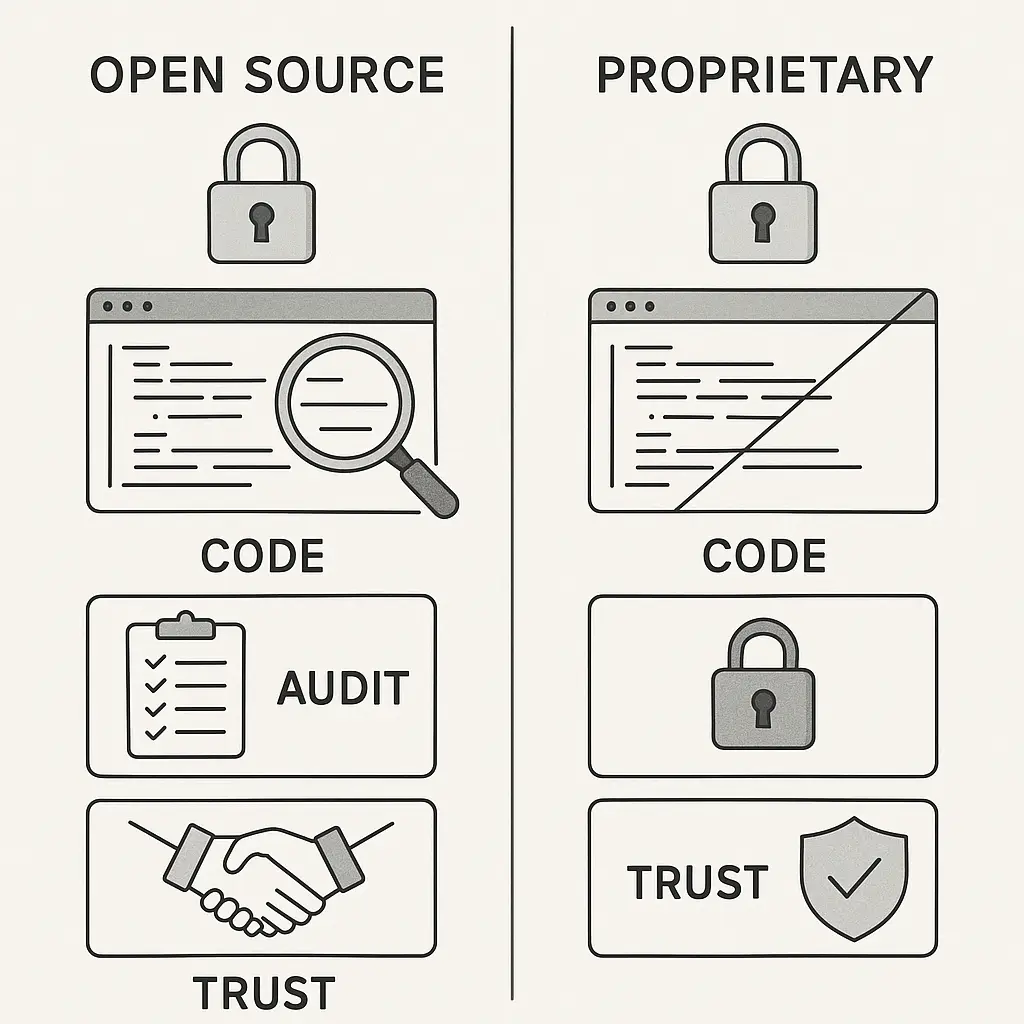
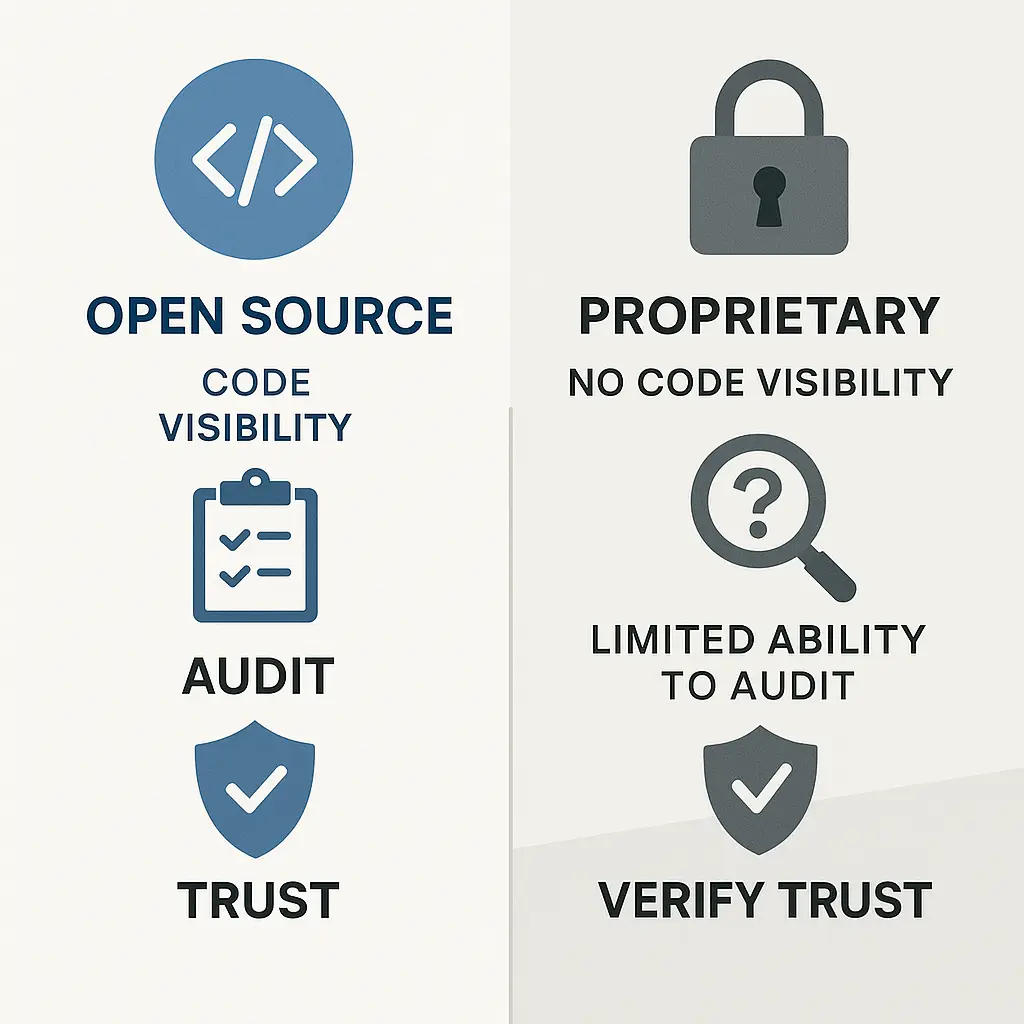
Security software protects your data, accounts, and devices. The code that does this work comes from one of two models: open source, where anyone can read and audit the implementation, or proprietary, where the vendor controls access to the code and you trust their claims about what it does.
The difference matters because security tools handle your most sensitive information. A password manager stores credentials for every account you own. Antivirus software scans every file you open. VPNs route all your internet traffic. Encryption tools protect data you can't afford to lose.
When you choose a security tool, you're choosing a trust model. Open source says "here's the code, verify it yourself." Proprietary says "trust us, we've built this securely." Both models can produce secure software. Both have produced catastrophic failures. The question isn't which is better in the abstract. The question is what you're actually getting with each approach, where the tradeoffs live, and how to evaluate tools when marketing claims collide with technical reality.
How Open Source Security Software Actually Works
Open source security software publishes its source code under licenses that let anyone read, modify, and redistribute it. The Open Source Initiative defines the criteria: you get the code, the right to study it, the right to change it, and the right to share your changes.
For security tools, this means the cryptographic implementation, the authentication mechanism, the data handling logic, and every other component sits in a public repository where anyone with the skills can audit it. If you want to know how your password manager generates encryption keys, you can read the exact code that does it. If you want to verify that your VPN doesn't log traffic, you can trace the network handling functions yourself.
The transparency extends to the development process. Security researchers, cryptographers, and independent auditors review the code, file bug reports, and submit patches. When someone finds a vulnerability, the fix happens in public. You can see what broke, how it was exploited, and what changed to close the hole.
Popular open source security tools include Bitwarden (password manager), Signal (encrypted messaging), KeePassXC (offline password storage), WireGuard (VPN protocol), VeraCrypt (disk encryption), and ClamAV (antivirus). Each follows the same model: code in the open, development in the open, security through transparency.
The model assumes that public scrutiny produces better security than secrecy. More eyes on the code means more people catching mistakes before attackers do. The assumption holds when the project has an active community of skilled reviewers. It breaks down when a project sits neglected with few contributors and no recent audits.
How Proprietary Security Software Actually Works
Proprietary security software keeps its source code secret. You get a compiled binary, an installer, or a cloud service. The vendor controls who sees the implementation, how it's reviewed, and what information gets disclosed about its internal workings.
The vendor might describe the security architecture in marketing materials or technical documentation, but you can't verify those claims by reading the code. You trust that the password manager actually uses AES-256 encryption because the vendor says it does. You trust that the antivirus doesn't send your browsing history to third parties because the privacy policy says it doesn't.
Some proprietary vendors commission third-party security audits and publish summary reports. These audits provide more assurance than marketing claims alone, but they're still constrained by what the vendor chooses to share. The auditor sees the code under NDA, tests specific components, and reports findings back to the vendor. You get a PDF that says "we found no critical vulnerabilities in the areas we examined during the time we had access."
Popular proprietary security tools include 1Password (password manager), Norton (antivirus), NordVPN (VPN service), LastPass (password manager), and Malwarebytes (anti-malware). Each follows the same model: code stays private, security through vendor reputation and controlled audits.
The model assumes that secrecy prevents attackers from finding vulnerabilities by studying the code. It also assumes the vendor has the resources, expertise, and incentives to build secure software without public oversight. Both assumptions can hold, but neither is guaranteed.
Vulnerability Disclosure: Where the Models Diverge
When someone discovers a security flaw, what happens next differs dramatically between open source and proprietary tools.
In open source projects with responsible disclosure practices, the researcher reports the vulnerability privately to the project maintainers. The maintainers develop a fix, test it, and coordinate a public release. Once the patch is available, the project publishes details about the vulnerability, the affected versions, and the remediation. The entire process happens in the open after users have time to update.
The CISA Known Exploited Vulnerabilities catalog tracks vulnerabilities across both models. Open source projects appear frequently because their disclosure is public by design. You see the flaw, the fix, and the timeline. That visibility doesn't mean open source software has more vulnerabilities. It means you know about them.
Proprietary vendors handle disclosure differently. Some follow coordinated disclosure practices similar to open source: they accept reports, develop patches, and publish advisories. Others minimize public disclosure, releasing patches quietly without detailed explanations. A few have been known to threaten researchers who report vulnerabilities, treating security research as a legal liability rather than a public service.
The EFF's Coders' Rights Project has documented cases where proprietary vendors used legal threats to silence security researchers. The pattern creates a chilling effect: if reporting a vulnerability might result in a lawsuit, fewer people report vulnerabilities. The flaws still exist. They just stay hidden until someone less ethical finds them.
Trust Models and Verification
Security software asks you to trust it with everything that matters. The trust model determines how you verify that trust is warranted.
Open source tools let you verify trust through code review. If you have the skills, you can audit the implementation yourself. If you don't, you rely on the community of people who do. Active projects with public security audits, bug bounty programs, and transparent development processes demonstrate that verification is happening.
Bitwarden, for instance, publishes annual third-party security audits on its website. The audits are comprehensive, the findings are public, and the code changes in response to audit recommendations are visible in the project's Git history. You don't have to trust Bitwarden's marketing. You can read what independent auditors found and verify the fixes yourself.
Proprietary tools ask you to trust the vendor's reputation, certifications, and controlled audit reports. Some vendors earn that trust through consistent behavior over years. Others exploit it through marketing that overstates their security capabilities.
LastPass, a proprietary password manager, suffered a breach in 2022 that exposed encrypted user vaults. The company's initial disclosure minimized the severity. Subsequent updates revealed that the breach was worse than first described: attackers had access to backup data including encrypted vaults and some unencrypted metadata. Users had no way to verify the company's claims about what was compromised because the code and infrastructure were proprietary.
The breach didn't happen because LastPass was proprietary. It happened because the company's security practices failed. But the proprietary model meant users couldn't audit the implementation, couldn't verify the encryption strength, and couldn't independently assess the risk. They had to trust the vendor's evolving statements about what went wrong.
The Maintenance Problem
Security software requires ongoing maintenance. Vulnerabilities get discovered. Protocols get deprecated. Operating systems change. A tool that was secure in 2020 might be dangerously outdated in 2026 if nobody's maintaining it.
Open source projects depend on volunteer contributors or foundation funding. Popular projects with active communities get regular updates, security patches, and new features. Neglected projects sit unmaintained, accumulating known vulnerabilities that never get fixed.
You can assess maintenance by checking the project's commit history, issue tracker, and release schedule. If the last commit was three years ago and open security issues have no responses, the project is effectively abandoned. Using abandoned security software is worse than using no security software, because you're trusting a tool that no longer receives fixes.
Proprietary vendors maintain software as long as it's profitable. When a product stops making money, support ends. Sometimes vendors give advance notice and migration paths. Sometimes they just shut down the service and leave users scrambling.
The SANS Institute tracks software lifecycle management as a security concern. Proprietary tools that reach end-of-life create risk because users keep running them without realizing support has ended. Open source tools can theoretically be forked and maintained by the community, but in practice, most abandoned open source projects stay abandoned.
The Compliance and Certification Game
Enterprise security often requires compliance with standards like SOC 2, ISO 27001, or FedRAMP. Proprietary vendors build entire business models around these certifications. They hire auditors, implement controls, and market their compliance status as proof of security.
Open source projects rarely pursue formal certifications because the process is expensive and designed for companies with legal entities, not distributed communities. This creates a paradox: the most transparent, auditable software often lacks the certifications that procurement departments require.
Some organizations solve this by using open source tools through commercial vendors who provide support and certifications. Red Hat Enterprise Linux, for instance, is open source software packaged with enterprise support and compliance certifications. You get the transparency of open source with the paperwork enterprises need.
In Ocean's Eleven, Danny Ocean's crew spends the entire film planning a heist that depends on understanding exactly how the casino's vault works. They study blueprints, test security systems, and rehearse every step. The vault's security isn't weakened by their knowledge of its design , it's tested by it. Open source security software works the same way: transparency doesn't create vulnerability. It creates the conditions for thorough testing.
Proprietary security is the opposite bet: the vault stays secure because nobody outside the casino knows how it works. That bet holds until someone inside makes a mistake, or until an attacker finds a way in that the designers didn't anticipate. Then the secrecy that was supposed to protect you becomes the thing that prevented anyone from catching the flaw early.
Performance and Feature Tradeoffs
Open source security tools often prioritize correctness over polish. The interface might be functional but unrefined. Features that require significant development resources might be missing. Documentation might assume technical knowledge.
Proprietary tools invest in user experience, customer support, and feature development because they're competing for paying customers. The password manager has a slick interface, browser extensions that work reliably, and customer service that responds when you're locked out.
These tradeoffs matter differently depending on your needs. If you're comfortable with technical tools and value transparency above convenience, open source might fit better. If you need something that works immediately with minimal configuration and has someone to call when things break, proprietary might be worth the trust tradeoff.
The performance difference is real but often overstated. Open source security tools like Signal and WireGuard are known for being fast and efficient. Proprietary tools like Norton antivirus are known for being resource-intensive. The correlation isn't with the development model. It's with the specific technical choices each project makes.
When Hybrid Models Complicate the Picture
Some security tools mix open source and proprietary components. The core cryptographic library might be open source while the user interface is proprietary. The protocol might be open while the server infrastructure is closed. The client might be open source while the cloud service that coordinates devices is proprietary.
These hybrid models attempt to get the best of both worlds: verifiable security through open source crypto, and polished experience through proprietary development. In practice, they often get the worst: you can't fully audit the system because critical components are closed, but you also don't get the full support and polish of a purely proprietary product.
Proton VPN publishes its client applications as open source but runs proprietary server infrastructure. You can verify what the client does with your traffic, but you're trusting Proton's claims about what happens on their servers. It's more transparency than a fully proprietary VPN, but less than a fully open source solution you could run yourself.
The hybrid model makes sense when certain components genuinely benefit from being proprietary (like server-side anti-abuse systems that would be easier to circumvent if public) while others benefit from transparency (like client-side encryption that users need to verify). The challenge is distinguishing legitimate hybrids from marketing that claims openness while keeping critical security components closed.
The Supply Chain Question
Security software doesn't exist in isolation. It depends on libraries, frameworks, operating systems, and build tools. A vulnerability in any dependency can compromise the security tool itself.
Open source projects typically list their dependencies explicitly. You can audit not just the main project but also everything it relies on. When a vulnerability appears in a widely-used library, you can trace which projects are affected and verify they've updated to the patched version.
Proprietary tools have dependencies too, but you often can't see them. The vendor might use open source libraries internally, but you won't know which ones or which versions unless they choose to disclose that information. When a major vulnerability like Heartbleed or Log4Shell hits a common library, you have to trust the vendor to identify affected products and release patches quickly.
The CISA software bill of materials (SBOM) initiative encourages vendors to publish detailed lists of their software components. Some proprietary security vendors have adopted SBOMs. Many haven't. Without an SBOM, you're trusting the vendor to know their own supply chain well enough to respond to third-party vulnerabilities.
Cost Structures and Sustainability
Open source security tools are usually free to use, but "free" doesn't mean "no cost." Someone has to maintain the code, respond to security reports, and develop new features. That work gets funded through donations, sponsorships, grants, or volunteer labor.
Projects that depend on volunteer labor can disappear when maintainers burn out or move on. Projects funded by a single company can change direction when business priorities shift. The XKCD comic about modern digital infrastructure depending on "some random person in Nebraska" maintaining a critical library isn't far from reality.
Proprietary tools fund development through subscriptions, licenses, or ads. The business model creates incentives to keep users paying, which usually means continuing to provide value. But it also creates incentives to add features that increase revenue rather than features that increase security, to collect user data for monetization, and to lock users into ecosystems that make switching expensive.
Neither funding model guarantees sustainability. Open source projects can thrive for decades with strong communities. Proprietary vendors can shut down profitable products when they don't fit corporate strategy. What matters is the specific project or vendor's track record, not the abstract model.
Making the Choice for Your Situation
The comparison between open source and proprietary security software isn't a simple good-versus-bad judgment. Both models can produce excellent tools. Both have produced disasters. What matters is evaluating specific tools based on what you need and what you can verify.
If you're choosing a password manager, ask: Can I verify the encryption implementation? Is there a public security audit? How does the vendor respond to vulnerabilities? What happens to my data if the company shuts down? Open source tools like Bitwarden let you answer these questions definitively. Proprietary tools like 1Password require trust in the vendor's claims and track record.
If you're choosing antivirus software, ask: How quickly does it respond to new threats? What data does it collect? Can I verify what it's doing on my system? Proprietary tools like Bitdefender and Malwarebytes have strong detection rates but limited transparency. Open source tools like ClamAV have full transparency but historically weaker detection. The tradeoff is real.
If you're choosing a VPN, ask: Can I verify the no-logging claims? Is the protocol implementation auditable? What jurisdiction is the company in? Open source protocols like WireGuard let you verify the technical implementation. Proprietary VPN services require trust in the company's policies and legal constraints.
For enterprise environments, the decision often comes down to support, compliance, and integration. A company might choose proprietary tools because they need vendor support contracts, compliance certifications, and integration with existing systems. An individual might choose open source tools because they value transparency, don't need phone support, and want to avoid vendor lock-in.
What You Can Control
You can't always choose between open source and proprietary security tools. Your employer might mandate specific software. Your bank might require a particular authentication method. Your jurisdiction might restrict certain technologies.
What you can control is how you evaluate the tools you use. Read security audits when they're available. Check the project's or vendor's history of vulnerability disclosure. Look for evidence of active maintenance. Verify that the tool does what it claims through independent sources, not just marketing materials.
You can also layer tools. Use an open source password manager for credentials you want to verify personally, and a proprietary one for accounts that require specific features. Use an open source VPN protocol through a proprietary service that provides the server infrastructure. Use open source encryption tools for data you can't afford to lose, even if you use proprietary tools for convenience elsewhere.
The security of your data, accounts, and devices depends on the tools you trust to protect them. Open source and proprietary models offer different paths to earning that trust. Neither is universally better. Both require you to do the work of verification, whether that's reading code, reading audit reports, or reading the track record of the people or organizations behind the software.