What 'legitimate interest' means in privacy law, and why it matters to you
You click through a privacy policy and see "legitimate interest" listed as the reason a company processes your data. The phrase sounds official, maybe even reassuring. But what does it actually mean? And more importantly, what control do you have over data processed under this legal basis?
Legitimate interest is one of six legal grounds for data processing under the General Data Protection Regulation (GDPR), the European Union's comprehensive privacy law that took effect in 2018. While GDPR applies directly to EU residents, its influence extends globally. Companies that serve European customers must comply, and many apply GDPR principles to all users rather than maintaining separate systems by geography.
Unlike consent, which requires your explicit agreement before processing begins, legitimate interest allows companies to process your data first and gives you the right to object later. This distinction creates fundamentally different power dynamics. Understanding how legitimate interest works, when companies can use it, and what rights you retain is essential to understanding what happens to your data.
This article explains the underlying mechanism of legitimate interest, the balancing test companies must perform, what types of processing commonly rely on this basis, and the practical steps you can take to exercise your right to object.
The six legal bases under GDPR
GDPR requires every instance of personal data processing to have a lawful basis. The regulation defines six options: consent, contract, legal obligation, vital interests, public task, and legitimate interest. Each basis works differently and grants different rights.
Consent requires explicit, informed, freely given agreement before processing. You must actively opt in. Consent must be specific to each purpose, and you can withdraw it at any time.
Contract covers processing necessary to fulfill an agreement you've entered. When you buy something online, the seller needs your address to ship the item. That's contract-based processing.
Legal obligation applies when law requires the processing. Tax reporting, employment records, and regulatory compliance fall here.
Vital interests covers life-or-death situations. Medical emergencies where consent isn't possible.
Public task applies to government functions and public authorities performing statutory duties.
Legitimate interest is the sixth basis and the most flexible. It allows processing when the company has a valid business reason and your fundamental rights don't override that reason. This flexibility makes it both useful and controversial.
Companies prefer legitimate interest over consent because it doesn't require asking permission upfront. Consent creates friction. Users say no. Legitimate interest shifts the burden: companies can process first, and you object later if you choose. This asymmetry matters.
The three-part balancing test
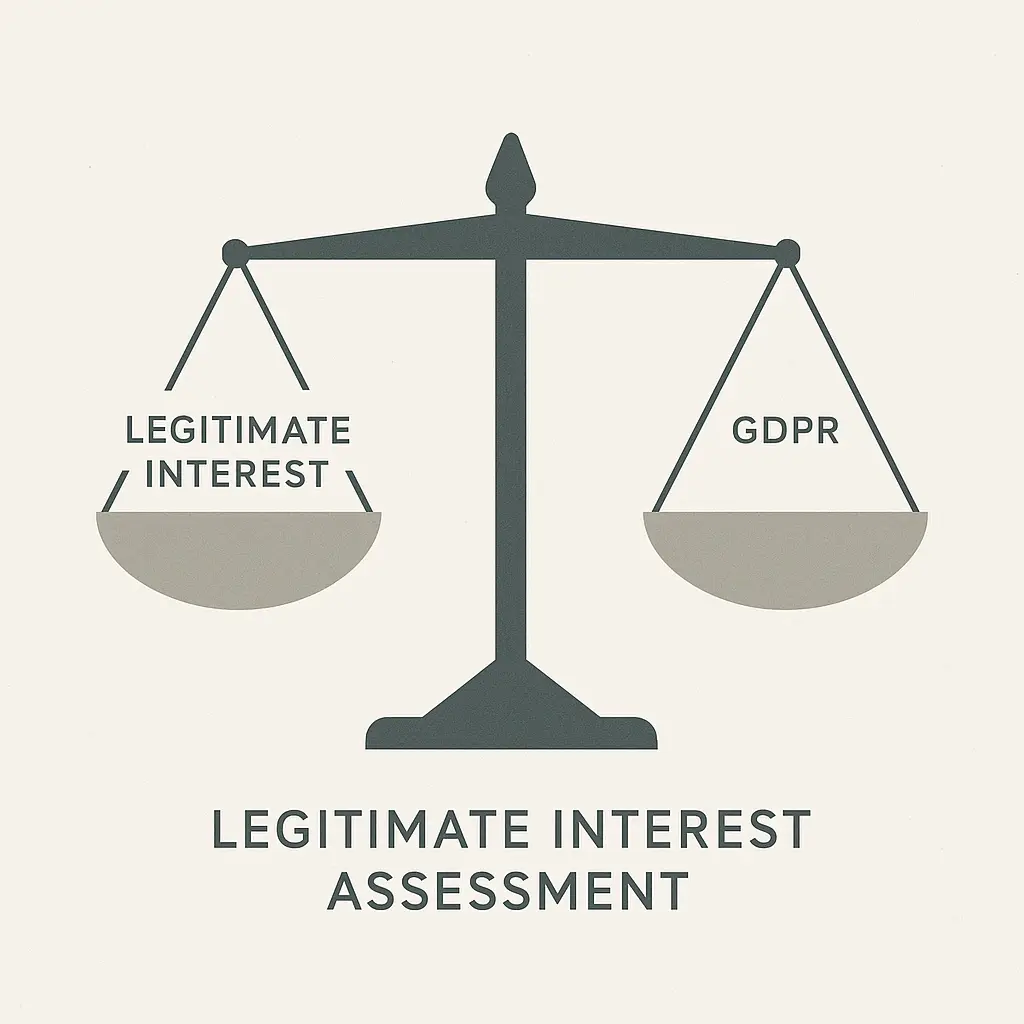
Legitimate interest isn't a free pass. GDPR requires companies to perform and document a balancing test before relying on this basis. The test has three parts: purpose, necessity, and balance.
Purpose test: The company must identify a specific, legitimate interest. "We want to make money" doesn't qualify. Fraud prevention, network security, direct marketing to existing customers, and improving service quality are examples of interests that can qualify. The interest must be real, present, and clearly articulated.
Necessity test: The processing must be necessary to achieve the stated interest. If the company can accomplish the same goal with less intrusive methods, legitimate interest fails. This is a proportionality requirement. You can't use a sledgehammer when a scalpel works.
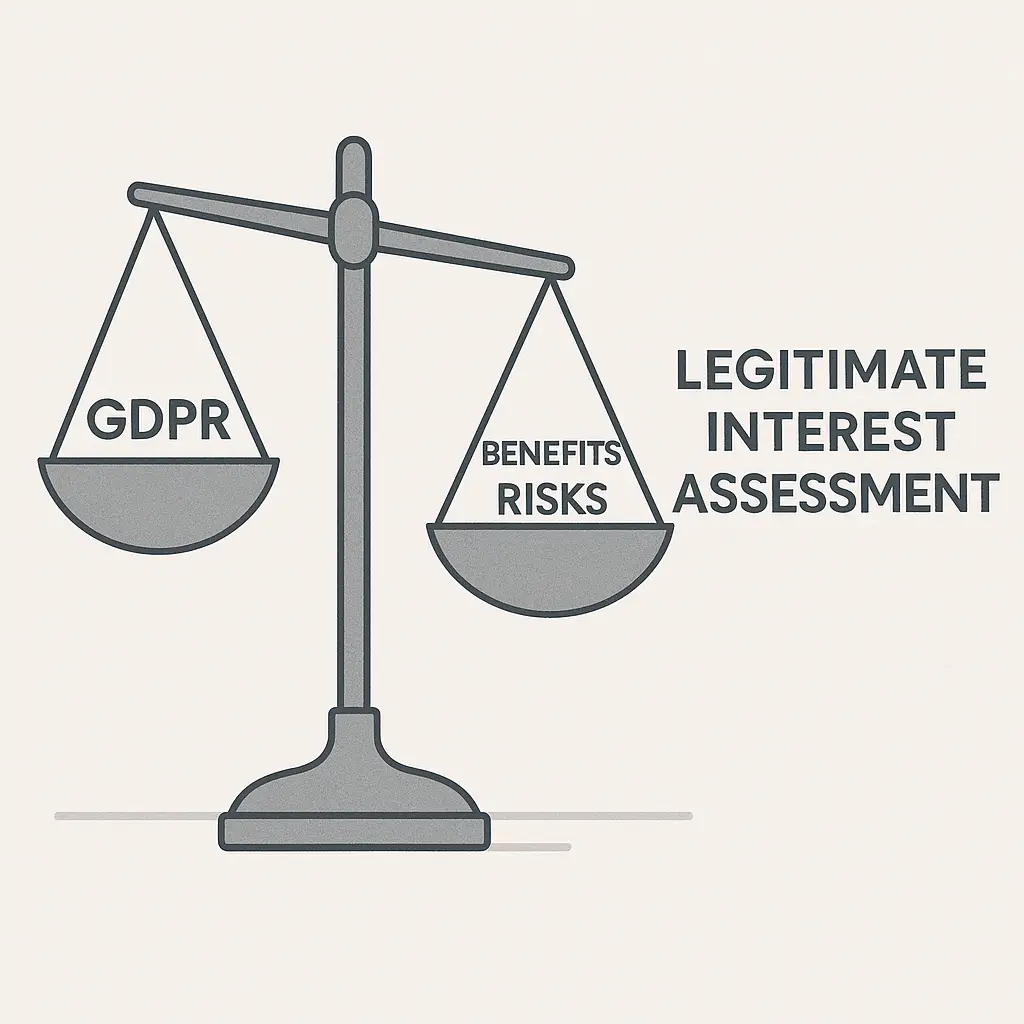
Balancing test: The company's interest must not override your fundamental rights and freedoms. This is where the rubber meets the road. The test weighs the nature of the data, how it's used, what you reasonably expect, and what impact the processing has on you.
The balancing test isn't a formality. The European Data Protection Board (EDPB), which issues guidance on GDPR interpretation, has published detailed guidelines on how to conduct legitimate interest assessments. Companies must document their reasoning. If challenged, they must show their work.
In Star Trek: The Next Generation, Data's positronic brain constantly evaluates competing priorities and calculates optimal outcomes based on multiple weighted factors. Legitimate interest assessments work the same way. Companies must weigh their business needs against your privacy rights, document the calculation, and reach a defensible conclusion. Unlike Data, companies don't always get it right, and their calculations often favor their own interests more than the law allows.
Several factors influence the balance. Sensitivity of the data matters. Processing health records or financial details requires stronger justification than processing email addresses for newsletters. Reasonable expectations matter. If you signed up for a service, you probably expect some data use for service delivery. You don't expect your browsing behavior sold to data brokers. The impact on you matters. Does the processing create risk? Does it limit your choices? Does it affect your autonomy?
Transparency matters. If the processing is invisible or unexpected, the balance tips against the company. If you can't understand what's happening or why, the company's interest weakens.
Common uses of legitimate interest
Certain types of processing appear repeatedly in legitimate interest justifications. Some are defensible. Some are questionable.
Fraud prevention and security almost always qualifies. Banks analyze transaction patterns to detect fraud. Email providers scan for phishing. Websites log IP addresses to block attacks. These uses protect both the company and users. The necessity is clear, the impact is minimal, and reasonable expectations support it.
Direct marketing to existing customers often relies on legitimate interest. If you bought something from a company, they can usually email you about similar products without asking permission first. The logic: you've already established a relationship, and marketing is a predictable business activity. But you retain the right to opt out, and companies must honor that immediately.
Analytics for service improvement is a gray area. Companies argue they need usage data to fix bugs, optimize performance, and build better features. The argument holds when the data stays internal, is aggregated, and serves clear operational purposes. It weakens when "improvement" means building advertising profiles or sharing data with third parties.
Personalization gets tricky. Showing you relevant content based on your behavior sounds user-friendly. But personalization often means tracking you across contexts, building detailed profiles, and making inferences you didn't authorize. The line between helpful and invasive is thin, and companies often cross it.
Behavioral advertising is where legitimate interest breaks down most often. Companies claim they have a legitimate interest in funding their services through ads. That's true. But the interest in showing you targeted ads based on extensive tracking doesn't automatically override your privacy rights. The EDPB has been clear that behavioral advertising usually requires consent, not legitimate interest. Many companies ignore this guidance.
What you can actually control
GDPR gives you the right to object to processing based on legitimate interest. This right is absolute for direct marketing. For other purposes, companies can refuse your objection if they demonstrate compelling grounds that override your interests.
To object, you need to know processing is happening. Privacy policies must disclose the legal basis for each type of processing. Look for sections labeled "legal grounds," "lawful basis," or "why we process your data." Legitimate interest should be explicitly named and explained.
The explanation should include what the interest is, why the processing is necessary, and how the company balanced your rights. If the policy just says "legitimate interest" without detail, the company probably hasn't done the required assessment. That's a red flag.
Once you know legitimate interest is being used, you can object. The process varies by company, but GDPR requires a simple method. Look for "privacy rights," "data subject requests," or "your choices" sections. Some companies provide web forms. Others require email. A few still demand postal mail, which is deliberately obstructive.
When you object to direct marketing, the company must stop immediately. No exceptions, no compelling grounds test. For other processing, the company has one month to respond. They must either stop processing or explain why their compelling grounds override your objection. If you disagree, you can file a complaint with your data protection authority.
The right to object is separate from the right to opt out of cookies or tracking technologies. Those are governed by the ePrivacy Directive (another EU law) and require consent upfront. Legitimate interest applies to processing that happens after data collection, not the collection itself.
Legitimate interest vs. consent in practice
The choice between consent and legitimate interest shapes what you see online. Consent requires asking. Legitimate interest allows proceeding.
When a website uses consent for analytics, you see a banner asking permission. You can say no. If you say no, the tracking doesn't happen. When the same website uses legitimate interest for analytics, you might see a notice that tracking is occurring, but the default is on. You have to actively object to stop it.
This difference is why companies prefer legitimate interest. Consent creates drop-off. People say no. Legitimate interest preserves the status quo. Most users never object because they don't know they can or don't understand what's happening.
The FTC has consistently emphasized that privacy protections must be clear, accessible, and genuinely empower users. Legitimate interest mechanisms that bury objection processes in dense policy language or multi-step forms fail that standard, even if they technically comply with GDPR's letter.
GDPR requires that objection be "as easy as" giving consent. If consent is one click, objection should be one click. Many companies violate this. They make consent easy (to comply with the law) and objection hard (to preserve data flow). This is a violation, but enforcement is inconsistent.
The enforcement reality
GDPR grants data protection authorities the power to investigate complaints, audit companies, and impose fines up to 4% of global annual revenue. In practice, enforcement is uneven.
Some authorities are aggressive. The Irish Data Protection Commission, which regulates most major tech companies due to their EU headquarters location, has issued hundreds of millions in fines. The French CNIL, German authorities, and others have also been active. But resources are limited, and the volume of violations exceeds enforcement capacity.
Smaller companies often fly under the radar. Large companies get attention because they process data at scale and violations affect millions. A local business using legitimate interest inappropriately might never face scrutiny unless someone complains.
Complaints matter. Data protection authorities investigate user complaints. If you believe a company is misusing legitimate interest, you can file a complaint with the authority in your country. The process is free. The authority investigates. If they find a violation, they can order the company to change practices and impose fines.
The EDPB coordinates enforcement across member states and issues binding decisions on cross-border cases. This mechanism ensures some consistency, but interpretation still varies by country.
Legitimate interest beyond GDPR
GDPR's influence extends beyond Europe. California's Consumer Privacy Act (CCPA) and its successor, the California Privacy Rights Act (CPRA), don't use the term "legitimate interest," but they create similar dynamics. Companies can process data for certain business purposes without consent, but you can opt out.
Other jurisdictions have adopted GDPR-inspired frameworks. Brazil's LGPD, South Africa's POPIA, and others include legitimate interest or equivalent concepts. The global trend is toward requiring legal justification for processing, not just "we want to."
In the United States, sectoral laws like HIPAA (health), FERPA (education), and GLBA (financial) create processing rules for specific industries. These laws don't use legitimate interest language, but they embody similar principles: processing must serve defined purposes, and individuals retain some control.
The absence of a comprehensive U.S. federal privacy law means most American companies aren't legally required to perform balancing tests. They process data because they can, not because they've justified it. This gap is significant. GDPR's legitimate interest framework, for all its flaws, at least requires companies to think through whether processing is necessary and proportionate. U.S. companies often skip that step entirely.
How to audit your own exposure
You can't control what you don't know about. Here's how to find out where legitimate interest affects you.
Start with the services you use most. Email, social media, banking, shopping, streaming. Pull up their privacy policies. Search for "legitimate interest" or "legal basis." Read those sections.
For each instance of legitimate interest, ask: Does the explanation make sense? Is the interest specific? Is the necessity clear? Does the balance seem reasonable? If the answer to any of these is no, consider objecting.
Look for objection mechanisms. Are they easy to find? Do they work? Test them. Submit an objection to one service and see what happens. Does the company respond within 30 days? Do they stop processing or explain why they won't? This tells you whether the company takes rights seriously.
Check cookie banners and privacy preference centers. Many sites now offer granular controls. Look for categories labeled "legitimate interest" or similar. These controls should let you object to specific processing. If they don't, the company might be violating GDPR.
Review third-party data flows. Privacy policies should list partners and explain what data gets shared. If a company shares data with dozens of partners under legitimate interest, that's a warning sign. The more entities involved, the weaker the necessity argument becomes.
When legitimate interest fails
Legitimate interest fails when companies skip the balancing test, when the interest is too vague, when necessity isn't demonstrated, or when your rights clearly outweigh the company's interest.
Vague interests don't qualify. "Business operations" or "improving our services" without specifics is too broad. The interest must be concrete.
Disproportionate processing fails necessity. If a company collects your location every five minutes to show you a weather widget once a day, that's excessive. Less intrusive methods exist.
High-risk processing rarely passes the balance test. Sensitive data, vulnerable populations, and opaque processing tip the scales against the company. If you don't know it's happening, you can't object, and the balance fails.
Third-party sharing weakens legitimate interest. When a company shares your data with partners under legitimate interest, each recipient must also have a legitimate interest and perform their own balancing test. In practice, this chain often breaks. The original interest (fraud prevention, maybe) doesn't transfer to the twentieth partner down the line.
Behavioral advertising almost never qualifies. The EDPB's guidance is explicit: tracking users across sites to build advertising profiles requires consent. Companies that claim legitimate interest for ad targeting are usually wrong.
What happens when you object
When you submit a legitimate interest objection, the company must respond within one month. For direct marketing, they stop immediately. For other processing, they evaluate whether they have compelling grounds to continue.
Compelling grounds are rare. The company must show that their interest is so strong and your impact so minimal that processing must continue despite your objection. Fraud prevention might qualify. Legal compliance might qualify. Operational necessity might qualify. But most processing doesn't rise to this level.
If the company refuses your objection, they must explain why in detail. The explanation should reference the original balancing test and show how compelling grounds override your rights. If the explanation is vague or circular ("we need this data to provide our service, and we have a legitimate interest in providing our service"), it's probably invalid.
You can challenge the refusal by filing a complaint with your data protection authority. Include the company's response and explain why you believe their compelling grounds don't hold. The authority investigates. If they agree with you, they can order the company to stop processing and potentially fine them.
Some companies make objection easy. They provide clear forms, respond promptly, and honor requests without argument. These companies understand that respecting user rights builds trust and reduces regulatory risk. Other companies obstruct. They hide objection mechanisms, delay responses, and claim compelling grounds without justification. These companies are betting you'll give up. Often, users do.
The future of legitimate interest
Legitimate interest remains controversial. Privacy advocates argue it's a loophole that undermines GDPR's consent requirements. Industry argues it's essential flexibility that allows beneficial processing without bureaucratic overhead. Both have a point.
The European Commission is considering updates to the ePrivacy Directive, which governs cookies and tracking. These updates may clarify when legitimate interest applies to online tracking. Current drafts suggest tightening the rules, requiring consent for most behavioral tracking regardless of the legal basis claimed.
Enforcement is increasing. Data protection authorities are scrutinizing legitimate interest claims more closely. Companies that relied on boilerplate justifications are facing audits. Fines are growing. This trend will likely continue.
Technology is changing the landscape. Privacy-preserving techniques like differential privacy, federated learning, and on-device processing reduce the need to collect and centralize personal data. If companies can achieve their goals without processing personal data in identifiable form, legitimate interest becomes irrelevant. The best privacy protection is not collecting the data in the first place.
User expectations are shifting. People increasingly understand that their data has value and that companies profit from it. The idea that companies can process data without asking because they have a "legitimate interest" feels less acceptable. This cultural shift will pressure both regulators and companies.
Practical steps you can take now
You can't eliminate legitimate interest processing, but you can reduce your exposure and exercise your rights.
Read privacy policies for the services you use most. Search for "legitimate interest" and read those sections. Understand what processing happens under this basis.
Object to direct marketing immediately. Every marketing email should have an unsubscribe link. Use it. This is your absolute right, and companies must comply.
Object to analytics and tracking. Many services let you opt out of analytics. Look for privacy settings or preference centers. If you can't find them, email the company and formally object under GDPR.
Use privacy tools. Privacy Badger, developed by the Electronic Frontier Foundation, blocks trackers automatically. Ad blockers reduce data collection. Browser privacy settings limit tracking. These tools don't address legitimate interest directly, but they reduce the data companies collect in the first place.
File complaints when companies violate your rights. If a company refuses a valid objection, ignores your request, or makes objection unreasonably difficult, complain to your data protection authority. Complaints drive enforcement.
Support stronger privacy laws. GDPR isn't perfect, but it's better than nothing. In jurisdictions without comprehensive privacy laws, advocate for them. In jurisdictions with laws, advocate for stronger enforcement.
Legitimate interest is a technical legal concept, but it affects you every day. Understanding it gives you power. Companies rely on user ignorance. When you know your rights and exercise them, you shift the balance.