iMessage Encrypts Your Texts. SMS Doesn't. Here's the Underlying Mechanism.
You send a text. The bubble turns blue. That blue means something specific: your message just got encrypted end-to-end before leaving your phone. Switch to a contact who uses Android, and the bubble turns green. That green means the message left your device in cleartext, readable by your carrier and anyone with access to the network infrastructure.
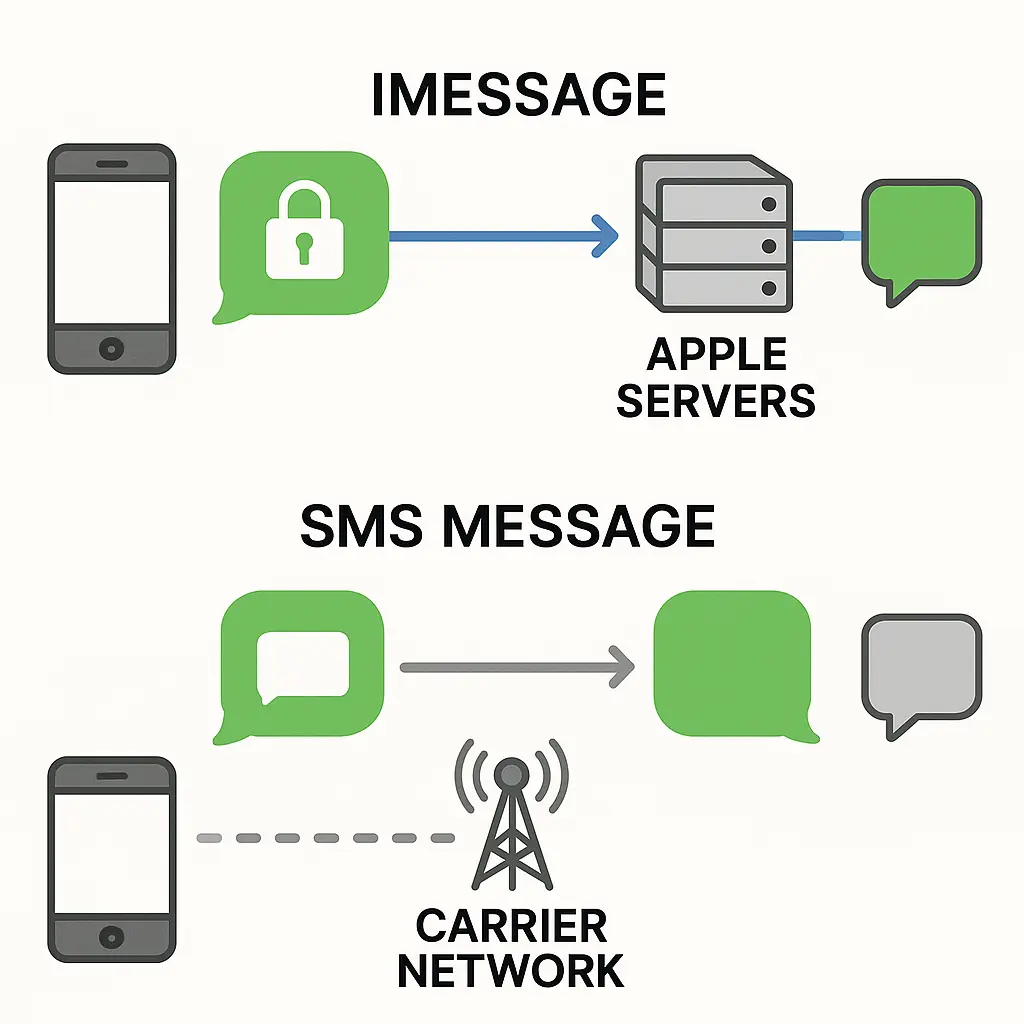
The difference isn't cosmetic. It's cryptographic. iMessage and SMS are two different protocols with fundamentally different security models. One encrypts your words before they leave your device. The other sends them as readable text through a decades-old system built before privacy was a design consideration.
Here's the underlying mechanism, what each protocol actually does, and when the distinction matters.
How SMS Actually Works
SMS predates smartphones by more than a decade. The protocol was designed in the 1980s as a way to send short messages over the signaling channels that cellular networks already used for call setup. Security wasn't part of the original specification because the threat model didn't include mass surveillance or data interception at scale.
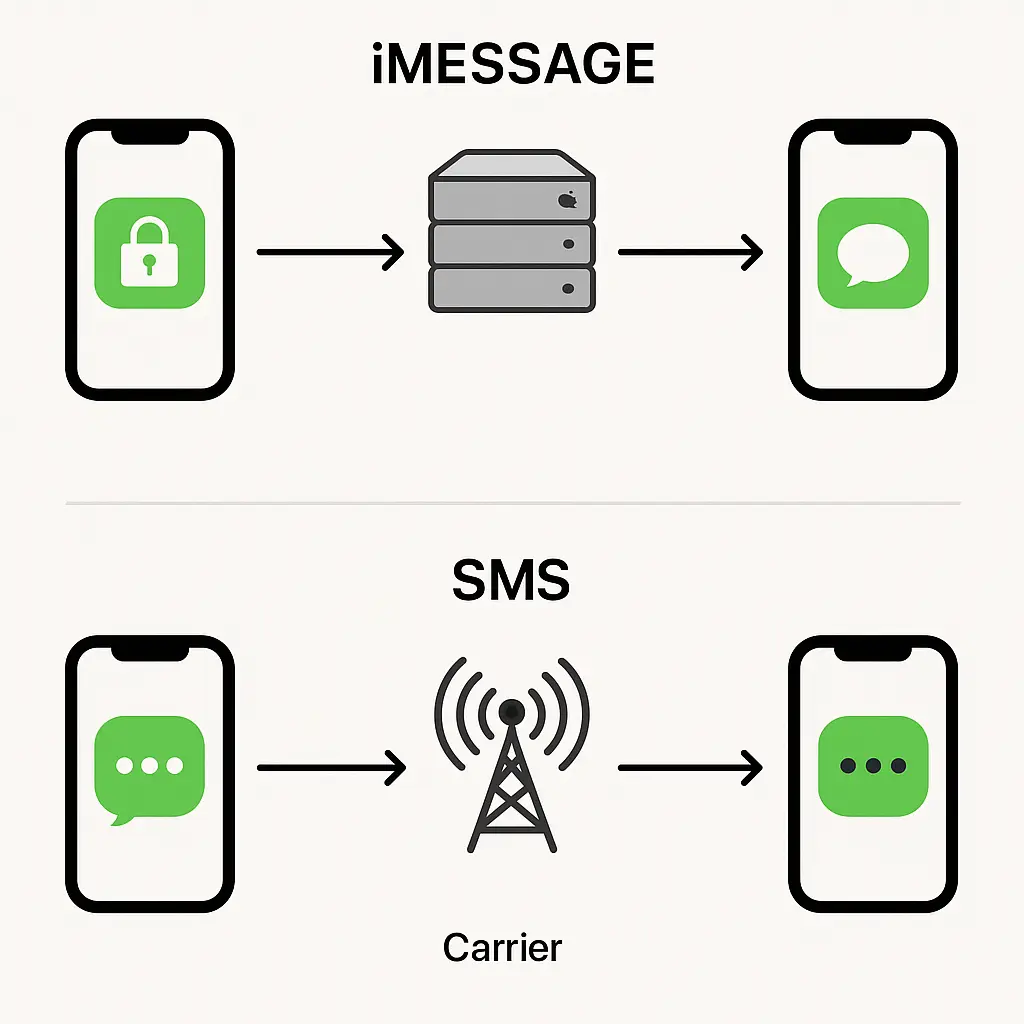
When you send an SMS, your phone converts the text into a standardized format and transmits it to your carrier's network. The message travels through multiple systems: your local tower, your carrier's routing infrastructure, potentially an interconnection point if the recipient uses a different carrier, and finally the recipient's carrier network before reaching their device.
At each hop, the message exists as cleartext. Your carrier can read it. The recipient's carrier can read it. Anyone with lawful access to those networks can read it. Anyone with unlawful access to those networks can read it.
Modern carriers encrypt the connection between your phone and the cell tower using algorithms like A5/3 or A5/4. This protects against casual eavesdropping by someone with a radio receiver. But once the message reaches the tower, that encryption ends. The rest of the journey happens in cleartext.
SMS was never designed with privacy in mind. The protocol assumes the network is trusted. That assumption made sense in 1985 when cellular networks were closed systems operated by a handful of carriers. It doesn't hold in 2026 when governments demand access, hackers exploit SS7 vulnerabilities, and carriers log everything for billing and compliance.
How iMessage Actually Works
iMessage is an internet-based messaging protocol that uses end-to-end encryption. When you send an iMessage, your phone generates a unique encryption key for that conversation. The message gets encrypted on your device using that key before transmission. Apple's servers route the encrypted data to the recipient, but Apple itself cannot decrypt the content.
The cryptographic mechanism relies on public-key cryptography. When you enable iMessage, your device generates a key pair: a private key that stays on your device and a public key that gets uploaded to Apple's servers. When someone sends you an iMessage, their phone retrieves your public key from Apple, encrypts the message with that key, and sends the ciphertext through Apple's infrastructure. Only your private key can decrypt it.
This is fundamentally different from SMS. The message never exists in readable form outside your device and the recipient's device. Apple sees encrypted data in transit. Your carrier sees encrypted data in transit. Anyone intercepting the transmission sees encrypted data.
iMessage also encrypts metadata differently than SMS. Your carrier knows when you send an SMS, to whom, and the message length. With iMessage, your carrier knows only that you're sending data to Apple. The recipient information, message size, and timing details are visible to Apple but not to your carrier.
The protocol supports features SMS can't handle: read receipts, typing indicators, high-resolution photos, and reactions. These work because iMessage is a data service, not a cellular protocol. Everything flows over the internet, encrypted, without touching the carrier's SMS infrastructure.
The Automatic Fallback Mechanism
Your iPhone doesn't ask which protocol to use. It decides automatically based on whether the recipient has iMessage enabled. If they do, the message goes out as iMessage. If they don't, it falls back to SMS.
This fallback is invisible to most users. You type a message, hit send, and the phone handles the rest. But the security implications are significant. A message to another iPhone user gets end-to-end encryption. A message to an Android user gets cleartext transmission through carrier networks.
The color-coding system exists to make this visible. Blue bubbles indicate iMessage. Green bubbles indicate SMS. But the distinction goes beyond aesthetics. Blue means encrypted. Green means readable by your carrier.
Group messages complicate this further. If everyone in the group uses iMessage, the conversation stays encrypted. If even one person uses Android or has iMessage disabled, the entire conversation falls back to SMS. Every message becomes cleartext. The iPhone doesn't warn you when this happens beyond changing the bubble color.
What Your Carrier Actually Sees
When you send an SMS, your carrier sees everything. The message content, the recipient, the timestamp, the message length, and your location when you sent it. This data gets logged for billing, regulatory compliance, and network optimization. How long carriers retain SMS content varies, but metadata typically persists for years.
When you send an iMessage, your carrier sees that you're transmitting data to Apple's servers. They see the data volume and timing. They don't see the recipient, the message content, or the conversation metadata. That information exists only in encrypted form as it passes through carrier infrastructure.
Apple sees different information. When you send an iMessage, Apple's servers route the encrypted message to the recipient. Apple can see who you're messaging and when, but not what you're saying. The company's privacy documentation describes this as "metadata visible to Apple, content visible to no one."
This creates different threat models. If you're concerned about carrier surveillance, iMessage protects message content but not communication patterns. If you're concerned about Apple having metadata, SMS offers no advantage because carriers collect the same metadata plus the message content.
Law enforcement requests follow these boundaries. A subpoena to your carrier can retrieve SMS content and metadata. A subpoena to Apple for iMessage data returns metadata (who you messaged, when) but not message content because Apple doesn't have the decryption keys.
The Android Side of the Equation
Android phones don't support iMessage. When an iPhone user sends a message to an Android user, the iPhone automatically falls back to SMS. The Android user receives a standard text message, unencrypted, through their carrier's network.
This isn't a technical limitation. It's a business decision. Apple controls iMessage and has chosen not to make it available on Android. Google has pushed RCS (Rich Communication Services) as an alternative. RCS supports encryption, but implementation varies by carrier and device.
As of 2026, RCS encryption works only between Android devices that both support it and have it enabled. Messages between RCS-enabled Android phones get encrypted end-to-end. Messages between Android and iPhone still fall back to SMS.
Apple announced RCS support for iPhones in 2024, but the implementation doesn't include encryption for cross-platform messages. An iPhone sending to an RCS-enabled Android phone uses RCS for features like read receipts and high-resolution media, but the encryption that works between two Android phones doesn't extend to iPhone-Android conversations.
This means in 2026, if you want encrypted messaging between iPhone and Android, you need a third-party app. Signal, WhatsApp, and others provide end-to-end encryption that works regardless of phone platform. But they require both users to install the same app, which SMS and iMessage don't.
Group Chat Encryption Breakdown
Group messages expose the weakest-link problem. When you create a group chat on iPhone with other iPhone users, every message gets encrypted. Add one Android user, and the entire conversation falls back to SMS.
The iPhone doesn't maintain two separate conversations. It doesn't send encrypted iMessages to the iPhone users and cleartext SMS to the Android user. It sends cleartext SMS to everyone. The security of the entire group drops to the lowest common denominator.
This happens silently. The bubbles turn green, but there's no explicit warning that your previously encrypted conversation just became readable by every participant's carrier. Users often don't notice until they see the green bubbles or realize features like reactions and high-resolution media stopped working.
The mechanism creates a social pressure problem. iPhone users sometimes exclude Android users from group chats to maintain encryption. This isn't a security decision most people make consciously. It emerges from the friction of losing features and the visual distinction of green bubbles.
From a security perspective, the all-or-nothing approach makes sense. Partial encryption would create confusion about which messages were protected. But it means group chat encryption is fragile. One person switching to Android, one person with iMessage disabled, or one person whose iMessage fails to activate breaks encryption for everyone.
What Metadata Still Leaks
Even with iMessage encryption, metadata remains visible. Apple knows who you message and when. Your carrier knows you're sending data to Apple. The recipient's carrier knows they're receiving data from Apple. This metadata can reveal patterns even when content stays hidden.
In The Wire, the police build entire cases from phone records without listening to a single call. The same principle applies to messaging. Knowing you messaged someone at 3 AM every night for a month reveals information even if the message content stays encrypted.
iMessage metadata includes: sender, recipient, timestamp, rough message size, and device identifiers. This data exists in Apple's systems to route messages correctly. Apple can't encrypt it away without breaking the service.
SMS metadata is identical, but carriers also have the message content. So while both protocols leak metadata, SMS adds content exposure on top.
Some security researchers argue that metadata matters more than content in many threat models. If someone wants to know who you talk to and when, message content might be irrelevant. iMessage protects content but not communication patterns. For some threats, that's enough. For others, it isn't.
The Backup Loophole
iCloud Backup creates a significant encryption gap. If you enable iCloud Backup on your iPhone, your iMessage conversations get backed up to Apple's servers. Those backups are not end-to-end encrypted by default.
This means Apple can decrypt your iMessage backups. Law enforcement can subpoena those backups. Anyone who gains access to your iCloud account can read your message history, even though the messages themselves were encrypted in transit.
Apple introduced Advanced Data Protection in 2022, which extends end-to-end encryption to iCloud Backups. But it's not enabled by default, and many users don't know it exists. Without Advanced Data Protection, your encrypted iMessages sit in readable form in iCloud.
SMS doesn't have this loophole because SMS isn't backed up to cloud services by default. Your carrier might retain SMS content for a period, but it doesn't sync to a cloud account you control. The tradeoff is you lose SMS history when you switch phones unless you manually back up locally.
When the Protocol Choice Actually Matters
For most people, most of the time, the difference between iMessage and SMS doesn't create immediate risk. Your carrier reading your texts about dinner plans isn't a meaningful threat. But specific situations make protocol choice significant.
If you're discussing anything legally sensitive, financially valuable, or personally private, SMS is a poor choice. Journalists, lawyers, activists, and anyone in a contentious legal situation should assume SMS content is accessible to adversaries with legal process or network access.
If you're traveling internationally, SMS often costs money per message while iMessage uses data. But more importantly, SMS in foreign countries routes through networks you don't control, in jurisdictions with different surveillance laws. iMessage encryption doesn't depend on the local carrier's security practices.
If you're concerned about a specific person gaining access to your messages, the threat model matters. An abusive partner with physical access to your phone can read both iMessage and SMS history unless you delete it. But if they have access to your iCloud account without access to your device, they can read iMessage backups but not SMS (unless you're backing up locally to a computer they access).
If you're facing government surveillance, iMessage content is harder to access than SMS content, but metadata remains visible. For high-risk individuals, neither protocol provides sufficient protection. Signal or similar tools designed for adversarial threat models become necessary.
The Cross-Platform Reality
The fundamental tension is that iMessage works only within Apple's ecosystem. This creates security fragmentation. iPhone users get encryption when messaging each other. Everyone else gets SMS.
Android's RCS adoption has been slow and inconsistent. Even where it works, it doesn't interoperate with iMessage encryption. The result is that in 2026, encrypted messaging between iPhone and Android requires a third-party app.
This isn't a technical problem. It's a business and standards problem. The technology to encrypt cross-platform messages exists. Signal proves it works. But the major platforms haven't agreed on a common standard that preserves end-to-end encryption across ecosystems.
For users, this means the default messaging app on your phone probably doesn't encrypt messages to roughly half your contacts. If you care about that, you need to move conversations to a platform both people use. If you don't, you're accepting that those messages travel in cleartext through carrier networks.
What You Can Actually Control
You can't change how SMS works. The protocol is what it is. But you can choose when to use it.
If you're on iPhone and messaging another iPhone user, iMessage happens automatically. The encryption is transparent. You don't need to do anything.
If you're messaging someone on Android, you have two options: accept SMS and its cleartext transmission, or move the conversation to a third-party app with encryption. Signal, WhatsApp, and others work across platforms and provide end-to-end encryption regardless of phone type.
If you want to keep iMessage backups encrypted, enable Advanced Data Protection in iCloud settings. This extends end-to-end encryption to backups, closing the loophole where Apple can decrypt your message history.
If you're in a group chat that includes Android users, understand that the entire conversation is SMS. If that matters for your threat model, create a separate group in an encrypted messaging app.
If you're traveling internationally, consider using iMessage or an encrypted messaging app instead of SMS to avoid routing messages through foreign carrier networks.
The protocol your phone chooses by default isn't always the protocol you should use. Blue bubbles mean encryption. Green bubbles mean cleartext. That distinction matters when the conversation matters.