Forum accounts from the 2000s: still out there, still yours
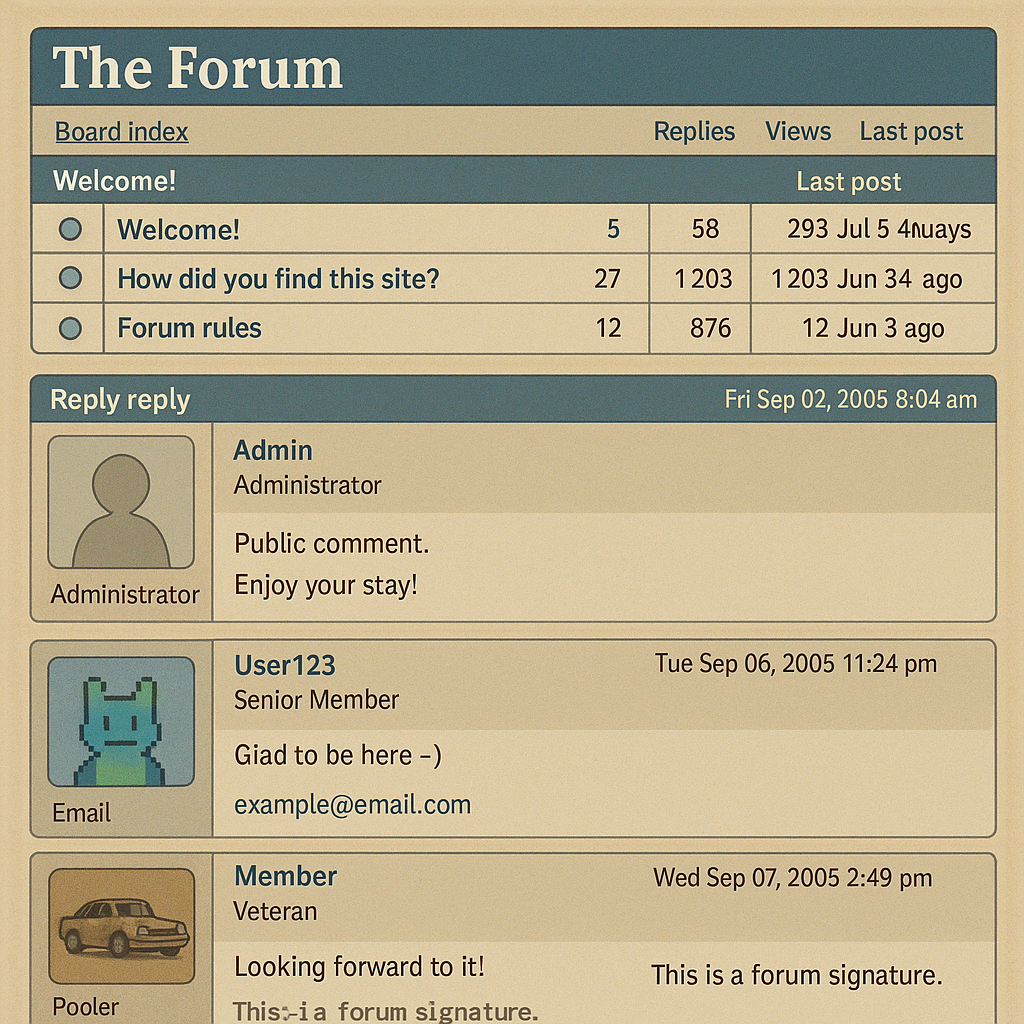
I found one of mine last month. A phpBB forum for a webcomic I read in 2006. I'd completely forgotten the account existed until I got a breach notification email to an address I haven't used as a primary in a decade.
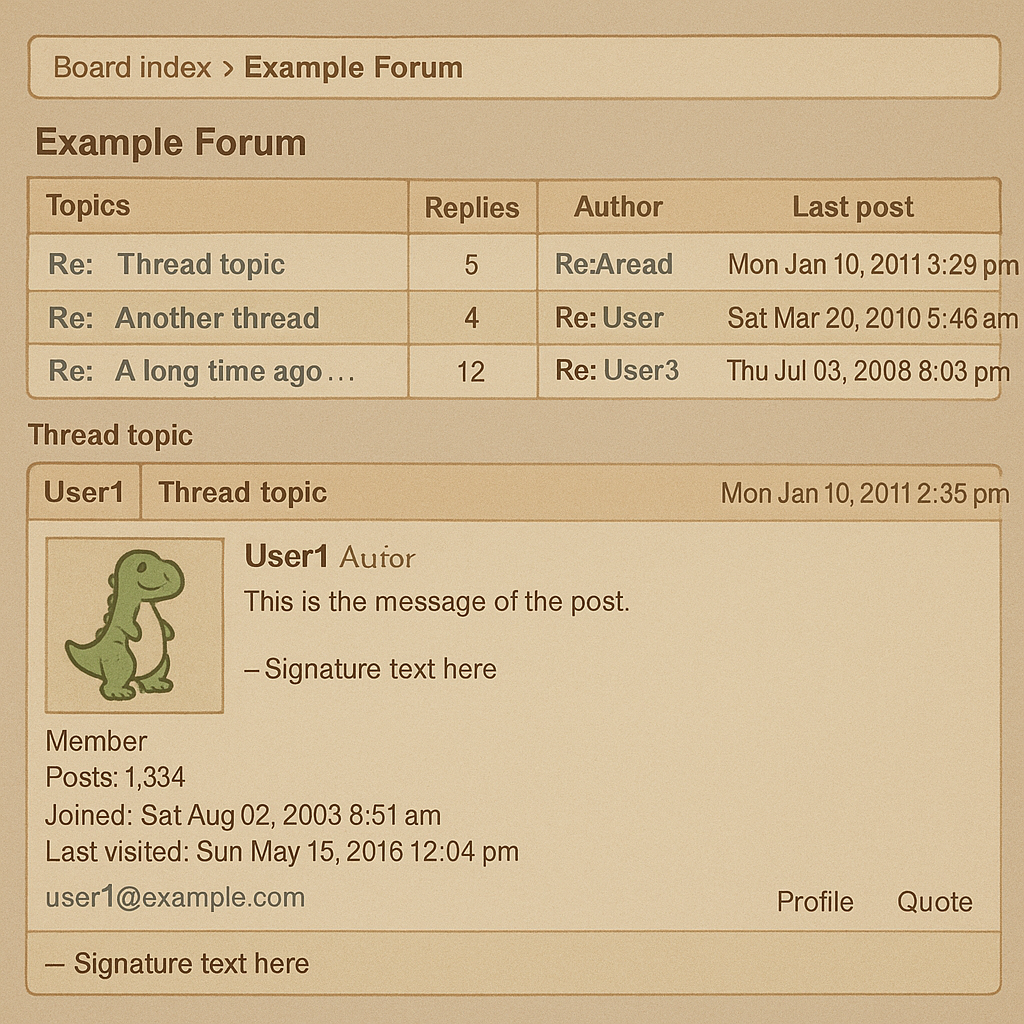
The forum was still running. My account was still active. My post count: 847. My last login: September 2007. My profile still displayed the email address I'd used for college applications, the AIM screen name I thought was clever at nineteen, and a signature block with a quote I can't believe I ever found profound.
The forum had been breached three months earlier. The attackers got usernames, email addresses, and password hashes. The site admins sent notifications to every registered email, which is how I found out the account still existed in the first place.
This is the story pattern for thousands of people right now. You created accounts on forums, message boards, and community sites between 2003 and 2012. You moved on. The forums didn't. Your accounts are still there, still associated with your data, still connected to email addresses that might route to your current inbox or might sit abandoned and accessible to anyone who requests a password reset.
The forums that never died
Forums peaked in the mid-2000s. Every niche interest, every game, every TV show, every city had dedicated discussion boards running phpBB, vBulletin, or Invision Power Board software. You registered with a username, an email address, and a password you probably reused from three other sites.
Then social media arrived. Facebook, Twitter, Reddit, Discord. The conversations moved. You stopped logging in. But the forums kept running, often maintained by a single dedicated admin who pays the hosting bill out of pocket and applies security patches when they remember.
According to research I've read, around 60 percent of forums launched before 2010 are still online in some form. Many are ghost towns. The last post in the general discussion section is from 2014. The most active user is a spambot that joined in 2019. But the database is intact, the accounts are active, and the software keeps serving pages to anyone who visits.
Your account is in that database. Your username, your email address, your password hash, your post history, your private messages, your IP address from every login. Some forums display your email publicly in your profile. Some let anyone view your post history without logging in. Some archive private messages indefinitely, including conversations you had with people whose real names you've forgotten.
The forums don't delete inactive accounts. There's no mechanism for it in the default software, and most admins never configured one. Your account persists until the domain expires or the server gets shut down, whichever comes first.
What's actually exposed
The data profile of a 2000s forum account is different from a modern social media account, but it's not less sensitive.
Your email address is the primary identifier. Forums required a valid email for registration, and many displayed it publicly in your profile or let other users request it through a contact form. If you used a college email, a work email, or an ISP-provided email that you've since abandoned, that address is now a data point disconnected from your active monitoring. You won't see breach notifications. You won't see password reset attempts. The address might forward to your current inbox, or it might not. You probably don't remember.
Your username might be your real name. Forums in the 2000s had inconsistent norms about pseudonymity. Some communities expected real names. Some expected handles. Some let you change your display name but kept your login name in the database. If you used your real name, it's still there, linked to your email and your post history.
Your post history is public by default. Every thread you started, every reply you posted, every opinion you shared between 2004 and 2009 is still readable. Some of it might be embarrassing. Some of it might contain personal information you wouldn't share now. Some of it might include details about your location, your job, your family, your health. You wrote it when you were younger, when the internet felt smaller, when you didn't think about data persistence.
Your private messages are stored in plaintext in the database. Forum software from that era didn't encrypt PMs. They're just rows in a table, readable by anyone with database access. If the forum gets breached, your private conversations go into the dump along with everything else.
Your password is hashed, but the hash algorithm matters. phpBB 2.x used MD5 with no salt. phpBB 3.x used MD5 with a salt. vBulletin 3.x used MD5. vBulletin 4.x and 5.x used bcrypt if the admin enabled it. If the forum hasn't been updated since 2008, your password is protected by an algorithm that modern cracking rigs can break in seconds if you chose a weak password.
IP addresses are logged. Every post, every login, every PM you sent includes the IP address you were using at the time. If you posted from home, that's your residential IP from 2006. If you posted from school, that's your school's IP. If you posted from a coffee shop, that's the coffee shop's IP. The logs persist indefinitely unless the admin manually purges them.
The breach timeline
Old forums get breached constantly. The software is outdated. The patches aren't applied. The admin doesn't monitor security advisories. The server runs an end-of-life version of PHP on an end-of-life version of Linux. Attackers scan for known vulnerabilities, find the forum, dump the database, and move on.
The breach might not get disclosed. Small forums don't have legal obligations to report breaches in most jurisdictions. The admin might not notice the intrusion for months. When they do notice, they might send an email to registered users, or they might just restore from backup and hope nobody asks questions.
The data ends up in breach databases. Sites like Have I Been Pwned catalog forum breaches, but only if someone reports them. Smaller forums fly under the radar. The data gets traded on forums (different forums, the irony is not lost on me), sold in bulk, or just posted publicly as part of a larger dump.
Your email address from that breach becomes a data point in credential stuffing attacks. Attackers take the email and password hash, crack the hash if it's weak, and try the credentials against hundreds of other sites. If you reused that password anywhere else, those accounts are now compromised too.
The timeline from breach to exploitation can be years. The forum gets breached in 2023. The data sits in a private database until 2025. Someone buys access, cracks the hashes, and starts testing credentials. You get a notification from your bank about a suspicious login attempt in 2026, three years after the initial breach, for an account you forgot existed.
The email address problem
The core issue with old forum accounts is email address persistence. You registered with an email you were using at the time. That email might still be active, or it might not.
If the email is still active and routes to your current inbox, you'll see breach notifications and password reset requests. That's the best case. You can respond, change passwords, delete accounts.
If the email is abandoned but still exists, it's a liability. Someone could request a password reset, gain access to the old email account through a different breach or social engineering, and use that access to take over your forum account. From there, they can read your post history, your private messages, and any personal information you shared. They can also use the forum account to request password resets on other services if you used the same email for multiple registrations.
If the email is defunct, you can't reset the password. You can't log in. You can't delete the account. The data just sits there, associated with an identifier you can't control.
College email addresses are particularly problematic. Many universities keep alumni email addresses active for years, then eventually deactivate them. If you registered for forums with your .edu address in 2005, that address might still forward to your personal email, or it might have been deactivated in 2015, or it might be in some liminal state where incoming mail gets queued but never delivered. You don't know, and the forum doesn't care.
ISP-provided email addresses are worse. If you had Comcast, Verizon, or AOL in the 2000s and used their email service, that address might still exist if you're still a customer. If you switched providers, the address might be gone, or it might be reassigned to a new customer, or it might sit in a deactivated state. ISPs have inconsistent policies about email retention after service termination.
Free email services from the 2000s are a mixed bag. Yahoo, Hotmail, and Gmail all still exist, but their policies on inactive accounts have changed over time. Yahoo deletes accounts after twelve months of inactivity, then recycles the username. If you had a Yahoo account in 2006 and stopped using it in 2008, someone else might own that address now. Gmail doesn't delete inactive accounts but reserves the right to. Hotmail became Outlook and has similar policies.
The email address you used for forum registrations in 2005 might be controlled by someone else now. That person can reset your forum password, access your post history, and read your private messages. They didn't steal the account. They just ended up with the email address through normal reassignment processes.
The cultural reference that fits
In The Lord of the Rings, the One Ring persists across centuries, forgotten by its bearers but never truly gone. It surfaces in unexpected places, carrying the history of everyone who wore it, waiting to be found again. Bilbo picks it up in a dark tunnel and carries it for sixty years, mostly unaware of what it is. Frodo inherits it and learns the full weight of its history only when the past catches up.
Your old forum accounts work the same way. You created them, used them for a while, and moved on. They didn't disappear. They persisted in databases, carrying your data, waiting. The breach notification is the moment when the past catches up, when you learn that the thing you forgot about has been there all along, connected to your current identity through an email address you barely remember using.
The analogy holds because the danger isn't in the object itself, it's in the accumulated history and the connections it creates. The Ring is dangerous because of what it represents and who wants it. Your forum account is dangerous because of what it contains and who can access it. Both persist far longer than their creators intended.
What actually happens when you try to delete
I tried to delete my webcomic forum account. The process revealed how little infrastructure exists for account closure on old forums.
First, I had to log in. The password reset link worked, which meant the email address was still active and routing to my current inbox. I received the reset email, set a new password, and logged in for the first time in nineteen years.
The account settings page had no delete button. The forum software was phpBB 3.0.12, released in 2014, running on a server that hadn't been updated since. phpBB added self-service account deletion in version 3.2, released in 2017. This forum was running older software and had never been upgraded.
I looked for a contact link. The forum had a "Contact Us" page with an email address for the admin. I sent a message explaining that I wanted my account deleted and my data removed. I included my username, my registered email address, and a request for confirmation when the deletion was complete.
I got a response three weeks later. The admin was apologetic. They didn't log in often. They'd be happy to delete my account, but they wanted to confirm: did I want my posts deleted too, or just my account? If they deleted my posts, it would break threading in old discussions. If they kept my posts but anonymized them, my content would remain but my username would change to "Guest" or "Deleted User."
I chose anonymization. The admin processed it manually, running SQL queries to update my posts and remove my profile data. They sent a confirmation email with a screenshot showing my account marked as deleted in the admin panel. The whole process took a month from initial contact to confirmation.
That's the best-case scenario. The admin was responsive, technically capable, and willing to help. Many forums have absent admins. The contact email bounces. The admin hasn't logged in since 2013. The forum runs on autopilot, serving pages and accumulating spam, but nobody's home to process deletion requests.
Some forums have terms of service that explicitly state they won't delete accounts or content. You agreed to those terms when you registered in 2006, even though you didn't read them and wouldn't have understood the implications if you had. The forum considers your posts to be their content under a perpetual license. They'll anonymize your account if you ask, but they won't remove your contributions to the community.
Finding your old accounts
You probably don't remember every forum you joined between 2003 and 2012. I didn't. The webcomic forum was a surprise. I found it through a breach notification, but that's reactive. Proactive discovery requires archaeology.
Start with your old email addresses. If you've been using the same primary email since the 2000s, search your inbox for registration confirmations. Look for phrases like "welcome to," "account activation," "registration complete," "confirm your email." Forums sent these automatically when you registered. If you never deleted them, they're still in your archive.
Check your password manager. If you started using a password manager in the late 2000s or early 2010s, it might have saved credentials for forums you've forgotten. Browser password managers are particularly good at this. Chrome, Firefox, and Safari all sync passwords across devices and preserve them indefinitely. Open your password manager and search for domains you don't recognize. Some of them will be forums.
Search for your old usernames. If you used the same handle across multiple sites, Google it. Put it in quotes to search for exact matches. Add terms like "forum," "posts," "member since," "join date." You'll find profiles on sites you forgot existed. Some of them will be forums. Some will be other community platforms that have similar data retention issues.
Check Have I Been Pwned. Enter your old email addresses. The site catalogs data breaches and tells you which services have exposed your information. If a forum you registered for got breached, it might appear in the results. That's a signal that the account still exists and has been compromised.
Look at your browser history if you still have access to old devices. If you kept a laptop or desktop from the 2000s and it still boots, the browser history might contain forum URLs. Firefox and Chrome both preserve history across years if you never cleared it. You can export the history database and search it for forum-related domains.
Ask your past self. If you kept a blog, a LiveJournal, a personal website, or any other online presence from the 2000s, you might have linked to your forum profiles. Search your old content for URLs. You might have put your forum signature in your blog sidebar. You might have linked to a forum thread in a blog post. Those links still work, and they'll take you directly to your profile.
The deletion process, step by step
Once you've found an old forum account, here's how to delete it if you can.
Log in if possible. Try a password reset using the registered email address. If the email is still active and you receive the reset link, set a new password and log in. If the email is dead, you're stuck. Most forums have no mechanism for account recovery without email access, and most admins won't process deletion requests without proof of ownership.
Check the account settings. Look for a delete, deactivate, or close account option. phpBB 3.2 and later have self-service deletion. vBulletin 5 has it. Invision Power Board 4 has it. If the forum is running modern software, the option exists. If the forum is running software from 2010, it probably doesn't.
If there's no self-service option, contact the admin. Look for a "Contact Us" link, a staff list, or a site admin username. Send a message requesting account deletion. Include your username, your registered email, and a clear statement that you want your account and associated data removed. Be polite. The admin is probably a volunteer who's doing this in their spare time.
If the admin doesn't respond within two weeks, send a follow-up. If they don't respond to the follow-up, you have limited options. You can't force deletion. You can't escalate to a higher authority because there isn't one. Small forums aren't subject to GDPR if they're not operating in the EU and don't target EU users. They're not subject to CCPA if they're not operating in California. They're just websites run by individuals, and your leverage is zero.
If the admin agrees to delete your account, ask what happens to your posts. Some forums delete posts along with accounts, which breaks threading. Some anonymize posts, which preserves content but removes your username. Some do nothing and just mark your account as inactive. Clarify what you want and what they're willing to do.
If the forum is defunct but still online, there's nothing you can do. The admin is gone. The site runs on autopilot. Your account exists in a database that nobody monitors. Eventually the hosting bill won't get paid and the domain will expire, but that could be years away. Your data sits there until the server dies.
What you can control
You can't delete accounts on forums where the admin is unresponsive or the software doesn't support it. But you can reduce the risk those accounts create.
Change the password if you can log in. Use a unique password generated by a password manager. That way, if the forum gets breached and the password hash gets cracked, the password doesn't work anywhere else. The breach becomes isolated to that one account.
Remove personal information from your profile. If you can edit your profile, delete your signature, remove your location, clear your instant messaging handles, and replace your bio with generic text. Some forums let you edit your email address in your profile. If yours does, change it to a dedicated email address you use only for account recovery on old sites. That way, if the forum gets breached, the exposed email isn't your primary address.
Delete private messages if the forum lets you. Most forum software has a "delete all messages" option in your PM inbox. Use it. That removes your side of the conversation from your account. The other person's copy might still exist in their inbox, but at least your account won't contain the full thread.
Edit or delete your posts if you want to and the forum allows it. This is tedious. You'd have to go through your post history one by one, editing each post to remove content or replacing it with a generic statement. Some people do this. Some forums have post edit time limits that prevent it. Some forums consider edited posts to be vandalism and will ban you for it. Assess the risk and decide whether it's worth the effort.
Monitor the email address for breach notifications. If you're still using the email you registered with, set up monitoring through Have I Been Pwned's notification service. That way, if the forum gets breached, you'll know about it even if the admin doesn't send notifications.
Don't reuse passwords. This is the universal rule, but it's particularly important for old forum accounts. If you used the same password on a forum in 2006 that you're using on your bank account in 2026, you've created a direct path from a likely-to-be-breached forum to your financial accounts. Use unique passwords everywhere, managed by a password manager, so that one breach doesn't cascade.
The forums that matter more
Not all old forum accounts carry the same risk. Some forums were always public. Some were private communities with sensitive discussions.
Gaming forums are mostly low-risk. Your posts were about game strategy, patch notes, and guild drama. Your username was probably a handle, not your real name. The worst-case scenario is that someone reads your opinions about game balance from 2007. Embarrassing, maybe, but not a security threat.
Local community forums are higher-risk. City forums, neighborhood forums, school forums. These often used real names. You might have posted about local events, asked for recommendations, or shared information about where you live. That data is more sensitive because it's tied to your physical location and your real identity.
Support forums are higher-risk. Medical forums, mental health forums, parenting forums, financial advice forums. You might have shared personal information about your health, your family, your finances. Those posts are still there, associated with your email address and your username. If the username is your real name or can be linked to your real identity, the exposure is significant.
Professional forums are higher-risk. Industry-specific forums where you discussed your work, your employer, your career. If you posted under your real name or a professional pseudonym that's linked to your LinkedIn profile, those posts are part of your public record. Future employers can find them. Colleagues can find them. Clients can find them.
Hobby forums are variable. It depends on the hobby and what you shared. Photography forums, cooking forums, woodworking forums are generally low-risk. You shared your work, asked for advice, participated in the community. Political forums, religious forums, forums about controversial topics are higher-risk because your opinions from fifteen years ago are still associated with your identity.
The risk isn't just about what you posted. It's about what the forum reveals about you as a data point. Your email address, your username, your registration date, your post count, your last login. All of that is metadata that can be combined with other breaches to build a profile. The forum itself might be low-risk, but the data it contributes to your overall digital footprint adds up.
The reality of data persistence
Here's what I wish someone had told me in 2006: everything you put online stays online until the server dies. Accounts don't expire. Posts don't disappear. Private messages aren't private. The forum you joined because you liked a webcomic will outlast your interest in the webcomic by a decade or more.
The forums from the 2000s are still running because hosting is cheap and domains auto-renew. The admins are still paying the bills because they care about the community or because they forgot to cancel the credit card charge. The databases are still intact because nobody configured automatic deletion and nobody's going back to clean up old accounts.
Your account is in there. Your data is in there. The email address you used is probably still in the profile, visible to anyone who looks. The posts you made are still in the threads, indexed by Google, readable by anyone. The private messages you sent are still in the database, unencrypted, waiting for the next breach.
This isn't a crisis. It's a reality. Old forum accounts are low-grade chronic risk, not acute danger. They probably won't be the thing that gets you, but they're part of the attack surface. They're data points in the profile that advertisers, data brokers, and attackers build about you over time.
The best time to delete them was when you stopped using them. The second-best time is now. Find them, log in if you can, delete them if the forum allows it, and reduce the footprint you're carrying from decisions you made when you were younger and the internet felt different.
The forums remember. Make sure you do too.