What to Do When You Forget Your Master Password

You open your password manager. The login screen appears. You type what you think is your master password. Wrong. You try a variation. Wrong again. You try the old version from six months ago. Still wrong. Now you're staring at a locked vault containing every password you own, and the sinking realization hits: you don't remember the key.
This is the nightmare scenario password manager skeptics imagine. It's also a real situation that happens to real people, and the outcome depends entirely on what you did during setup. If you configured recovery options, you have a path forward. If you didn't, your vault stays locked forever.
Here's the step-by-step process for what to do right now, what recovery methods actually work, and how to prevent this from happening again.
Step 1: Stop Guessing and Check Your Recovery Options
Your first instinct is to keep trying passwords. Stop. Most password managers lock you out temporarily after too many failed attempts, and some have permanent lockout thresholds. Guessing wastes your remaining attempts.
Instead, check what recovery options your password manager offers. The specific methods vary by provider, but they fall into a few categories. Not all providers offer all methods, and some offer none.
Open your password manager's login screen. Look for links labeled "Forgot password," "Can't log in," or "Account recovery." Click through to see what options appear. This tells you what recovery paths you configured during setup.
If you see no recovery links, or if the links lead to a page that says "We cannot recover your password," you're looking at zero-knowledge architecture with no recovery configured. That's not a dead end yet, but it narrows your options significantly.
Step 2: Try Emergency Access Contacts
Emergency access is a feature some password managers offer that lets you designate a trusted contact who can request access to your vault. You set a waiting period during setup (anywhere from a few hours to 30 days). If they request access and you don't deny it within that window, they get access to your vault.
This works because the emergency contact doesn't need your master password. The password manager's servers handle the decryption after the waiting period expires, using cryptographic keys you configured when you set up the feature.
Check your email for messages from your password manager about emergency access setup. If you configured this feature, you would have received a confirmation email when you designated your contact. Search for the password manager's name plus "emergency access" or "trusted contact."
If you find evidence you set this up, contact the person you designated. They'll need to log into their own account with the same password manager and request emergency access to your vault. Then you wait out the timer you configured.
If you didn't set up emergency access, this path is closed. Move to the next option.
Step 3: Look for a Recovery Key
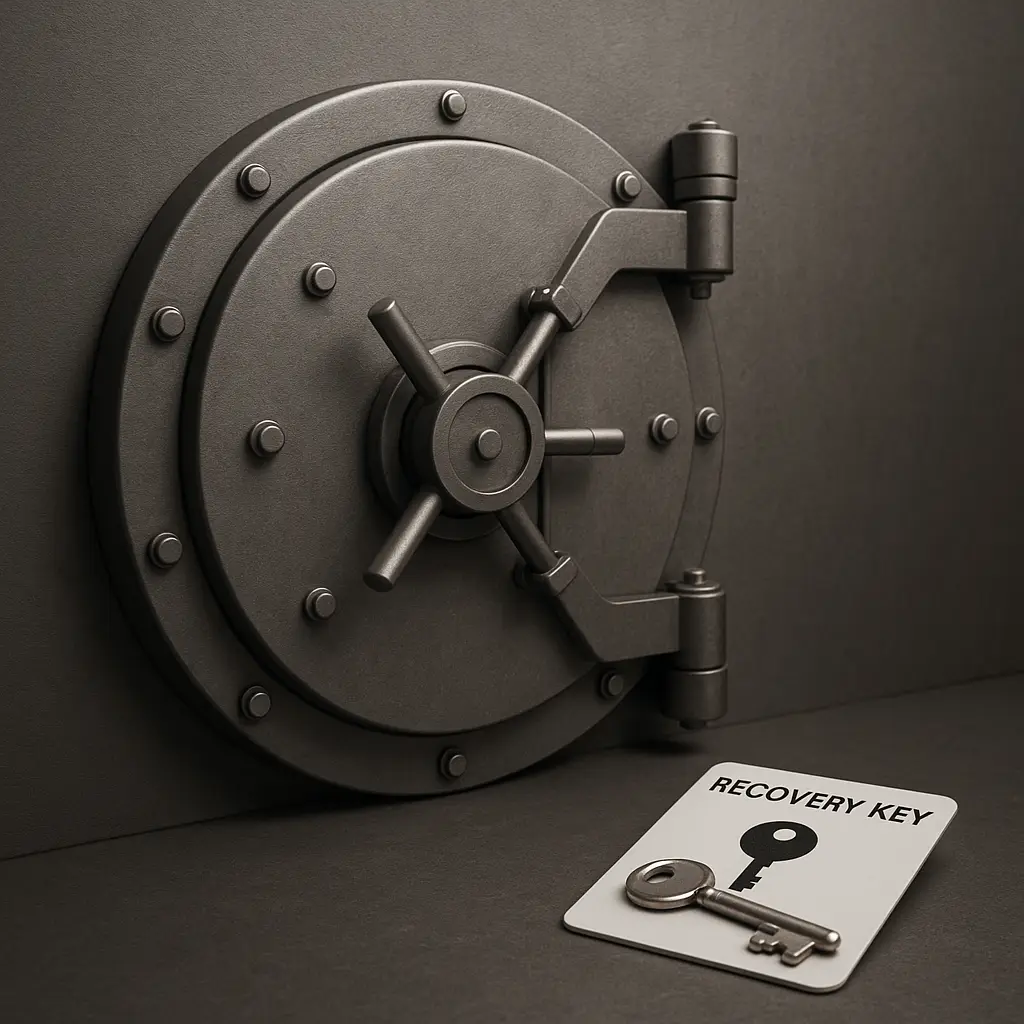
A recovery key is a long string of random characters generated during account setup. Some password managers offer this as a one-time download, others display it on screen with instructions to save it. The key acts as a second authentication factor that can unlock your account without the master password.
Recovery keys are usually stored as a text file, a PDF, or written down on paper. Search your computer for files with names like "recovery key," "emergency kit," or your password manager's name. Check your Downloads folder, Documents folder, and desktop. Search your email for messages from your password manager sent around the time you created your account.
If you printed the recovery key, check anywhere you store important documents: file folders, desk drawers, safes, or fire-resistant boxes. Some people tape recovery keys inside the back of a desk drawer or file them with tax documents.
If you find your recovery key, go to your password manager's account recovery page and enter it. The exact process varies by provider, but the key should unlock your account without requiring your master password. Once you're in, you can set a new master password.
If you can't find a recovery key, either you didn't generate one or it's lost. Move to the next option.
Step 4: Check for Account Recovery via Email or Phone
Some password managers offer account recovery through a verified email address or phone number. This is less common in zero-knowledge systems because it requires the provider to have some way to decrypt your vault, which contradicts the zero-knowledge model. But some providers offer a hybrid approach where they can reset your account (deleting your old vault) and let you start fresh.
Go to your password manager's account recovery page. If they offer email or SMS recovery, you'll see an option to send a recovery link or code. Enter your email address or phone number. Check for a message.
If you receive a recovery link, click it. You'll likely be asked to verify your identity through additional steps: answering security questions, entering a backup code, or confirming details about your account. Follow the prompts.
Be aware: this method often resets your account entirely, which means your old vault gets deleted. You'll regain access to your account, but your stored passwords are gone. This is a last resort, not a recovery method.
If no email or SMS recovery option exists, you're out of standard recovery paths. Move to the final options.
Step 5: Try Biometric or Device-Based Unlock
If you're trying to access your password manager on a device where you previously logged in and enabled biometric unlock (fingerprint, face recognition), you might still have access to your vault on that device. The password manager stored your vault locally after decrypting it with your master password, and biometric unlock acts as a convenience layer on top.
Open your password manager app on your phone, tablet, or computer where you previously used it. Try the biometric unlock. If it works, you're in. Once inside, go to your account settings and look for an option to view or change your master password. Some password managers let you set a new master password from within the app without entering the old one, as long as you're already authenticated.
If biometric unlock works, write down your new master password immediately. Store it somewhere secure. Then set up recovery options you skipped during initial setup: emergency access, recovery key download, or account recovery contacts.
If biometric unlock fails, or if you never set it up, this path is closed.
Step 6: Contact Support (With Realistic Expectations)
If you've exhausted the recovery options above, contact your password manager's support team. Be clear about what you've tried and what recovery options you did or didn't configure.
Support can't recover your master password. That's not evasion; it's architecture. Zero-knowledge encryption means the provider never has access to your master password or your unencrypted vault. They can't reset it for you the way a website can reset a regular password.
What support can do:
- Confirm what recovery options exist for your account
- Walk you through the recovery process if you missed a step
- Verify whether you configured emergency access or saved a recovery key
- Explain the account reset process if no recovery is possible
What support cannot do:
- Decrypt your vault without your master password
- Bypass the recovery methods you didn't set up
- Retrieve your master password from their servers
If support confirms you have no recovery options configured, your vault stays locked. The next step is account reset.
Step 7: Reset Your Account and Start Over
If no recovery method works, you're left with account reset. This deletes your encrypted vault permanently and gives you a blank account. You lose every password stored in the manager.
This is the outcome zero-knowledge encryption is designed to produce. The system prioritizes your security over convenience. If an attacker steals your laptop, gets your email password, and tries to access your vault, they hit the same wall you're hitting now. That wall protects you most of the time. Right now, it's protecting your data from you.
To reset your account, go to your password manager's website and look for account deletion or reset options. Some providers require you to contact support to initiate a reset. Follow their process.
Once your account is reset, you'll need to rebuild your password collection. This is tedious but manageable:
- Start with your most critical accounts: email, banking, work systems
- Use the "forgot password" feature on each site to reset passwords
- Generate new strong passwords using your password manager
- Store each new password as you create it
As you reset passwords, set up recovery options properly this time. Configure emergency access, download your recovery key, write down your master password, and store backups in multiple secure locations.
How Password Manager Recovery Actually Works (Or Doesn't)
The reason master password recovery is so limited comes down to how password managers encrypt your data. Understanding the mechanism helps explain why some recovery methods exist and others don't.
When you create a password manager account, you choose a master password. The password manager uses that password to generate an encryption key through a process called key derivation. The encryption key is what actually encrypts your vault. The master password never leaves your device, and the provider never stores it.
Your encrypted vault lives on the provider's servers, but it's gibberish without the encryption key. The key only exists when you type your master password. Type the wrong password, and you generate the wrong key. The wrong key can't decrypt the vault.
This is zero-knowledge architecture. The provider knows you have an account, but they don't know your master password, they don't have your encryption key, and they can't read your vault. This protects you from server breaches, rogue employees, and government demands for your data.
Recovery methods work by creating alternate paths to your encryption key:
- Emergency access works because you pre-authorized another user to request access. The provider's servers hold an encrypted copy of your vault that can be decrypted using the emergency contact's authentication, after the waiting period you set.
- Recovery keys work because the key is derived from the same cryptographic seed as your master password. It's a second valid input that generates the correct encryption key.
- Biometric unlock works because your device stored the encryption key locally after you entered your master password the first time. Biometrics unlock the local storage, not the vault itself.
Methods that don't exist:
- Provider password reset doesn't exist because the provider doesn't have your encryption key and can't generate it without your master password.
- Security questions don't exist in zero-knowledge systems because the answers would need to be stored in a way the provider could access, which breaks the zero-knowledge model.
- Backdoors don't exist because any backdoor that lets the provider recover your password also lets attackers recover your password.
The tradeoff is deliberate. You get strong protection against external attacks, but you lose the safety net of provider-assisted recovery. Some password managers offer hybrid models with weaker encryption in exchange for easier recovery, but most providers in 2026 have moved toward zero-knowledge as the default.
Prevention: Set Up Recovery Options Before You Need Them
The time to configure recovery options is during initial setup, not after lockout. Here's what to set up and why each one matters.
Emergency access contacts: Designate at least one trusted person who also uses the same password manager. Set a waiting period that balances security and convenience. I use 48 hours. That's long enough to notice and deny a fraudulent request, short enough that I'm not locked out for a week if I genuinely need access.
Choose someone who will respond quickly if you contact them. A family member who checks email daily is better than a friend who ignores notifications for a week.
Recovery key download: If your password manager offers a recovery key, download it during setup. Save it in multiple locations: a USB drive stored in a fire-resistant safe, a printed copy in a file folder with other important documents, and an encrypted file on a separate device you don't use daily.
Don't store your recovery key in the cloud unless you encrypt it first with a separate tool. The recovery key is as powerful as your master password. Anyone who finds it can access your vault.
Account recovery email or phone: If your password manager offers this, set it up, but understand the tradeoff. Email or phone recovery usually means the provider can reset your account, which implies they have some ability to bypass zero-knowledge encryption. Read the provider's documentation to understand what "recovery" means in their system. If it means "account reset with vault deletion," that's fine. If it means "provider-assisted decryption," that's a weaker security model.
Write down your master password: This is the most controversial recommendation, but it's also the most practical. Write your master password on paper and store it somewhere physically secure: a locked drawer at home, a safe, or a file folder you keep in a specific location.
Physical security is often stronger than digital security for this specific use case. An attacker who breaks into your house and finds a written password is a rare threat. An attacker who breaches a cloud service and steals encrypted data is a common threat. The written password protects you from the more common threat (forgetting) without significantly increasing your exposure to the rarer threat (physical theft).
In Friends, Monica keeps her spare key hidden in the hallway because she locks herself out of her apartment regularly. The key is a vulnerability, but it's a calculated one. The risk of being locked out exceeds the risk of someone finding the key. Your written master password is the same calculation.
What to Do Right Now If You're Currently Locked Out
If you're reading this because you're locked out right now, here's the priority order:
- Stop trying random passwords. Check how many attempts you have left before temporary or permanent lockout.
- Check for emergency access contacts. Search your email for setup confirmations.
- Search your devices and physical storage for a recovery key.
- Try biometric unlock on any device where you previously logged in.
- Contact support to confirm what recovery options exist for your account.
- If no recovery options exist, accept that account reset is your only path forward.
If you're not locked out, set up recovery options today. Open your password manager, go to account settings, and configure emergency access, download your recovery key, and write down your master password. Do it now, before you need it.
After Recovery: Preventing Future Lockout
Once you regain access (or reset your account), change your approach to master password management. The goal is to remember your master password through regular use, while having backups for the scenario where memory fails.
Use your master password daily: The best way to remember your master password is to type it regularly. Don't rely on biometric unlock exclusively. Log out of your password manager at the end of each day and log back in the next morning. This keeps the password fresh in your memory.
Write it down and store it securely: Keep a written copy of your master password in a specific location at home. Update the written copy whenever you change your master password. Store it with other important documents: tax records, insurance policies, or estate planning paperwork.
Set up multiple recovery methods: Don't rely on a single recovery method. Configure emergency access, save a recovery key, and write down your master password. Redundancy protects you when one method fails.
Test your recovery methods: Once a year, verify that your recovery methods still work. Contact your emergency access person and confirm they still have access to their account. Check that your recovery key file is still readable. Make sure your written master password is still legible and stored where you think it is.
Use a passphrase, not a random string: If you're creating a new master password after lockout, use a passphrase made of random words rather than a random string of characters. Passphrases are easier to remember and type, which reduces the risk of future lockout. NIST recommends long passwords over complex ones, and passphrases deliver length without sacrificing memorability.
Four to six random words separated by spaces or symbols give you a password that's strong enough to resist cracking and easy enough to remember with regular use. Examples: correct horse battery staple or mountain coffee telescope umbrella. Generate random words using EFF's Diceware list or your password manager's passphrase generator.
The Reality of Master Password Lockout
Forgetting your master password is a design feature, not a bug. The same architecture that locks you out also locks out attackers. The system can't distinguish between you forgetting your password and an attacker guessing wrong. That's the point.
The providers who offer easy master password recovery do so by weakening encryption or storing some form of access on their servers. That access becomes a target. When breaches happen, attackers go after the recovery mechanisms first.
Zero-knowledge architecture accepts that some users will lock themselves out permanently in exchange for protecting all users from server breaches and provider compromise. It's a tradeoff, and it's the right one for most threat models.
Your job is to set up recovery options that give you a path back in without giving attackers a path in. Emergency access, recovery keys, and written passwords all do that, as long as you configure them properly and store them securely.
The worst time to think about recovery is when you're locked out. The best time is right now, before you need it.