Fake online stores: how to spot them before you lose money
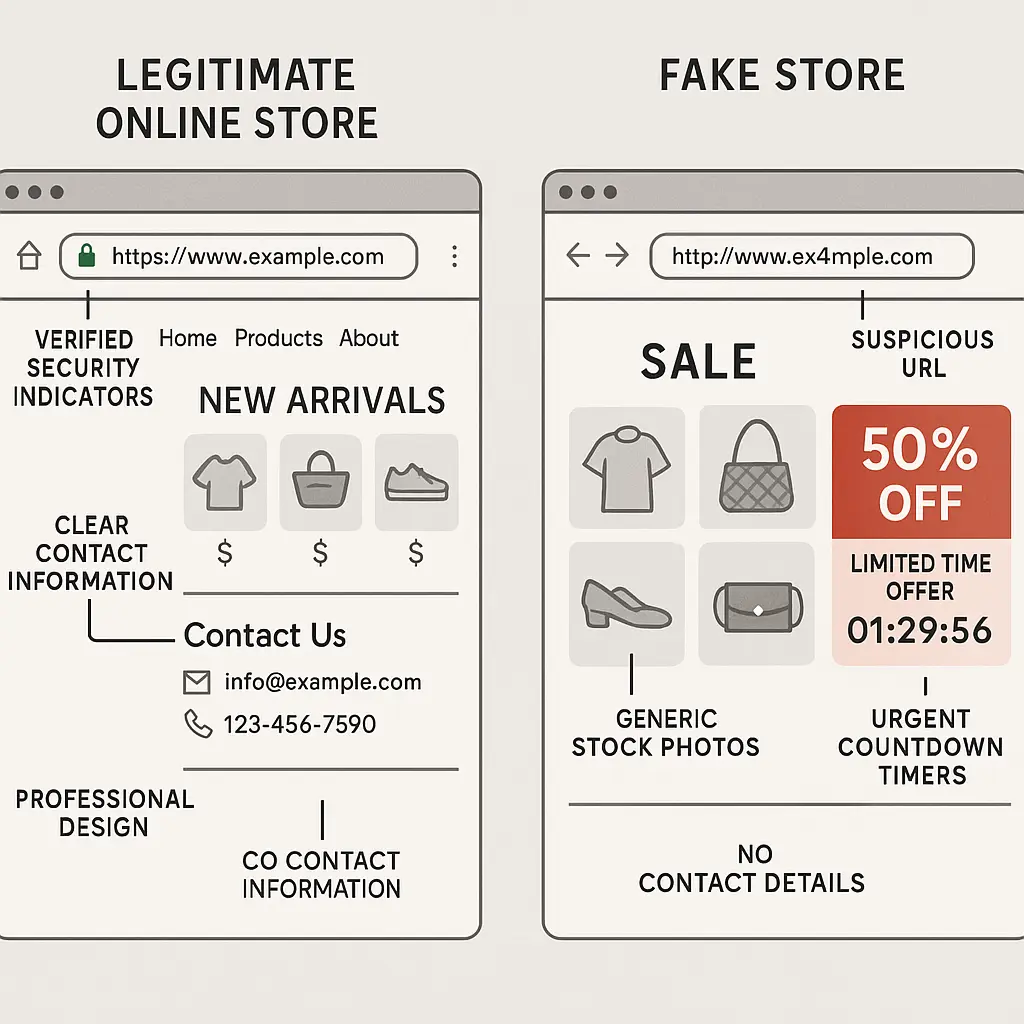
You find the perfect gift at an unbelievable price. The site looks professional. The checkout process feels normal. You enter your card number, click submit, and wait. Nothing ships. The site vanishes. Your card gets charged twice more before you notice.
Fake online stores cost Americans around $337 million in 2023, according to the FTC's Consumer Sentinel Network data. The fraud works because counterfeit sites have become increasingly difficult to distinguish from legitimate retailers. Scammers copy layouts, steal product images, and register domains that mimic real brands with single-letter variations. The sites exist long enough to collect payment information and disappear before victims realize they've been defrauded.
This is a practical guide to spotting fake stores before you hand over payment details. You'll learn the step-by-step inspection process, what each verification check reveals, and how to make the determination when a site raises questions but doesn't scream fraud.
The anatomy of a fake shopping site
Fraudulent stores follow predictable construction patterns. Understanding what scammers build helps you recognize what to look for.
The typical fake store starts with a domain that approximates a real brand. Scammers register variations like nikeoutlet-store.com when the legitimate site is nike.com, or amazon-deals.shop when the real domain is amazon.com. The goal is to pass a quick glance test while remaining technically distinct enough to avoid trademark enforcement.
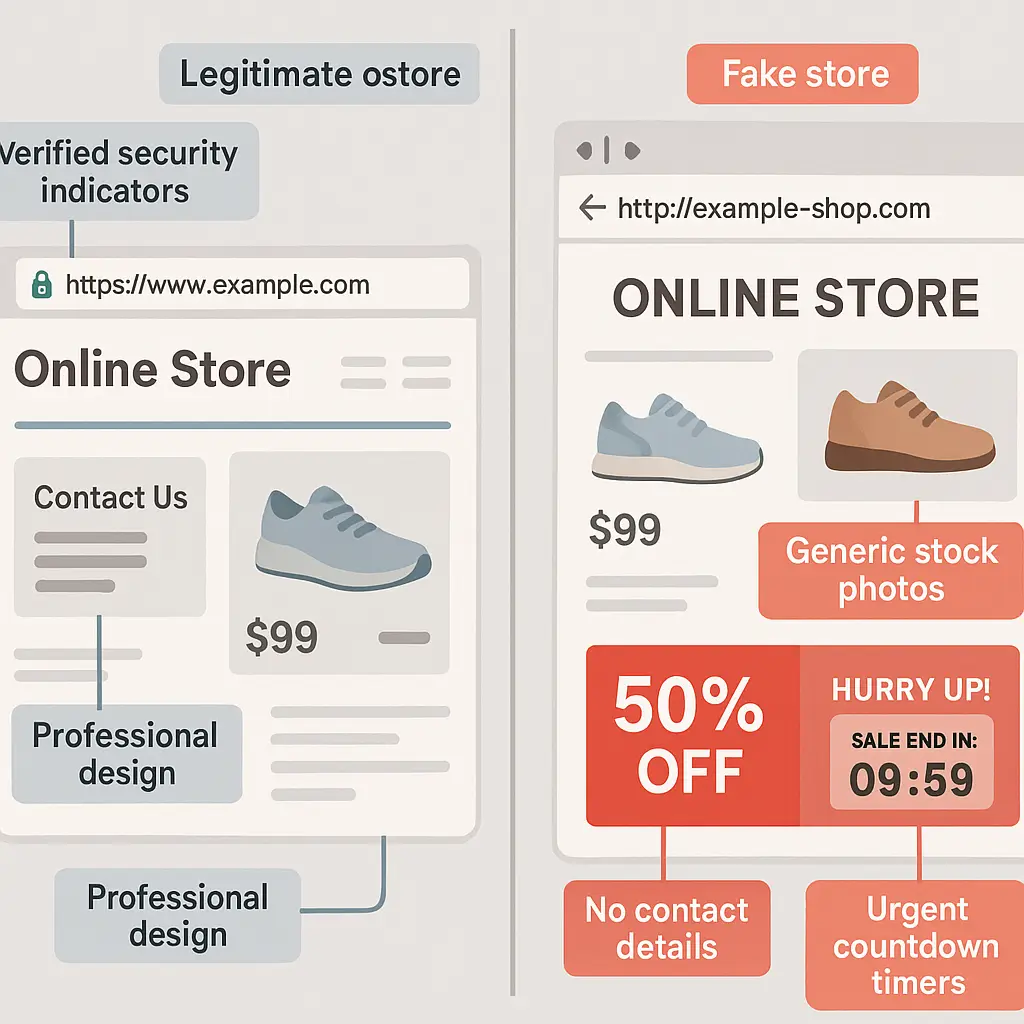
The site design usually falls into one of two categories. The first copies a legitimate retailer's layout directly, using stolen images, fonts, and color schemes to create a near-perfect replica. The second uses generic e-commerce templates populated with stock photography and placeholder text that reads professionally but says nothing specific.
Product catalogs on fake stores tend toward two extremes. Some list hundreds of items across unrelated categories (designer handbags next to power tools next to children's toys), suggesting the operator scraped images without understanding merchandising logic. Others focus narrowly on high-demand items (sneakers, electronics, luxury goods) at prices 40 to 70 percent below market rate.
The checkout process mimics legitimate flows. You add items to cart, enter shipping information, and proceed to payment. The difference appears in what happens after you submit. Legitimate stores process the transaction and provide tracking numbers. Fake stores either ship nothing, send counterfeit goods that bear no resemblance to what you ordered, or deliver items that break immediately.
The fraud mechanism relies on volume and speed. Scammers launch dozens of sites simultaneously, drive traffic through social media ads and search engine manipulation, collect as many transactions as possible before complaints accumulate, then abandon the domains and repeat the process with new URLs.
Domain inspection: the first filter
The domain name is your first verification checkpoint. Legitimate businesses invest in clear, memorable domains that match their brand. Scammers work within constraints that create detectable patterns.
Start by examining the domain structure. Type the URL into a text editor where you can see it clearly without the visual formatting a browser applies. Look for:
- Extra words before or after the brand name (
officialnikestore.com,nike-outlet.shop) - Hyphens separating words that shouldn't be separated (
ama-zon.com,tar-get.net) - Misspellings that exploit similar-looking characters (
arnazon.comwithrninstead ofm,gogle.commissing ano) - Unusual top-level domains (
.shop,.store,.online,.top) when the real brand uses.com - Subdomains that place the brand name before a generic domain (
nike.discount-shopping.com)
None of these patterns automatically indicates fraud. Legitimate businesses sometimes use hyphens, alternative TLDs, or descriptive words in domains. But each variation increases the inspection burden. A site using nike-clearance-outlet.shop requires more verification than nike.com.
Check domain age using a WHOIS lookup service. Type "WHOIS [domain]" into a search engine and use any of the free lookup tools. Newly registered domains (under six months old) selling established brand merchandise warrant skepticism. Scammers register domains shortly before launching fraud campaigns because maintaining sites long-term increases detection risk.
Domain privacy protection (where registration details are hidden) is common and doesn't indicate fraud by itself. Legitimate small businesses use privacy services to avoid spam. But privacy protection combined with a new domain, unusual TLD, and brand name variation creates a pattern worth investigating further.
Search for the exact domain name in quotes. If the site is legitimate and has been operating for any length of time, you'll find mentions on forums, social media, review sites, or news articles. If a site claims to have been selling products for years but generates zero search results outside its own pages, that discrepancy demands explanation.
Contact information: the credibility test
Legitimate businesses provide multiple ways to reach them because customer service drives retention. Fake stores minimize contact options because responding to inquiries costs time and increases exposure.
Navigate to the "Contact Us" or "About Us" page. Verify the following elements exist:
- Physical address (not a PO box)
- Phone number
- Email address
- Business registration or company information
Copy the physical address and paste it into a map service. Does it resolve to a real location? Is that location plausible for the type of business? A luxury watch retailer listing a residential apartment or a warehouse in an industrial park raises questions. A small boutique operating from a home address might be legitimate but requires additional verification.
Call the phone number during stated business hours. Does someone answer? Do they identify themselves as representatives of the business? Can they answer basic questions about products, shipping, and return policies? Fake stores often list phone numbers that go to voicemail, disconnect, or route to unrelated businesses.
Send an email with a specific question about a product. Legitimate businesses typically respond within 24 to 48 hours with relevant answers. Fake stores either never respond, send automated replies that don't address your question, or provide responses that feel like they came from someone who has never seen the product.
Check if the business is registered. In the United States, most states maintain searchable databases of registered businesses. Search "[state name] business entity search" and look up the company name. Legitimate businesses operating legally appear in these registries. Absence doesn't prove fraud (sole proprietorships sometimes operate under personal names), but it's another data point.
Look for social media presence. Real businesses maintain active accounts on platforms where their customers spend time. Check if the accounts show regular posting history, customer interactions, and follower counts that align with the business's claimed size. Fake stores either have no social media presence or maintain accounts with minimal activity, purchased followers, and engagement that looks artificial.
Price analysis: the too-good filter
Pricing below market rate is the primary lure for fake shopping sites. Understanding why legitimate retailers can't match certain price points helps you recognize when an offer defies economic logic.
Compare the listed price to the same product on established retailers. Search for the exact product name and model number on Amazon, Walmart, Target, or the manufacturer's official site. If the price you're seeing is 40 percent or more below the lowest price from known retailers, ask why.
Legitimate discounts exist for several reasons: seasonal clearance, overstock liquidation, manufacturer rebates, or promotional loss leaders. But these discounts follow patterns. A winter coat in March at 50 percent off makes sense. The same coat in November at the same discount doesn't, because retailers have no incentive to discount seasonal inventory before peak demand.
Electronics and luxury goods rarely see deep discounts from unauthorized sellers. Manufacturers control pricing through authorized dealer agreements. A site offering the latest iPhone model at 40 percent below Apple's price is either selling stolen goods, counterfeits, or nothing at all.
Check if the site lists products that are genuinely hard to find. Scammers populate fake stores with items that are sold out everywhere else because scarcity creates urgency and reduces the likelihood that buyers will comparison shop. If a site has unlimited inventory of a product that every legitimate retailer shows as backordered, that abundance is suspicious.
Look for pricing inconsistencies within the site itself. Fake stores sometimes list the same product at different prices on different pages because they're scraping data from multiple sources without reconciling conflicts. A coffee maker listed at $79 on one page and $129 on another suggests automated content population rather than intentional merchandising.
Visual inspection: the design tells
Professional web design costs money. Legitimate retailers invest in custom photography, clear navigation, and polished interfaces because those elements drive conversion. Fake stores cut corners in ways that create visible patterns.
Examine product images. Right-click and select "Search image with Google" or use a reverse image search tool. If the photos appear on dozens of other sites, they're stock images or stolen content. Legitimate retailers use unique photography or licensed images that don't appear everywhere.
Look for image quality inconsistencies. Do some products have high-resolution photos while others use grainy, pixelated images? Are the photos shot against different backgrounds with different lighting? Legitimate stores maintain visual consistency. Fake stores aggregate images from wherever they can find them.
Read product descriptions. Do they provide specific details (dimensions, materials, technical specifications) or generic marketing language that could apply to anything? Copy a sentence from the description and paste it into a search engine. If the exact text appears on multiple unrelated sites, it's template content.
Check for spelling and grammar errors. Professional retailers employ copywriters and editors. Mistakes happen, but patterns of errors (inconsistent capitalization, missing articles, awkward phrasing) suggest the content was written by someone for whom English is a second language or generated by automated translation.
Navigate through the site. Do internal links work? Does the search function return relevant results? Are category pages properly organized? Fake stores often have broken links, non-functional search, and navigation that leads to dead ends because they're built quickly using templates and never tested.
Look at the footer. Legitimate sites include links to privacy policies, terms of service, shipping information, and return policies. These pages should contain specific, detailed information. Fake stores either omit these pages entirely or populate them with generic template text that makes no specific commitments.
Payment and security indicators
Payment processing reveals operational legitimacy. How a site handles transactions tells you whether it's connected to real financial infrastructure or designed to harvest credentials.
Check for HTTPS encryption. The URL should begin with https:// and display a padlock icon in the address bar. But understand what this actually means. HTTPS encrypts data between your browser and the server. It does not verify that the business is legitimate. Scammers routinely obtain SSL certificates for fraudulent sites. Encryption protects data in transit but doesn't validate the recipient.
Examine payment options. Legitimate retailers offer multiple methods: credit cards, debit cards, PayPal, Apple Pay, and similar. Fake stores often limit options to direct credit card entry or wire transfer. The absence of third-party payment processors (PayPal, Stripe, Square) is a red flag because those services perform merchant verification that scammers can't pass.
Be wary of sites that only accept payment methods with no buyer protection. Wire transfers, cryptocurrency, and prepaid debit cards offer zero recourse if the seller ships nothing. Legitimate businesses accept these methods occasionally, but they always offer alternatives. A site that demands Bitcoin or Western Union exclusively is almost certainly fraudulent.
Look for trust badges and security seals. Many sites display logos from Norton, McAfee, TRUSTe, or the Better Business Bureau. Click these badges. Legitimate seals link to verification pages on the issuing organization's website. Fake seals either don't link anywhere or link to the store's own pages. Scammers copy badge images without obtaining actual certification.
Check the checkout flow. Does the site ask for information beyond what's necessary to complete the transaction? Requesting your Social Security number, driver's license number, or other sensitive data that has no legitimate purpose in a retail transaction indicates the goal is identity theft rather than selling products.
Reviews and reputation research
Customer reviews provide social proof, but only if they're real. Learning to distinguish genuine feedback from fabricated testimonials is essential.
Search for reviews outside the store's own website. Type the store name plus "review" or "scam" into a search engine. Check consumer complaint sites like the Better Business Bureau, Trustpilot, and Sitejabber. Read what independent sources say. Legitimate businesses accumulate reviews over time across multiple platforms. Fake stores either have no independent reviews or show patterns of recent, similar complaints.
Analyze on-site reviews if they exist. Do they provide specific details about products, shipping times, and customer service? Or do they use generic praise ("Great product!", "Fast shipping!", "Highly recommend!") without substance? Real reviews include both positive and negative experiences with specific details. Fake reviews follow templates.
Look at review dates. If a site claims to have been in business for years but all reviews were posted in the last month, that discrepancy suggests the reviews were purchased or fabricated. Legitimate businesses accumulate reviews gradually over time.
Check reviewer profiles if the platform allows it. Do reviewers have history beyond this single review? Have they reviewed other products or businesses? Fake review profiles typically show no activity beyond the single paid review.
Search for the business on scam reporting sites. The FTC's complaint database and the FBI's IC3 collect consumer fraud reports. While not all scams get reported, checking these resources takes two minutes and might reveal that dozens of people have already filed complaints about the site you're considering.
The urgency manipulation
Fake stores create artificial pressure to bypass your verification instinct. Recognizing these manipulation tactics helps you resist them.
Countdown timers are the most common urgency device. "Sale ends in 2 hours!" or "Only 3 left at this price!" create false scarcity. Refresh the page. Does the timer reset? Does the "limited quantity" never decrease no matter how many times you return? Legitimate flash sales exist, but they don't reset when you reload the page.
Pop-ups claiming other customers just purchased the same item exploit social proof. "John from Texas bought this 3 minutes ago!" These notifications are usually fabricated. They appear on predictable intervals regardless of actual site traffic.
Pressure to "act now" before verification is a red flag in any context. Legitimate businesses want you to be confident in your purchase. They provide detailed information, answer questions, and give you time to decide. Scammers need you to commit before you think.
Offers that seem too good to be true usually are. The phrase has become a cliché, but the underlying logic holds. If a deal requires you to abandon normal caution, that requirement is part of the scam design.
When uncertainty remains
Some sites fall into gray areas. They're not obviously fraudulent, but they don't pass every verification check cleanly. Here's how to proceed when you're unsure.
Start with a small test purchase using a virtual credit card number. Services like Privacy.com generate single-use card numbers linked to your real account but with spending limits you control. If the site is legitimate, your order ships and you can place larger orders later. If it's fraudulent, your exposure is limited to the test amount.
Use a credit card, not a debit card. Credit cards offer stronger fraud protection under federal law. The Fair Credit Billing Act limits your liability to $50 for unauthorized charges, and most issuers waive even that amount. Debit cards link directly to your bank account, making recovery more difficult.
Document everything. Take screenshots of product listings, prices, terms of service, and confirmation emails. Save all correspondence. If you need to dispute the charge or file a fraud report, this documentation provides evidence.
Monitor your account closely after purchase. Check for unauthorized charges daily for the first week, then weekly for a month. Scammers sometimes test stolen card numbers with small charges before attempting larger fraud.
Set a deadline for delivery. If the site promises shipping within a certain timeframe and nothing arrives, initiate a chargeback immediately. Don't wait for the seller to respond to inquiries. The longer you wait, the harder recovery becomes.
What to do if you've already been scammed
Discovering you've been defrauded feels like a violation. The emotional response is real, but you need to act quickly to limit damage.
Contact your bank or credit card company immediately. Report the transaction as fraudulent and request a chargeback. Most issuers have 60-day windows for dispute filing, but acting sooner improves your chances of recovery. Don't wait to see if the merchant responds to your complaints.
File a report with the FTC. The report feeds into the Consumer Sentinel Network, which law enforcement agencies use to identify patterns and build cases. Your individual report might not trigger immediate action, but collective data helps authorities shut down fraud operations.
Report the site to the FBI's Internet Crime Complaint Center. The IC3 collects cybercrime reports and refers them to appropriate law enforcement agencies. Again, individual reports rarely result in immediate action, but aggregated data drives investigations.
If you entered personal information beyond payment details (Social Security number, driver's license, date of birth), place a fraud alert on your credit reports. Contact one of the three major bureaus (Equifax, Experian, TransUnion) and request a fraud alert. The bureau you contact is required to notify the other two. The alert makes it harder for identity thieves to open new accounts in your name.
Change passwords for any accounts that used the same credentials you entered on the fake site. Scammers test stolen credentials across multiple services. If you reused a password, assume it's compromised.
Monitor your credit reports for the next year. You're entitled to one free report from each bureau annually through AnnualCreditReport.com. Stagger your requests (one every four months) to maintain continuous monitoring without paying for credit monitoring services.
The broader pattern
Fake online stores are a specific instance of a larger fraud category: impersonation scams. The FTC reports that impersonation fraud has increased more than fourfold in recent years, with losses reaching billions annually. The fundamental mechanism remains constant: scammers impersonate trusted entities to exploit the assumption that familiar appearances indicate legitimacy.
The defense against impersonation fraud is verification. Don't assume. Check. The steps outlined here take time, but they take less time than recovering from fraud.
In Star Wars, Obi-Wan Kenobi tells Luke, "Your eyes can deceive you. Don't trust them." The line applies to evaluating online stores. A professional-looking website doesn't guarantee a legitimate business. Visual polish is cheap. Operational legitimacy requires infrastructure, compliance, and accountability that scammers can't fake across multiple verification vectors.
The goal isn't paranoia. Most online retailers are legitimate. But the cost of assuming legitimacy without verification is high enough that the inspection process is worth the time. You're not being unreasonable when you verify a business before handing over payment information. You're being appropriately cautious in an environment where fraud is common and consequences are real.
The verification checklist
Before you buy from an unfamiliar online store, run through these checks:
- Inspect the domain for misspellings, extra words, unusual TLDs, and brand name variations
- Verify the domain age using WHOIS lookup (be skeptical of domains under six months old)
- Confirm contact information exists: physical address, phone number, email
- Test contact methods: call the number, send an email, verify the address on a map
- Compare prices to established retailers (be suspicious of discounts exceeding 40 percent)
- Reverse image search product photos to check for stolen content
- Read product descriptions for specificity and search for template text
- Check for HTTPS encryption (but understand it doesn't verify legitimacy)
- Verify payment options include third-party processors with buyer protection
- Search for independent reviews on multiple platforms
- Look for scam reports on FTC and IC3 databases
- Watch for urgency manipulation: countdown timers, false scarcity, pressure to act immediately
If the site passes all twelve checks, you're probably dealing with a legitimate business. If it fails multiple checks, walk away. If it's unclear, proceed with caution using the limited-exposure methods described earlier.
The verification process becomes faster with practice. After running through these steps a few times, you'll recognize patterns quickly. What initially takes fifteen minutes eventually takes three.
Final thought
Fake online stores succeed because they exploit the gap between appearance and verification. A site can look legitimate without being legitimate. Visual design is easy to copy. Operational legitimacy is hard to fake.
The defense is straightforward: verify before you trust. Check the domain. Test the contact information. Compare the prices. Search for independent reviews. Use payment methods with buyer protection. Don't let urgency override verification.
These steps won't eliminate all risk, but they'll filter out most fraud. The scammers who can pass this level of scrutiny are rare enough that your odds improve dramatically just by running through the checklist.
You're not being difficult when you verify. You're being appropriately cautious in an environment where fraud is common and the cost of assumption is high. The extra three minutes you spend checking a site before purchase is time well spent.