Card Skimmers: Spotting Them at Gas Stations and ATMs
You're standing at a gas pump at 11 PM, card in hand, and the reader looks fine. Probably. You insert your card, punch in your PIN, pump your gas, and drive away. Three weeks later, charges appear from cities you've never visited.
Card skimmers are physical devices criminals attach to legitimate card readers. They capture your card data when you swipe or insert. The mechanism is straightforward: a thin electronic overlay sits on top of the real reader, records your card's magnetic stripe or chip data, and stores it for later retrieval. Often, a hidden camera or fake PIN pad overlay captures your PIN at the same time.
The FTC reports that card skimming remains one of the most common forms of payment fraud, and gas stations and ATMs are the primary targets. Criminals install these devices because they work. You can't rely on the business to catch them before you use the machine. You have to check yourself.
This is a practical guide. You'll learn the step-by-step inspection process for gas pumps and ATMs, what each warning sign means, and what to do if you find a skimmer or suspect you've used one.
How Card Skimmers Actually Work
A card skimmer has three jobs: read your card, capture your PIN, and store the data.
The reading component is usually a thin electronic device placed over or inside the card slot. When you insert or swipe your card, the skimmer reads the magnetic stripe data, your card number, expiration date, and cardholder name. Some advanced skimmers can also capture chip card data, though this is harder and less common.
The PIN capture happens one of two ways. A fake PIN pad overlay sits on top of the real keypad and records your keystrokes. Or a tiny camera, often hidden in a brochure holder, mirror, or fake security panel, films your hand as you type.
The storage component is memory inside the skimmer itself. Criminals return later to retrieve the device and download the stolen data. Some newer skimmers use Bluetooth to transmit data wirelessly, eliminating the need for physical retrieval.
The entire setup can be installed in under a minute by someone who knows what they're doing. Gas pumps are especially vulnerable because the cabinet doors are often secured with generic keys that criminals can buy online. ATMs in low-traffic areas, hotel lobbies, convenience stores, standalone machines in strip malls, are also common targets.
Chip cards add protection by generating a unique transaction code each time you use them, making it harder for criminals to clone your card. But many readers still support magnetic stripe fallback, and some skimmers are designed to capture chip data as well. The chip reduces risk but doesn't eliminate it.
Inspecting Gas Pumps: Step-by-Step
Gas pumps are one of the most common skimmer locations. Here's how to check before you use one.
Step 1: Look at the security seal.
Most gas pumps have a security seal over the cabinet door where the card reader electronics live. This seal should be intact. If it's broken, peeling, or missing, someone has opened the cabinet. That doesn't guarantee a skimmer is inside, but it's a red flag.
Some stations use numbered seals that change color when tampered with. If the seal looks different from other pumps at the same station, or if the number doesn't match the station's records (sometimes posted inside the store), that's a warning.
Step 2: Inspect the card reader slot.
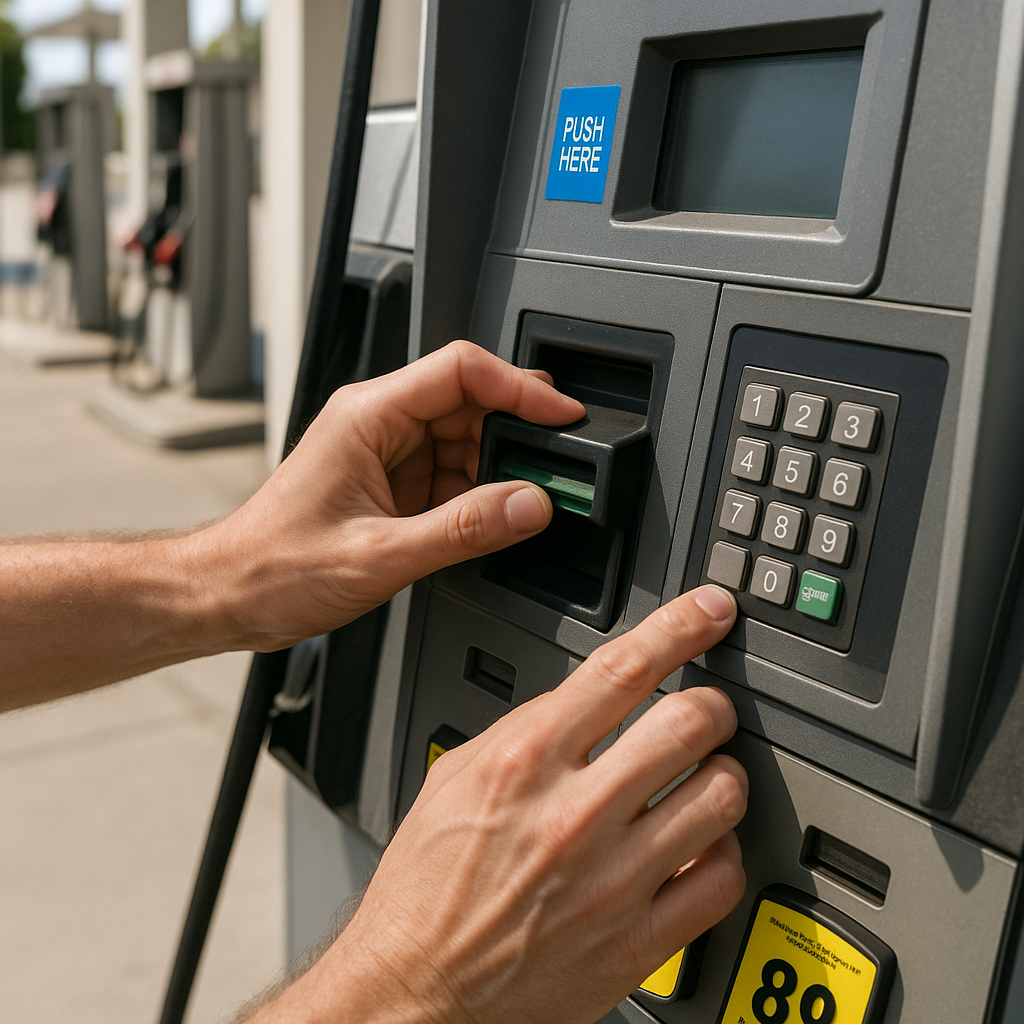
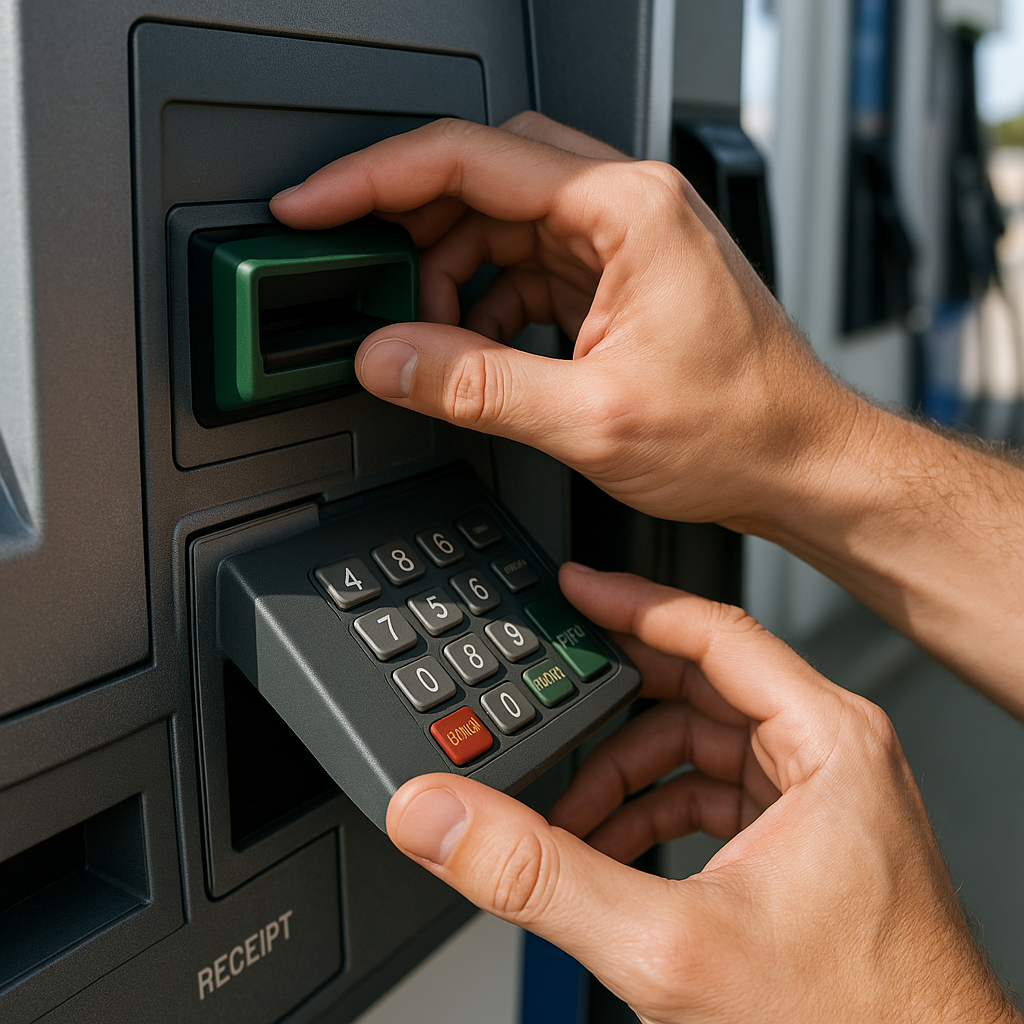
Look at where you insert your card. The slot should be flush with the pump's surface, with no gaps, unusual bulk, or mismatched colors. Run your finger around the edges. If anything feels loose or raised, don't use it.
Compare the reader to other pumps at the same station. Skimmers often look slightly different, a different shade of plastic, a thicker profile, or a slot that sits higher or lower than the others. Consistency across pumps is normal. Variation is suspicious.
Step 3: Wiggle the card reader.
Grab the card reader housing and pull gently. It should not move. Skimmers are attached on top of or in front of the real reader, and they're often not secured as firmly as the original hardware. If the reader shifts, flexes, or feels loose, stop.
Do the same with the PIN pad. Press on the keys and wiggle the pad itself. A legitimate PIN pad is solidly mounted. A skimmer overlay will sometimes feel spongy or shift under pressure.
Step 4: Check for cameras.
Look around the card reader area for anything unusual. Common hiding spots for PIN-capture cameras include:
- Small holes in the pump's speaker grill or branding panel
- Fake security mirrors or panels mounted near the PIN pad
- Brochure holders or card slots positioned to aim at the keypad
A camera lens is tiny, sometimes smaller than a pencil eraser. If you see a small black circle or a reflective surface in an odd location, that's worth investigating.
Step 5: Choose pumps visible from the store.
Criminals prefer pumps that are hard for station employees to monitor, the ones farthest from the building, around corners, or blocked by other vehicles. Pumps directly in front of the store windows are less likely to be tampered with because the risk of being seen is higher.
If you're unsure about a pump, move to one closer to the store or go inside and pay with your card at the register.
Inspecting ATMs: Step-by-Step
Standalone ATMs, especially those in convenience stores, hotel lobbies, and gas stations, are frequent skimmer targets. Bank-operated ATMs inside branches are lower risk but not immune.
Step 1: Inspect the card slot.
The card slot should be a single, solid piece that's flush with the ATM's faceplate. Look for:
- Mismatched colors or materials (a skimmer might be a slightly different shade of plastic)
- Unusual thickness or bulk around the slot
- Loose edges or gaps where a device could be inserted
- Scratches or adhesive residue suggesting something was recently attached
Run your finger around the slot's perimeter. If it feels raised or loose, don't use it.
Step 2: Wiggle everything.
Grab the card slot housing and pull gently. It should not move. Do the same with the PIN pad. A skimmer overlay on the keypad will sometimes shift or feel spongy when you press the keys.
Check the fascia, the panel around the card slot and screen. If it's loose or doesn't sit flush, that's a warning.
Step 3: Look for cameras.
PIN-capture cameras on ATMs are often hidden in:
- Fake brochure holders mounted above or beside the PIN pad
- Small holes in the ATM's speaker grill
- Mirrors or decorative panels positioned to view the keypad
- The top edge of the screen bezel
A camera doesn't have to be large. Some are the size of a shirt button. If you see a small lens or reflective surface aimed at the keypad, that's suspicious.
Step 4: Check the keyboard.
Press each key on the PIN pad. They should all feel the same, same resistance, same sound, same depth. If one key feels different or the entire pad feels mushy, that could indicate an overlay.
Some skimmers use a thin membrane that sits on top of the real keys. It's hard to detect by sight, but the tactile feedback is often slightly off.
Step 5: Compare to other ATMs.
If there are multiple ATMs in the same location, compare them. Skimmers are usually installed on one machine, not all of them. If one ATM looks different, thicker card slot, different keypad texture, extra bulk around the reader, use a different one.
Step 6: Prefer ATMs inside bank branches.
ATMs inside bank lobbies are monitored more closely and are harder for criminals to access. Standalone machines in low-traffic areas are easier targets. If you have a choice, use the ATM inside the branch.
What to Do If You Find a Skimmer
You're inspecting a card reader and something feels wrong. The card slot is loose, the PIN pad shifts when you touch it, or you spot a camera aimed at the keypad. Here's what to do.
Step 1: Don't use the machine.
This is obvious, but worth stating. If you suspect a skimmer, don't insert your card. Move to a different pump or ATM.
Step 2: Don't touch it further.
You've already wiggled the reader to check for looseness. That's fine. But don't try to remove the skimmer yourself. Criminals sometimes rig devices with alarms or mechanisms that erase data if tampered with. More importantly, law enforcement may want to examine the device in place.
Step 3: Notify the business immediately.
If you're at a gas station, go inside and tell an employee. If you're at an ATM, call the bank's customer service number (usually printed on the machine). Explain what you found and where.
Some businesses respond quickly. Others don't. Your job is to report it. What they do next is on them.
Step 4: Report it to local police.
Card skimming is a crime. Call the non-emergency police line and report the location and what you observed. They may send an officer to investigate, or they may log the report for follow-up.
Step 5: If you already used the machine, act fast.
If you used the compromised reader before noticing the skimmer, monitor your account closely. Check your transaction history daily for the next two weeks. If you see unauthorized charges, report them to your bank immediately.
Consider calling your bank to freeze or replace your card. Most banks will issue a new card within a few days at no cost. This is inconvenient, but it's less inconvenient than dealing with fraud after the fact.
If you entered your PIN, change it. Do this even if you don't see fraudulent charges yet. Criminals may sit on stolen data for weeks before using it.
What Skimmers Look Like: Real Examples
Skimmers vary in sophistication. Some are obvious. Others are nearly invisible.
Gas pump skimmers:
The most common type is an internal skimmer installed inside the pump's cabinet. You won't see it by inspecting the card reader from the outside. The only external sign is a broken security seal on the cabinet door.
External skimmers fit over the card slot. They're usually made of molded plastic that matches the pump's color, but the fit is imperfect. Look for gaps, mismatched shades, or a slot that sits higher or doesn't align with the surrounding panel.
Bluetooth skimmers transmit data wirelessly. These are harder to detect because criminals don't need to return to retrieve the device. Some security researchers use Bluetooth scanning apps to detect nearby skimmers, but this requires technical knowledge and isn't practical for most people.
ATM skimmers:
The classic ATM skimmer is a false front that fits over the entire card slot. It's designed to look like part of the machine, but the seams often give it away. Run your finger along the edges, if you feel a ridge or gap, that's a warning.
Thin-film skimmers sit inside the card slot itself. These are nearly invisible from the outside. The only way to detect them is to wiggle the slot and check for unusual resistance or looseness.
PIN pad overlays are thin membranes placed on top of the real keypad. They record your keystrokes and transmit the data to the skimmer. These are hard to spot visually, but they often feel slightly different when you press the keys, softer, mushier, or less responsive.
Cameras:
PIN-capture cameras are small. Some are the size of a pencil eraser. Common hiding spots include fake brochure holders, mirrors, or small holes drilled into the machine's fascia. The lens is usually a tiny black circle or a reflective surface.
Some criminals use a camera disguised as part of the ATM's design, a fake security panel, a decorative strip, or a modified speaker grill. If something looks out of place or doesn't match other ATMs from the same manufacturer, investigate.
Protecting Yourself Beyond Visual Inspection
Visual inspection is your first line of defense, but it's not foolproof. Here are additional steps to reduce your risk.
Use credit cards instead of debit cards.
Credit cards offer stronger fraud protection than debit cards. If your credit card is skimmed, you're not liable for fraudulent charges under federal law (beyond a small amount if you report promptly). If your debit card is skimmed and your PIN is captured, criminals have direct access to your bank account.
Debit card fraud protections exist, but the money is gone from your account while the bank investigates. With a credit card, you're disputing a charge, not recovering stolen funds.
Cover the PIN pad when you type.
Even if there's no camera, cover the keypad with your hand or body when entering your PIN. This simple habit defeats most camera-based PIN capture.
Make it a reflex. Every time. Even at ATMs you trust.
Enable transaction alerts.
Most banks and credit card issuers offer real-time alerts for every transaction. Enable these. If a fraudulent charge appears, you'll know within minutes instead of days.
Set the alert threshold to $0.01 so you're notified of every transaction, no matter how small. Criminals sometimes test stolen cards with small purchases before making larger ones.
Check your statements regularly.
Alerts are helpful, but they're not a substitute for reviewing your full transaction history. Check your bank and credit card statements at least once a week. Look for charges you don't recognize, even small ones.
If you see something suspicious, call your bank immediately. The faster you report fraud, the easier it is to resolve.
Use contactless payment when possible.
Contactless payment (tap-to-pay using your phone or card) doesn't require inserting your card into a reader, which eliminates the risk of skimmers that capture magnetic stripe or chip data. The transaction generates a unique code that can't be reused, making it harder for criminals to exploit.
Not all merchants support contactless payment, but when the option exists, use it.
Avoid standalone ATMs in low-traffic areas.
ATMs inside bank branches are monitored more closely and are harder for criminals to tamper with. Standalone machines in convenience stores, hotel lobbies, and gas stations are easier targets.
If you need cash, plan ahead and use a bank-operated ATM during business hours when possible.
The Cultural Reference
In The Good Place, Eleanor spends the first season convinced she's gotten away with something, that the system didn't catch her, that the cracks in the façade are invisible to everyone else. She's right, for a while. But the system isn't broken; it's just slow. The truth catches up.
Card skimmers work the same way. You use a compromised reader, and nothing happens immediately. Your card works. The transaction goes through. You drive away or walk away, and everything seems fine. The fraud appears weeks later, after the criminals have had time to sell your data, test your card, and make purchases. By then, the trail is cold. You don't remember which gas station you used on which day, and even if you do, the skimmer is long gone.
The lag between compromise and consequence is what makes skimming effective. You can't rely on immediate feedback to tell you something went wrong. You have to check before you use the machine, not after.
What Happens to Your Data After It's Stolen
Your card data doesn't sit idle. Once a skimmer captures it, the information moves quickly.
Criminals retrieve the skimmer and download the stolen data. This includes card numbers, expiration dates, cardholder names, and PINs (if captured). The data is either used directly by the thieves or sold on criminal marketplaces.
Card data sells for anywhere from a few dollars to $50 per card, depending on the card type, available balance, and whether the PIN is included. Bulk data, hundreds or thousands of cards from a single skimmer, sells for less per card but generates significant revenue in aggregate.
Buyers test the cards with small transactions to confirm they work. If the card is active and hasn't been reported as stolen, they move to larger purchases, gift cards, electronics, or cash advances. Gift cards are especially popular because they're easy to resell and hard to trace.
Some criminals use stolen card data to create cloned physical cards. This requires encoding the magnetic stripe data onto a blank card, which can then be used at any merchant that still accepts magnetic stripe transactions. Chip cards are harder to clone, but magnetic stripe fallback remains common enough to make this profitable.
Your bank's fraud detection systems may catch some of these transactions, but not all. Small purchases often slip through. By the time you notice, multiple fraudulent charges may have already posted.
The FTC's Consumer Sentinel Network tracks fraud reports and shows that payment card fraud remains one of the most reported categories year after year. The data moves fast, and the window to act is narrow.
Reporting Fraud and Recovering
If you discover fraudulent charges on your account, here's the step-by-step recovery process.
Step 1: Call your bank or credit card issuer immediately.
Report the fraud as soon as you notice it. Most issuers have 24/7 fraud hotlines. Explain which charges are fraudulent and when you first noticed them.
The issuer will freeze your card to prevent additional charges and begin a fraud investigation. This usually takes a few days to a few weeks, depending on the complexity.
Step 2: Dispute the charges in writing.
Follow up your phone call with a written dispute. Most issuers provide online dispute forms, but you can also send a letter. Include:
- Your name and account number
- A list of fraudulent transactions with dates and amounts
- A statement that you did not authorize these charges
- Any supporting documentation (receipts, transaction alerts, police reports)
Keep a copy of everything you send.
Step 3: File a police report.
If the fraud involves a significant amount of money or identity theft, file a report with your local police. Some banks require a police report as part of the fraud investigation.
You can also report the fraud to the FTC at ReportFraud.ftc.gov. This doesn't result in an investigation of your specific case, but it helps law enforcement track fraud patterns and prioritize enforcement.
Step 4: Monitor your accounts.
Even after your card is replaced, continue monitoring your accounts for at least 30 days. Criminals sometimes sit on stolen data and use it in waves. If new fraudulent charges appear, report them immediately.
Check your credit reports as well. If the fraud involved identity theft beyond card skimming, you may see new accounts or inquiries you didn't authorize. You can freeze your credit to prevent new accounts from being opened in your name.
Step 5: Update automatic payments.
If the compromised card was linked to recurring payments, subscriptions, utilities, loan payments, update those accounts with your new card information. Missing a payment because your old card was deactivated creates its own problems.
Why Skimmers Still Work in 2026
Chip cards were supposed to end skimming. Contactless payment was supposed to make card readers obsolete. Fraud detection was supposed to catch everything.
None of that happened completely.
Chip cards are more secure than magnetic stripe cards, but many readers still support magnetic stripe fallback. If the chip doesn't read, the terminal prompts you to swipe. That swipe is vulnerable to skimming.
Contactless payment is growing, but adoption is uneven. Not every merchant supports it, and not every customer uses it. As long as physical card readers exist, skimmers remain viable.
Fraud detection systems catch a lot of fraudulent transactions, but not all of them. Small purchases, transactions that match your spending patterns, or charges made in locations you've visited before can slip through. By the time the system flags something as suspicious, multiple fraudulent charges may have already posted.
Criminals adapt. As security improves in one area, they shift to another. Internal gas pump skimmers became common after external skimmers became easier to detect. Bluetooth-enabled skimmers eliminated the need for physical retrieval. Thin-film skimmers became popular as ATM manufacturers improved tamper detection.
The underlying problem is that card readers are physical devices in public spaces. You can't monitor them 24/7, and criminals only need a few minutes of access to install a skimmer. As long as that remains true, skimming will continue.
The Bottom Line
Card skimmers are physical devices that criminals attach to gas pumps and ATMs to steal your card data. They work because most people don't check the reader before using it.
Visual inspection takes less than a minute. Check the security seal on gas pumps. Wiggle the card reader and PIN pad. Look for cameras. Compare the reader to others nearby. If something feels wrong, use a different machine.
If you find a skimmer, don't use the machine, notify the business and police, and move on. If you already used a compromised reader, monitor your accounts closely and report fraud immediately.
Use credit cards instead of debit cards when possible. Enable transaction alerts. Cover the PIN pad when you type. Check your statements regularly.
Skimmers still work in 2026 because they exploit a predictable gap: the time between when you use a compromised reader and when you notice the fraud. Close that gap by checking first and monitoring after. The system won't catch it for you.