VPNs and Country Restrictions: Where They're Illegal and What Happens When You Use One
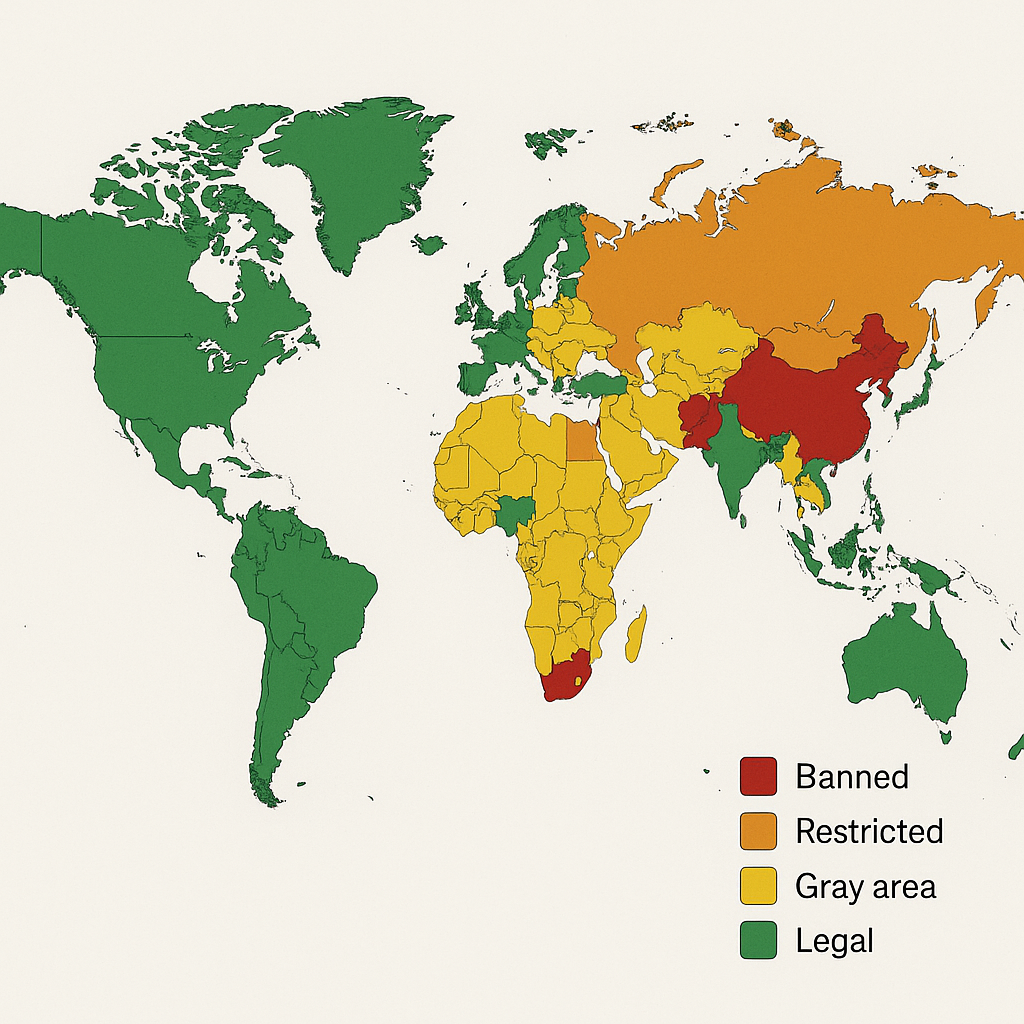
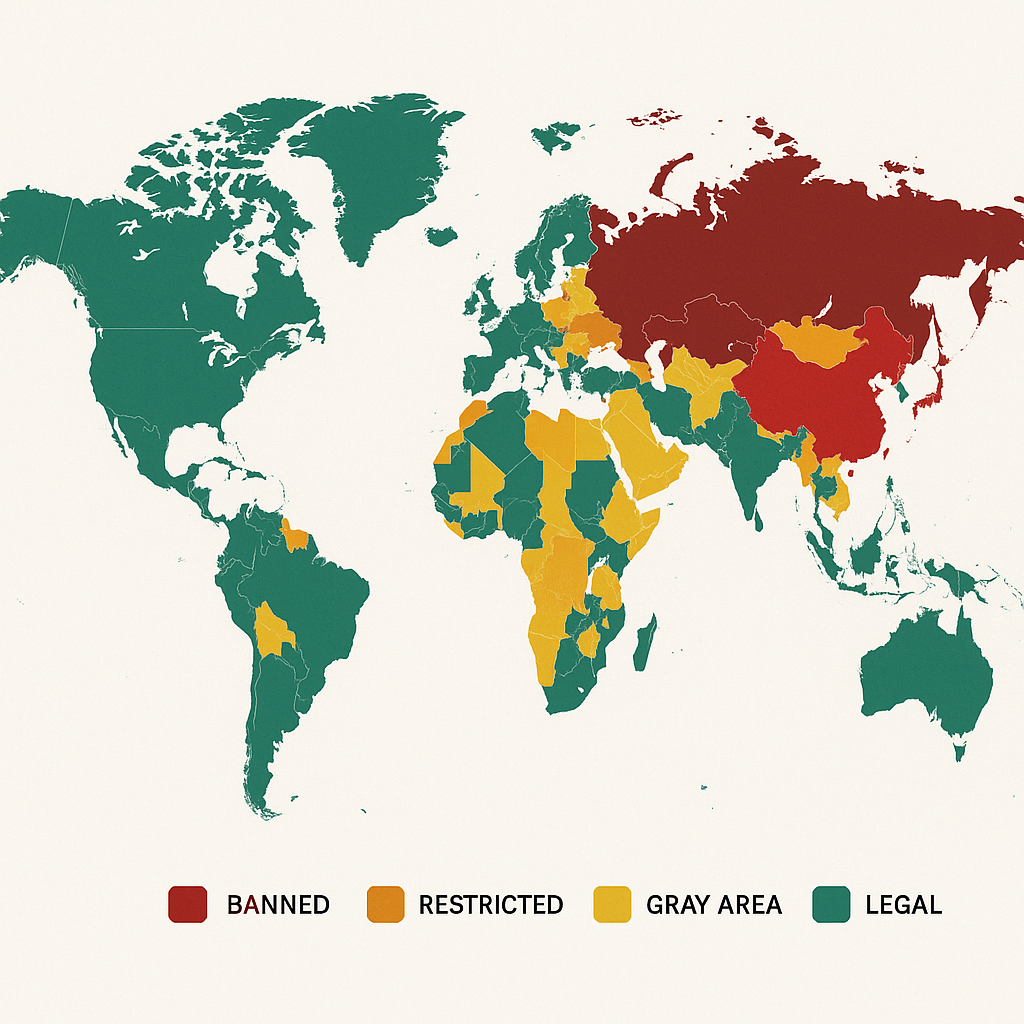
VPNs are legal in most of the world. You can download an app, connect to a server in another country, and route your traffic through an encrypted tunnel without breaking any laws. But in around a dozen countries, using a VPN is either outright illegal or restricted to government-approved services only.
The restrictions fall into three categories: outright bans (North Korea, Belarus, Turkmenistan), government-approved-only policies (China, Russia, Iran, UAE, Turkey, Oman, Iraq), and ambiguous legal environments where VPNs are technically legal but enforcement targets specific uses (Egypt, Uganda, Venezuela). The difference matters because enforcement mechanisms vary dramatically.
This article explains the legal framework in each category, what enforcement actually looks like, what happens when you use a VPN in a restricted country, and what travelers need to know before crossing borders.
The Three Categories of VPN Restrictions
Outright bans. North Korea, Belarus, and Turkmenistan prohibit VPN use entirely. The legal framework treats VPNs as tools for evading state control of information. Enforcement in these countries is part of broader internet censorship infrastructure. North Korea maintains a closed intranet with almost no international connectivity. Belarus and Turkmenistan block VPN traffic at the ISP level and prosecute violators under laws against unauthorized telecommunications equipment.
Travelers to these countries face a simple situation: VPNs don't work, and attempting to use one creates legal risk disproportionate to any benefit. The infrastructure doesn't allow the connection, and the legal system treats circumvention attempts as serious offenses.
Government-approved-only policies. China, Russia, Iran, UAE, Turkey, Oman, and Iraq allow VPNs, but only services that register with the government and agree to logging, filtering, or backdoor access. Unauthorized VPNs are illegal.
China's Great Firewall uses deep packet inspection to identify and block VPN traffic. The legal framework requires VPN providers to obtain a license from the Ministry of Industry and Information Technology. Foreign VPN services cannot obtain licenses. Chinese citizens and residents who use unlicensed VPNs face fines. Enforcement focuses on VPN providers and resellers more than individual users, but the law criminalizes use.
Russia passed a VPN law in 2017 requiring providers to connect to a government database of blocked sites and enforce those blocks. VPN services that refuse are blocked at the ISP level. Individual use of unauthorized VPNs is technically illegal, but enforcement targets organizers and activists more than casual users. Fines range from around 5,000 to 300,000 rubles depending on whether you're an individual or a business.
Iran blocks most VPN traffic and requires government registration for legal services. The filtering infrastructure targets popular VPN protocols. Enforcement includes fines and, in cases tied to political activity, prosecution under broader internet crimes statutes.
UAE's telecommunications law prohibits using VPNs to commit crimes or access blocked content. The ambiguity creates risk: using a VPN to access a blocked news site is illegal, but using one to secure a corporate network connection is not. Enforcement focuses on prosecuting VPN use in conjunction with other offenses. Fines can reach around 500,000 dirhams (roughly $136,000 USD) and imprisonment is possible for serious cases.
Turkey requires VPN providers to obtain licenses and comply with content blocking orders. Unlicensed VPNs are blocked. Individual use isn't aggressively prosecuted, but the legal framework allows it.
Oman and Iraq have similar frameworks: VPNs are legal for businesses and approved uses, illegal for circumventing censorship. Enforcement is inconsistent.
Ambiguous or selective enforcement. Egypt, Uganda, and Venezuela have laws that could be used to prosecute VPN use, but enforcement is selective and tied to political activity rather than casual use.
Egypt's cybercrime law allows prosecution for using technology to evade monitoring. VPNs aren't explicitly illegal, but activists and journalists have been prosecuted for using them. Tourists and business travelers generally face no enforcement.
Uganda imposed a social media tax in 2018, and VPN use to avoid the tax is technically illegal. Enforcement targets residents, not visitors.
Venezuela's internet controls focus on blocking opposition sites and monitoring dissent. VPN use isn't explicitly illegal, but the legal framework around "cyberterrorism" is broad enough to cover almost anything.
What Enforcement Actually Looks Like
Enforcement mechanisms differ more than the laws themselves.
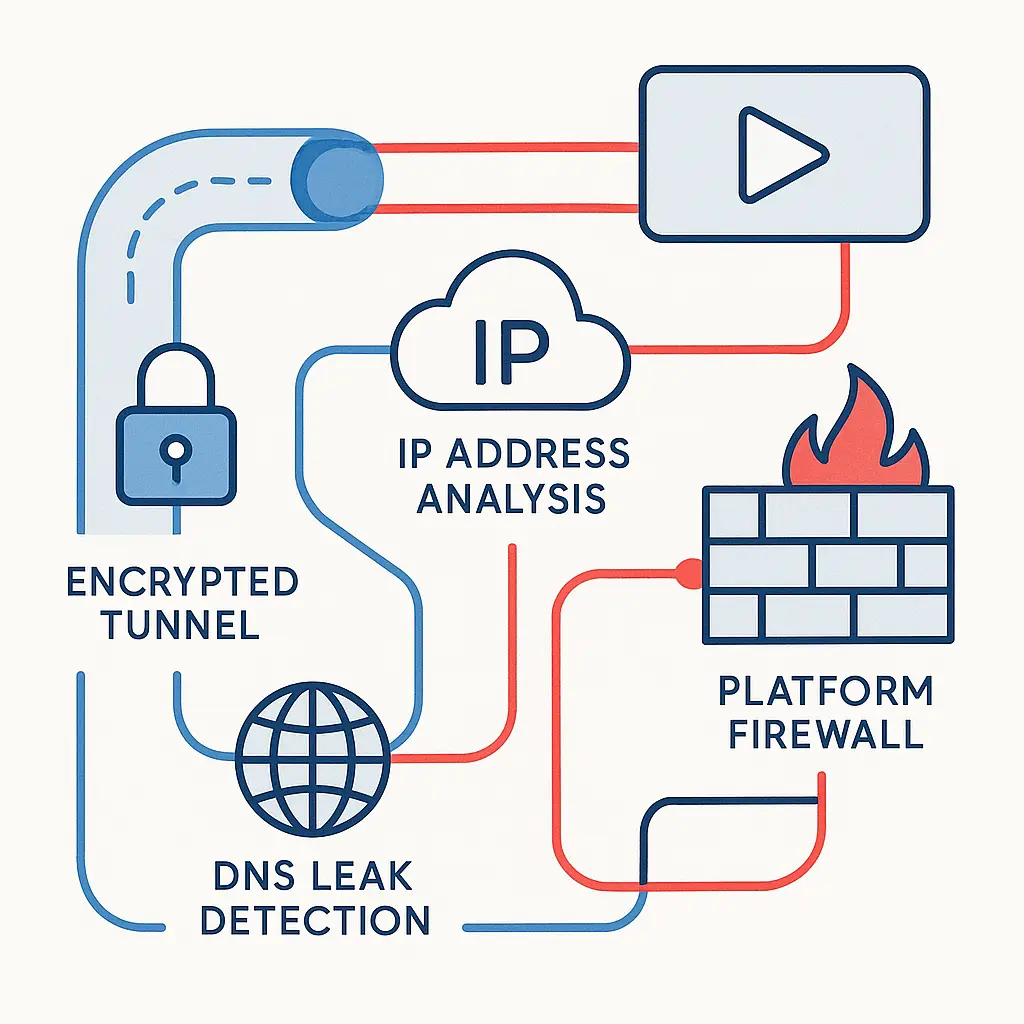
Network-level blocking. China, Russia, Iran, and Turkey use deep packet inspection to identify VPN traffic and block connections in real time. The systems analyze traffic patterns, protocol signatures, and destination IPs. When a VPN handshake is detected, the connection drops.
This is the primary enforcement mechanism in China. The Great Firewall doesn't wait for legal proceedings. It just blocks the connection. You can have a VPN app installed, but it won't connect to most servers. Some VPN providers use obfuscation techniques to disguise traffic as regular HTTPS, and these sometimes work, but success rates fluctuate as the filtering systems adapt.
Russia's blocking is less sophisticated than China's but follows the same model. ISPs maintain blocklists of VPN server IPs and use protocol detection to drop connections. Enforcement is reactive: when a VPN service becomes popular, it gets added to the blocklist.
Iran's filtering focuses on popular consumer VPN services. Corporate VPNs using IPsec or proprietary protocols often connect without issue because the filtering targets known commercial providers.
Fines and legal action. Russia, UAE, and some other countries in the government-approved-only category issue fines for unauthorized VPN use. The fines target businesses and resellers more often than individual users, but individuals can be prosecuted.
In Russia, around 400 people were fined for VPN-related offenses in 2024, according to reporting from security researchers. Most were resellers or operators of VPN services, not end users. The legal framework allows prosecution of individuals, but enforcement priorities focus on supply rather than demand.
UAE prosecutes VPN use when it's connected to another crime. Using a VPN to access a blocked voice-over-IP service is illegal. Using a VPN to commit fraud is prosecuted more harshly than the fraud alone. The law is written broadly enough that almost any VPN use to access blocked content is technically illegal, but enforcement is selective.
Targeting activists and dissidents. In countries with ambiguous legal frameworks, VPN enforcement focuses on political cases. Egypt, Venezuela, and Belarus prosecute VPN use by activists, journalists, and opposition figures, but ignore use by business travelers and expats.
The legal mechanism is usually a broad cybercrime or national security statute that criminalizes "evading monitoring" or "unauthorized access to telecommunications infrastructure." These laws don't mention VPNs explicitly, but prosecutors apply them selectively.
Belarus prosecuted several activists in 2023 for using VPNs to access banned Telegram channels. The charges were part of broader cases against opposition organizers, not standalone VPN violations.
Border searches. Some countries check devices at borders for VPN apps, evidence of circumvention, or access to blocked content. China, UAE, and Russia have all been reported to search phones and laptops during entry screening, though the practice isn't universal.
The risk is higher for residents returning home than for tourists arriving for the first time. Border agents in China sometimes check WeChat messages and browsing history. Finding evidence of VPN use or access to blocked sites can lead to questioning, device seizure, or denial of entry for foreign nationals.
Having a VPN app installed isn't illegal in most of these countries. The issue is using it. But border agents may interpret the presence of a VPN app as intent to circumvent, especially if you're flagged for other reasons.
What Travelers Need to Know
The legal risk for short-term travelers is different from the risk for residents. Enforcement in most restricted countries focuses on locals, long-term residents, and people engaged in political activity. Tourists using VPNs to access email or check bank accounts face lower risk, but the risk isn't zero.
Before you travel:
Research the specific country's VPN laws. The categories above are generalizations. Legal frameworks and enforcement priorities change. CISA's cybersecurity guidance includes some country-specific information, though it's written for government travelers and may be more cautious than necessary for tourists.
Decide whether you need a VPN at all. If you're traveling to China for a week and you can live without Instagram, you might not need to fight the Great Firewall. If you need access to work systems or sensitive accounts, the calculation changes.
Test your VPN before you leave. Some providers have servers and protocols specifically designed for restricted countries. NordVPN's obfuscated servers, for example, are built to work in China and similar environments. ExpressVPN and ProtonVPN also maintain infrastructure for high-censorship regions. Success rates fluctuate, but these providers invest in circumvention technology.
Download the VPN app and configure it before you cross the border. App stores in China, UAE, and other restricted countries don't offer most VPN apps. If you arrive without the app installed, you can't download it. Some providers offer APK files or desktop installers you can sideload, but that requires preparation.
While traveling:
Understand that VPN connections may not work. China's blocking is effective enough that you should have a backup plan. If your VPN is your only way to access work email, and it doesn't connect, you're stuck. Travelers who rely on VPNs for work often bring a backup device with a local SIM and no VPN, using it only for non-sensitive tasks.
Be aware that using a VPN in a restricted country creates legal exposure, even if enforcement is rare. The risk is higher if you're doing anything else that attracts attention. Posting political content, attending protests, or interacting with local activists while using a VPN to evade monitoring compounds the risk.
Don't assume encryption alone protects you. VPNs encrypt your traffic, but they don't make you invisible. ISPs and governments can see that you're using a VPN, even if they can't see what you're doing inside the tunnel. In countries with government-approved-only policies, that's enough to create legal risk.
Consider using Tor instead of a VPN in some cases. Tor is harder to block than most VPNs because it uses a distributed network of relays and constantly changing entry points. But Tor is also slower, and using it can attract more suspicion than using a VPN. Some countries treat Tor use as evidence of intent to evade monitoring.
After you return:
If you used a VPN in a restricted country, assume your activity was logged somewhere. That doesn't mean you'll face consequences, but it does mean you shouldn't assume perfect anonymity. Travelers who used VPNs to access sensitive information in China or Russia sometimes change passwords and review account activity after returning home, on the assumption that monitoring may have occurred.
The Mechanism Behind VPN Blocking
Understanding how VPN blocking works helps explain why some connections succeed and others fail.
Deep packet inspection. China's Great Firewall and similar systems analyze the content and metadata of network packets in real time. VPN protocols have recognizable handshake patterns. OpenVPN, for example, uses specific packet structures and TLS fingerprints. IPsec uses distinct headers. The filtering system identifies these patterns and drops the connection.
Obfuscation techniques disguise VPN traffic as regular HTTPS. The VPN client wraps the encrypted tunnel inside another layer that looks like a web browsing session. This works until the filtering system learns the new pattern, at which point the cat-and-mouse game continues.
IP blocklists. VPN providers operate servers at known IP addresses. Governments compile lists of these IPs and instruct ISPs to block connections. This is simpler than deep packet inspection and works well against large commercial providers. It's less effective against small providers, self-hosted VPNs, or frequently rotating IPs.
DNS filtering. Some countries block access to VPN provider websites, making it harder to sign up or download apps. This doesn't stop people who already have VPNs configured, but it raises the barrier for new users.
Protocol-specific blocking. Some filtering systems target specific VPN protocols. OpenVPN over UDP is easier to detect and block than OpenVPN over TCP. WireGuard's lightweight design makes it harder to fingerprint, but it's not invisible. Proprietary protocols from commercial providers sometimes evade detection longer than open-source protocols because the filtering systems haven't been trained to recognize them yet.
In The Lord of the Rings, the Elves give Frodo a phial of light from Eärendil's star, a tool that works when all other defenses fail, but only if used at the right moment. VPNs in restricted countries are not that phial. They're useful tools with real limitations, and knowing when not to rely on them matters as much as knowing how to use them. The Great Firewall isn't Shelob, and you're not Frodo, but the principle holds: the tool that works perfectly at home may fail when you need it most, and having a backup plan is the difference between inconvenience and real trouble.
VPN Legality by Region
Asia-Pacific: China, North Korea, Turkmenistan, UAE, Oman, and Iraq restrict or ban VPNs. India requires VPN providers to log user data for five years, which isn't a ban but creates privacy concerns. Most other countries in the region allow VPNs without restriction.
Middle East: Iran, UAE, Oman, Iraq, and Turkey restrict VPNs to government-approved services. Saudi Arabia doesn't ban VPNs but blocks some VPN traffic and monitors use. Israel, Jordan, and most other countries in the region allow VPNs.
Africa: Uganda's social media tax creates legal ambiguity around VPN use for tax evasion. Egypt's cybercrime law allows selective prosecution. Most other African countries allow VPNs, though internet infrastructure and government monitoring vary widely.
Europe: Russia and Belarus restrict VPNs. All other European countries allow them, though data retention laws in some EU countries require VPN providers to log user data if they operate servers there.
Americas: Venezuela's ambiguous legal framework creates risk for activists but not tourists. All other countries in North and South America allow VPNs without restriction.
What About Corporate VPNs?
Most countries with VPN restrictions carve out exceptions for businesses. A corporate VPN connecting an employee to their company's internal network is treated differently from a consumer VPN used to access blocked websites.
The distinction isn't always clear in practice. China's law requires businesses to register VPNs with the government, but enforcement focuses on consumer services. A foreign business traveler connecting to their company's VPN in Shanghai is unlikely to face prosecution, but the legal framework technically requires the company to have government approval.
UAE's law explicitly allows VPNs for legitimate business purposes. The ambiguity is in defining "legitimate." Connecting to a corporate network: fine. Using that same VPN to access a blocked news site: illegal.
Russia's VPN law targets consumer services, not corporate networks. Businesses operating in Russia use VPNs for internal communications without legal issue.
The practical takeaway: corporate VPNs face less enforcement than consumer VPNs in restricted countries, but they're not immune to blocking or legal risk. Network-level filtering doesn't distinguish between corporate and consumer traffic if the protocol signatures match.
Protocols and Obfuscation
VPN protocols differ in how easily they're detected and blocked. Understanding the tradeoffs helps explain why some VPNs work in restricted countries and others don't.
OpenVPN is the most common protocol, open-source, and well-documented. It's also the easiest to detect. The handshake pattern is recognizable, and filtering systems have been trained to block it. OpenVPN over TCP port 443 (disguised as HTTPS) has better success rates than OpenVPN over UDP, but it's still detectable with deep packet inspection.
WireGuard is newer, faster, and uses less distinctive packet structures. It's harder to fingerprint than OpenVPN, but not invisible. China's Great Firewall blocks some WireGuard traffic, though success rates vary by server and configuration.
IPsec is common in corporate VPNs. It's detectable, but filtering systems sometimes allow it because blocking IPsec would disrupt business traffic. This isn't a guarantee, and enforcement varies by country.
Proprietary protocols from commercial providers (NordVPN's NordLynx, ExpressVPN's Lightway) are designed to evade detection. They use obfuscation, frequently changing server IPs, and traffic patterns that mimic regular HTTPS. Success rates in China and Russia are higher than open-source protocols, but the arms race continues. What works this month may not work next month.
Shadowsocks is a proxy protocol designed specifically for circumventing the Great Firewall. It's not a VPN, but it's often used for the same purpose. Shadowsocks traffic is harder to detect than standard VPN protocols, and it's popular among residents of restricted countries. Some commercial VPN providers include Shadowsocks as an option.
Long-Term Residents vs. Short-Term Travelers
The legal risk calculation is different for expats, long-term residents, and people with ongoing ties to a restricted country.
Residents face higher enforcement risk. China's VPN crackdown targets Chinese citizens more aggressively than foreign tourists. Russia's fines focus on residents. UAE's prosecutions involve long-term residents or people with business ties to the country.
If you're moving to a restricted country for work, assume VPN use will be monitored and plan accordingly. Some expats use VPNs for work and accept the legal risk. Others avoid VPNs entirely and adjust to local internet restrictions. The calculation depends on your risk tolerance, the nature of your work, and how long you'll be there.
Border crossings create additional risk for frequent travelers. If you enter and exit China monthly, and border agents notice VPN apps or circumvention evidence on repeated trips, you may attract scrutiny. Residents returning home face more invasive device searches than first-time tourists.
The Practical Reality for Tourists
Most tourists who use VPNs in restricted countries face no consequences. Enforcement focuses on residents, activists, and businesses. A traveler using a VPN to check Gmail in Beijing is unlikely to be prosecuted.
But "unlikely" isn't "impossible." The legal framework in China, Russia, UAE, and similar countries criminalizes unauthorized VPN use. Enforcement is selective, but the law exists. If you use a VPN in a restricted country, you're technically breaking the law, and whether you face consequences depends on enforcement priorities that can change.
The risk is higher if you combine VPN use with other activities that attract attention. Posting about politics, attending protests, or interacting with activists while using a VPN to evade monitoring compounds the risk. Tourists who keep a low profile face lower enforcement risk than travelers who engage with local issues.
Network-level blocking is a bigger obstacle than legal prosecution for most travelers. If your VPN doesn't connect, the legal risk is moot. Testing your VPN before you travel, using obfuscated protocols, and having a backup plan matter more than worrying about prosecution.
What to Do If You're Questioned
If border agents or local authorities question you about VPN use, the situation is already serious. This section is not legal advice. If you're detained or questioned by authorities in a foreign country, contact your embassy or consulate immediately.
General principles:
Don't volunteer information. If asked about VPN apps on your device, answer the question asked, but don't elaborate. "I use it to connect to my company's network" is a factual answer that doesn't invite further questioning. "I use it to access blocked websites" is an admission of illegal activity in countries with government-approved-only policies.
Understand that lying to authorities can create additional legal problems. If you're asked a direct question and you lie, that can be prosecuted separately from the underlying VPN offense. If you're not comfortable answering truthfully, say you'd like to contact your embassy before answering further questions.
Device searches are legal in most countries. Border agents can examine your phone, laptop, and browsing history. If you're traveling to a country with VPN restrictions, assume your device may be searched and configure it accordingly. Some travelers bring a clean device with no VPN apps, no access to sensitive accounts, and minimal personal data. Others encrypt their devices and accept the risk of refusing to unlock them, knowing that refusal can lead to denial of entry or detention.
The Bottom Line
VPNs are illegal or restricted in around a dozen countries. The legal frameworks fall into three categories: outright bans (North Korea, Belarus, Turkmenistan), government-approved-only policies (China, Russia, Iran, UAE, Turkey, Oman, Iraq), and ambiguous enforcement (Egypt, Uganda, Venezuela).
Enforcement mechanisms vary. China and Russia use network-level blocking as the primary enforcement tool. UAE and some other countries prosecute VPN use in conjunction with other offenses. Ambiguous legal frameworks in Egypt and Venezuela target activists, not tourists.
Travelers face lower enforcement risk than residents, but the risk isn't zero. Using a VPN in a restricted country is technically illegal in most cases, and whether you face consequences depends on enforcement priorities that can change.
Before you travel, research the specific country's laws, test your VPN, and decide whether you need one at all. While traveling, understand that connections may not work, and using a VPN creates legal exposure. After you return, assume your activity was logged and take appropriate precautions.
VPNs are useful tools, but they're not magic. In countries with sophisticated filtering infrastructure, they often don't work. In countries with legal restrictions, using them creates risk. The decision to use a VPN in a restricted country is a calculated risk, and making that calculation requires understanding both the technical and legal landscape.
If you're looking for a VPN provider with servers and protocols designed for high-censorship environments, NordVPN offers obfuscated servers specifically built to work in China and similar regions. Success rates fluctuate as filtering systems adapt, but providers that invest in circumvention technology generally perform better than those that don't.