Tor vs VPN: which one for what
Tor and VPNs both encrypt your traffic. Both hide your activity from casual observers. Both promise privacy. The tools look similar from the outside, but the mechanisms underneath solve fundamentally different problems.
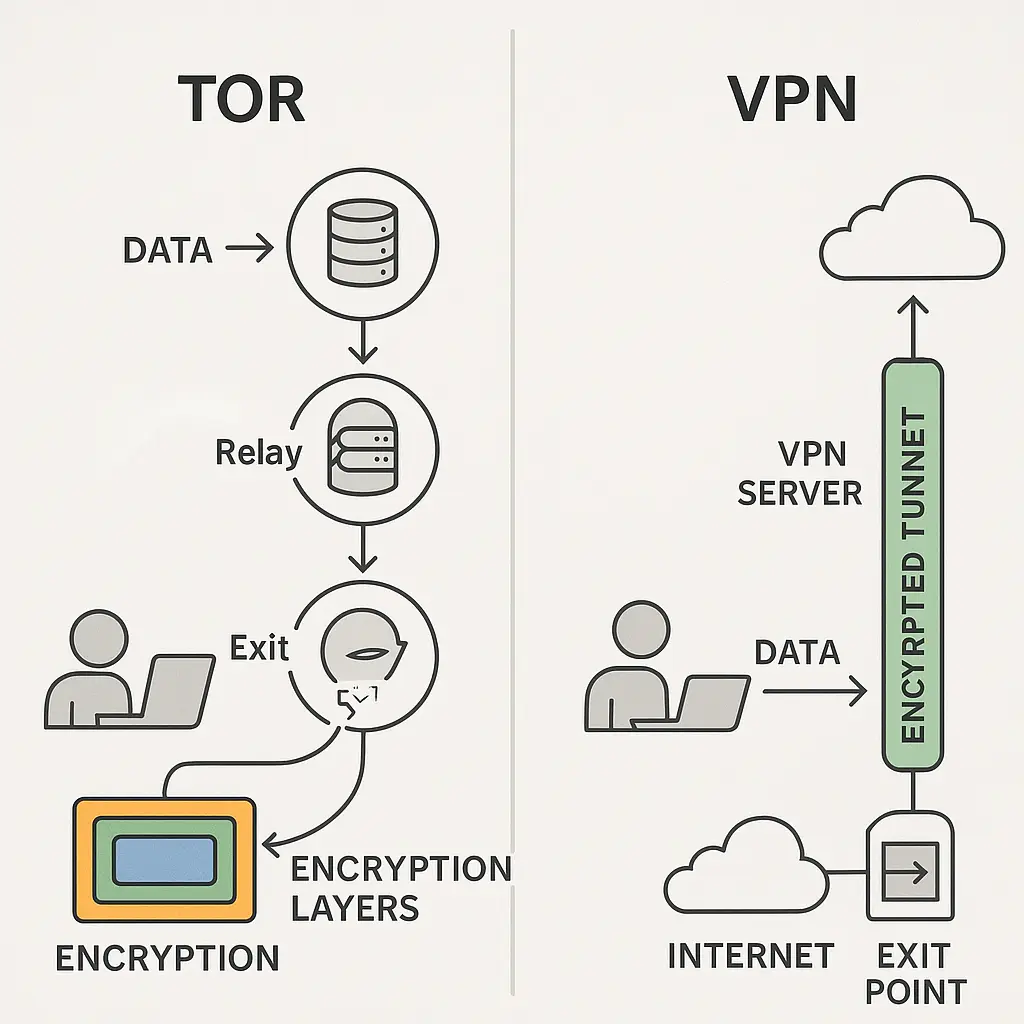
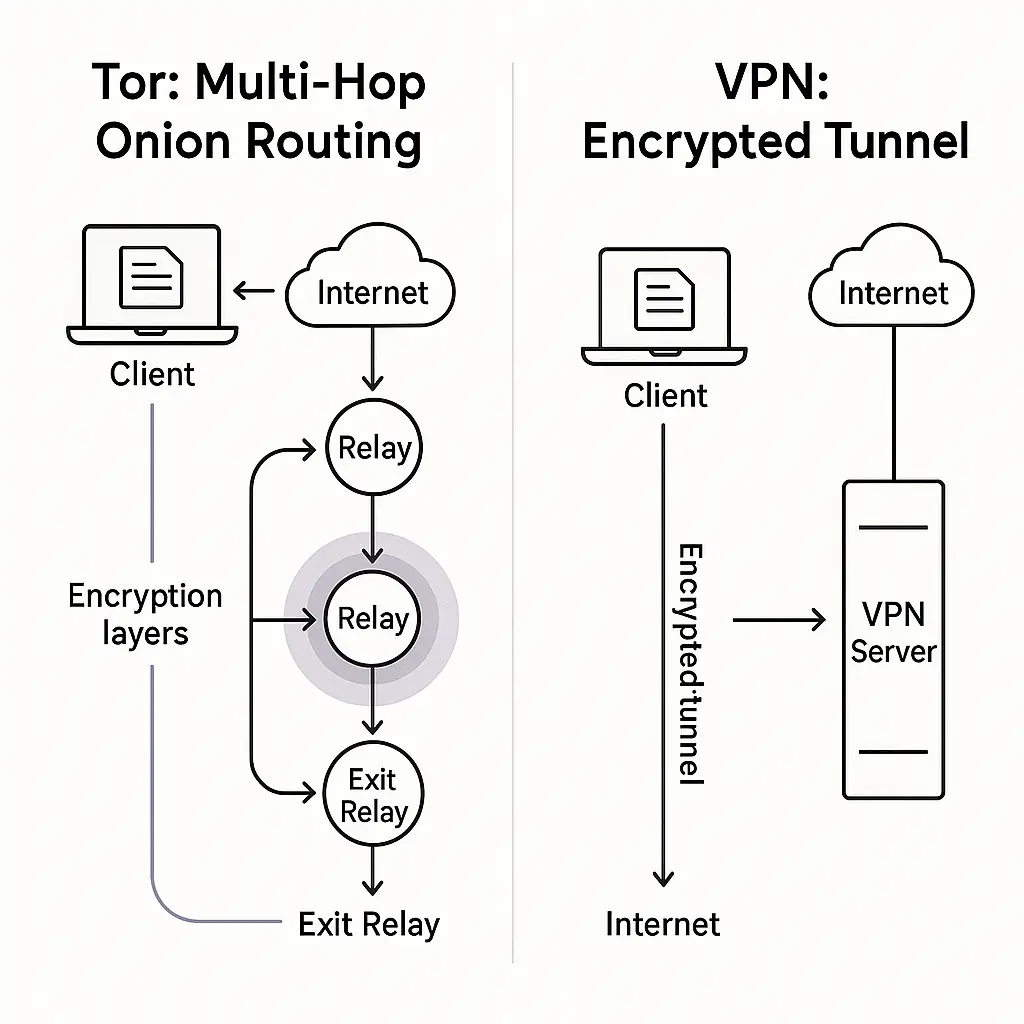
A VPN routes your traffic through one encrypted tunnel to one server run by one company. Tor routes your traffic through three encrypted layers across three volunteer-run nodes, with each node seeing only one piece of the path. The architectural difference creates a tradeoff: Tor delivers stronger anonymity at the cost of speed. A VPN delivers practical speed at the cost of trusting a provider.
This isn't a question of which tool is better. It's a question of which problem you're solving.
How Tor actually works
Tor, The Onion Router, wraps your traffic in three layers of encryption. When you request a website through Tor, your computer picks three nodes from a global network of volunteer-run relays: an entry node, a middle node, and an exit node.
The entry node sees your real IP address but doesn't know your destination. It peels off the first encryption layer and forwards your traffic to the middle node. The middle node sees neither your IP nor your destination, only instructions to pass data to the exit node. The exit node removes the final encryption layer, sees your destination, and forwards your request to the target website. The response travels back through the same three nodes in reverse.
No single node sees both who you are and where you're going. The entry node knows your identity but not your destination. The exit node knows your destination but not your identity. The middle node knows neither. This distributed trust model is Tor's core strength: you don't have to trust any single entity with the full picture.
CISA's guidance on network security describes this as defense in depth, layering protections so that no single failure compromises the whole system. Tor applies that principle to anonymity.
The Tor Browser bundles this routing mechanism with Firefox configured to resist fingerprinting, block trackers, and prevent plugins from leaking your real identity. Using Tor without the Tor Browser defeats much of the protection, because your browser itself can expose you even when your traffic is encrypted.
Tor is slow. The three-hop architecture adds latency. The volunteer infrastructure means nodes vary in speed and reliability. Streaming video is impractical. Large downloads take patience. The design prioritizes anonymity over performance.
How VPNs actually work
A VPN, virtual private network, creates an encrypted tunnel between your device and a server run by the VPN provider. Your traffic flows through that tunnel to the VPN server, which then forwards it to the destination website. To the website, your request appears to come from the VPN server's IP address, not yours.
Your ISP sees encrypted traffic going to the VPN server but can't see what's inside the tunnel. The destination website sees the VPN server's IP, not yours. The VPN provider sees everything: your real IP, your destination, the content of unencrypted traffic, and the timing of your requests.
This is a trust shift, not anonymity. You're hiding your activity from your ISP and from websites, but you're revealing it fully to the VPN provider. If you trust the provider more than your ISP or the websites you visit, that tradeoff makes sense. If you can't trust the provider, the VPN offers no privacy advantage.
NIST's framework for network security emphasizes understanding where data flows and who has access at each point. A VPN moves visibility from your ISP to the provider. That's useful when your ISP is the threat. It's not useful when the provider is the threat.
VPNs are fast. The single-hop architecture introduces minimal latency. Commercial providers run optimized servers on high-bandwidth connections. You can stream, download, and browse at speeds close to your baseline connection. The design prioritizes usability over anonymity.
What each tool hides and what leaks
Tor hides your identity from the destination and your destination from your ISP. It doesn't hide the fact that you're using Tor. Your ISP can see Tor traffic, it has a recognizable signature. In some countries, using Tor is itself suspicious or restricted. Tor bridges can obfuscate Tor traffic to look like ordinary HTTPS, but sophisticated network monitoring can still detect patterns.
Tor doesn't encrypt the final hop between the exit node and the destination unless the site uses HTTPS. An exit node operator can see unencrypted traffic. That's why the Tor Browser forces HTTPS connections when possible and warns you when sites don't support it. Malicious exit nodes have been documented reading passwords, injecting malware, and harvesting data from unencrypted traffic.
Tor protects you from traffic correlation attacks, where an observer monitors both your connection and the destination to link them, only if the adversary doesn't control both the entry and exit nodes. If a single entity runs enough Tor nodes, they can correlate timing patterns to deanonymize users. Researchers have demonstrated this in controlled environments. In practice, the Tor network is large enough that this attack is expensive and difficult, but not impossible.
A VPN hides your IP from the destination and your browsing activity from your ISP. It doesn't hide anything from the VPN provider. If the provider logs connection data, those logs can be subpoenaed, hacked, or sold. If the provider is dishonest about logging, you have no way to verify their claims without access to their infrastructure.
A VPN doesn't hide the fact that you're using a VPN. Your ISP sees encrypted traffic to a known VPN server. In some regions, VPN traffic is blocked or throttled. Some websites block VPN IP addresses to prevent bypassing geographic restrictions. A VPN that works today might not work tomorrow if the provider's IPs get blacklisted.
EFF's guidance on HTTPS emphasizes that encryption in transit is necessary but not sufficient. Tor and VPNs both encrypt your traffic, but encryption only protects data in motion. Metadata, timing, volume, destination patterns, can still reveal information even when content is encrypted.
Speed, usability, and practical limits
Tor is slow enough to change how you use the internet. Streaming video doesn't work. Large file downloads are impractical. Even loading image-heavy websites takes patience. The three-hop architecture and volunteer infrastructure create latency that no amount of patience with buffering will overcome.
Tor's speed isn't a bug. It's a consequence of the anonymity mechanism. Adding more hops would increase anonymity but make the network unusable. Reducing hops would increase speed but weaken anonymity. The three-hop design is a deliberate compromise.
Some sites block Tor exit nodes. Cloudflare, Google, and others treat Tor traffic as suspicious and serve CAPTCHAs or block access entirely. You can complete the CAPTCHAs, but the friction adds up. Banking sites, streaming services, and many commercial platforms won't work through Tor at all.
VPNs are fast enough that most people don't notice the difference. Streaming works. Downloads proceed at reasonable speeds. The single-hop architecture and commercial infrastructure deliver performance close to your baseline connection. The usability tradeoff is minimal.
Some sites block known VPN IP addresses. Netflix, Hulu, BBC iPlayer, and other streaming services actively detect and block VPN traffic to enforce geographic licensing. Banking sites sometimes flag VPN connections as suspicious and trigger additional authentication. The friction is less than Tor, but it exists.
VPNs marketed for bypassing geographic restrictions play a cat-and-mouse game with content platforms. A VPN that works today might not work next month when the platform updates its detection methods. Providers respond by rotating IP addresses, but the arms race continues.
Threat models: when each tool makes sense
Use Tor when anonymity is the primary goal. Whistleblowing, journalism in hostile regions, accessing censored information, or communicating when you cannot afford to trust a single company with your identity. Tor's distributed trust model protects you when the adversary is powerful, well-resourced, or has legal authority over commercial providers.
In Ocean's Eleven, Danny Ocean's crew doesn't trust any single member with the full plan. Each person knows only their piece. If one gets caught, the whole operation doesn't collapse. Tor applies the same principle: no single node knows enough to compromise you.
Use a VPN when you need to hide your activity from your ISP, bypass geographic restrictions, or protect your traffic on untrusted networks. Public WiFi at coffee shops and airports, hotel networks, and ISPs that log or throttle traffic are scenarios where a VPN's single-hop encryption is sufficient. You're trusting the VPN provider, but that's a reasonable tradeoff when the alternative is trusting an even less trustworthy network operator.
Use neither when you're browsing from home on a trusted connection and the content you're accessing isn't sensitive. Tor and VPNs both add friction. If you're reading news, checking weather, or shopping on mainstream sites, the privacy benefit rarely justifies the performance cost.
Don't use Tor for anything that requires you to log in with your real identity. If you access your Gmail account through Tor, Google knows it's you regardless of the IP address. Tor protects anonymity, not pseudonymity. Mixing anonymous and identified activity in the same session defeats the purpose.
Don't use a VPN if you can't verify the provider's logging policy. Marketing claims about "no logs" are unverifiable without access to the company's infrastructure. Some providers have been subpoenaed and proven they kept no logs. Others have been subpoenaed and handed over data despite claiming they didn't log. Research the provider's history, jurisdiction, and third-party audits before trusting them with your traffic.
Tor over VPN and VPN over Tor
You can layer Tor and a VPN, but the configuration matters and the benefits are narrow.
Connecting to a VPN before using Tor, VPN over Tor, hides Tor usage from your ISP. Your ISP sees encrypted traffic to the VPN server, not Tor traffic. This is useful in regions where using Tor is suspicious or restricted. The VPN provider sees that you're using Tor, but they don't see your destinations. The Tor network still distributes trust across three nodes. The anonymity mechanism is unchanged.
Connecting to Tor before using a VPN, Tor over VPN, routes your traffic through Tor's three hops, then through the VPN server before reaching the destination. This configuration is complex to set up and rarely necessary. It hides your Tor usage from the destination website, but the VPN provider sees your traffic after it exits Tor. You're trusting the VPN provider with visibility into your destinations, which defeats much of Tor's anonymity benefit.
Some VPN providers market Tor over VPN as a feature. The use case is narrow: you want Tor's anonymity but need to access a service that blocks Tor exit nodes. The VPN's IP address gets you past the block, but you're still trusting the VPN provider with your destinations.
Layering Tor and a VPN doesn't make you "twice as anonymous." It adds complexity, slows your connection further, and introduces new points of failure. For most threat models, using one tool correctly is stronger than using both tools poorly.
Logging policies and jurisdiction
Tor doesn't log. The protocol doesn't include mechanisms for logging user activity. Individual node operators could log traffic passing through their nodes, but they'd only see one piece of the path. The entry node sees your IP but not your destination. The exit node sees your destination but not your IP. Correlating that data requires controlling multiple nodes and monitoring timing patterns, expensive and difficult.
VPN providers vary wildly on logging. Some log connection timestamps, IP addresses, bandwidth usage, and destinations. Others claim to log nothing. Verifying these claims is nearly impossible without access to the provider's infrastructure. Some providers have undergone third-party audits. Some have been subpoenaed and proven in court that they kept no logs. Others have been subpoenaed and handed over data despite marketing claims.
Jurisdiction matters. A VPN provider based in the United States operates under U.S. surveillance laws and can be compelled to hand over data or install monitoring equipment. A provider based in Switzerland operates under Swiss privacy laws, which are stronger. A provider based in a country with weak rule of law might ignore subpoenas but could also ignore your privacy.
NIST's cybersecurity framework emphasizes understanding the legal and regulatory environment where your data is stored and processed. A VPN provider's privacy policy is only as strong as the jurisdiction that governs it.
Some providers are part of intelligence-sharing alliances, Five Eyes, Nine Eyes, Fourteen Eyes, where member countries share surveillance data. A provider in one of these countries can be compelled to hand over logs to any member government. This doesn't make them automatically untrustworthy, but it's a factor to consider when your threat model includes government surveillance.
Tor's jurisdiction is nowhere and everywhere. The network is decentralized. No single government controls it. No single entity can be compelled to hand over logs. The tradeoff is that you're trusting thousands of volunteer node operators, some of whom might be malicious.
What about bridges, pluggable transports, and obfuscation
Tor bridges are entry nodes that aren't listed in the public Tor directory. If your ISP blocks connections to known Tor nodes, a bridge lets you connect to the Tor network without triggering the block. Bridges are distributed through the Tor Project on request, not published in a searchable list.
Pluggable transports obfuscate Tor traffic to look like ordinary HTTPS or other protocols. If your ISP uses deep packet inspection to detect and block Tor, a pluggable transport makes Tor traffic blend in with normal encrypted web traffic. The obfs4 transport is the most widely used and effective in 2026.
These tools help in regions with aggressive network filtering, China, Iran, Turkey, and others, but they're not perfect. Sophisticated adversaries can still detect Tor usage through traffic analysis, timing patterns, and statistical correlation. Bridges and transports raise the cost of detection but don't make it impossible.
VPNs face similar challenges. Some providers offer obfuscation features that disguise VPN traffic as HTTPS. Others route traffic through non-standard ports to evade blocks. The effectiveness varies by region and by how aggressively the network operator monitors and filters traffic.
When neither tool is enough
Tor and VPNs protect you from network-level surveillance. They don't protect you from endpoint compromise, malware, phishing, or social engineering. If your device is infected, the attacker sees everything before it enters the encrypted tunnel. If you're tricked into revealing your password, the encryption doesn't matter.
Tor and VPNs don't protect you from traffic analysis at scale. If an adversary monitors both your connection and the destination, they can correlate timing patterns to link you to your activity even when content is encrypted. This attack is expensive and requires significant resources, but it's not theoretical. Researchers have demonstrated it. Intelligence agencies have the capability.
Tor and VPNs don't protect you from browser fingerprinting. Websites can identify you by analyzing your browser's configuration, installed fonts, screen resolution, time zone, and dozens of other characteristics. The Tor Browser includes fingerprinting protections, but they're not perfect. Using a VPN with a standard browser does nothing to prevent fingerprinting.
Tor and VPNs don't protect you from yourself. If you log into your real accounts, post identifying information, or reuse usernames across anonymous and identified contexts, the encryption is irrelevant. Operational security, how you behave online, matters more than the tools you use.
Configuration mistakes that break protection
Using Tor without the Tor Browser defeats much of the protection. The Tor Browser is configured to resist fingerprinting, block trackers, and prevent plugins from leaking your identity. If you route traffic through Tor using a standard browser, you're still vulnerable to fingerprinting, plugin leaks, and configuration flaws.
Maximizing the Tor Browser window breaks fingerprinting protection. The Tor Browser sets a standard window size to make all users look identical. If you maximize the window, your screen resolution becomes a unique identifier. The browser warns you about this, but people ignore the warning.
Enabling JavaScript on high-security sites in Tor weakens anonymity. JavaScript can fingerprint your browser, exploit vulnerabilities, and leak your real IP through WebRTC. The Tor Browser blocks JavaScript by default on .onion sites for this reason. Enabling it is a tradeoff: some sites won't work without it, but enabling it increases risk.
Using a VPN that logs connection data defeats the privacy benefit. If the provider logs timestamps, IP addresses, and destinations, those logs can be subpoenaed or hacked. The encryption protects you from your ISP but not from the provider. Research the provider's logging policy, jurisdiction, and history before trusting them.
Connecting to a VPN over an untrusted network without verifying the server's identity opens you to man-in-the-middle attacks. If an attacker intercepts your connection and presents a fake VPN server, they can decrypt your traffic. Most VPN clients verify server certificates automatically, but misconfigurations happen.
Using the same VPN account on multiple devices simultaneously can leak your real IP. If one device connects without the VPN active, the provider sees your real IP associated with your account. When you connect with the VPN on another device, the provider can correlate the two sessions. This isn't a flaw in the protocol, it's a consequence of account-based authentication.
The decision framework
Ask yourself: who am I hiding from, and what are they capable of?
If you're hiding from your ISP, a VPN is sufficient. Your ISP can see what sites you visit and when, but they lack the resources to perform sophisticated traffic analysis. A VPN shifts visibility to the provider, which is a reasonable tradeoff if you trust the provider more than your ISP.
If you're hiding from websites that track you across the internet, neither tool alone is enough. Tor protects your IP address but doesn't stop fingerprinting. A VPN protects your IP address but doesn't stop cookies or trackers. You need browser-level protections, tracker blockers, fingerprinting resistance, cookie isolation, in addition to network-level encryption.
If you're hiding from a government with legal authority over commercial providers, Tor is the stronger choice. A VPN provider can be compelled to log your activity, install monitoring equipment, or hand over data. Tor's distributed trust model protects you when the adversary has the power to compel cooperation from any single entity.
If you're hiding from a government with the resources to perform traffic analysis at scale, neither tool guarantees safety. Tor and VPNs protect against casual surveillance, but sophisticated adversaries can correlate timing patterns, compromise nodes, and deanonymize users. At that threat level, operational security and behavior matter more than tools.
If you're trying to access content blocked by geographic restrictions, a VPN is the practical choice. Tor is too slow for streaming, and many services block Tor exit nodes entirely. A VPN delivers usable speeds and works with most content platforms, though the cat-and-mouse game with detection continues.
If you're browsing from a public network and want basic protection, a VPN is sufficient. Coffee shop WiFi, airport networks, and hotel connections are insecure by design. A VPN encrypts your traffic and prevents casual eavesdropping. Tor would work, but the speed tradeoff isn't worth it for routine browsing.
What I actually use
I use NordVPN when I'm on public WiFi or accessing content that's blocked in my region. The speed is close to my baseline connection, and the provider has a verified no-logs policy backed by third-party audits and court cases. I trust them more than I trust random coffee shop networks.
I use Tor when I'm researching sensitive topics, accessing censored information, or communicating when I can't afford to trust a single company with my identity. The speed is frustrating, but the anonymity is worth it for those specific use cases. I don't use Tor for routine browsing because the friction outweighs the benefit.
I don't layer Tor and a VPN. The added complexity doesn't improve my security for the threats I face. I use one tool correctly instead of two tools poorly.
I don't use either tool when I'm browsing from home on my trusted connection. My ISP isn't my adversary. The sites I visit aren't my adversary. Adding encryption for routine browsing doesn't improve my security, it just slows my connection and adds friction.
The tools exist. The mechanisms work. The choice depends on your threat model, your tolerance for friction, and who you're trying to hide from. Neither tool is universally better. Both tools solve real problems. Use the one that matches the problem you're actually facing.