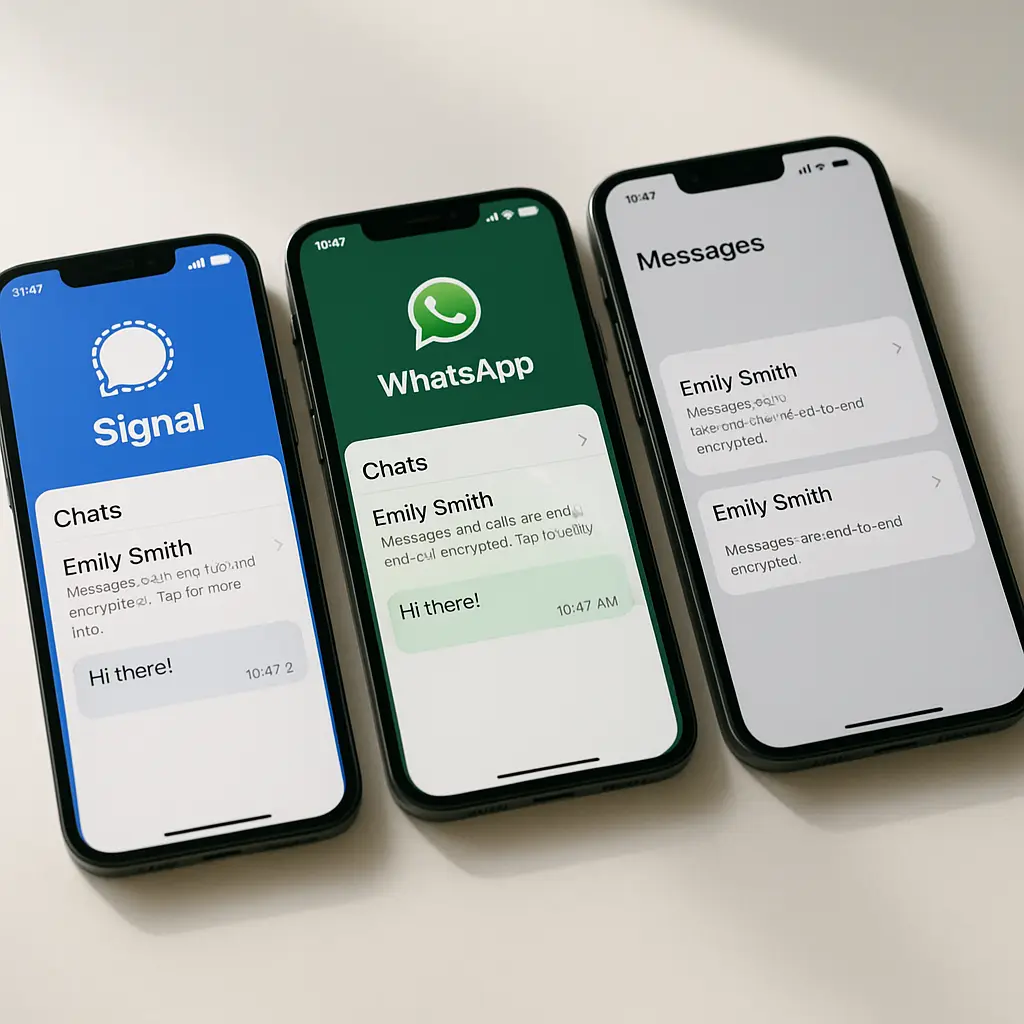
Signal vs WhatsApp vs iMessage: Which Messaging App Actually Protects Your Privacy?
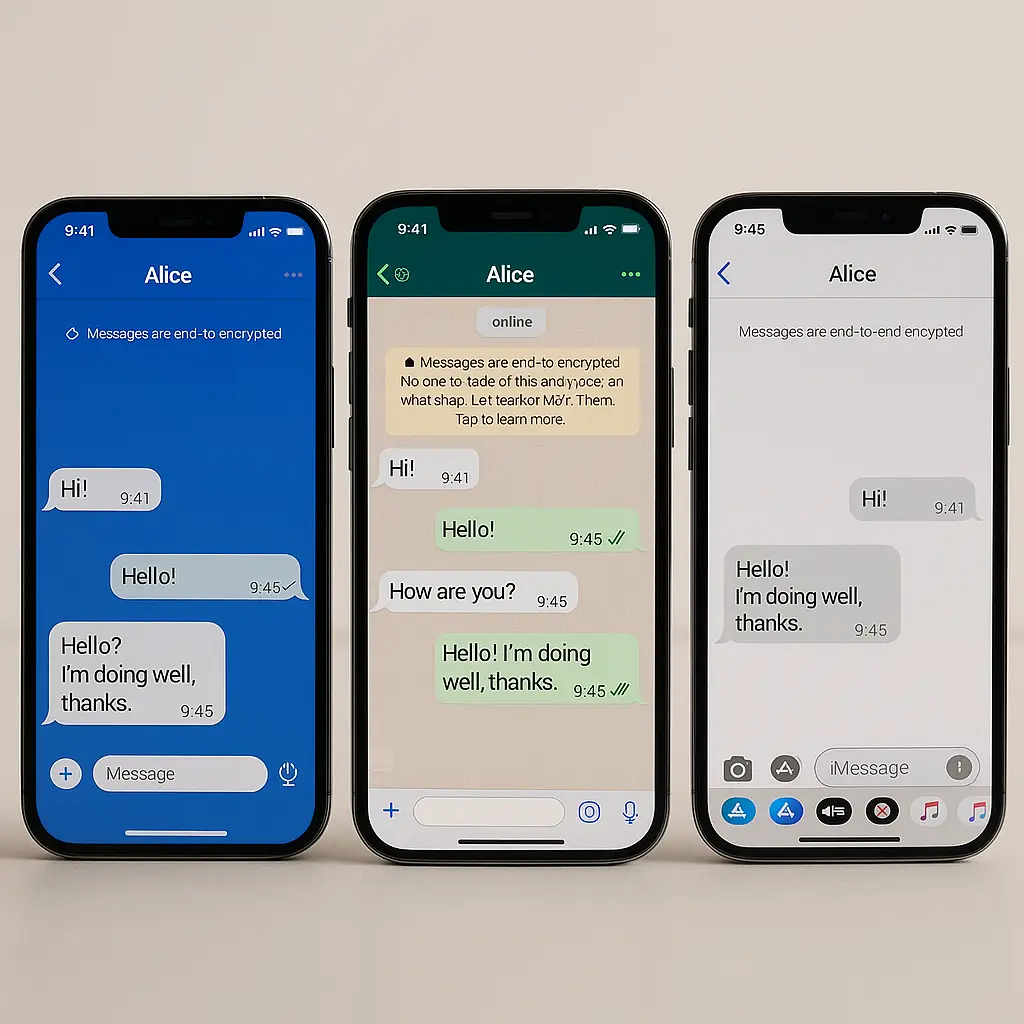
You want private conversations. Signal, WhatsApp, and iMessage all promise encryption. All three claim to protect your messages from prying eyes. But the differences in what they actually protect, what they collect, and who controls them matter more than the marketing suggests.
Here's how these three platforms compare on the privacy features that actually make a difference in 2026.
The Encryption Baseline
All three services use end-to-end encryption for messages by default. That means the content of your conversations, the actual words, photos, and files you send, is encrypted on your device and can only be decrypted by the recipient's device. The service provider running the platform cannot read the content.
This is the baseline. It's what the EFF recommends as the minimum standard for private messaging. Without end-to-end encryption, your messages travel through the provider's servers in a form they can read, store, analyze, or hand over to law enforcement.
Signal, WhatsApp, and iMessage all clear this bar. The content of your messages is protected from the companies running the services. But that's where the similarities end.
What Metadata Reveals About You
End-to-end encryption protects message content, but it doesn't protect metadata, the information about who you talk to, when you talk to them, how often, and for how long. Metadata creates a detailed map of your social connections and communication patterns.
Signal collects almost no metadata. It doesn't store your contact list on its servers. It doesn't log who you message or when. It doesn't track group memberships. The only information Signal retains is the date you created your account and the last date you connected to the service. That's it.
WhatsApp collects substantially more. It stores metadata about who you message, when you message them, and your group memberships. WhatsApp shares this metadata with Facebook (Meta), which uses it for ad targeting and analytics. The content of your messages stays encrypted, but Meta knows who your friends are, who you talk to most often, and when you're most active.
iMessage sits between the two. Apple collects metadata about your conversations, who you message and when, but doesn't use it for advertising. Apple's business model doesn't depend on profiling users for ad targeting, which reduces the incentive to harvest and analyze communication patterns. However, Apple does retain this metadata and can be compelled to provide it to law enforcement with a valid legal request.
The difference matters. In Carpenter v. United States (2018), the Supreme Court ruled that location data creates a detailed picture of someone's life. The same logic applies to messaging metadata. Knowing who you talk to reveals your social network, your habits, your relationships, and your movements. Content encryption without metadata protection is incomplete privacy.
Backup Encryption
Messages don't just live on your phone. They get backed up to cloud storage, Google Drive for Android, iCloud for iPhone. If those backups aren't encrypted, your message history sits on someone else's servers in a form they can access.
Signal encrypts backups by default. If you enable Signal's backup feature, it creates an encrypted backup stored locally on your device or in Signal's cloud storage (if you opt in). Signal cannot access the contents of these backups. You control the encryption key.
WhatsApp offers end-to-end encrypted backups, but it's opt-in. If you don't explicitly enable encrypted backups in WhatsApp's settings, your message history backs up to Google Drive or iCloud without end-to-end encryption. That means Google or Apple can access your WhatsApp messages if they receive a legal request, even though the messages themselves are encrypted in transit.
iMessage backups depend on whether you've enabled Advanced Data Protection for iCloud. Without Advanced Data Protection, Apple holds the encryption keys for your iCloud backups, including your iMessage history. Apple can decrypt your messages if compelled by law enforcement. With Advanced Data Protection enabled, your iMessage backups are end-to-end encrypted, and Apple cannot access them. But Advanced Data Protection is opt-in and not widely adopted.
The default matters. Most people don't change settings. If privacy requires opting in, most users won't get it.
Platform Control and Lock-In
iMessage only works on Apple devices. If you message someone on Android, iMessage falls back to SMS, which is not encrypted. This creates a two-tier system: private conversations with other Apple users, unencrypted conversations with everyone else.
WhatsApp works across platforms. You can message someone on Android from an iPhone, or vice versa, and the encryption works the same way. But WhatsApp is owned by Meta, a company whose business model depends on collecting and monetizing user data. Meta has repeatedly changed WhatsApp's privacy policies to expand data sharing with Facebook, and users have limited recourse beyond switching to a different app.
Signal works across platforms and is controlled by a nonprofit foundation with no financial incentive to monetize user data. Signal's code is open source, meaning independent security researchers can audit it to verify that it works as advertised. Signal's funding comes from donations, not advertising or data sales.
Platform control determines incentives. Apple's business model depends on selling hardware, not harvesting data. Meta's business model depends on advertising, which requires data. Signal's nonprofit structure removes the profit motive entirely.
The incentive structure shapes what happens over time. Companies change. Privacy policies evolve. A commitment to privacy backed by a business model that doesn't depend on data collection is more durable than a commitment that conflicts with the company's revenue strategy.
Group Chats and Disappearing Messages
All three platforms support group chats with end-to-end encryption. But the implementation differs in ways that affect privacy.
Signal encrypts group chats using the same protocol as one-on-one messages. Group membership, message history, and metadata stay encrypted. Signal doesn't store information about who's in which groups on its servers.
WhatsApp encrypts group chats, but stores group membership metadata on its servers. WhatsApp knows who's in each group, when the group was created, and when members join or leave. This metadata is shared with Meta.
iMessage encrypts group chats, but group messages route through Apple's servers, and Apple retains metadata about group membership and activity. If your iCloud backup isn't protected by Advanced Data Protection, Apple can access your group chat history.
Disappearing messages, messages that delete themselves after a set time, are available on all three platforms. Signal pioneered the feature and offers the most granular controls, including the ability to set messages to disappear after being read. WhatsApp and iMessage added disappearing messages later, with less flexibility.
Disappearing messages protect against long-term storage, but they don't protect against screenshots, photos of the screen, or someone copying the text before it disappears. They're a layer of defense, not a guarantee.
The Threat Model Question
Which app you should use depends on what you're protecting against.
If you're concerned about government surveillance, Signal provides the strongest protection. Minimal metadata collection, open-source code, nonprofit control, and a track record of resisting legal pressure make Signal the choice for journalists, activists, and anyone facing state-level threats.
If you're concerned about corporate data harvesting, Signal still wins, but iMessage is a reasonable second choice if you're already in the Apple ecosystem and enable Advanced Data Protection. WhatsApp's ties to Meta make it the weakest option for this threat model.
If you're concerned about convenience and getting other people to use the same app, WhatsApp has the largest user base and the easiest onboarding. Most people already have it installed. iMessage works seamlessly if everyone you talk to uses Apple devices. Signal requires convincing people to install a new app, which creates friction.
The tradeoff is real. The most private option isn't always the most practical. But understanding the differences lets you make an informed choice instead of assuming all encryption is equivalent.
What Actually Stays Private
Here's what each platform protects and what it doesn't:
Signal:
- Message content: encrypted, Signal cannot access
- Metadata: minimal, Signal doesn't store who you message or when
- Backups: encrypted by default, Signal cannot access
- Platform control: nonprofit, open source, no data monetization
- Cross-platform: works on iOS and Android
WhatsApp:
- Message content: encrypted, Meta cannot access
- Metadata: collected and shared with Meta for advertising
- Backups: encrypted only if you opt in; otherwise accessible to Google or Apple
- Platform control: owned by Meta, closed source, data shared across Meta properties
- Cross-platform: works on iOS and Android
iMessage:
- Message content: encrypted between Apple devices
- Metadata: collected by Apple, not used for advertising
- Backups: encrypted only if Advanced Data Protection is enabled; otherwise accessible to Apple
- Platform control: owned by Apple, closed source, falls back to unencrypted SMS for non-Apple users
- Cross-platform: Apple devices only
None of these platforms protect you from someone taking a screenshot of your conversation, forwarding your messages to someone else, or reporting your messages to law enforcement. Encryption protects data in transit and at rest. It doesn't protect against human decisions.
The Practical Choice
In Breaking Bad, Walter White uses a flip phone and destroys it after each call. That's not a realistic model for most people. You need to message your family, coordinate with friends, and stay in touch with colleagues. The goal isn't perfect secrecy. The goal is reasonable privacy against the threats you actually face.
For most people, that means choosing a messaging app that encrypts content, minimizes metadata collection, and doesn't monetize your communication patterns. Signal meets that standard. WhatsApp and iMessage make tradeoffs that weaken privacy in exchange for convenience or ecosystem integration.
The comparison isn't about absolutes. It's about understanding what each platform protects, what it collects, and who controls it. Then you can decide which tradeoffs you're willing to make.
If privacy is your top priority, use Signal. If you're already in the Apple ecosystem and willing to enable Advanced Data Protection, iMessage is acceptable. If you need to reach people who won't install Signal and you trust Meta more than you trust unencrypted SMS, WhatsApp is better than nothing.
But don't assume all encryption is equal. The differences matter.