Posting your kid's photos online: the privacy calculus
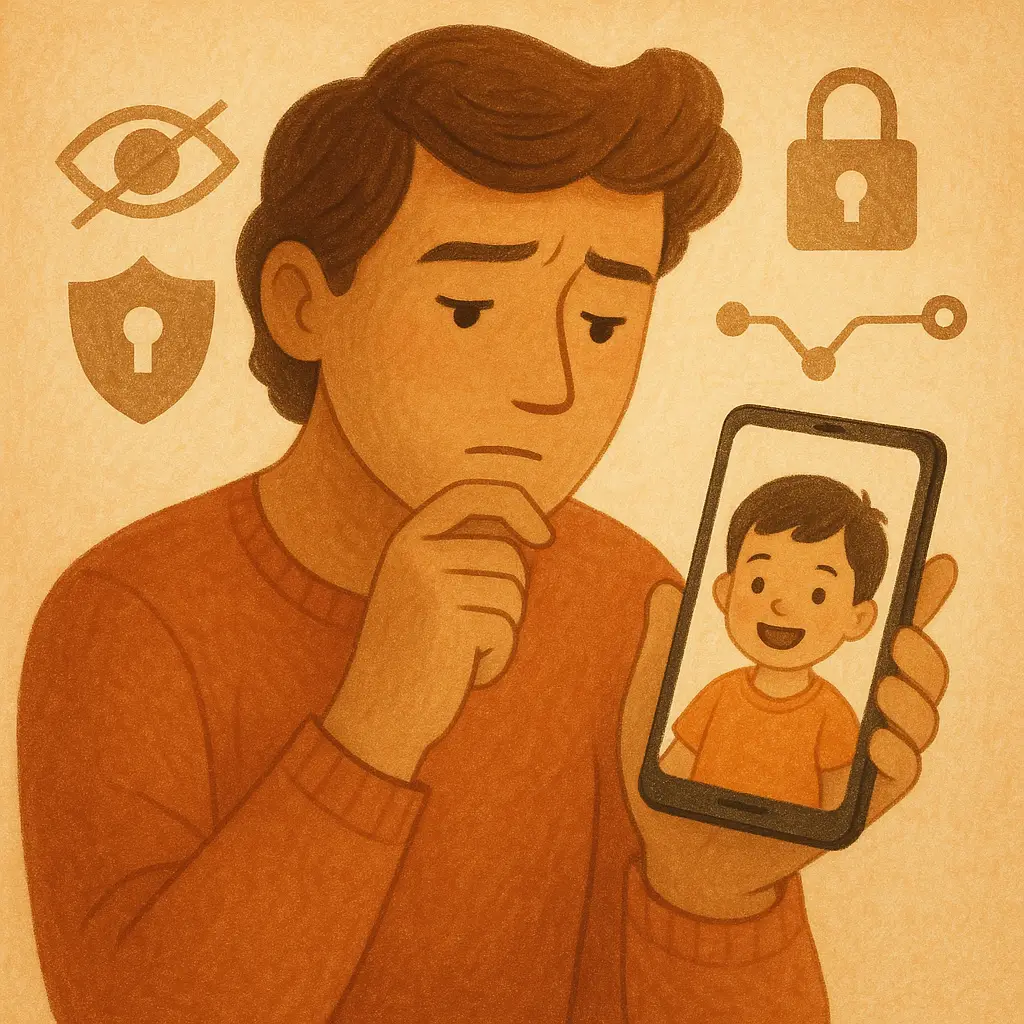
You're at the park. Your kid does something hilarious. You pull out your phone, snap a photo, and your thumb hovers over the share button.
This moment happens millions of times a day. Parents post photos of their children to Instagram, Facebook, family group chats, cloud albums, and private messaging apps. The photos accumulate. The digital footprint grows. And the privacy calculus gets more complicated with every tap.
The question isn't whether sharing kid photos is universally good or bad. It's whether you understand the actual tradeoff you're making each time you post.
What happens to photos after you share them
When you post a photo to a social platform, you lose control of it in ways that aren't obvious from the interface.
The platform stores the image on its servers. Even if you delete the post later, the company typically retains the file in backups, archives, or internal systems. Some platforms explicitly state in their terms of service that deletion removes public visibility but not the underlying data.
Anyone who sees the photo can screenshot it, download it, or save it to their device. You can't prevent that. Privacy settings control who sees the post initially, but they don't stop people from creating copies that live outside the platform's control.
Facial recognition systems can index your child's face. Companies use these systems to organize photos, suggest tags, and power search features. Once a face is indexed, the system can potentially recognize that person across different photos, accounts, and platforms. The technology improves every year. What gets indexed now persists as the systems get better at connecting dots you didn't know existed.
Photos contain metadata. EXIF data embedded in image files can include the exact GPS coordinates where you took the photo, the time and date, and details about your camera or phone. Most platforms strip some metadata before displaying images publicly, but not all of them do, and the data exists in the original file before you upload it.
Search engines crawl public posts. If your profile is public or your privacy settings allow it, photos you post can appear in Google Images, Bing, or other search results. Someone searching your child's name years from now could find images you posted when they were three.
The persistence problem
Digital content doesn't fade the way physical photos do. A printed photo in a shoebox degrades over time. A digital photo posted online in 2026 will look identical in 2046, assuming the platform still exists and the servers still run.
Your child will grow up. The embarrassing bath time photo, the potty training victory, the tantrum at the grocery store, those moments pass quickly in real life. Online, they persist indefinitely.
Around age 13, kids start caring intensely about how they're perceived. What felt cute when they were four can feel humiliating when they're fourteen. You can't predict which photos will bother them, because you don't know who they'll become or what will matter to them when they're older.
Some parents argue that kids don't get to control their childhood documentation. That's true in the sense that parents make decisions for young children all the time. But posting online is different from showing a photo album to relatives. The audience is larger, the distribution is permanent, and the child has no say in who sees what.
The photos you post now create a digital history that your child inherits. They didn't choose it, they can't edit it, and they can't make it disappear. That inheritance shapes how strangers, future employers, romantic partners, and peer groups perceive them before they've had a chance to define themselves.
What strangers can do with photos
Most people who see photos of your kid online are harmless. They're friends, family, or acquaintances scrolling through their feed. But not everyone falls into that category.
Strangers can collect photos for purposes you never intended. Some people save images of children they find attractive in ways that aren't illegal but feel deeply wrong. Others compile photos to create fake profiles, impersonate families, or build convincing backstories for scams.
Facial recognition technology makes it easier to track individuals across platforms. Someone who sees your child's photo on Instagram can potentially find other photos of the same child on Facebook, TikTok, or public albums if the platforms use facial recognition to organize images. The more photos you post, the easier it becomes to build a comprehensive profile.
Photos reveal patterns. If you post pictures from the same playground every Tuesday at 3 PM, you've documented your routine. If your child wears a school uniform with a visible logo, you've identified their school. If you tag locations or mention neighborhoods, you've narrowed down where you live. Each individual photo might seem harmless, but the aggregate creates a map of your family's life.
Predators use publicly available information to build trust with children. Knowing a child's name, school, interests, and daily routine makes it easier to approach them online or in person with convincing familiarity. Most parents don't post enough detail for this to be a high-probability risk, but the risk isn't zero, and it scales with how much you share.
The platform's role in the equation
Social media companies make money by keeping you engaged. The algorithms that decide what you see prioritize content that generates reactions, likes, comments, shares, and time spent viewing. Photos of kids perform well because they trigger emotional responses. Platforms know this, and they optimize for it.
When you post a photo of your child, you're feeding the engagement machine. The platform analyzes the image, tracks who interacts with it, and uses that data to refine its understanding of what keeps people scrolling. Your child's face becomes part of the training data that teaches the algorithm what works.
Most platforms offer privacy settings that limit who can see your posts. You can restrict visibility to friends, create private groups, or share only with specific people. These settings work as advertised in the sense that they control initial access, but they don't prevent the people who do have access from saving, screenshotting, or resharing the content.
Platform terms of service typically grant the company a broad license to use your content. You retain ownership of the photos you post, but you also give the platform permission to store, display, and distribute those images as needed to operate the service. Some terms extend that license to include things like training AI models or creating promotional materials. Most people don't read the terms closely enough to know what they've agreed to.
Platforms get breached. In 2026, data breaches remain a persistent threat, and companies that store millions of user photos are high-value targets. A breach that exposes user data can include photos, metadata, and account information. Once leaked, that data spreads across the internet in ways that are nearly impossible to contain.
The family group chat isn't as private as it feels
Switching from public posts to private group chats reduces exposure, but it doesn't eliminate risk.
Messaging apps like WhatsApp, Signal, and iMessage store photos on company servers or in cloud backups. Even if the app uses end-to-end encryption, the photos often get backed up to cloud services that don't encrypt them the same way. Apple iCloud backups, for example, are encrypted in transit and at rest, but Apple holds the keys, which means the company can access the data if legally required to do so.
Anyone in the group chat can screenshot or save the photos you share. You can't prevent that, and you can't control what they do with the images afterward. They might post them to their own social media, forward them to someone else, or store them in a way that exposes them during a future breach.
Group chats grow over time. You might start with close family, but then someone adds a cousin, a neighbor, or a family friend. The more people in the group, the more copies of the photos exist on different devices, and the higher the chance that someone's phone gets lost, stolen, or compromised.
Private doesn't mean invisible. Law enforcement can request access to messaging data through legal channels, and companies comply when required. If your account gets hacked, the attacker gains access to everything in your message history, including photos. If the platform shuts down or changes ownership, the data policies that protect your content today might not apply tomorrow.
The consent question
Your child can't consent to having their photos posted online because they're too young to understand the implications. That's not a moral failing on your part, it's a reality of parenting young children. You make decisions for them all the time based on what you believe is best.
But the inability to consent now doesn't mean the decision is consequence-free later. When your child reaches an age where they can form opinions about their digital presence, they might wish you had made different choices. They might feel embarrassed by certain photos, frustrated by the volume of content, or angry that they didn't get a say in how they were represented online.
Some parents address this by asking older kids for permission before posting. That works once the child is old enough to have an opinion, but it doesn't solve the problem retroactively. The photos you posted when they were three are still out there, and deleting them from your account doesn't remove them from the internet.
The consent question gets harder when you consider that your child will eventually become an adult. The digital footprint you create for them now will follow them into job interviews, college applications, romantic relationships, and social circles. They'll inherit a version of themselves that they didn't choose and can't fully control.
In The Good Place, Eleanor Shellstrop spends the entire first season trying to escape the consequences of decisions her past self made without considering the future. The show treats this as comedy, but the underlying tension is real: the person you were at 25 shapes the life you live at 35, whether you like it or not. The same dynamic applies to kids growing up with a digital history they didn't author. The difference is that Eleanor made her own choices. Your kid didn't.
What you can control
You can't eliminate risk entirely, but you can reduce it by being deliberate about what you share and where you share it.
Ask yourself whether the photo reveals identifying information. Does it show your child's face clearly? Does it include a school name, team logo, or uniform? Does the background reveal your home address, a recognizable landmark, or a routine location? The more identifying details a photo contains, the higher the privacy cost.
Consider whether the photo documents a vulnerable moment. Bath time, potty training, tantrums, medical procedures, and emotional meltdowns are part of childhood, but they're also moments your child might not want preserved and distributed online. If you wouldn't want a photo of yourself in a similar state circulating the internet, think twice before posting it of your kid.
Think about who benefits from the post. Are you sharing the photo because it brings joy to grandparents who live far away? Are you documenting a milestone for your own memory? Or are you posting because the photo will get likes and comments that feel good in the moment? The answer matters, because it helps you distinguish between sharing that serves your family and sharing that serves the algorithm.
Adjust your privacy settings to limit who can see your posts. On most platforms, you can restrict visibility to friends, create custom lists, or share only with specific people. This doesn't prevent screenshots or resharing, but it reduces the initial audience and makes it harder for strangers to access your content.
Turn off location tagging. Most platforms let you disable automatic location data in posts. You can also manually remove location tags before sharing. This prevents the photo from broadcasting where you were when you took it.
Avoid tagging your child by name in public posts. If you tag them, the platform associates their name with their face, which makes it easier for facial recognition systems to track them across photos and accounts. Some parents use nicknames or initials instead of full names to reduce searchability.
Use private albums or shared folders instead of public posts. Services like Google Photos, iCloud Shared Albums, and Amazon Photos let you share photos with specific people without posting them to social media. The photos still live on company servers, but they're not indexed by search engines or visible to the general public.
Review what you've already posted and delete content that doesn't meet your current standards. Platforms make it easy to bulk-delete old posts or download your data and start fresh. Deleting a post removes it from public view, but it doesn't erase it from the platform's servers or from copies other people made. Still, reducing visibility is better than leaving everything up indefinitely.
The decision framework that works
There's no universal rule that fits every family. Some parents share freely and see no harm in it. Others avoid posting photos of their kids entirely. Most people fall somewhere in between, navigating the tradeoff on a case-by-case basis.
What helps is having a framework to guide decisions instead of relying on impulse or social pressure.
Start by asking whether the photo passes the "future test." Imagine your child at 15, 20, or 30. Would they be okay with this photo existing online? If the answer is no or even maybe, that's a signal to reconsider.
Next, ask whether the photo reveals information that could be used to identify, locate, or track your child. If it does, think about whether the benefit of sharing outweighs the risk of that information being out there.
Then, ask who actually needs to see the photo. If the answer is "close family," a private group chat or shared album works better than a public post. If the answer is "everyone I'm connected to on social media," ask yourself why that audience matters and whether the photo serves a purpose beyond generating engagement.
Finally, ask whether you're sharing the photo for your child or for yourself. There's nothing wrong with documenting your own experience of parenthood, but if the primary beneficiary of the post is you and the primary subject is your child, the consent question becomes harder to ignore.
What research suggests about long-term effects
Researchers have started studying how growing up with a digital footprint affects kids, but the field is still young because the first generation of children with extensive online histories is just now reaching adulthood.
Some studies suggest that kids whose parents posted frequently about them online report feeling embarrassed, frustrated, or violated when they become old enough to understand what was shared. Other research indicates that the relationship between parents and children can suffer when kids feel their privacy wasn't respected during childhood.
There's also evidence that young adults struggle with the disconnect between how they see themselves and how they're portrayed in photos their parents posted years earlier. The version of them that exists online doesn't match the person they've become, but they can't fully control or erase that earlier representation.
At the same time, some young adults report feeling grateful that their parents documented their childhood in ways that created a rich archive of memories. The difference seems to hinge on whether the child feels their parents were thoughtful about what they shared and respectful of boundaries as the child grew older.
The long-term effects likely depend on context, volume, and the nature of the content. A few carefully chosen photos shared with a small audience probably create less friction than hundreds of posts documenting every milestone, mishap, and mundane moment.
The legal landscape
In most places, parents have broad authority to make decisions about their children's image and likeness. There's no law in the United States that prohibits parents from posting photos of their own kids online, and platforms generally don't restrict this behavior as long as the content doesn't violate terms of service around nudity, exploitation, or harm.
Some countries have stronger privacy protections for children. France, for example, recognizes a child's right to privacy even within the family, and parents can theoretically face legal consequences if they post content that harms their child's dignity or reputation. In practice, enforcement is rare, but the legal framework acknowledges that children have privacy interests separate from their parents.
As kids who grew up with extensive digital footprints reach adulthood, some are exploring legal options to control or remove content their parents posted without their consent. A few cases have made headlines, but the law in this area is still evolving, and outcomes vary widely depending on jurisdiction and circumstances.
The FTC provides guidance on protecting children's privacy online, but most of that guidance focuses on how companies collect and use data rather than on what parents choose to share. The legal responsibility for deciding what to post still rests with you.
What you owe your kid
You owe your child safety, stability, and the opportunity to develop into whoever they're going to become. Part of that is protecting their privacy in ways they can't protect themselves.
That doesn't mean never posting a photo. It means being deliberate about what you share, where you share it, and why. It means recognizing that the convenience of sharing a cute moment with 500 people on Instagram comes with a privacy cost that your child will pay later.
It means understanding that platforms, algorithms, and strangers don't have your child's best interests in mind. You do. And that responsibility doesn't end when you hit the share button, it extends to thinking through what happens next.
The privacy calculus isn't simple, and there's no formula that spits out the right answer every time. But the calculus exists whether you think about it or not. The question is whether you're making the tradeoff consciously or letting the default settings and social norms make it for you.
Your kid didn't ask to be born into a world where every moment can be documented, distributed, and archived forever. But here we are. The least you can do is think carefully about what you're building for them before you add another brick to the digital footprint they'll inherit.