Local SIM vs International Roaming vs eSIM: Which Mobile Data Option Actually Works for Travel
You land in Barcelona. Your phone says "No Service." You need maps, you need messaging, you need to tell someone you've arrived. Now what?
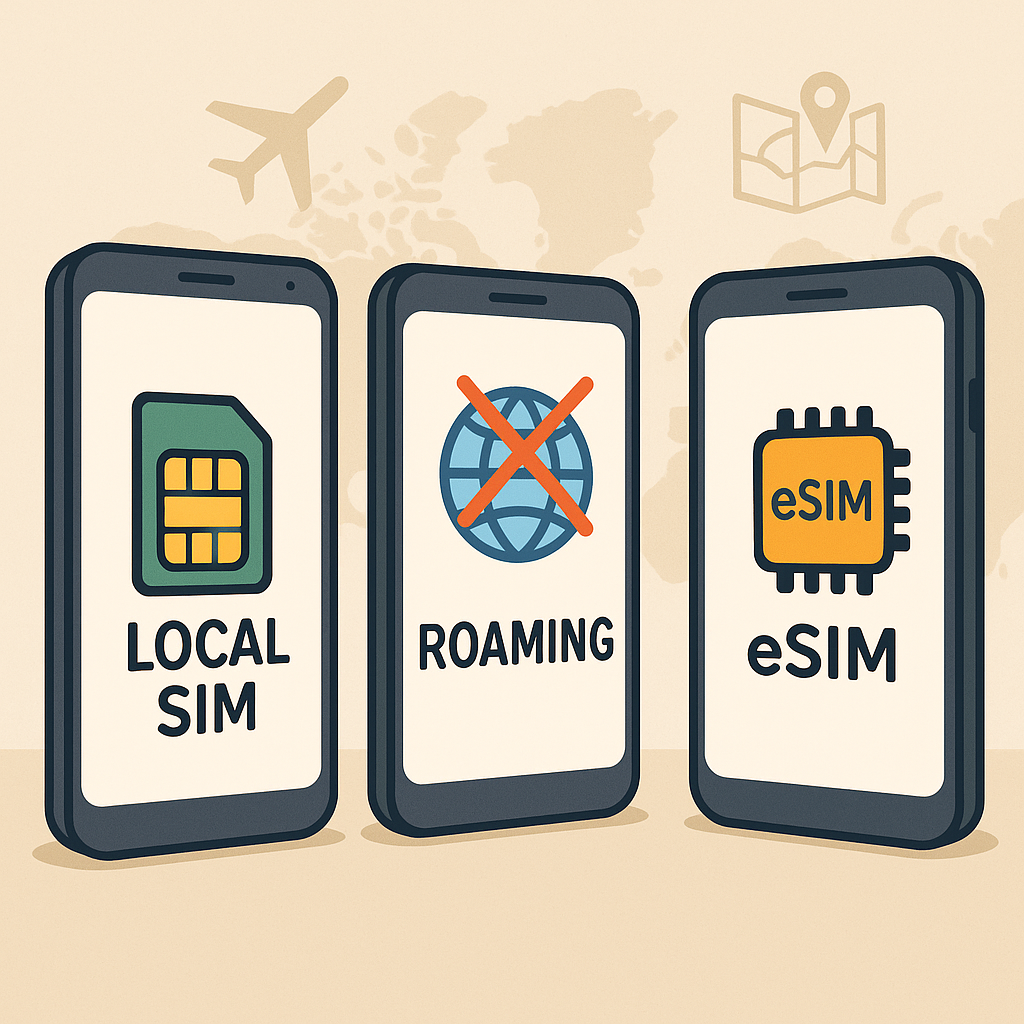
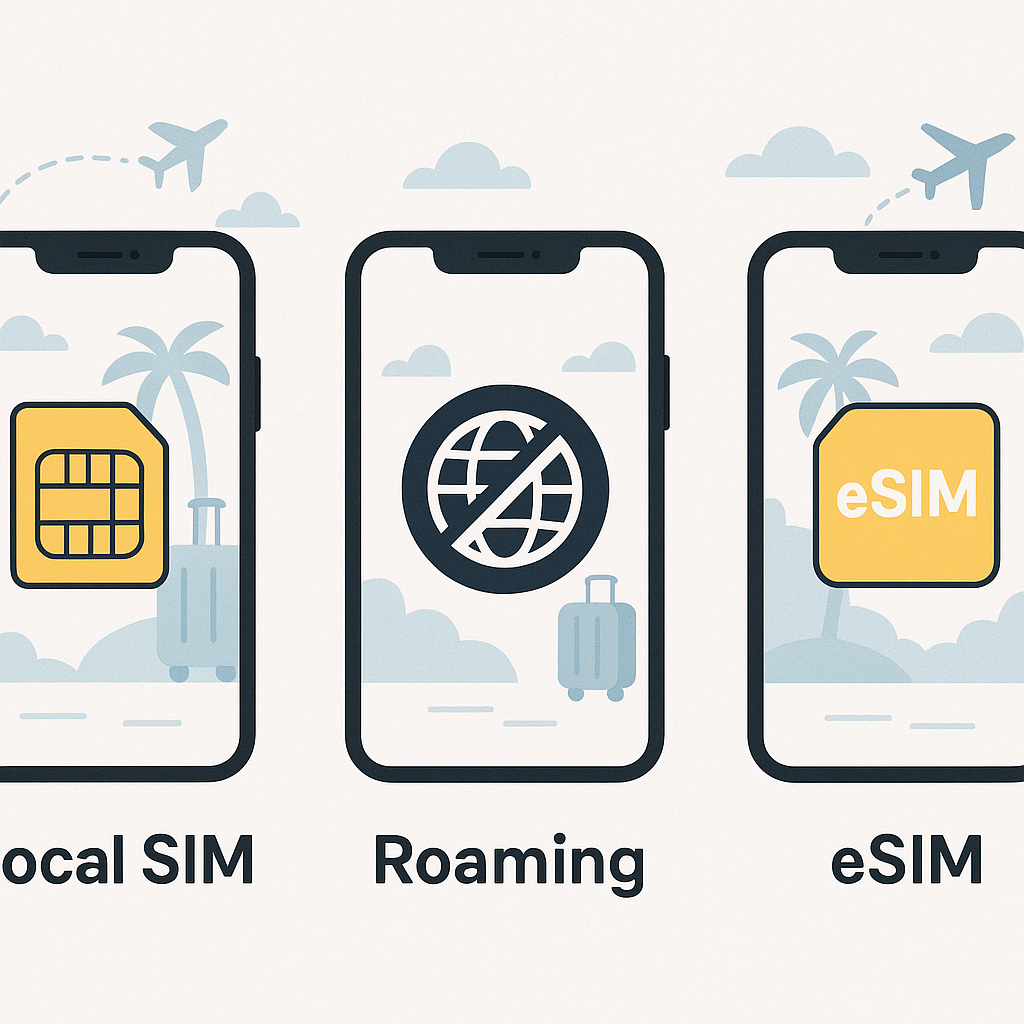
Three options: buy a local SIM card from a kiosk, pay your carrier's international roaming fees, or download an eSIM profile before you left. Each one gets you online, but the mechanics, costs, and tradeoffs differ enough that the wrong choice costs you money, time, or both.
This is a comparison. Not a philosophical exploration of connectivity or a meditation on the digital nomad lifestyle. We're looking at three specific solutions to one specific problem, getting mobile data when you travel internationally, and we're comparing them on the criteria that actually matter: cost, setup friction, speed, coverage, and security.
What You're Actually Comparing
All three options connect your phone to a cellular network in a foreign country, but the path from your device to that network is different in each case.
Local SIM card: You buy a physical SIM from a carrier in the destination country, remove your home SIM, insert the local one, and configure your phone to use it. Your phone now acts as a local customer of that carrier. You get a local phone number, local data rates, and local network priority.
International roaming: You keep your home carrier's SIM in your phone. When you cross a border, your phone connects to a foreign network through a wholesale agreement your carrier has with that network. You keep your home phone number. Your carrier bills you for the roaming usage, either per day, per megabyte, or through a monthly add-on plan.
eSIM: You download a digital SIM profile from an eSIM provider (sometimes your home carrier, sometimes a third-party service) before you travel or after you land. The profile activates when you arrive. Your phone connects to a foreign network through that provider's wholesale agreements, similar to roaming but with a different billing relationship. You may get a temporary local number or just data service, depending on the provider.
The comparison framework is cost, setup complexity, data speed, coverage reliability, and security posture. We'll walk through each.
Cost: What You Actually Pay
Local SIM cards are the cheapest option if you're staying in one country for more than a few days. A week of data in most European countries costs $10-20. Southeast Asia runs $5-15. Japan runs $20-30. You buy the SIM at the airport, a convenience store, or a carrier shop, and you're done. No ongoing billing, no surprises.
The friction is upfront. You need to find a shop, compare plans (often in a language you don't speak fluently), hand over cash or a card, and wait for activation. Some airports have SIM vending machines. Some don't. Some carriers require passport verification. Some don't. The process takes anywhere from five minutes to an hour depending on location and luck.
International roaming from U.S. carriers costs more. Verizon's TravelPass is $12 per day in most countries. AT&T's International Day Pass is $12 per day. T-Mobile includes unlimited international data in some plans, but throttles speeds to 2G (around 128 kbps) unless you pay $5 per day for high-speed access or $50 per month for 15GB of high-speed data.
The convenience is real. You land, your phone connects, you're online. No shop visit, no SIM swap, no configuration. But the daily fees add up fast. A week costs $84 with Verizon or AT&T. Two weeks costs $168. A month costs more than most people's entire home phone bill.
eSIM services sit in the middle. Saily charges $4.99 for 1GB in Spain, $9.99 for 3GB, $18.99 for 10GB. Airalo charges similar rates. Prices vary by destination, some countries cost more, some less, but the pattern holds: cheaper than daily roaming, more expensive than local SIMs, and you pay only for what you use.
The setup happens before you leave or right after you land, assuming you have WiFi. You download the eSIM profile through an app, activate it, and switch your phone's data settings to use the new profile. No physical shop, no SIM swap, but also no instant activation if you don't plan ahead.
Setup Friction: What You Actually Do
Local SIM cards require the most physical action. You need to locate a shop, purchase the SIM, remove your home SIM (which means you need a SIM ejector tool or a paperclip), insert the new SIM, wait for activation, and configure APN settings if they don't auto-configure. Then you need to store your home SIM somewhere you won't lose it.
If your phone supports dual SIM (physical SIM plus eSIM, or two physical SIM slots), you can keep your home SIM active for calls and texts while using the local SIM for data. If not, you lose access to your home number until you swap SIMs again.
Some travelers carry a second phone for the local SIM. Some carry a SIM case with slots for multiple cards. Some just accept that they'll lose their home number for the duration of the trip. The logistics are annoying but manageable if you've done it before.
International roaming requires zero setup if your carrier includes it in your plan. T-Mobile customers with Magenta or Magenta Max plans land, connect, and go. Verizon and AT&T customers with TravelPass or International Day Pass need to enable the feature before they leave (or it activates automatically when they use data abroad), but there's no SIM swap, no shop visit, no configuration.
The tradeoff is cost. You're paying for convenience, and the convenience is substantial if you're traveling for a few days or hopping between countries frequently.
eSIM setup happens in software. You download an eSIM app (Saily, Airalo, Holafly, or your carrier's app if they offer eSIM roaming), purchase a plan, scan a QR code or enter an activation code, and wait for the profile to download. The process takes 2-10 minutes depending on your phone model and whether you're on WiFi.
Once the eSIM profile is installed, you switch your phone's cellular data setting to use the eSIM instead of your physical SIM. Your home SIM stays in the phone and remains active for calls and texts (if your phone supports dual SIM), but data routes through the eSIM.
The friction is minimal if you plan ahead. If you wait until you land and you don't have airport WiFi, you're stuck until you find a connection. Some eSIM services let you purchase and install profiles before you leave, which eliminates the WiFi dependency.
Speed and Coverage: What You Actually Get
Local SIM cards deliver the fastest speeds and the most reliable coverage because you're a direct customer of the local carrier. You're not routing through a wholesale agreement. You're not subject to roaming throttles. You get the same speeds and priority as any other customer on that network.
The limitation is geography. If you're traveling through multiple countries, you need a new SIM for each one (or a regional SIM that works across borders, which costs more and covers fewer countries than you'd expect). Swapping SIMs every time you cross a border gets old fast.
International roaming speeds depend on your carrier's wholesale agreements with foreign networks. T-Mobile's international data is capped at 2G speeds (128 kbps) unless you pay extra. Verizon and AT&T deliver full LTE or 5G speeds through TravelPass and International Day Pass, but those speeds depend on the local network your phone connects to and the terms of the roaming agreement.
Some roaming agreements deprioritize roaming customers during network congestion. You might see full bars but slow speeds because local customers get priority. This isn't universal, but it happens often enough that you shouldn't assume roaming speeds will match local speeds.
eSIM speeds also depend on wholesale agreements, but the agreements vary by provider. Saily, Airalo, and similar services negotiate their own deals with local carriers, and those deals sometimes deliver better speeds than your home carrier's roaming agreements. Sometimes worse. There's no universal rule.
The advantage of eSIM over roaming is cost, not speed. If you're paying $5-20 for an eSIM plan instead of $12 per day for roaming, you're getting similar speeds (usually LTE, sometimes 5G depending on the destination) for a fraction of the price.
Coverage follows the same pattern. Local SIMs give you the full coverage footprint of the local carrier. Roaming and eSIM give you whatever coverage the wholesale agreements provide, which is usually the largest carrier in the country but not always.
Security and Privacy: What You're Trading
All three options expose your device to cellular network security risks. Cellular networks use SS7 and Diameter protocols for routing and authentication, and both protocols have known vulnerabilities that allow interception of calls and texts. This is true whether you're using a local SIM, roaming, or eSIM.
The difference is metadata exposure. Local SIMs register you as a customer of the local carrier, so your usage data (which towers you connect to, which websites you visit, how much data you use) lives with that carrier. Some countries have strong data protection laws. Some don't. You're trusting a foreign carrier with your activity logs.
International roaming keeps your usage data with your home carrier, which then shares some of that data with the foreign carrier for billing and network management. Your home carrier sees your activity. The foreign carrier sees your connection metadata. Both have access to different pieces of the puzzle.
eSIM providers sit in the middle. They negotiate with foreign carriers on your behalf, so your usage data flows through the eSIM provider first, then to the foreign carrier. You're trusting the eSIM provider's data handling policies, which vary widely. EFF's Surveillance Self-Defense guide covers threat modeling for international travel, but the short version is: if your threat model includes state-level surveillance, none of these options protect you. If your threat model is opportunistic interception or commercial data harvesting, eSIM and roaming expose you to fewer local carrier data retention policies than local SIMs.
Physical security differs. Local SIMs can be removed from your phone if it's stolen, which means the thief can't access your accounts through SMS-based two-factor authentication (assuming you have a screen lock). eSIM profiles can't be physically removed, but they can be deleted through software if the thief gets past your screen lock.
The practical takeaway: use a strong screen lock (biometric plus PIN, not just biometric), enable remote wipe through Find My iPhone or Find My Device, and assume that any cellular connection exposes your location and metadata to someone. The question is who, and whether you care.
When to Use Which Option
Use a local SIM if you're staying in one country for a week or longer, you want the fastest speeds and best coverage, and you don't mind the friction of buying and installing a physical card. This is the cheapest option per gigabyte, and it's the most reliable option for data-heavy use like video calls or hotspot tethering.
Use international roaming if you're traveling for a few days, hopping between countries frequently, or you value convenience over cost. The daily fees hurt, but the zero-setup experience is worth it if you're landing in three countries in five days and you don't want to deal with SIM logistics.
Use eSIM if you want a middle ground: cheaper than roaming, less friction than local SIMs, and good enough speeds for most use cases. This works well for trips longer than a few days but shorter than a month, especially if you're visiting multiple countries and you want one plan that covers all of them (regional eSIM plans exist for Europe, Asia, and other regions).
The decision tree is cost versus convenience versus duration. Short trips favor roaming. Long single-country trips favor local SIMs. Multi-country trips of moderate length favor eSIM.
Dual SIM and Hybrid Approaches
Most modern phones support dual SIM: one physical SIM slot plus eSIM, or two physical SIM slots. This lets you keep your home number active while using a local SIM or eSIM for data.
The configuration: keep your home SIM active for calls and texts, but disable it for cellular data. Set the local SIM or eSIM as your data line. Incoming calls and texts to your home number still reach you. Outgoing calls and texts use your home number and your home carrier's international rates (which are usually expensive), so you'll want to use WiFi calling or messaging apps instead.
This hybrid approach gives you the best of both worlds: local data rates and speeds, plus access to your home number for important calls or two-factor authentication codes. The tradeoff is battery drain (your phone maintains two cellular connections simultaneously) and the need to manage which line is active for which purpose.
Some travelers use this setup with two eSIM profiles instead of a physical SIM plus eSIM: one eSIM for their home carrier, one eSIM for local or regional data. This works if your home carrier supports eSIM and your phone supports multiple eSIM profiles (most iPhones and recent Android phones do).
What About WiFi?
Airports, hotels, cafes, and public spaces offer WiFi, and WiFi avoids cellular costs entirely. But WiFi isn't a replacement for cellular data when you're navigating an unfamiliar city, waiting for a rideshare, or trying to find your hotel at midnight.
The security posture of public WiFi is worse than cellular in most cases. Cellular networks use encryption between your device and the tower (though the encryption can be broken with specialized equipment). Public WiFi often uses no encryption or weak encryption, and even encrypted WiFi exposes your activity to the network operator.
CISA's cybersecurity best practices recommend avoiding sensitive transactions on public WiFi, but the practical reality is that most web traffic uses HTTPS, which encrypts your data end-to-end regardless of the underlying network. The risk is metadata exposure (which sites you visit, when you visit them) and the possibility of man-in-the-middle attacks if you ignore certificate warnings.
Cellular data is more secure than public WiFi for most use cases, but it's not immune to interception. The tradeoff is convenience and cost, not absolute security.
The eSIM Landscape in 2026
eSIM adoption has accelerated. Most phones sold in the U.S. since 2020 support eSIM. Apple removed the physical SIM slot from U.S. iPhone models starting with the iPhone 14. Android manufacturers followed. The result: eSIM is now the default for many travelers, whether they planned for it or not.
The provider landscape is crowded. Saily, Airalo, Holafly, Nomad, and dozens of other services compete on price, coverage, and features. Some offer data-only plans. Some include a temporary local phone number. Some provide regional plans that work across multiple countries. Some offer global plans that work almost everywhere (at a premium price).
Your home carrier may also offer eSIM roaming plans that are cheaper than traditional roaming but more expensive than third-party eSIM services. Verizon, AT&T, and T-Mobile all offer eSIM options now, and the pricing has improved as competition increased.
The decision framework is the same: compare cost, coverage, and setup friction for your specific trip. Don't assume one provider is always better. Prices vary by destination, and the cheapest option in Europe might be expensive in Asia.
Real-World Scenarios
Scenario 1: Week in Paris, occasional data use. Local SIM wins. You'll pay around €15 for 10GB, which is more than enough for maps, messaging, and occasional browsing. The setup friction is minimal (SIM vending machines at Charles de Gaulle are reliable), and the speeds are excellent.
Scenario 2: Three days in London for a conference. Roaming wins if you're on Verizon or AT&T. Three days costs $36, which is more than a local SIM but less annoying than finding a shop and swapping SIMs for a short trip. If you're on T-Mobile with included international data, you're already covered (though speeds will be slow).
Scenario 3: Two weeks across Spain, France, and Italy. eSIM wins. A regional eSIM plan covering all three countries costs $20-40 depending on data amount, which is cheaper than roaming and less annoying than buying three local SIMs. Speeds are good enough for navigation and messaging, and you don't need to swap SIMs at each border.
Scenario 4: Month in Japan, heavy data use for work. Local SIM wins. You'll need 20-50GB for video calls, file uploads, and hotspot tethering, and local SIM plans deliver that at $30-50. Roaming would cost $360 for the month. eSIM would cost $60-100 depending on provider, but local SIM speeds and coverage are better.
Scenario 5: Weekend in Mexico from the U.S. Roaming wins if you're on T-Mobile (included in most plans). eSIM wins if you're on Verizon or AT&T and you don't want to pay $12 per day. Local SIM is overkill for two days.
What You Need to Know Before You Leave
Check if your phone is unlocked. Carrier-locked phones won't accept local SIMs or third-party eSIM profiles. You can request an unlock from your carrier if you've paid off your device and you're not under contract, but the process takes a few days, so don't wait until the night before you leave.
Check if your phone supports eSIM. Most iPhones since the XS (2018) support eSIM. Most Android phones since 2020 support eSIM, but some budget models and some carrier-specific models don't. Look for "eSIM" in your phone's settings under Cellular or Mobile Data.
Check if your phone supports dual SIM. This determines whether you can keep your home number active while using a local SIM or eSIM for data. iPhones with eSIM support dual SIM (physical SIM plus eSIM). Most Android phones with eSIM also support dual SIM, but the implementation varies by manufacturer.
Check your carrier's roaming rates before you leave. Don't assume roaming is expensive. T-Mobile includes free international data in many plans. Google Fi includes free international data in all plans. Verizon and AT&T charge per day, but the rates are predictable and sometimes worth it for short trips.
Check eSIM provider coverage for your destination. Not all eSIM providers cover all countries, and some providers have better agreements with local carriers in some regions than others. Read recent reviews. Prices and coverage change frequently.
The Stranger Things Principle
In Stranger Things, Eleven uses her powers to flip between dimensions, the normal world and the Upside Down, by concentrating on the right frequency. She's physically in one place, but she's accessing a parallel version of reality that exists alongside it.
That's how cellular roaming works. Your phone is physically in Barcelona, but it's authenticating through a network tunnel that routes back to your home carrier in the U.S., then forward again to the Spanish carrier your home carrier has an agreement with. You're in two places at once: a customer of your home network, accessing service through a foreign network, billed as if you're still home but with a surcharge for the dimensional crossover.
Local SIMs collapse that duality. You're just in Barcelona, on a Barcelona network, as a Barcelona customer. No tunnel, no split identity, no surcharge for crossing dimensions. eSIM sits in between: you're in Barcelona, but your billing relationship is with a third-party service that negotiates access on your behalf, so you're not quite local and not quite roaming. You're in a third dimension that exists because the technology allows it.
The analogy holds because the choice between these options is about how much dimensional complexity you're willing to tolerate. Roaming keeps you tethered to home. Local SIM cuts the tether entirely. eSIM gives you a new tether that's cheaper and more flexible but still a tether. Which dimension you choose depends on how long you're staying and how much you're willing to pay for the privilege of staying connected to both worlds at once.
What Actually Matters
Cost matters if you're traveling for more than a few days. Roaming fees add up fast, and the convenience doesn't justify the expense for trips longer than a week unless you're on a corporate card.
Setup friction matters if you're landing in a foreign country late at night, tired, and you just want your phone to work. Roaming wins here. eSIM is a close second if you planned ahead. Local SIM is last.
Speed matters if you're doing anything data-intensive: video calls, large file uploads, hotspot tethering. Local SIM wins. Roaming and eSIM are usually good enough for maps and messaging but not always.
Coverage matters if you're traveling outside major cities. Local SIMs give you the full carrier footprint. Roaming and eSIM give you whatever the wholesale agreements cover, which is usually fine but not always.
Security matters if your threat model includes state-level surveillance or you're carrying sensitive data. None of these options protect you from determined adversaries, but local SIMs expose you to foreign carrier data retention policies, and roaming keeps more of your data with your home carrier. eSIM is a middle ground.
The comparison framework is cost, friction, speed, coverage, and security. Weight them based on your specific trip, your specific needs, and your specific threat model. There's no universal answer, but there is a right answer for your situation if you think through the tradeoffs before you leave.