Buy-Now-Pay-Later: What the Deferred Payment Model Actually Means for Your Credit
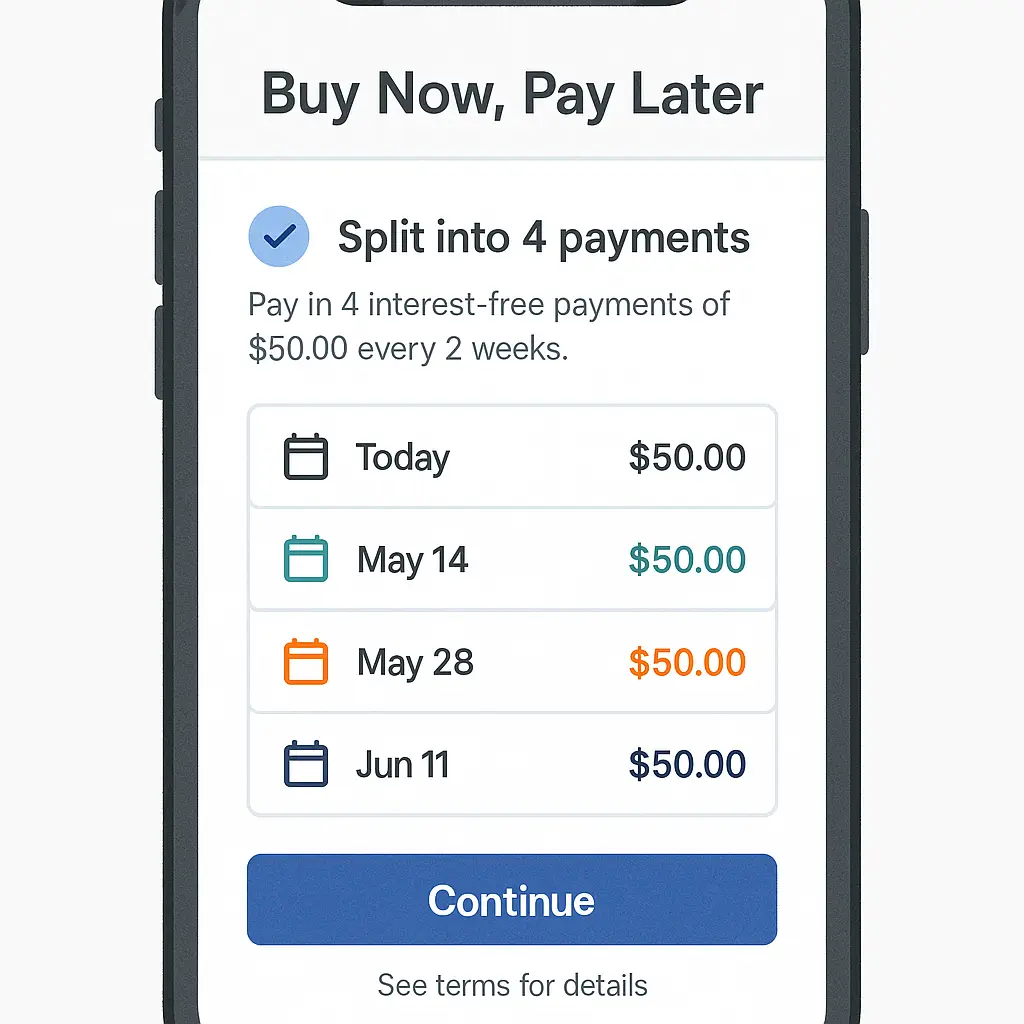
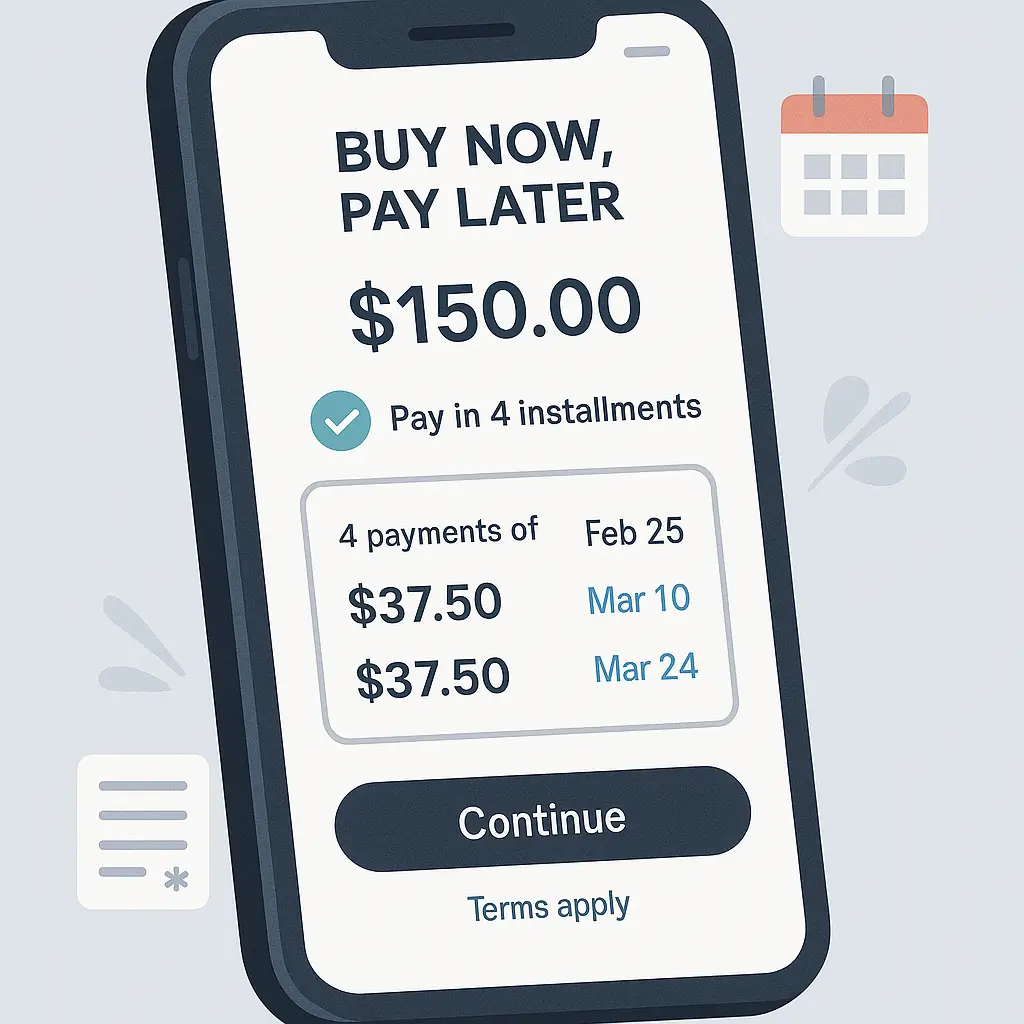
Buy-now-pay-later appeared in online checkout flows around 2015 and exploded during the pandemic. The pitch is simple: split your purchase into installments, usually four payments over six weeks, with no interest if you pay on time. Click a button, enter some basic information, get approved in seconds, and walk away with your stuff while paying later.
Around 100 million Americans have used BNPL at least once. The FTC reports that complaints about payment processing and debt collection have increased alongside BNPL adoption, though the agency doesn't break out BNPL-specific data. The Consumer Financial Protection Bureau receives complaints about BNPL services, but the category is still relatively new in regulatory reporting.
The mechanism looks like layaway in reverse: you get the product immediately and pay over time. But the underlying structure is more complex than that framing suggests, and the tradeoffs are real.
The Underlying Mechanism
When you choose BNPL at checkout, you're entering a short-term loan agreement with a third-party lender, not the retailer. The BNPL provider pays the merchant upfront, then collects from you in installments.
The typical structure: four equal payments, first payment due at purchase, remaining three payments spaced two weeks apart. No interest if you pay on time. Late fees if you don't. Some providers charge interest from the start; others add it only after missed payments.
The approval process runs a soft credit check or uses alternative data like bank account history and purchase behavior. Approval is fast because the loan amount is small and the repayment period is short. The provider is betting you'll pay within six weeks, and if you don't, they'll either collect fees or write off the loss as a cost of doing business.
The economic model depends on three revenue streams: merchant fees (the retailer pays the BNPL provider a percentage of the sale, typically higher than credit card processing fees), late fees from consumers who miss payments, and interest charges on longer-term plans. The no-interest promise holds only if you pay on time and choose the standard plan.
What BNPL Does to Your Credit
Credit reporting for BNPL is inconsistent. Some providers report all activity to credit bureaus; others report only negative information like missed payments; some don't report at all. This creates unpredictability.
If your BNPL provider reports positive payment history, on-time payments can help build credit. If they only report negative information, you get no credit-building benefit but still risk damage from missed payments. If they don't report at all, BNPL activity is invisible to your credit score, until you apply for a mortgage and the lender asks about undisclosed debt.
Hard credit inquiries from BNPL applications can lower your score temporarily, but most providers use soft checks that don't affect your credit. The inconsistency means you need to check each provider's policy before you apply.
Credit utilization doesn't apply to BNPL the way it does to credit cards, because BNPL loans are installment debt, not revolving credit. But multiple active BNPL plans can signal financial stress to lenders reviewing your application for a mortgage or car loan. Even if the BNPL debt doesn't appear on your credit report, lenders may ask about it during underwriting.
The credit impact depends on which provider you use, how they report, and whether you pay on time. There's no universal answer.
The Convenience Trap
BNPL makes impulse purchases frictionless. You see something you want, you click a button, you own it. The psychological barrier of paying upfront disappears. The first payment is small enough to feel manageable, and the future payments feel distant.
This is by design. BNPL providers optimize checkout flows to reduce friction. The approval process is fast, the interface is clean, and the payment schedule is presented as a series of small, affordable chunks rather than a total cost.
The problem emerges when you use BNPL across multiple providers and multiple purchases. Each BNPL plan operates independently. You might have four payments due to Affirm, three to Afterpay, and two to Klarna, all on different schedules. Tracking becomes complicated. Missed payments become likely.
Overdraft fees compound the problem. If you don't have enough in your account when a BNPL payment processes, you pay both the BNPL late fee and your bank's overdraft fee. Two fees for one missed payment.
The convenience of BNPL works best when you use it sparingly, track every payment manually, and have enough cushion in your account to absorb timing mismatches. The convenience becomes expensive when you treat it like free money.
Fraud Protection Gaps
Credit cards offer robust fraud protection under federal law. If someone steals your card and racks up charges, your liability is capped at $50, and most issuers waive even that. You can dispute charges, freeze your account, and reverse transactions while the investigation proceeds.
BNPL doesn't offer the same protections. The legal framework is different. BNPL providers are not credit card issuers, so they're not bound by the same consumer protection rules. If someone uses your BNPL account to make fraudulent purchases, your recourse depends on the provider's internal policies, not federal law.
Some BNPL providers offer fraud protection voluntarily. Others don't. The terms vary by company. You might get full protection, partial protection, or no protection at all, depending on which service you use and how the fraud occurred.
Disputing a charge through BNPL is also more complicated than disputing a credit card charge. With a credit card, you call the issuer, explain the problem, and they handle the dispute with the merchant. With BNPL, you're dealing with the merchant directly for product issues and the BNPL provider for payment issues. The lines of responsibility are less clear.
If you receive a defective product or never receive the product at all, your ability to stop payment depends on the BNPL provider's policies and the merchant's return policy. You can't simply reverse the charge the way you can with a credit card. You're still on the hook for the installment payments while you work through the dispute process.
The Regulatory Gap
BNPL operates in a regulatory gray zone. Credit cards are governed by the Truth in Lending Act, which requires clear disclosure of interest rates, fees, and terms. BNPL providers argue they're not credit cards, so they're not bound by the same rules.
The Consumer Financial Protection Bureau has started paying attention. In 2022, the CFPB opened an inquiry into BNPL practices, focusing on data harvesting, debt accumulation, and regulatory compliance. But as of 2026, there's no comprehensive federal framework governing BNPL the way there is for credit cards.
Some states have introduced consumer protection bills targeting BNPL, but the patchwork of state-level regulation creates inconsistency. What's required in California might not be required in Texas. What's prohibited in New York might be legal in Florida.
The lack of standardized regulation means BNPL providers operate with more flexibility than credit card issuers. They can change terms, adjust fees, and modify reporting practices with less oversight. This benefits the providers but creates uncertainty for consumers.
When BNPL Makes Sense
BNPL works well for planned purchases when you have the money but want to smooth cash flow. You're buying a $400 appliance, you have $400 in your account, but you'd rather pay $100 now and $100 every two weeks for the next six weeks to avoid draining your emergency fund. That's a reasonable use case.
BNPL also works for purchases where the alternative is a high-interest credit card. If your only credit option charges 25% APR and you know you can pay off the BNPL plan in six weeks, BNPL is the better choice. You avoid interest charges and keep the debt short-term.
The key is treating BNPL like a budgeting tool, not a credit line. You're not borrowing money you don't have; you're restructuring the timing of money you do have. The purchase fits within your budget, the payment schedule is manageable, and you have a plan to pay it off on time.
BNPL makes the most sense when you use it infrequently, track every payment manually, and avoid stacking multiple BNPL plans simultaneously. One active BNPL plan at a time is manageable. Four active plans across three providers is a recipe for missed payments.
When BNPL Becomes Expensive
BNPL becomes expensive when you use it to buy things you can't afford. The installment structure makes the purchase feel smaller than it is. You see four payments of $50 instead of one payment of $200. The psychological framing shifts your perception of affordability.
Late fees add up fast. Miss one payment and you might pay $10 to $30 in fees, depending on the provider. Miss multiple payments and the fees compound. Some providers charge interest after the first missed payment, converting your no-interest plan into a high-interest loan retroactively.
Longer-term BNPL plans, 12 months, 24 months, often charge interest from the start. The no-interest promise applies only to the standard four-payment plan. If you choose a longer repayment period, you're paying interest, and the rate can be comparable to credit card rates or higher.
Stacking multiple BNPL plans creates a debt spiral. You have payments due to multiple providers on different schedules. You lose track of what's due when. You miss a payment, incur a fee, overdraft your account, incur another fee. The convenience that attracted you to BNPL in the first place becomes a source of financial stress.
The Data Collection Layer
BNPL providers collect more data than credit card issuers. They see what you buy, where you buy it, how often you buy it, and whether you return it. They track your browsing behavior, your purchase history, and your payment patterns. This data feeds into approval algorithms, risk models, and marketing strategies.
Some BNPL providers sell aggregated data to third parties. Others use it internally to build consumer profiles. The data collection is legal and disclosed in privacy policies, but the extent of tracking often surprises users who think BNPL is just a payment method.
The data also flows to merchants. BNPL providers share purchase data with retailers to help them optimize pricing, inventory, and marketing. Your BNPL activity becomes part of a larger data ecosystem that shapes what you see, what you pay, and what gets recommended to you.
If you care about minimizing data collection, BNPL is a poor choice. Credit cards collect transaction data, but BNPL providers collect transaction data plus behavioral data plus demographic data. The tradeoff for convenience is visibility.
Comparing BNPL to Credit Cards
Credit cards and BNPL solve different problems. Credit cards offer flexibility, fraud protection, and rewards programs. BNPL offers simplicity, no-interest terms for short repayment periods, and fast approval without a credit check.
Credit cards charge interest if you carry a balance, but they don't charge interest if you pay in full every month. BNPL charges no interest if you pay on time, but late fees can be higher than credit card late fees, and fraud protection is weaker.
Credit cards build credit history when used responsibly. BNPL might build credit, might not, depending on the provider. Credit cards offer dispute resolution and chargeback rights under federal law. BNPL offers dispute resolution at the provider's discretion.
Credit cards can trap you in revolving debt if you only make minimum payments. BNPL can trap you in a cycle of missed payments and fees if you overextend. Neither is inherently safer. The risk depends on how you use them.
If you have good credit and pay off your balance every month, a credit card is usually the better choice. You get fraud protection, rewards, and credit-building without paying interest. If you have poor credit or no credit and need to make a purchase you can pay off in six weeks, BNPL might be the better option. You avoid interest and get approval without a hard credit check.
The Schitt's Creek Problem
In Schitt's Creek, the Rose family loses their fortune and has to rebuild their lives from scratch in a small town. They're used to spending freely, and the transition to budgeting is painful. Moira tries to maintain her lifestyle on a fraction of her former income, and it doesn't work. She has to learn the difference between what she wants and what she can afford.
BNPL creates a similar dynamic. The installment structure makes purchases feel affordable when they're not. You're not asking "Can I afford this $200 purchase?" You're asking "Can I afford this $50 payment?" The framing changes the answer, but the underlying financial reality doesn't change.
The Rose family's recovery required honest budgeting and delayed gratification. BNPL works the same way. It's a tool that can help you manage cash flow, but only if you're already living within your means. If you're using BNPL to buy things you can't afford, you're not solving a cash flow problem, you're creating a debt problem.
The Practical Approach
If you're going to use BNPL, treat it like a budget line item, not a credit line. Before you click the button, ask yourself: Do I have the money to pay this off in full right now? If the answer is yes, and you're using BNPL to smooth cash flow, proceed. If the answer is no, and you're using BNPL because you can't afford the purchase otherwise, walk away.
Track every BNPL payment manually. Don't rely on autopay alone. Set calendar reminders for every payment date. Check your account balance before each payment processes. Make sure you have enough cushion to avoid overdrafts.
Limit yourself to one active BNPL plan at a time. Stacking multiple plans across multiple providers is where things fall apart. One plan is manageable. Four plans is chaos.
Read the terms before you agree. Check whether the provider reports to credit bureaus, what the late fee structure is, and what happens if you miss a payment. The terms vary by provider, and the differences matter.
If you miss a payment, deal with it immediately. Contact the provider, pay the late fee, get back on track. Don't let one missed payment turn into a cascade of fees and credit damage.
And if you find yourself using BNPL more than occasionally, step back and reassess. BNPL should be a convenience tool for planned purchases, not a lifeline for staying afloat. If you're relying on BNPL to cover basic expenses, the problem isn't cash flow, it's income versus spending. Fix the underlying issue before the debt spiral starts.