ATM Safety Abroad: Step-by-Step Protection for International Travelers
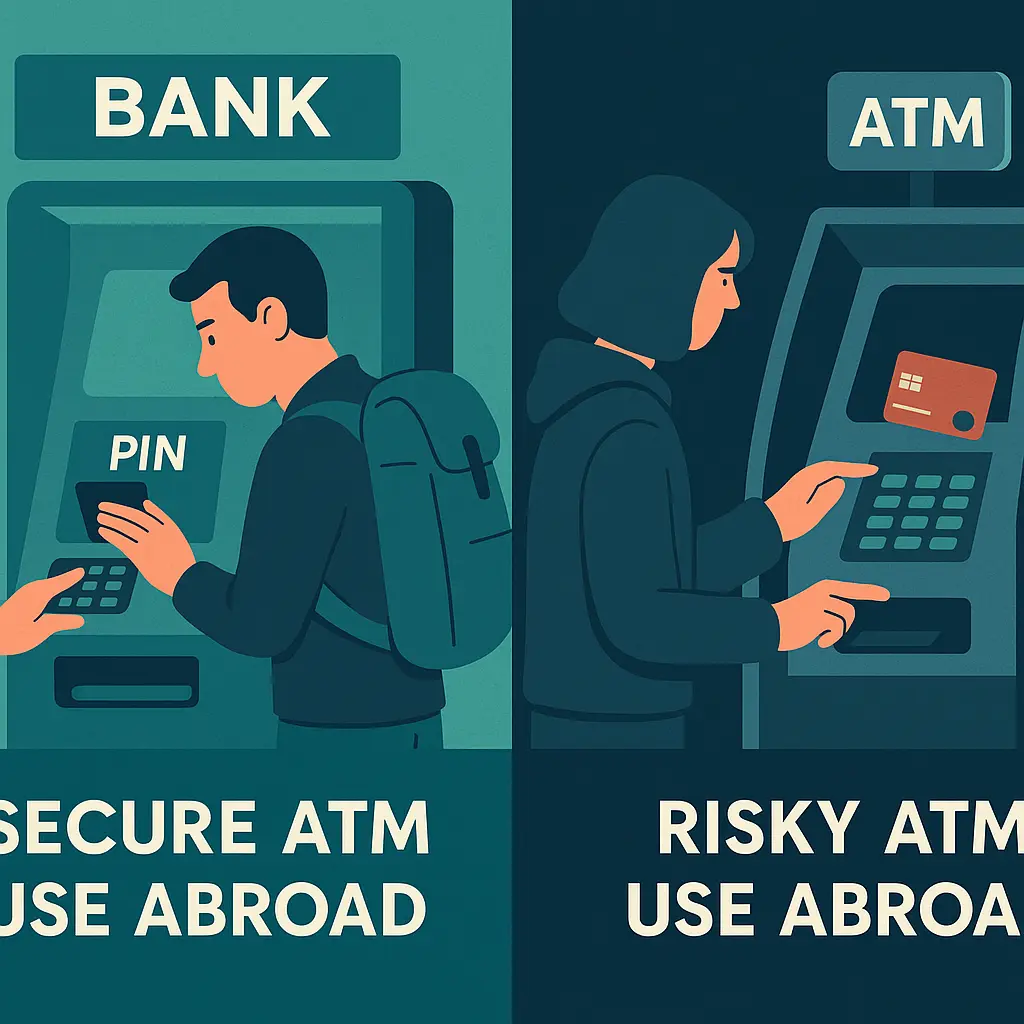
You're standing in front of an ATM in Prague at 11 PM, jet-lagged and low on cash. The machine looks different from what you're used to. There's a fee disclosure in Czech you can't quite parse. Your card goes in, and you're suddenly wondering whether this is safe.
International ATM use creates specific risks that don't exist at your neighborhood bank. Skimmers target tourist areas. Dynamic currency conversion quietly drains your account. Card retention in a foreign country becomes a crisis when you can't just walk into your branch.
This is the practical guide to using ATMs abroad without getting robbed, scammed, or locked out of your money. Here's what to do before you leave, how to choose safe machines when you arrive, and what to do when something goes wrong.
Before You Leave: Set Up Your Financial Safety Net
Start two weeks before departure. This gives you time to fix problems without scrambling at the airport.
Notify every financial institution. Call your bank and all credit card issuers. Give them your exact travel dates and every country you'll visit, including layovers. Most institutions let you register travel through their mobile apps, but calling creates a paper trail if fraud alerts still block your cards.
Why this matters: fraud detection systems flag foreign transactions as suspicious. Without advance notice, your card gets declined at the first ATM in Rome, and you're calling an international support line at 2 AM to prove you're really you.
Write down international support numbers. Your bank's toll-free number doesn't work from overseas. Find the international collect-call number, it's usually buried in the "Contact Us" section of the website under "Traveling Abroad." Save it in your phone and email it to yourself. Do this for every card you're bringing.
Enable transaction alerts. Set your banking app to notify you immediately for every transaction over $1. Real-time alerts let you catch fraud while you're still near the ATM, not three days later when the money's already moved.
Photograph both sides of every card. Store the images in a password-protected note in your password manager, not your phone's photo library. If your wallet gets stolen, you'll need those card numbers to report fraud and request emergency replacements.
Check your daily withdrawal limits. International ATMs often impose lower limits than domestic ones, and your bank's daily cap still applies. If your limit is $500 and the foreign ATM caps you at $300, you can't make two withdrawals to reach $500, the bank's daily limit blocks the second attempt. Know both numbers before you need cash urgently.
Bring two cards from different banks. If one card gets compromised, retained, or blocked, you need a backup that isn't connected to the same institution. A Visa and a Mastercard from different banks gives you redundancy if one network has outages.
Memorize your PINs. Don't write them down, don't store them in your phone, don't keep a photo of them. If you're using a card you rarely use, practice the PIN at a domestic ATM before you travel. Entering the wrong PIN three times at a foreign ATM can lock your card, and unlocking it from abroad is a nightmare.
Choosing Safe ATMs: What to Look For
Not all ATMs carry equal risk. Location, ownership, and physical condition tell you what you need to know.
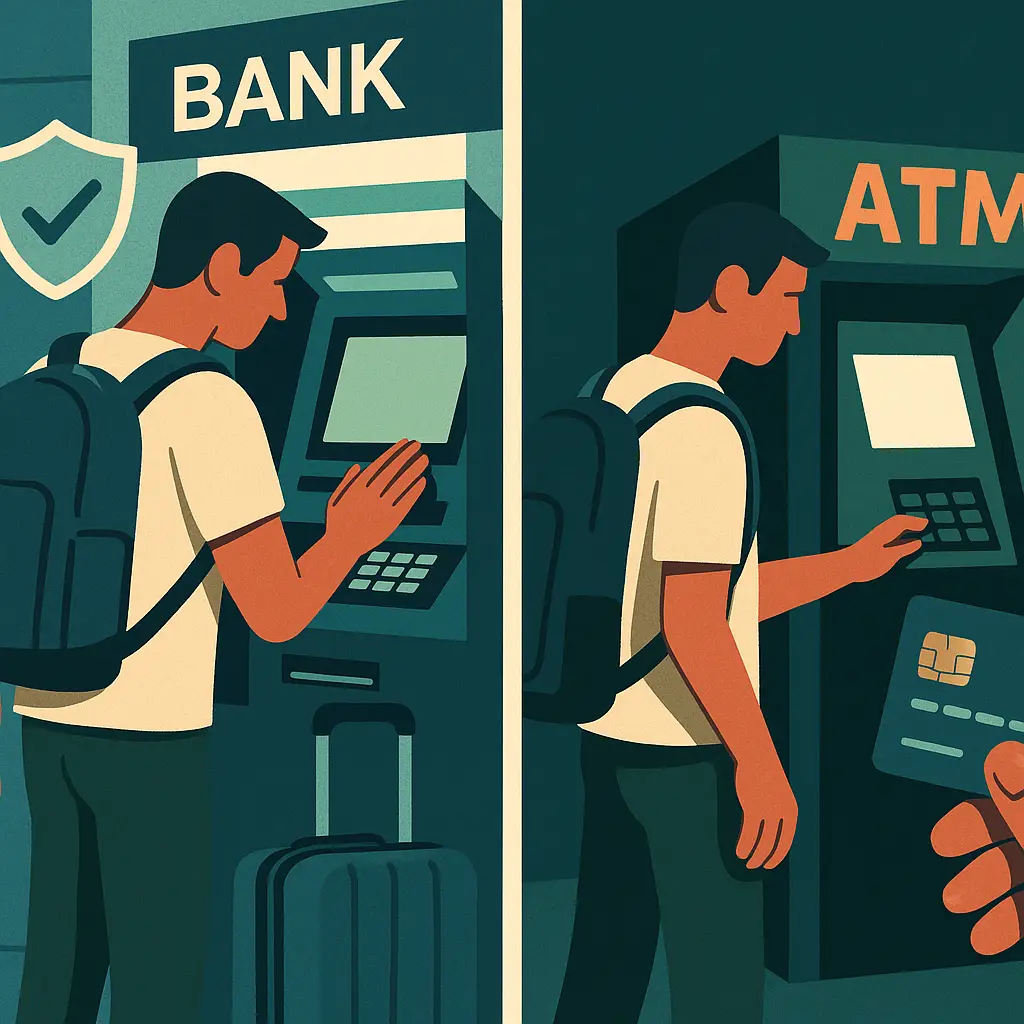
Use ATMs inside bank branches whenever possible. Machines inside lobbies have security cameras, regular maintenance, and bank employees nearby. Skimmers avoid them because the risk of detection is higher. Street-corner ATMs in tourist districts are the opposite, high traffic, low oversight, perfect for tampering.
Avoid standalone ATMs in tourist areas. The ATM outside the train station, in the airport arrival hall before you clear customs, or on the main tourist drag charges higher fees and attracts more skimmer installations. Walk two blocks to a bank.
Check the machine before inserting your card. Run your hand over the card slot. Legitimate readers sit flush with the machine and don't move when you wiggle them. Skimmers are overlays, they protrude slightly, feel loose, or have seams that don't match the machine's color. If the card slot looks newer or cleaner than the rest of the machine, that's a red flag.
Look for pinhole cameras. Skimmers need to capture your PIN, so they install tiny cameras in the pamphlet holder, the ceiling of the ATM enclosure, or a fake panel above the keypad. Inspect anything that could conceal a lens.
Shield your PIN entry. Every time. Even at ATMs that look safe. Cup your other hand over the keypad so no camera, skimmer or bank security, can see what you're typing. This defeats both skimmer cameras and shoulder surfers.
Avoid ATMs that display errors or unusual prompts. If the screen shows typos, strange fonts, or requests information your bank never asks for (like your full card number after you've inserted the card), cancel the transaction and leave. Skimmers sometimes replace the entire screen interface.
Use ATMs during business hours when possible. If something goes wrong, your card gets retained, the machine dispenses the wrong amount, or you suspect tampering, you want the bank open so you can walk inside and resolve it immediately.
The Transaction: Step-by-Step Protection
You've found a safe-looking ATM inside a bank. Here's how to complete the transaction without losing money to fees or fraud.
Insert your card and remove it quickly. Some skimmers work by trapping your card for a split second longer than normal, reading the magnetic stripe during that delay. Don't leave your card in the slot while you're thinking.
Decline dynamic currency conversion. This is the single most expensive mistake travelers make at foreign ATMs. The machine will ask if you want to complete the transaction in your home currency instead of the local currency. Always choose the local currency.
Here's why: dynamic currency conversion lets the ATM operator set the exchange rate, and they always set it 3-7% worse than the rate your bank would give you. If you're withdrawing €200 and the prompt says "Would you like to be charged $215 USD instead of €200?", you're looking at hidden markup. Decline it. Let your bank do the conversion at the mid-market rate.
The prompt is deliberately confusing. It frames the choice as a convenience, "See the charge in dollars so you know exactly what you're paying!" But you're paying extra for that "convenience." Always choose to be charged in the local currency.
Withdraw larger amounts less frequently. Every ATM transaction triggers fees from both the ATM operator and your bank. If your bank charges $5 per withdrawal and the ATM charges €3, making four small withdrawals costs you $32 in fees. One larger withdrawal costs you $8. The math is brutal.
Check your bank's foreign ATM fee structure before you leave. Some banks reimburse all ATM fees worldwide. Others charge a flat fee plus a percentage. If you're paying per transaction, minimize transactions.
Take your receipt. Even if you don't normally keep ATM receipts, take them abroad. They're evidence if you need to dispute a transaction, and they show the exact exchange rate and fees you were charged. Photograph them and store the images in your password manager, then destroy the physical receipts.
Don't count your cash at the ATM. Step away from the machine, find a secure location, and count it there. Standing at the ATM with a stack of bills tells everyone nearby that you're a tourist carrying cash.
Check your banking app immediately. Before you leave the ATM, open your app and verify the transaction posted correctly. If you withdrew €200 and your account shows a $500 charge, you need to report it now, not tomorrow.
When Things Go Wrong: Fraud, Retention, and Disputes
Despite precautions, cards get compromised. Here's what to do when it happens abroad.
If the ATM keeps your card: Stay at the machine. Call your bank immediately using the international number you saved before the trip. Report the retention, get a reference number, and ask them to block the card. If the ATM is inside a bank branch, go to the counter, they can sometimes retrieve retained cards on the spot.
Don't leave the ATM to "come back later." Skimmers install card traps specifically to harvest cards from travelers who walk away in confusion.
If you see unauthorized charges: Report them immediately through your banking app or by calling the international support line. Credit card fraud disputes are faster than debit card disputes, but both require you to act quickly. The longer you wait, the harder it is to prove you didn't make the charge.
Take screenshots of the unauthorized transactions. Note the date, time, and amount. If you were nowhere near an ATM at the time of the fraudulent withdrawal, your phone's location data can prove it, mention this to your bank.
If your card gets declined: First, verify you entered the correct PIN. Second, call your bank to confirm they didn't block the card due to fraud alerts (this happens even when you've registered travel). Third, check if you've hit your daily withdrawal limit. Fourth, try a different ATM, sometimes the issue is the machine, not your card.
If none of that works and you're stuck without access to money, your bank can often arrange an emergency cash advance at a local branch of a partner bank, or wire money to a Western Union location. These services cost extra, but they're faster than waiting for a replacement card to arrive internationally.
If you need a replacement card abroad: Most major banks offer emergency card replacement to international destinations, but it takes 3-7 business days and costs $50-$100. Request it immediately if your card is lost, stolen, or compromised. In the meantime, use your backup card from a different bank, this is why you brought two.
Country-Specific Considerations
ATM safety varies by region. Some countries have specific risks or practices you need to know.
In Europe: Bank ATMs inside branches are generally safe. Avoid Euronet ATMs, they're the bright yellow machines in tourist areas that charge egregious fees and push dynamic currency conversion aggressively. Stick to ATMs operated by actual banks (Santander, Deutsche Bank, BNP Paribas, and similar).
In Southeast Asia: Skimmers are common in Thailand, Vietnam, and Indonesia. Use ATMs inside bank branches during business hours. Avoid standalone machines in tourist districts. Expect ATM fees of $5-7 per transaction regardless of which bank you use, there's no way around this, so withdraw larger amounts less often.
In Latin America: ATM security varies dramatically by country. In Mexico, use ATMs inside bank branches or inside OXXO convenience stores (which have security cameras). In Brazil, avoid street ATMs entirely, they're frequent targets for skimming and physical robbery. In Argentina, ATM withdrawal limits are often absurdly low ($50-100 per transaction), so you'll pay fees multiple times to get enough cash.
In Africa: ATM availability is inconsistent outside major cities. Bring multiple cards, carry some USD cash as backup, and expect ATMs to run out of money frequently. When you find a working ATM, withdraw as much as you safely can carry.
In the Middle East: ATMs are generally secure in UAE, Qatar, and Saudi Arabia. Many machines offer instructions in English. Be aware that some countries restrict ATM access for tourists, check before you arrive.
What About Airport ATMs?
Airport ATMs are convenient but expensive. Here's when to use them and when to wait.
Avoid airport ATMs if you can wait. They charge higher fees than bank ATMs in the city, and they're prime locations for skimmers because of high tourist traffic and low oversight. If you can make it to your hotel without cash (taxi apps, credit cards), wait until you're in the city to find a bank ATM.
Use them if you need cash immediately. If you're arriving late at night, need cash for a taxi because apps don't work in that country, or won't have access to a bank ATM for days, airport ATMs are acceptable. Just expect to pay $10-15 in combined fees for the convenience.
Choose bank-operated machines over independent operators. Airports often have both. The bank ATMs are inside the terminal near the baggage claim. The independent operators (Travelex, Euronet, and similar) are in high-traffic areas and charge more. If you must use an airport ATM, find the one operated by a local bank.
The Credit Card Alternative
You don't always need ATM cash. Credit cards work for most purchases in most countries, and they offer better fraud protection than debit cards.
Use credit cards for purchases, ATMs for cash only. When you swipe a credit card, disputed charges don't drain your checking account while the bank investigates. When you use a debit card, the money leaves your account immediately, and getting it back takes weeks.
Decline dynamic currency conversion at point-of-sale terminals too. The same scam that happens at ATMs happens at payment terminals in stores, restaurants, and hotels. When the terminal asks "Charge in USD or local currency?", always choose local currency. The merchant is trying to add 3-7% markup by doing the conversion themselves.
Know which cards have foreign transaction fees. Most credit cards charge 2-3% on every foreign purchase. Some travel-focused cards (Chase Sapphire, Capital One Venture, and similar) waive foreign transaction fees entirely. If you travel frequently, get one of those cards before your trip, it saves more than the annual fee.
Backup Plans: What If Everything Fails?
Your cards are compromised, your backup card isn't working, and you're stuck abroad without access to money. Here's the emergency hierarchy.
First: Mobile payment apps. If you have Apple Pay, Google Pay, or Samsung Pay set up before you travel, they work even if your physical card is gone. The app uses a virtual card number, so compromising your physical card doesn't compromise the app. This buys you time to get a replacement card shipped.
Second: Emergency cash services. Western Union, MoneyGram, and similar services let someone back home send you cash that you pick up at a local agent location. Fees are high (10-15% of the transfer amount), but it's faster than waiting for a bank wire.
Third: Bank wire to a local branch. Your bank can wire money to a branch of a partner bank in the country you're visiting. You'll need your passport and the wire confirmation number to pick it up. This takes 1-3 business days and costs $30-50 in fees, but it's more secure than cash pickup services.
Fourth: U.S. Embassy assistance. If you're a U.S. citizen and completely out of options, the U.S. Embassy can facilitate an emergency loan to get you home, but you'll have to repay it. This is a last resort, embassies can't give you spending money, only repatriation assistance.
After You Return: The Final Check
You're home. You didn't get robbed. Your cards still work. You're not done.
Review every transaction from the trip. Open your banking app and check every charge from the day you left until the day you returned. Look for duplicate charges, incorrect amounts, and transactions you don't recognize. Dispute anything suspicious within 60 days, after that, your liability increases.
Check your credit report. If your card was compromised abroad, criminals might open new accounts in your name before you notice. Pull your free credit report at annualcreditreport.com and look for accounts you didn't open. Do this 30 days after you return, which gives fraudulent accounts time to appear.
Change your PINs if you suspect compromise. If you used an ATM that felt wrong, or if you noticed suspicious charges during the trip, change your PIN as soon as you're home. Don't wait for confirmation of fraud, changing a PIN is free and takes two minutes.
Document what worked and what didn't. Write down which ATMs you used, which banks charged reasonable fees, which cards worked smoothly, and which situations created problems. You'll forget the details in six months, and you'll want this information for your next trip.