AI-Generated Reviews: How to Spot Fake Amazon Reviews in 2026
You're looking at a $40 Bluetooth speaker with 4.8 stars and 3,200 reviews. The top review calls it "absolutely perfect for any occasion" and mentions "crystal-clear sound quality." The second review uses nearly identical language. The third review praises the "amazing battery life" in the same sentence structure. By the tenth review, you're reading the same review with minor variations.
Those aren't ten different people. That's one language model, deployed at scale.
AI-generated reviews have moved from theoretical threat to operational reality. The mechanism is straightforward: an attacker feeds a large language model a product description, a desired star rating, and maybe a few example reviews. The model outputs synthetic reviews that sound plausible, grammatically correct, and emotionally appropriate. The attacker posts them through compromised accounts, review farms, or networks of low-wage workers with real Amazon accounts. The platform's fraud detection catches some, but not all. The ones that survive shape your buying decisions.
This article explains how AI-generated reviews work, what makes them different from earlier fake review operations, what patterns still give them away, and how to evaluate reviews when you can't trust the aggregate rating.
The mechanism behind AI-generated reviews
A language model is a statistical system trained on vast amounts of text. It learns patterns: which words follow which other words, how sentences connect, what tone matches what context. When you prompt it with "Write a five-star review for a Bluetooth speaker emphasizing sound quality," it generates text that fits the statistical pattern of five-star reviews emphasizing sound quality.
The model doesn't listen to the speaker. It doesn't form an opinion. It produces text that resembles the text it was trained on.
For review fraud, this is sufficient. The goal isn't to fool an expert who reads 50 reviews carefully. The goal is to move the aggregate star rating from 3.2 to 4.5, to flood the top results with positive sentiment, and to make the product look more popular than it is. AI makes this cheap and scalable.
Earlier fake review operations required human writers. You could hire workers on platforms like Fiverr or Mechanical Turk, but each review cost money and took time. A hundred reviews might cost $500 and take a week. With a language model, a hundred reviews cost pennies in API calls and generate in minutes. The economic barrier collapsed.
The technical barrier also collapsed. You don't need to train your own model. OpenAI, Anthropic, Google, and others offer API access to models that can generate convincing product reviews out of the box. Open-source models like Llama or Mistral run on consumer hardware. The tools are commodity.
Attackers combine language models with other automation. They use account farms (networks of aged Amazon accounts with purchase history), VPNs to mask geographic patterns, and scripts to randomize posting times. Some operations buy cheap items to earn verified purchase badges. Others compromise real accounts through phishing or credential stuffing. The reviews come from accounts that look legitimate to Amazon's fraud detection.
The result is synthetic reviews that pass surface-level checks: they're grammatically correct, contextually appropriate, emotionally coherent, and posted from accounts with history. They don't trigger the obvious flags that earlier fake reviews did (broken English, identical text, new accounts posting dozens of reviews).
What's different about AI-generated reviews versus earlier fakes
Earlier fake reviews were written by humans, usually non-native English speakers working for low pay. The tells were obvious: awkward phrasing, repetitive sentence structures, generic praise that could apply to any product, and sometimes identical text copy-pasted across multiple products.
You could spot them by reading three reviews. If all three used the phrase "very good quality product" in the first sentence, you knew something was wrong.
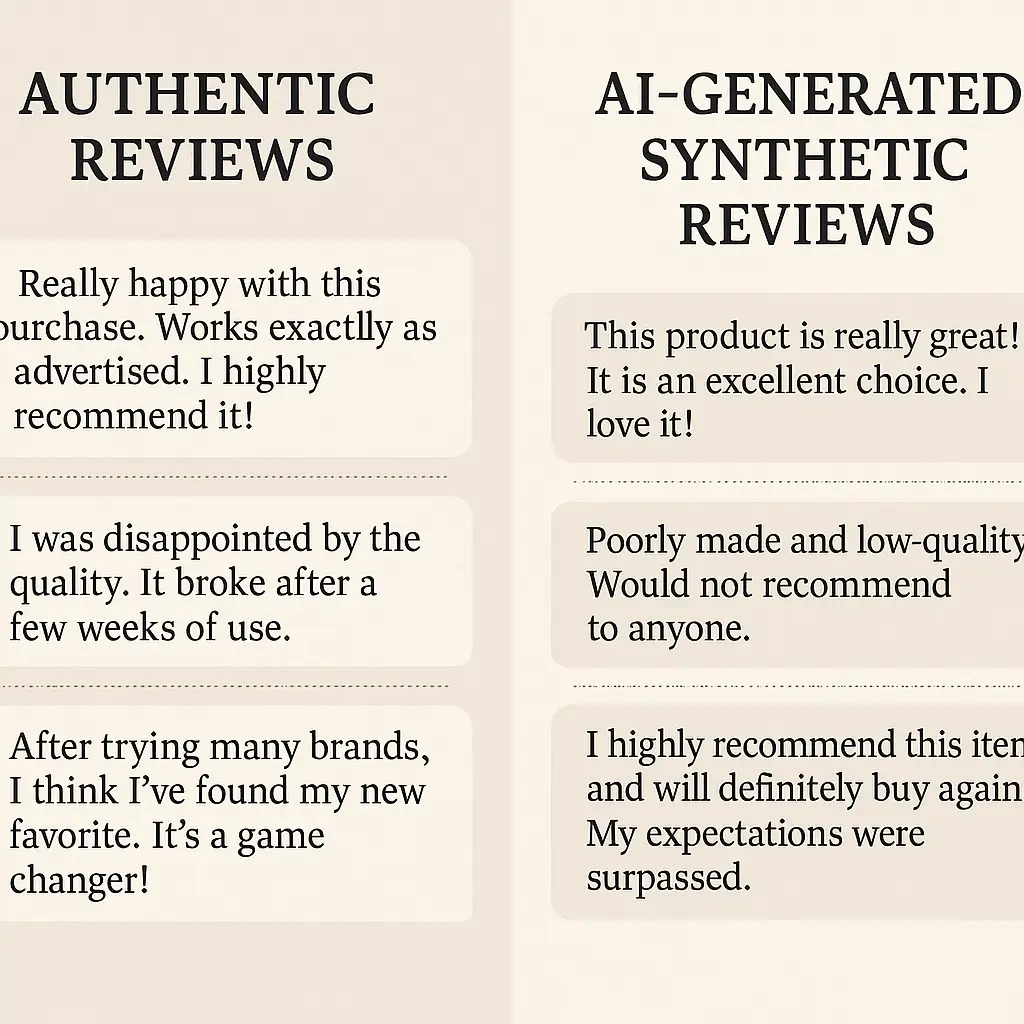
AI-generated reviews are harder to detect because they don't repeat exact phrases. The language model generates unique text each time, with natural variation in sentence structure, word choice, and tone. One review says "The sound quality exceeded my expectations." Another says "I was pleasantly surprised by how clear the audio was." A third says "For the price, the audio performance is remarkable." All three convey the same sentiment, but none repeat the same words.
The grammar is flawless. Modern language models produce text indistinguishable from native English speakers. There are no awkward phrasings, no missing articles, no verb tense errors. The reviews read like they were written by competent humans.
The emotional tone is appropriate. Language models trained on product reviews learn the patterns of genuine enthusiasm, disappointment, or frustration. A five-star review sounds excited. A two-star review sounds annoyed but not enraged. The sentiment matches the rating.
The content is contextually relevant. If the product is a Bluetooth speaker, the review mentions sound quality, battery life, Bluetooth range, and build quality. If it's a kitchen knife, the review mentions sharpness, handle comfort, and edge retention. The model pulls from its training data to include details that fit the product category.
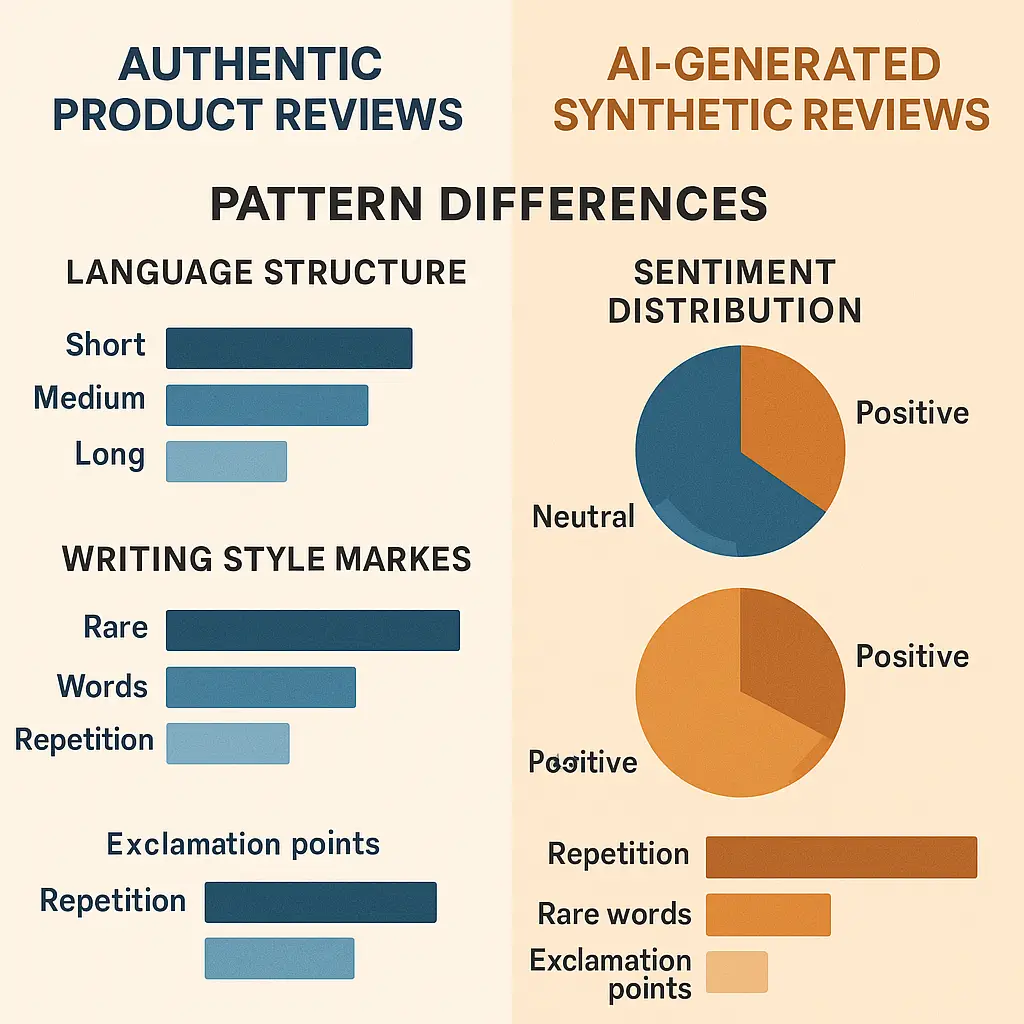
But AI-generated reviews still differ from human reviews in subtle ways. They tend to be shorter and more focused. They rarely include the tangential details that humans add (I bought this for my daughter's birthday, I've owned three other brands, I use it every morning with my coffee). They avoid specificity. A human review might say "the battery lasted exactly 8 hours and 22 minutes on a single charge." An AI review says "the battery life is impressive."
They also cluster. Attackers generate reviews in batches, often posting dozens or hundreds within a short time window. If you sort reviews by date, you might see 30 five-star reviews posted over three days, all using similar language patterns, all from accounts with minimal review history.
The tells that still work
AI-generated reviews are harder to spot than earlier fakes, but they're not invisible. Certain patterns persist.
Generic praise without specifics. Human reviewers who love a product explain why. They mention the specific feature that solved their problem, the moment they realized it was better than alternatives, or the use case where it performed well. AI reviews say "great product" or "highly recommend" without grounding the praise in concrete experience.
Look for details. A real review of a Bluetooth speaker might say "I tested it outdoors at a family barbecue, and it stayed connected to my phone 40 feet away even with a brick wall between us." An AI review says "excellent Bluetooth range."
Repetitive sentence structures across multiple reviews. Language models have favorite patterns. If you read ten reviews and notice that five of them start with "I was skeptical at first, but..." or "This product exceeded my expectations," you're seeing the model's statistical preferences leak through.
Read reviews in sequence. If the phrasing feels formulaic, if the rhythm of the sentences sounds the same across multiple reviews, that's a signal.
Unnatural sentiment consistency. Real products get mixed reviews. Even excellent products have flaws, and even terrible products have redeeming qualities. If a product has 200 five-star reviews and zero critical comments, that's suspicious.
Look at the distribution. A legitimate product might have 60% five-star, 20% four-star, 10% three-star, and 10% one- or two-star. A product with 95% five-star reviews and nothing below four stars is likely manipulated.
Cluster posting patterns. Check the review dates. If 50 reviews appeared in the same week, all five-star, all from accounts with minimal history, that's a red flag. Organic reviews trickle in over time. Fake reviews flood in batches.
Verified purchase badges on low-value items. Attackers sometimes buy cheap items to earn verified purchase badges, then post reviews for unrelated products. Check the reviewer's history. If they've reviewed 20 products in the last month, all five-star, all in different categories (Bluetooth speakers, kitchen knives, phone cases, dog toys), they're likely part of a review farm.
Photos that don't match the text. Some fake reviews include photos to look more authentic, but the photos are stock images or unrelated products. If a review praises the "sleek black finish" and the attached photo shows a white product, something's wrong.
Overly positive language for low-quality products. If a $15 product with obvious design flaws (visible in the product photos) has reviews calling it "premium quality" and "luxury craftsmanship," the reviews are fake. Real users would mention the flaws.
How review fraud actually works in practice
Attackers don't just generate reviews and post them. They run coordinated operations designed to evade detection.
The operation starts with product selection. Attackers target high-margin products with low competition: Bluetooth speakers, phone accessories, kitchen gadgets, supplements, beauty products. These categories have high search volume, impulse buyers, and weak brand loyalty. A fake-boosted product can capture significant sales before anyone notices.
The attacker creates or sources the product. Sometimes they manufacture it (often white-label products from Alibaba). Sometimes they dropship. Sometimes they hijack an existing product listing and replace the legitimate seller.
They generate reviews using a language model. The prompts are specific: "Write a five-star review for a Bluetooth speaker emphasizing sound quality and battery life. Include one minor complaint to sound authentic. 100-150 words." The model outputs a batch of reviews. The attacker edits for variety, removing any phrases that appear in multiple outputs.
They post the reviews through aged Amazon accounts. These accounts have purchase history, verified email and phone numbers, and sometimes years of legitimate activity. Attackers buy accounts from underground markets or compromise them through phishing. Some operations use real people (often low-wage workers in developing countries) who receive products, post reviews, and return the items.
The reviews post over several days or weeks to avoid clustering. The attacker uses VPNs to vary IP addresses and timing to mimic organic behavior. Some reviews include photos (either stock images or photos of the actual product taken by workers in the operation).
Amazon's fraud detection catches some of these reviews. The platform uses machine learning models trained to detect fake reviews, and it removes millions annually. But detection lags behind generation. By the time Amazon removes a batch of fake reviews, the product has already climbed the search rankings and captured sales.
The attacker monitors the product's performance. If the star rating drops or if Amazon removes reviews, they generate and post more. The goal is to maintain a 4.5+ star rating and stay in the top search results for key terms.
This isn't a one-person operation. Organized review fraud involves teams: account managers, writers (or AI operators), customer service (to handle complaints), and logistics (to ship products or process returns). Some operations run dozens of products simultaneously, generating thousands of fake reviews per month.
Why aggregate ratings are less reliable than you think
Star ratings are averages, and averages are easy to manipulate.
A product with 10 legitimate reviews (seven five-star, two four-star, one three-star) has a 4.5 average. Add 50 fake five-star reviews, and the average climbs to 4.85. The fake reviews drown out the real signal.
Amazon's "verified purchase" badge helps, but it's not a guarantee. Attackers run verified purchase operations where real accounts buy the product, post a review, and return the item. The badge appears, the review stays, and the attacker recoups most of the cost through the return.
Sorting by "most helpful" doesn't solve the problem either. Fake review operations include upvote campaigns where accounts vote fake reviews as helpful. The fake reviews rise to the top, and real reviews with critical feedback get buried.
Even the review count is misleading. A product with 3,000 reviews sounds more established than a product with 300 reviews, but if 2,500 of those reviews are fake, the smaller product might be more trustworthy.
You can't trust the aggregate rating. You have to read individual reviews, check for patterns, and evaluate the product based on multiple signals.
How to evaluate reviews when you can't trust the rating
Start by reading the three-star and four-star reviews. These are more likely to be genuine. Five-star reviews attract fake operations because they boost the average. One-star reviews sometimes come from competitors running negative campaigns. Three- and four-star reviews are the middle ground where real users explain what works and what doesn't.
Look for specific details. A real review mentions the reviewer's use case, compares the product to alternatives, and includes concrete observations. "I use this speaker in my garage workshop, and it stays connected to my phone even when I'm in the next room" is more credible than "great sound quality."
Check the reviewer's history. Click on the reviewer's name and look at their other reviews. If they've reviewed 50 products in the last month, all five-star, they're likely part of a review farm. If they've reviewed 10 products over two years, with a mix of ratings, they're probably real.
Read the critical reviews carefully. Real negative reviews explain what went wrong. Fake negative reviews (from competitors) are vague or overly dramatic. "The speaker stopped working after three days, and customer service never responded" sounds real. "Worst product ever, complete garbage, don't waste your money" sounds fake.
Look at review photos and videos. Real users post photos showing the product in use, with visible wear, in their actual environment. Fake operations post stock photos or staged shots. If every photo looks like a professional product shoot, be suspicious.
Use review analysis tools as one input. Fakespot, ReviewMeta, and similar services analyze review patterns and flag suspicious clusters. They're not perfect, but they can highlight products worth investigating further. Don't rely on them exclusively.
Check multiple sources. If you're buying a Bluetooth speaker, look at reviews on Amazon, Best Buy, Walmart, and Reddit. Cross-reference the feedback. If Amazon reviews are overwhelmingly positive but Reddit threads mention consistent problems, trust Reddit.
Consider the price-to-quality ratio. If a $20 product has the same star rating as a $200 product in the same category, something's wrong. Either the cheap product is exceptional (rare) or the reviews are fake (common).
Look at the seller. Established brands with years of history and recognizable names are less likely to run fake review operations (though it happens). New sellers with generic names (TechPro, QualityGoods, BestValue) and no brand presence outside Amazon are higher risk.
Read the questions and answers section. Real users ask specific questions about compatibility, dimensions, and use cases. Fake operations sometimes post softball questions ("Is this product good?") with glowing answers from the seller.
What platforms are doing and why it's not enough
Amazon, Yelp, Google, and other platforms invest heavily in fake review detection. They use machine learning models trained on millions of reviews, analyzing text patterns, account behavior, posting velocity, and network connections. They remove fake reviews, ban accounts, and sue review fraud operations.
In 2024, Amazon reported removing over 200 million suspected fake reviews before they appeared on the site. The company employs thousands of investigators and uses automated systems to flag suspicious activity. They've sued review brokers and pursued legal action against sellers caught manipulating reviews.
But detection lags behind generation. Language models improve faster than fraud detection systems. By the time Amazon trains a model to detect one generation of fake reviews, attackers have moved to a new model with different patterns.
The economic incentive is misaligned. For Amazon, fake reviews are a cost (they damage trust and invite regulatory scrutiny), but they're also a feature (they increase sales velocity and keep sellers on the platform). Amazon's incentive is to remove the most obvious fakes while tolerating the marginal cases.
Platforms also face a verification problem. How do you prove a review is fake? If the review came from a real account, with a verified purchase, posted from a residential IP address, and the text is grammatically correct and contextually appropriate, what's the evidence of fraud? The platform can't call the reviewer and ask if they really bought the product. They rely on statistical patterns, and statistical patterns have false positives.
The scale is overwhelming. Millions of reviews post daily across all platforms. Even a 95% accurate fraud detection system would miss hundreds of thousands of fake reviews per year. The attackers only need a small percentage to slip through.
Regulatory pressure is increasing. The FTC has pursued cases against companies buying fake reviews, and some states have passed laws requiring platforms to disclose review verification practices. But enforcement is slow, penalties are modest, and the practice continues.
The future of review fraud
AI-generated reviews will get better. The next generation of language models will produce text that's indistinguishable from human writing at the individual review level. The tells will become even more subtle, requiring analysis across hundreds of reviews to detect patterns.
Attackers will adapt to detection. As platforms improve fraud detection, operations will shift tactics: slower posting velocity, more variation in text generation, better account aging, and more sophisticated coordination. The arms race continues.
Multimodal models will enable fake photos and videos. Current review fraud operations rely on text and stock photos. Emerging models can generate realistic product photos, unboxing videos, and usage demonstrations. A fake reviewer could post a video showing the product in use, generated entirely by AI, with no real product involved.
Platforms will struggle to keep up. Detection requires constant iteration, and the economic incentive to invest in detection competes with other priorities. Platforms will improve, but they won't eliminate the problem.
The burden will shift to consumers. You'll need to develop your own heuristics for evaluating reviews, cross-referencing sources, and distinguishing real feedback from synthetic noise. The aggregate rating will become less useful. The skill of reading reviews critically will become more valuable.
Some platforms might move toward verified reviewer systems, where only users with confirmed purchase history and identity verification can post reviews. This would reduce fraud but also reduce the total number of reviews, making it harder to evaluate niche products.
Reputation systems might replace star ratings. Instead of trusting the aggregate, you might follow specific reviewers whose judgment you trust, similar to how people follow critics for movies or restaurants. This works for enthusiast communities but doesn't scale to mass-market products.
The underlying problem is trust at scale. When millions of people evaluate millions of products, and the evaluation system is open to anyone, fraud becomes inevitable. AI made fraud cheaper and harder to detect. The solution isn't better AI detection. The solution is rethinking how we evaluate products in a world where synthetic content is indistinguishable from real content.
What you can do right now
Don't trust aggregate star ratings. Treat them as a starting point, not a verdict.
Read individual reviews, focusing on three- and four-star reviews. Look for specific details, check reviewer history, and watch for repetitive language patterns.
Use review analysis tools like Fakespot or ReviewMeta, but don't rely on them exclusively. They flag suspicious patterns but aren't perfect.
Cross-reference reviews across multiple platforms. If a product has great reviews on Amazon but terrible reviews on Reddit, trust Reddit.
Check the seller's history and brand presence. Established brands with years of history are lower risk than new sellers with generic names.
Look for red flags: cluster posting patterns, generic praise without specifics, unnatural sentiment consistency, and verified purchase badges on accounts with suspicious review history.
When in doubt, buy from retailers with strong return policies. If the product doesn't match the reviews, return it.
Trust your judgment. If something feels off, it probably is. The goal of fake reviews is to overwhelm your skepticism with volume. Resist the volume. Read critically.
Related reading: