Work-from-home scams in 2026: How to tell if a job offer is real
The text arrives at 9:47 AM on a Tuesday. "Congratulations! You've been selected for a remote customer service position. $32/hour, flexible schedule, work from anywhere. Reply YES to claim your spot before 5 PM today."
You didn't apply. You don't recognize the company. But you've been looking for remote work for three months, and $32 an hour would solve problems you've been carrying since your last contract ended.
That's the hook. The rest is a script refined through millions of attempts.
Work-from-home scams aren't new, but the scale and sophistication changed dramatically between 2024 and 2026. The FTC's Consumer Sentinel Network data shows job scams cost Americans over $367 million in reported losses in 2024, with the real number likely much higher since most victims don't report. The FBI's Internet Crime Complaint Center logged more than 14,000 employment scam complaints in 2024, a 76% increase from 2023.
The pandemic normalized remote work. Scammers noticed. They adapted their playbooks to exploit the fact that millions of people now expect job offers to arrive via text, interviews to happen over Zoom, and onboarding to occur entirely online. The boundary between legitimate remote hiring and fraud blurred just enough to make the con work.
This guide walks you through the verification process. You'll learn how to spot fake job offers before you waste time applying, how to verify company legitimacy when something feels off, what information you should never provide, and what to do if you've already engaged with a scammer.
How work-from-home scams actually work
The basic mechanism hasn't changed in twenty years: create urgency, promise easy money, extract payment or personal information, disappear. What changed is the delivery system and the volume.
Scammers start with data. Your phone number, email, and the fact that you're job hunting came from somewhere. Researchers have found that job scam operators scrape resumes from public job boards, harvest contact information from LinkedIn profiles, buy lead lists from data brokers, and pull names from breached databases. If you posted a resume online in the last six months, you're in someone's targeting list.
The initial contact follows predictable patterns. A text message congratulates you on being selected for a position you didn't apply for. An email claims a recruiter reviewed your resume and wants to schedule an interview immediately. A WhatsApp message from someone using a company name you recognize offers a remote position with suspiciously high pay for minimal qualifications. The FTC warns that unsolicited job offers via text are almost always scams.
The conversation moves fast. Legitimate hiring takes weeks. Scam hiring takes hours. You're told you need to respond by end of day, start training tomorrow, or provide information immediately to secure your spot. Urgency is the tell. Real employers don't hire people in 24 hours through text messages.
The ask varies, but it always involves extracting something valuable. Some scams request payment for training materials, background checks, equipment, or software licenses. Others collect personal information: Social Security number, bank account details, copies of your driver's license, or login credentials for job boards. A third category involves check fraud, you're hired, sent a check to buy equipment, told to wire the excess back to a vendor, and then the check bounces after you've sent real money.
The IC3's 2024 report breaks down employment scams into several categories: fake job postings that collect personal data, reshipping scams that turn victims into money mules, work-from-home schemes that require upfront payment, and business email compromise attacks targeting HR departments. All variations exploit the same vulnerability: your need for income and your reasonable expectation that remote hiring happens online.
Red flags that appear in every fake job offer
Fake job offers follow templates. The language, structure, and requests repeat across thousands of scams because the templates work. Here's what to look for.
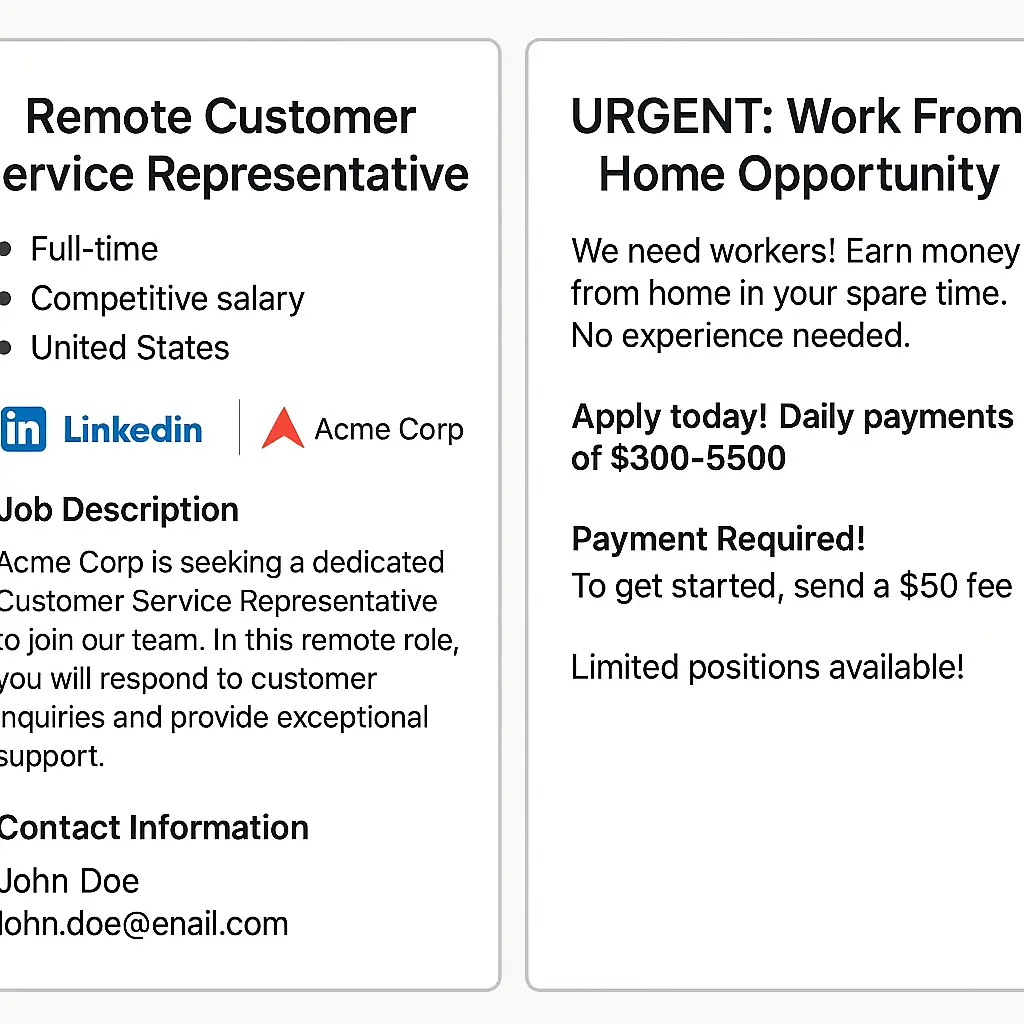
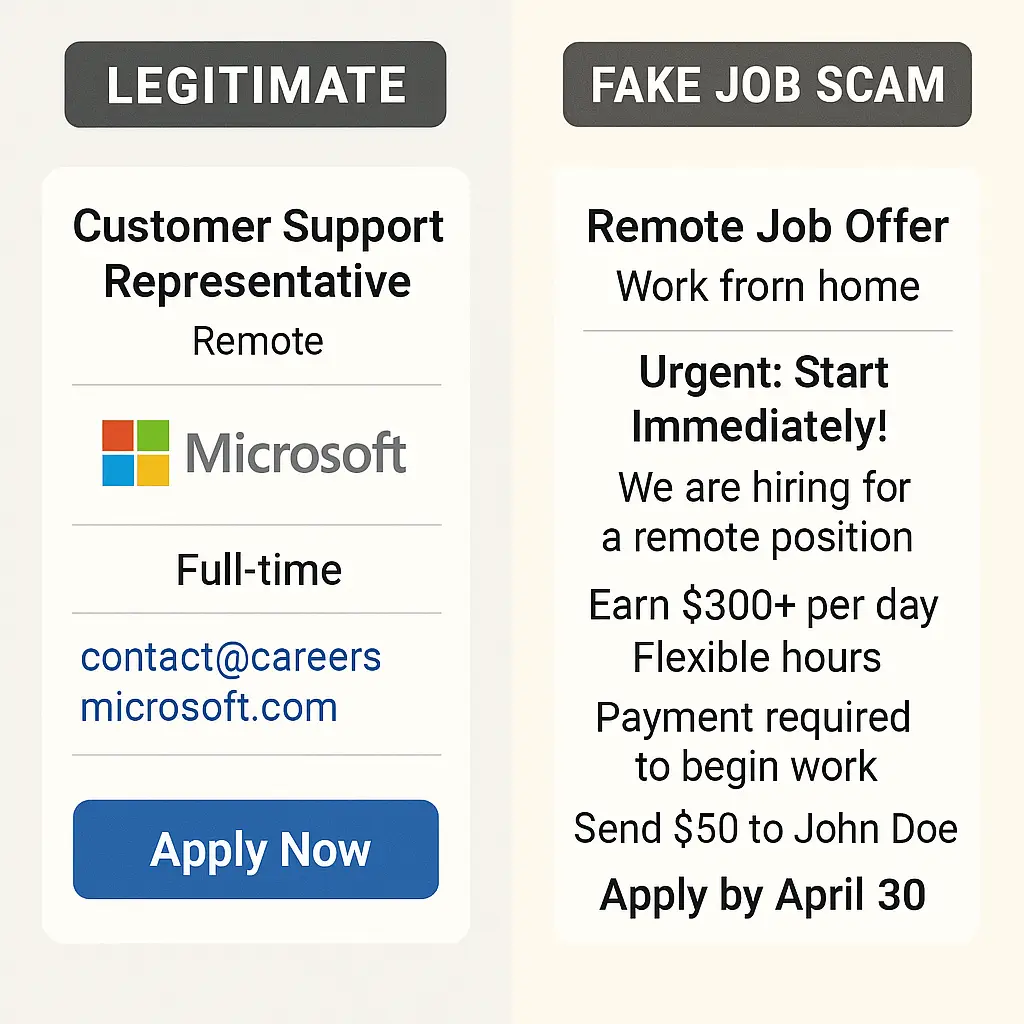
Guaranteed high pay for minimal work. Legitimate remote customer service jobs pay around $15-18 per hour. Data entry positions pay $12-16 per hour. If someone's offering $30+ per hour for entry-level work with no experience required, you're looking at fraud. The FTC notes that promises of easy money with little effort are a universal scam indicator.
Vague job descriptions. Real job postings specify responsibilities, required skills, software you'll use, team structure, and reporting relationships. Fake postings say things like "customer service representative," "data entry specialist," or "administrative assistant" without explaining what the work actually involves. If you can't picture your day-to-day tasks after reading the posting, walk away.
Requests for payment before hiring. No legitimate employer charges you to work for them. Not for training, not for background checks, not for equipment, not for software, not for anything. If someone asks you to pay money to get a job, it's a scam. Full stop. The Consumer Financial Protection Bureau is clear: legitimate employers cover all costs associated with hiring and onboarding.
Communication only through text, WhatsApp, or Telegram. Real companies use email from company domains, phone calls from verifiable numbers, and video interviews through scheduled calendar invites. If your entire interaction happens through text messages or encrypted messaging apps, you're not talking to a real employer. Security researchers have found that scammers prefer platforms that don't leave easily traceable records.
Pressure to respond immediately. "Claim your spot before 5 PM today." "Only three positions left." "If we don't hear from you in the next hour, we'll move to the next candidate." Real hiring moves slowly because companies need time to verify your background, check references, and coordinate between departments. Artificial urgency is a manipulation tactic designed to prevent you from researching the offer.
Requests for personal financial information early in the process. You should never provide your Social Security number, bank account information, or copies of identity documents until after you've accepted a written offer and begun formal onboarding. Legitimate employers ask for this information to set up payroll and benefits, not during the application or interview phase. If someone's asking for your SSN before you've even interviewed, you're being scammed.
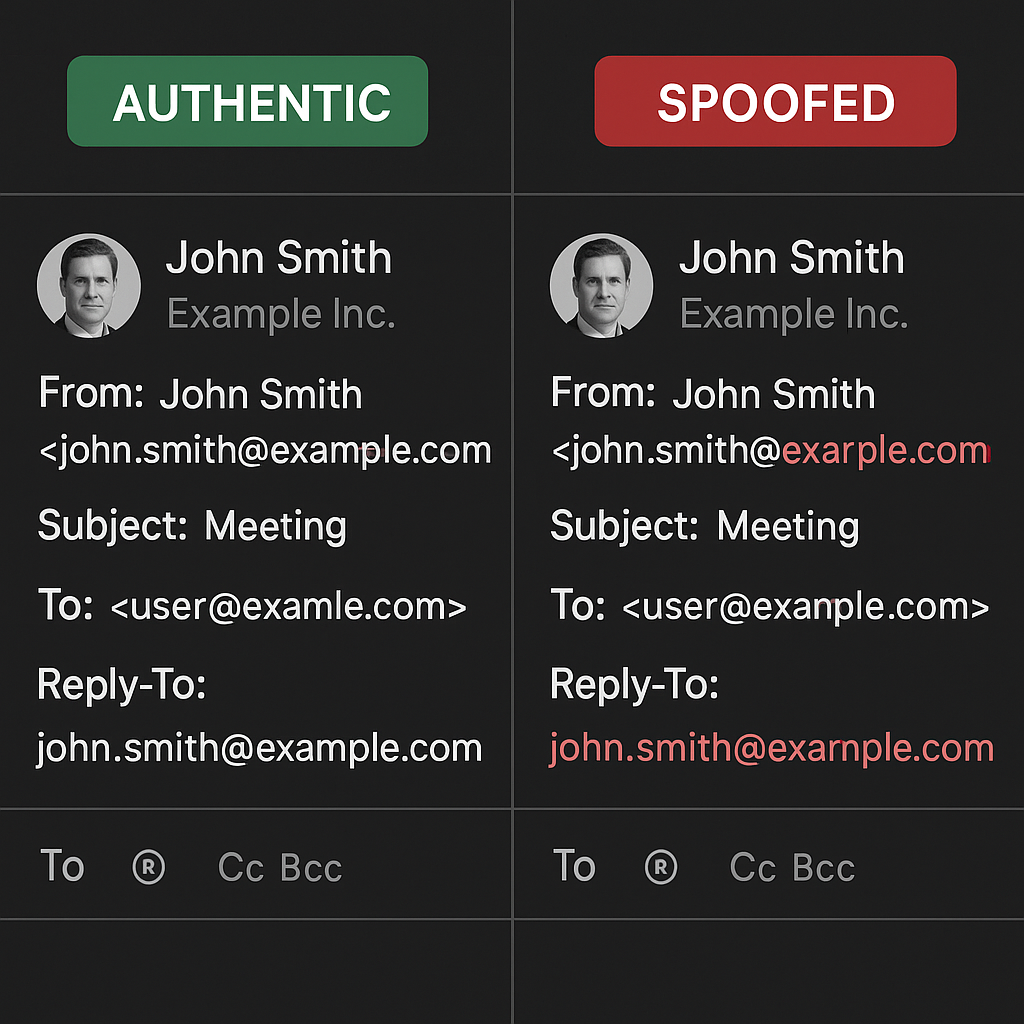
Generic email addresses. Real companies use company domain emails: firstname.lastname@companyname.com. Scammers use Gmail, Yahoo, Outlook, or Proton addresses. If your recruiter's email is "hiring.manager2847@gmail.com," you're not talking to a real company.
Misspellings and grammatical errors in official communications. Professional recruiters proofread. Scammers don't always. Typos in company names, inconsistent formatting, and awkward phrasing suggest the message came from someone operating at volume who doesn't care about quality control.
Job offers that arrive before you've interviewed. You can't be hired for a position without at least one conversation with someone who works there. If you receive a job offer after only exchanging text messages, you're being set up for a scam.
Step-by-step verification process
You've received a job offer that might be legitimate. Here's how to verify it before you provide any information.
Step 1: Search for the company independently. Don't click links in the message. Open a new browser tab and search for the company name. Look for an official website, news coverage, social media presence, and reviews on sites like Glassdoor or Indeed. If the company doesn't appear in search results or only shows up in connection with scam warnings, stop here.
Step 2: Verify the email domain matches the company website. If the company's website is acmetech.com, legitimate emails should come from @acmetech.com addresses. If the email comes from @acme-tech.com, @acme-technologies.com, or any Gmail/Yahoo/Outlook address, it's fake. Scammers register domains that look similar to real companies.
Step 3: Check the company's official careers page. Navigate to the company's website and find their jobs or careers section. Search for the position you were offered. If it doesn't appear on their official careers page, the offer isn't real. Don't trust job listings that only appear on third-party sites or in text messages.
Step 4: Call the company directly. Find the company's phone number from their official website, not from the job offer message. Call their main line and ask to speak to HR or recruiting. Describe the offer you received and ask if they're currently hiring for that position. Real companies will confirm or deny the posting immediately.
Step 5: Research the recruiter's name. Search for the recruiter's name on LinkedIn. Check if they work for the company they claim to represent. Look at their profile history, connections, and activity. If the profile was created recently, has few connections, or shows no activity, it's likely fake. The FBI warns that scammers create fake LinkedIn profiles to add legitimacy to their schemes.
Step 6: Verify the interview process. Legitimate remote interviews happen over Zoom, Google Meet, Microsoft Teams, or phone calls scheduled through calendar invites. If someone wants to interview you through text messages, WhatsApp, or Telegram, you're being scammed. Real companies use professional video conferencing tools that integrate with their corporate systems.
Step 7: Check the job board where you found the listing. If you found the job on Indeed, LinkedIn, or another major platform, report suspicious listings to the platform. Most job boards remove fake postings quickly once they're flagged, and they can tell you if other users have reported the same listing.
Step 8: Look for the company on the Better Business Bureau website. Search for the company on bbb.org and read reviews. If the company has a pattern of complaints about fake job offers or if they're not listed at all, that's a warning sign.
Step 9: Google the exact text of the job offer. Copy a distinctive phrase from the job posting and search for it in quotes. If the same text appears in dozens of listings for different companies, you're looking at a template scammers are using at scale.
Step 10: Trust your instinct. If something feels wrong, the pay seems too high, the timeline feels rushed, the questions seem intrusive, pause. Real opportunities don't disappear in 24 hours. Scams do.
What information you should never provide
Certain requests are automatic disqualifiers. If someone asks for any of the following before you've accepted a written offer and begun formal onboarding, you're being scammed.
Social Security number. Your SSN is required for payroll and tax purposes, but only after you've been hired and completed I-9 verification. No legitimate employer needs your SSN during the application or interview phase.
Bank account information. Direct deposit setup happens during onboarding, not before. If someone asks for your bank account number, routing number, or online banking login credentials before you've signed an offer letter, stop communicating.
Copies of your driver's license or passport. Identity verification happens after hiring, not before. Scammers use these documents to open fraudulent accounts in your name.
Credit card or payment information. You should never pay to get a job. Not for training, not for equipment, not for background checks, not for anything. The FTC is explicit: legitimate employers don't charge application fees.
Login credentials for job boards or email accounts. No real company needs access to your Indeed, LinkedIn, or email account. Scammers request this information to hijack your accounts and use them to spread more scams.
Money transfers or cryptocurrency. If someone sends you a check and asks you to wire money back, deposit the check and buy gift cards, or transfer funds via cryptocurrency, you're in the middle of a money laundering scheme. The Consumer Financial Protection Bureau warns that check fraud scams are common in fake employment schemes.
Personal references before an interview. Real companies ask for references late in the hiring process, after they've decided you're a serious candidate. If someone wants your references' contact information before you've even had a conversation, they're harvesting data.
The check scam variant
One specific work-from-home scam deserves detailed explanation because it's both common and financially devastating.
You're hired for a remote position. The company sends you a check to buy equipment, a laptop, software, office supplies. The check is for more than the equipment costs. You're instructed to deposit the check, buy the equipment from a specific vendor, and wire the excess back.
Here's what actually happens: the check is fake, but it takes banks several days to discover that. You deposit the check, your bank makes the funds available immediately under federal law, you wire the money to the "vendor," and then the check bounces. You're now responsible for the full amount of the fake check, the money you wired is gone forever, and you never get the equipment.
The FTC notes that fake check scams cost victims an average of $1,500 per incident. The scam works because federal banking regulations require banks to make funds available quickly, before the check fully clears. Scammers exploit this timing gap.
If anyone sends you a check and asks you to wire money back, stop. Don't deposit the check. Don't wire anything. Contact the company directly through their official website to verify the request. Real employers don't send you money before you've worked.
The reshipping scam variant
Another common variant turns you into an unwitting accomplice in fraud.
You're hired as a "shipping coordinator" or "inventory manager" working from home. Your job is to receive packages at your address, repackage them, and ship them to addresses the company provides. You're paid per package processed.
The packages contain merchandise purchased with stolen credit cards. You're receiving stolen goods and shipping them to addresses where they can't be traced back to the original thieves. When law enforcement investigates the credit card fraud, the shipping address on record is yours. You become the suspect.
The FBI warns that reshipping scams turn victims into money mules who face potential criminal charges. Legitimate companies don't hire random people to receive and reship packages from home. Warehouses exist for a reason.
The data harvesting variant
Some fake job offers don't ask for money. They ask for data.
You apply for a position. The application form requests your name, address, phone number, email, date of birth, Social Security number, and answers to security questions. You never hear back about the job. Six months later, someone opens credit cards in your name.
The job posting was never real. It was a data collection operation designed to harvest identity information at scale. The IC3 reports that employment scams increasingly focus on identity theft rather than immediate financial fraud, because stolen identities have long-term value in criminal markets.
If a job application asks for your Social Security number before you've even interviewed, close the tab. Real companies don't need that information until after you're hired.
What to do if you've already engaged with a scammer
You responded to a fake job offer. You provided information. Maybe you sent money. Here's what to do next.
Stop all communication immediately. Block the phone number, email address, and any messaging app accounts. Don't respond to follow-up messages. Don't try to get your money back by engaging further. The person on the other end is a criminal, not a confused employer.
If you sent money, contact your bank or payment service immediately. If you wired money, call your bank and report the fraud. Wire transfers are difficult to reverse, but sometimes banks can stop the transfer if you report it quickly enough. If you sent money through a payment app like Zelle or Venmo, contact the app's fraud department. If you bought gift cards, contact the gift card company and report the scam. Recovery is unlikely, but you need to try.
If you provided your Social Security number, freeze your credit. Contact Equifax, Experian, and TransUnion to place a credit freeze on your file. This prevents anyone from opening new credit accounts in your name. The freeze is free and you can lift it temporarily when you need to apply for legitimate credit.
Monitor your accounts for suspicious activity. Check your bank accounts, credit card statements, and credit reports for unauthorized transactions or new accounts. Set up fraud alerts with your bank. Consider signing up for credit monitoring if you don't already have it.
Report the scam to the FTC at reportfraud.ftc.gov. The FTC tracks scam patterns and uses reports to identify and shut down fraud operations. Your report helps protect others.
Report the scam to the FBI's IC3 at ic3.gov. The FBI investigates large-scale fraud operations. Your report contributes to their database and may help with criminal prosecution.
If the fake job offer came through a job board, report it to the platform. Indeed, LinkedIn, and other major job sites remove fake listings when they're reported. Help them clean up their platforms.
Warn others. Post about your experience on social media, write a review warning people about the fake company, and tell friends who are job hunting. Scammers succeed because people don't know what to look for. Share what you learned.
Don't blame yourself. Job scams are sophisticated. They exploit legitimate needs and reasonable expectations about how remote hiring works. Thousands of people fall for these scams every year. What matters is that you stop the damage and warn others.
How to protect yourself going forward
Prevention is simpler than recovery. Here's how to reduce your exposure to job scams.
Use privacy settings on job boards. Most job sites let you control who sees your resume and contact information. Set your profile to private or visible only to verified employers. This limits how many scammers can scrape your data.
Remove old resumes from public sites. If you posted your resume on multiple job boards years ago, log back in and delete them. Scammers scrape old listings constantly. Don't leave your information sitting in public databases indefinitely.
Never include your full Social Security number on a resume. Your resume should contain your name, phone number, email, and location. That's it. No SSN, no date of birth, no bank account information. Real employers don't need that information until after they've hired you.
Apply directly through company websites when possible. Instead of using third-party job boards, navigate to the company's official website and apply through their careers page. This eliminates the risk of fake job listings on aggregator sites.
Research companies before applying. Spend five minutes verifying the company exists, has a real office address, and employs real people before you submit an application. If you can't find evidence the company is legitimate, don't apply.
Use a separate email address for job hunting. Create an email account specifically for job applications. If that account gets compromised or flooded with scam offers, your primary email stays clean. This also makes it easier to spot patterns in fake job offers.
Enable two-factor authentication on job board accounts. Scammers sometimes hijack legitimate job board accounts to post fake listings or message users. Two-factor authentication makes your account harder to compromise.
Be skeptical of unsolicited job offers. If you didn't apply and someone contacts you about a job, verify independently before responding. Real recruiters do reach out to passive candidates, but they do it through LinkedIn InMail or professional emails from company domains, not through text messages.
Learn to recognize social engineering tactics. Urgency, flattery, promises of easy money, and requests for sensitive information are universal manipulation techniques. When you see them, pause. Ask yourself why someone would use these tactics in a legitimate hiring process. The answer is usually that they wouldn't.
The real cost of job scams
The financial loss is obvious. The FTC reports that the median loss to job scams in 2024 was $2,000, with some victims losing tens of thousands. But the damage extends beyond the immediate theft.
Identity theft creates years of cleanup work. Fraudulent credit accounts, tax return fraud, and criminal records filed under your name require dozens of hours to resolve. Some victims spend years fighting to restore their credit and clear their names.
The psychological impact compounds the financial loss. Job hunting is already stressful. Being scammed during that process creates shame, self-doubt, and reluctance to keep applying. Some victims withdraw from the job market entirely because they can't trust their judgment anymore.
The time cost matters too. Every hour you spend engaging with a fake job offer is an hour you're not applying to real positions. Scammers don't just steal your money and data. They steal your time and attention during a period when both are already scarce.
And there's the ripple effect. When you tell other people you were scammed, some of them will judge you. They'll assume you were careless or naive. That social cost keeps many victims silent, which allows scams to continue spreading because people don't know what to watch for.
The industry response
Job boards and platforms know they have a scam problem. Their responses vary in effectiveness.
Indeed, LinkedIn, and ZipRecruiter all use automated systems to flag suspicious job postings based on language patterns, posting behavior, and user reports. Industry guidance suggests these systems catch some obvious scams but struggle with sophisticated operations that mimic legitimate hiring practices.
Some platforms require identity verification for employers who post jobs. Others manually review high-risk postings before they go live. A few platforms have started using machine learning to identify scam patterns, though the effectiveness of these systems is difficult to assess from outside.
The problem is that scammers adapt faster than platforms can build defenses. When one technique gets blocked, operators switch to a slightly different approach. The economic incentive is too strong. As long as job scams remain profitable, someone will figure out how to get past the filters.
Platform liability is limited. Section 230 of the Communications Decency Act protects job boards from legal responsibility for user-generated content, including fake job postings. This creates a situation where platforms benefit from high listing volume but don't bear the full cost when those listings turn out to be scams.
Some platforms have started offering scam education to users. Indeed publishes guides on how to spot fake job offers. LinkedIn sends warnings when users interact with suspicious accounts. These efforts help, but they shift the burden of verification onto job seekers who are already overwhelmed.
Why remote work makes this worse
The shift to remote work didn't create job scams, but it made them significantly more effective.
Before 2020, most job offers involved in-person interviews, office visits, and face-to-face interactions that made it harder for scammers to maintain the illusion of legitimacy. Remote hiring eliminated those checkpoints. Now it's entirely normal to be hired, onboarded, and trained without ever meeting your employer in person.
That normalization created cover for fraud. When every legitimate job offer arrives via email, happens over Zoom, and involves signing documents electronically, the boundary between real and fake becomes harder to identify. Scammers exploited that ambiguity.
The volume of remote job seekers also matters. Millions of people entered the remote job market between 2020 and 2026, many of them with no prior experience evaluating remote offers. They didn't know what normal looked like because remote hiring was new to everyone. Scammers targeted that uncertainty.
And remote work attracts people in vulnerable situations. Parents who need flexible schedules, people with disabilities who can't commute, workers in rural areas without local opportunities, and people who lost jobs during economic disruptions all turned to remote work as a solution. Scammers know this and design their pitches accordingly. The promise of remote work isn't just about convenience. For many people, it's about survival.
The future of job scams
Job scams will get worse before they get better. Here's why.
AI-generated content makes it easier to create convincing fake job postings at scale. Language models can write job descriptions that sound professional, generate personalized responses to applicant questions, and maintain conversations that feel human. The barrier to entry for running a job scam operation dropped significantly between 2024 and 2026.
Deepfake technology will eventually enable video interviews with fake recruiters. We're not there yet at scale, but the technology exists. When it becomes accessible enough for scam operations to deploy routinely, the last remaining verification checkpoint, seeing someone's face on a video call, will become unreliable.
The economic pressure that drives people to seek remote work isn't going away. As long as millions of people need flexible income and legitimate remote jobs remain competitive, scammers will have a ready pool of targets.
And law enforcement struggles to keep up. Job scams often involve international operations, encrypted communications, and cryptocurrency payments that make investigation difficult. The IC3 reports that recovery rates for fraud losses remain low because operators move quickly and hide their tracks effectively.
The most likely future is one where job scam detection becomes a permanent part of job hunting literacy. You'll verify offers the same way you verify URLs before clicking, check sender addresses before opening attachments, and research companies before providing information. It becomes one more cognitive load in an already exhausting process.
The cultural reference that fits
In The Fellowship of the Ring, Gandalf tells Frodo that "all we have to decide is what to do with the time that is given us." The line works here because job hunting is fundamentally about time, how you spend it, who deserves it, and what you're willing to risk for the possibility of something better.
Scammers understand this. They know you're under pressure. They know you've been applying for weeks or months. They know you need income. So they offer you a shortcut: respond now, skip the usual process, get hired today. The promise isn't just money. It's the end of uncertainty.
The trap is that engaging with a scam doesn't just waste the time you spend on it. It steals the time you would have spent on legitimate opportunities. Every hour you spend verifying a fake offer, preparing for a fake interview, or recovering from a fake job is an hour you're not moving forward.
The decision isn't whether to be skeptical. It's what to do with the time you have. You can spend it chasing offers that feel too good to be true, or you can spend it on the slower, harder work of finding real opportunities. The scam offers speed. The real path offers something better: actual employment.
What legitimate remote hiring looks like
After two thousand words about what's fake, here's what real remote hiring actually involves.
You apply through a company's official website or a verified job board. You receive an email from a company domain address acknowledging your application. You're contacted by a recruiter who schedules a phone or video interview through a calendar invite. The interview happens over Zoom, Google Meet, or Microsoft Teams. You meet multiple people from the company over several rounds of interviews. You're asked about your experience, skills, and fit for the role. You're given time to ask questions about the company, the team, and the position.
If you're selected, you receive a written offer letter via email from a company domain. The letter specifies your title, salary, benefits, start date, and reporting structure. You're asked to sign the offer electronically through DocuSign or a similar service. After you accept, you receive onboarding instructions. You complete I-9 verification, W-4 tax forms, and direct deposit setup. You're given access to company systems, email, and any tools you need to do the job. You start work on the agreed date.
The entire process takes weeks, sometimes months. There are delays, scheduling conflicts, and waiting periods. It's not exciting. It's not urgent. It's boring and bureaucratic and slow.
That's how you know it's real.