Soft credit pulls vs hard pulls: what they reveal, what they cost you
You check your credit score on a banking app. A week later, you apply for a car loan. Both actions involve someone looking at your credit report, but only one of them affects your credit score. The difference between soft and hard credit pulls determines whether a credit check is invisible or costs you points, and most people don't learn the distinction until they've already taken the hit.
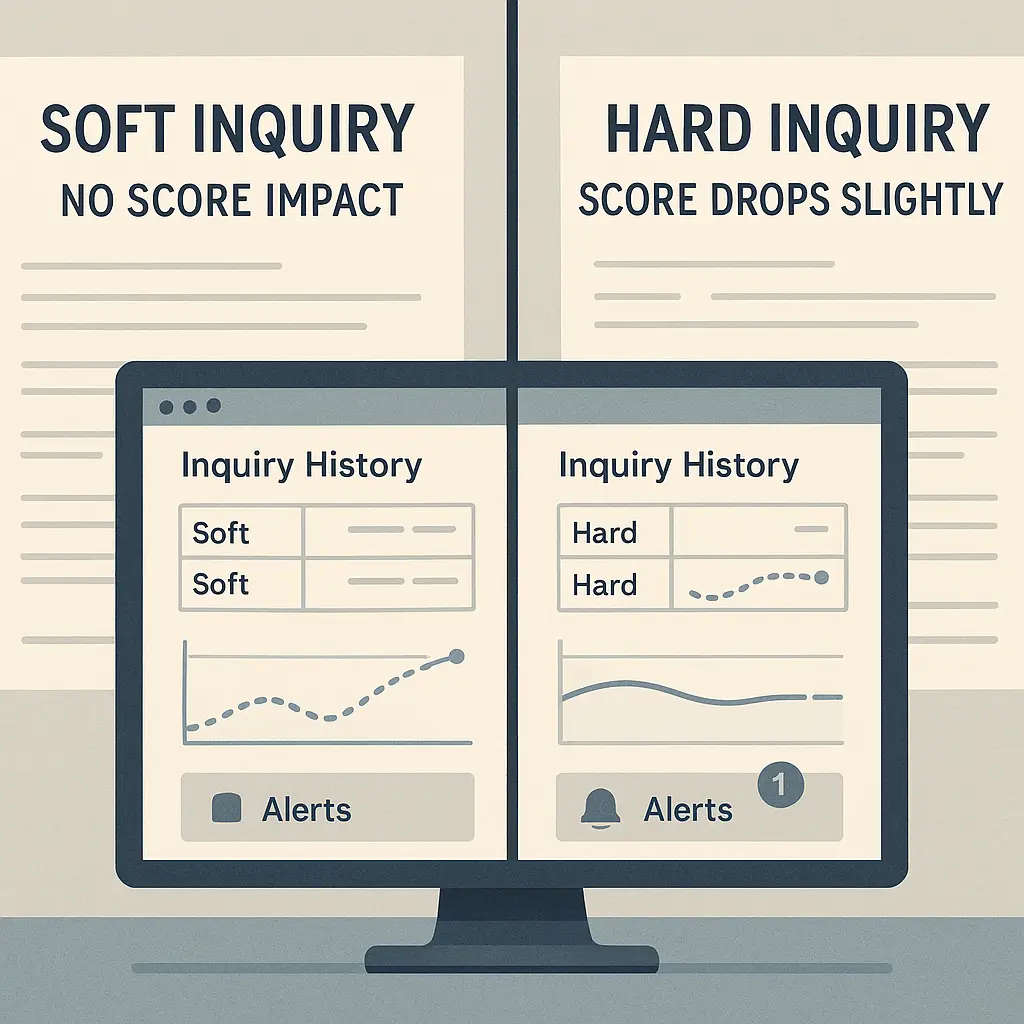
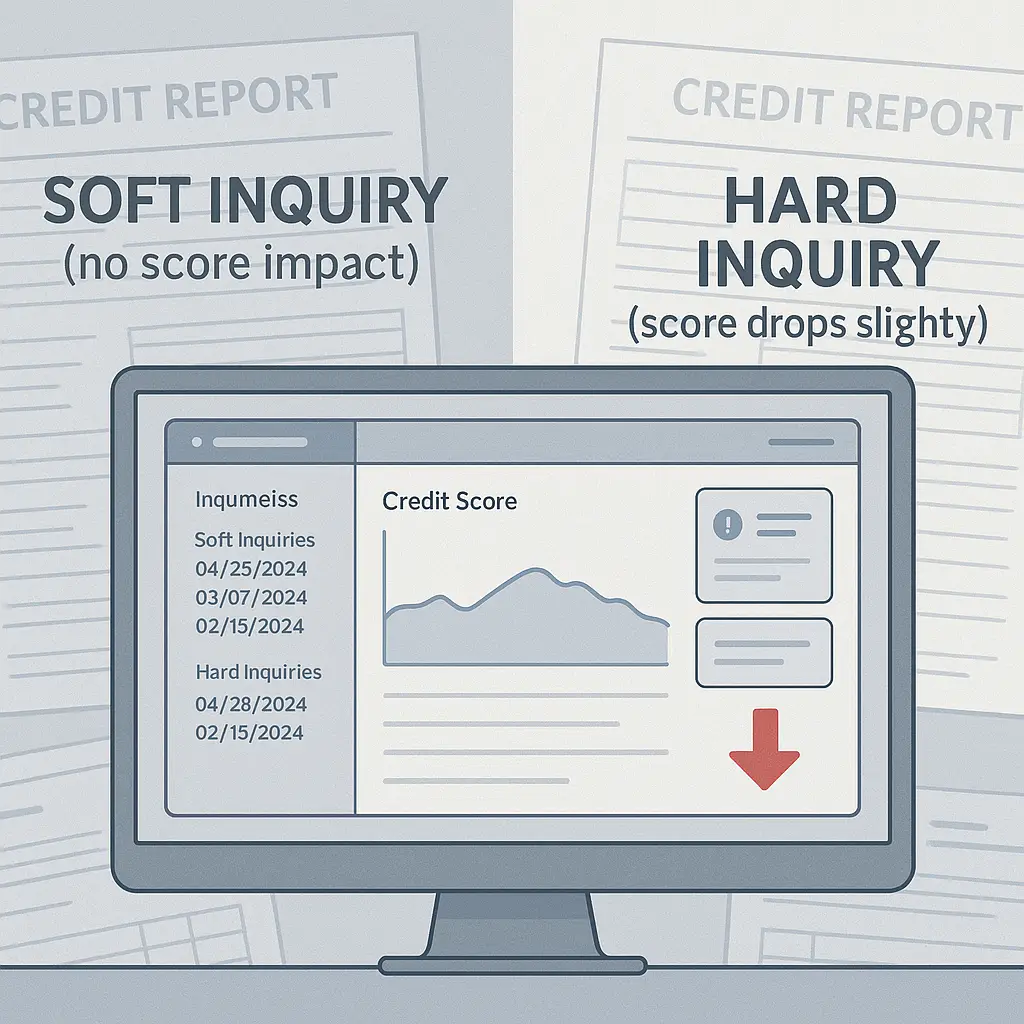
Credit inquiries fall into two categories. Soft pulls happen when you check your own credit, when a lender pre-qualifies you for an offer, or when an employer runs a background check. Hard pulls occur when you formally apply for credit, a mortgage, auto loan, credit card, or personal loan. The distinction matters because hard pulls signal risk to lenders. Every hard inquiry tells the credit bureaus that you're actively seeking new credit, which can lower your score temporarily and raise questions about your financial stability.
Understanding the mechanics behind each type of pull gives you control over when your score takes a hit and when it doesn't. Here's how soft and hard inquiries work, what each one reveals, and how to navigate credit checks without unnecessary damage.
What happens during a soft credit pull
A soft pull occurs when someone checks your credit report without you formally applying for new credit. You trigger a soft pull when you check your own score through AnnualCreditReport.com or a credit monitoring service. Lenders run soft pulls when they send you pre-approved credit card offers. Employers use soft pulls during background checks. Landlords sometimes run them when screening rental applicants.
The defining characteristic of a soft pull is that it doesn't affect your credit score. Credit scoring models ignore soft inquiries entirely because they don't indicate that you're actively seeking new debt. The inquiry still appears on your credit report, but only you can see it, lenders reviewing your credit for a formal application won't see soft pulls from other companies.
A soft pull gives the requester access to your credit report, which contains your payment history, current account balances, credit utilization, public records like bankruptcies, and a list of accounts you've opened or closed. What it doesn't include is your exact credit score. Some soft pulls generate an estimated score range, but the three-digit number lenders use when making approval decisions comes from a hard pull.
Pre-qualification offers rely on soft pulls because they're exploratory. A credit card company runs a soft pull on millions of consumers, identifies people who meet their criteria, and sends targeted mailers. You're not applying for credit at this stage, the company is just checking whether you're a plausible candidate. If you decide to formally apply, that's when the hard pull happens.
You can run soft pulls on yourself as often as you want without consequence. Checking your credit weekly through a monitoring service, pulling your full report from all three bureaus, or using a banking app that displays your score, all of these are soft inquiries. The myth that checking your own credit lowers your score is exactly that: a myth. Self-checks are always soft pulls.
What happens during a hard credit pull
A hard pull happens when you authorize a lender to review your credit as part of a formal application for new credit. You fill out a loan application, a credit card application, or a financing agreement, and the lender requests your full credit report and score from one or more of the three major credit bureaus: Equifax, Experian, or TransUnion.
The hard inquiry appears on your credit report immediately and stays there for two years. Unlike soft pulls, hard inquiries are visible to other lenders. When a mortgage lender reviews your credit report, they see every hard pull from the past 24 months. Multiple hard inquiries in a short period can signal financial distress or overextension, which raises red flags.
A single hard pull typically lowers your credit score by around 5 to 10 points. The exact impact depends on your overall credit profile. If you have a long credit history, strong payment record, and low utilization, one hard inquiry barely registers. If you're new to credit or already have a thin file, the same inquiry can have a larger effect. The score drop is temporary, hard pulls stop affecting your score after 12 months, even though they remain visible on your report for another year.
Credit scoring models treat multiple hard pulls differently depending on the type of credit you're seeking. If you're shopping for a mortgage, auto loan, or student loan, the models recognize that you're rate-shopping and group all inquiries made within a 14-to-45-day window (depending on the scoring model) as a single hard pull. This prevents you from being penalized for comparing offers. The same logic doesn't apply to credit cards, each application counts as a separate hard inquiry.
Hard pulls give lenders access to the same information as soft pulls, but with one critical addition: they see your exact credit score at the time of the inquiry. This score determines your approval odds, your interest rate, and the credit limit or loan amount you're offered. A hard pull also signals intent. You're not browsing, you're asking for money.
When lenders use soft pulls versus hard pulls
Lenders use soft pulls during the pre-qualification stage to gauge whether you're a viable candidate without affecting your credit. You enter basic information, income, employment, estimated credit score, and the lender runs a soft pull to generate an offer estimate. Pre-qualification tells you whether you're likely to be approved and what terms you might receive, but it's not binding. The lender hasn't committed to anything, and neither have you.
Pre-approval is different. Some lenders use the term interchangeably with pre-qualification, but in industries like mortgages, pre-approval often involves a hard pull. A mortgage pre-approval letter requires the lender to verify your financials, which means pulling your credit report with a hard inquiry. The distinction matters because a pre-approval carries more weight with sellers, but it also costs you points on your credit score.
Credit card companies almost always run a hard pull when you submit a formal application, even if they pre-qualified you with a soft pull. The soft pull got you the mailer or the online offer; the hard pull happens when you click "apply" or mail back the form. Some credit card issuers let you check if you're pre-qualified on their website using a soft pull before you apply, which gives you a sense of approval odds without the score hit.
Auto lenders, mortgage companies, and personal loan providers use hard pulls for all formal applications. If you walk into a dealership and apply for financing, the dealer runs a hard pull. If you submit a mortgage application to three different lenders to compare rates, you get three hard pulls, but if you do it within the rate-shopping window (typically 14 to 45 days), credit scoring models count them as one.
Landlords and employers typically use soft pulls, though practices vary. Some landlords request authorization for a hard pull as part of the rental application, particularly in competitive markets. Employers conducting background checks almost always use soft pulls because they're evaluating your financial responsibility, not offering you credit.
How multiple hard pulls affect your credit score
One hard pull costs you around 5 to 10 points. Two hard pulls in the same month can double that impact, but the damage isn't linear. Credit scoring models don't just count inquiries, they analyze patterns. A burst of hard pulls over a short period signals urgency, which lenders interpret as financial stress. Are you applying for credit everywhere because you're desperate? Are you overextending yourself?
The rate-shopping exception exists to prevent this interpretation when you're shopping for a mortgage, auto loan, or student loan. FICO and VantageScore models recognize that comparing offers is financially responsible behavior, so they group inquiries made within a specific window as a single event. The window varies: older FICO models use 14 days, newer versions extend it to 45 days. VantageScore uses 14 days across the board.
Credit card inquiries don't get the same treatment. If you apply for three credit cards in one week, you get three hard pulls, and all three count separately. The scoring models assume you're not rate-shopping, you're either trying to maximize available credit or you're being reckless. Either interpretation lowers your score.
The impact of hard pulls fades over time. After 12 months, a hard inquiry stops affecting your score, though it remains visible on your report for another year. Lenders reviewing your credit can still see the inquiry, but it no longer factors into the algorithm that calculates your score. After 24 months, the inquiry disappears entirely.
If you're planning a major credit application, a mortgage, a car loan, a business loan, avoid unnecessary hard pulls in the months leading up to it. Every inquiry chips away at your score, and even small drops can push you into a higher interest rate tier. A difference of 10 points might not sound significant, but it can cost you thousands of dollars over the life of a loan.
What soft and hard pulls reveal to lenders
Both soft and hard pulls give the requester access to your credit report, which contains your entire credit history. They see every account you've opened, every payment you've made or missed, your current balances, your credit limits, and your utilization ratio. They see public records like bankruptcies, tax liens, and civil judgments. They see how long you've had credit and how many accounts you've opened recently.
The difference is visibility and intent. Soft pulls don't show other lenders that someone checked your credit. If you run a soft pull on yourself through a monitoring service, no one else knows. If a credit card company pre-qualifies you with a soft pull, that inquiry doesn't appear to the mortgage lender who pulls your credit six months later.
Hard pulls are public within the credit system. Every lender who runs a hard pull on you in the future sees the list of previous hard inquiries. They see the date, the type of credit you applied for, and the name of the lender who pulled your report. This information helps them assess risk. If they see five hard pulls in the past three months, they know you've been actively seeking credit, which might indicate financial instability.
Hard pulls also give lenders your exact credit score at the time of the inquiry. Soft pulls often generate score estimates or ranges, but hard pulls deliver the three-digit number that determines your approval and your terms. This score reflects your credit profile at a specific moment in time, which is why lenders use hard pulls for final decisions.
Neither type of pull reveals your income, your employment status, or your bank account balances. Credit reports track how you manage debt, not how much money you earn or save. Lenders request that information separately, either through your application or by verifying pay stubs and tax returns.
How to check your credit without triggering a hard pull
You're entitled to one free credit report from each of the three major bureaus every 12 months through AnnualCreditReport.com, the only site authorized by federal law to provide free reports. Requesting your report through this site is always a soft pull. You can stagger your requests, pull Equifax in January, Experian in May, TransUnion in September, to monitor your credit throughout the year without paying for a subscription service.
Credit monitoring services like Credit Karma, Credit Sesame, and the monitoring tools offered by banks and credit card companies all use soft pulls. They update your score weekly or monthly, alert you to changes, and let you review your full report without affecting your score. These services are free because they make money by recommending credit products, but you're not obligated to apply for anything.
If you're shopping for a loan or credit card and want to check your approval odds before applying, look for pre-qualification tools on the lender's website. These tools run a soft pull and give you an estimate of your approval chances and potential terms. Pre-qualification isn't a guarantee, the lender still runs a hard pull when you formally apply, but it lets you gauge your options without the score hit.
Some credit card issuers, including Capital One and Discover, offer pre-qualification checkers that explicitly state they use soft pulls. You enter basic information, and the tool tells you which cards you're likely to be approved for. If you like what you see, you proceed to the formal application, which triggers the hard pull. If you don't, you walk away with your score intact.
Employers and landlords sometimes request authorization to check your credit as part of a background or rental application. Ask whether they're running a soft or hard pull. Most use soft pulls, but some landlords in competitive markets request hard pulls to verify your financial stability. If you're uncomfortable with a hard pull for a rental application, you can decline, but that might cost you the apartment.
When hard pulls are worth the score hit
Hard pulls are unavoidable when you're applying for credit, but not all credit applications are created equal. A mortgage is worth the hard pull because the long-term financial benefit, homeownership, building equity, locking in a fixed rate, outweighs the temporary score drop. A car loan is worth it if you need reliable transportation and can't pay cash. A student loan is worth it if it's funding education that increases your earning potential.
A credit card application is worth a hard pull if the card offers rewards, benefits, or a 0% APR period that aligns with your financial goals. Opening a new card to earn a sign-up bonus, consolidate debt at a lower rate, or access better fraud protection can justify the score hit. Opening a card because the cashier at the checkout counter offered you 10% off your purchase today probably doesn't.
The rate-shopping window for mortgages and auto loans exists specifically to let you compare offers without compounding the damage. If you're buying a house, apply to three or four lenders within a two-week period. The scoring models treat all those inquiries as one, and you get to choose the best rate. Spreading those applications over three months turns one hard pull into four, which multiplies the score impact and signals instability to future lenders.
If your credit score is already strong, above 740, a single hard pull won't meaningfully affect your approval odds or your interest rate. You have enough cushion to absorb the temporary drop. If your score is borderline, hovering around 680, a hard pull might push you into a higher rate tier, which could cost you thousands of dollars over the life of a loan. In that case, focus on improving your score before applying.
Avoid hard pulls for credit you don't need. Store credit cards, promotional financing offers, and "just in case" credit lines all come with hard inquiries. Each one chips away at your score, and the cumulative effect can tip you from approval to denial or from a good rate to a mediocre one.
The Gilmore Girls problem
In Gilmore Girls, Lorelai Gilmore walks into a bank to apply for a business loan, only to discover that her credit score is terrible because she's never had debt. She's paid for everything in cash, which means she has no credit history. The loan officer explains that without a track record of borrowing and repaying, the bank can't assess her risk. Lorelai is financially responsible, but the credit system doesn't know that.
Credit inquiries work the same way. A soft pull shows you what's in your file, but it doesn't prove you can handle new debt. A hard pull signals intent, you're asking for credit, and the lender needs to decide whether to trust you. The inquiry itself doesn't make you more or less creditworthy, but it creates a record of your behavior. Too many hard pulls in a short window suggest you're either desperate or reckless, which makes lenders nervous. The system penalizes you not for seeking credit, but for seeking it too aggressively.
How to minimize the impact of hard pulls
If you're planning to apply for a mortgage, auto loan, or another major credit product, time your applications strategically. Submit all your applications within the rate-shopping window, 14 to 45 days, depending on the scoring model, so they count as a single hard pull. This requires planning. Research lenders, gather your documents, and line up your applications before you start submitting them.
Avoid applying for new credit in the six months before a major loan application. Every hard pull lowers your score temporarily, and even small drops can affect your rate. If you're planning to buy a house in the spring, don't open a new credit card in the fall. Wait until after you close on the mortgage.
If you're denied credit, don't immediately apply elsewhere. Each denial comes with a hard pull, and stacking rejections signals financial distress. Instead, request a copy of the denial letter, which the lender is required to provide under federal law. The letter explains why you were denied and often includes your credit score at the time of the decision. Use that information to address the issues, pay down balances, dispute errors, wait for negative marks to age off, before applying again.
Monitor your credit report regularly to catch unauthorized hard pulls. Identity thieves sometimes apply for credit in your name, which generates hard inquiries you didn't authorize. If you see a hard pull you don't recognize, contact the credit bureau to dispute it. Fraudulent inquiries can be removed, though the process requires documentation and persistence.
Consider freezing your credit if you're not actively applying for new accounts. A credit freeze blocks lenders from accessing your credit report, which prevents identity thieves from opening accounts in your name. It also prevents legitimate hard pulls, so you'll need to temporarily lift the freeze when you're ready to apply for credit. Freezes are free, and you can manage them online through each bureau's website.
What to do if you have too many hard pulls
If you've accumulated multiple hard inquiries over the past year, the damage is already done. Hard pulls can't be removed unless they're fraudulent or the result of a reporting error. Disputing legitimate inquiries won't work, the bureaus verify them with the lender, and the inquiry stays on your report.
The best strategy is to stop applying for new credit and let time do its work. Hard pulls stop affecting your score after 12 months, even though they remain visible for 24. If you can avoid new applications for a year, your score will recover naturally. Focus on the factors you can control: pay your bills on time, keep your credit utilization below 30%, and avoid closing old accounts, which shortens your average credit history.
If you need credit before the inquiries age off, expect higher interest rates or lower approval odds. Lenders see the hard pulls and adjust their risk assessment accordingly. You might still get approved, but the terms won't be as favorable as they would be with a clean inquiry history. In some cases, it's worth waiting. A few months of score recovery can translate to thousands of dollars in interest savings over the life of a loan.
Some credit repair companies claim they can remove hard inquiries from your report. They can't, unless the inquiries are fraudulent. Paying someone to dispute legitimate hard pulls wastes money and delays the real work of rebuilding your credit. If you're struggling with debt or credit issues, consider working with a nonprofit credit counseling agency accredited by the National Foundation for Credit Counseling instead.
The long-term view on credit inquiries
Hard pulls matter in the short term, but they're a minor factor in your overall credit score. Payment history accounts for around 35% of your FICO score. Credit utilization accounts for around 30%. Length of credit history and credit mix make up another 25%. Hard inquiries fall into the "new credit" category, which represents just 10% of your score.
This doesn't mean you should ignore hard pulls. Ten percent is still enough to push you across a rate threshold or tip a borderline approval into a denial. But it does mean that obsessing over every hard inquiry while ignoring your payment history or maxing out your credit cards is backward. Focus on the big drivers first.
Soft pulls are noise. They don't affect your score, they don't appear to other lenders, and you can run as many as you want. Use them to monitor your credit, check your approval odds, and stay informed about your financial profile. The only cost is the time it takes to review the report.
Hard pulls are signals. They tell lenders you're actively seeking credit, and they tell the scoring models to adjust your risk profile accordingly. Each one costs you a few points, but the real risk is the pattern they create. One hard pull is routine. Five hard pulls in three months is a red flag. The system doesn't care why you applied, it just sees the behavior and responds.
If you're planning a major financial move, buying a house, financing a car, consolidating debt, treat your credit score like a resource you need to preserve. Avoid unnecessary hard pulls in the months leading up to the application. Use soft pulls to monitor your progress. Time your rate-shopping applications to fall within the window that groups them as one. The difference between a 720 and a 700 credit score isn't abstract, it's thousands of dollars in interest over the life of a loan.
Credit inquiries don't define your financial health, but they reveal how you navigate the credit system. Soft pulls show you're monitoring your profile and making informed decisions. Hard pulls show you're seeking new debt. Both have their place, but only one costs you points. Know the difference, use each tool appropriately, and the system works in your favor instead of against it.