Manual Opt-Out from Data Brokers—Step-by-Step Removal Guide
Data brokers hold files on around 300 million Americans. These files contain your address history, phone numbers, relatives' names, property records, estimated income, shopping patterns, and sometimes health conditions or political affiliations. The brokers didn't ask permission. They assembled this from public records, loyalty programs, warranty registrations, and purchases from other brokers.
You can remove yourself. The process is manual, repetitive, and never truly finished, but it works. Here's how to do it.
Why Manual Removal Exists
The FTC doesn't require data brokers to delete your information automatically. Federal law gives brokers wide latitude to collect and sell data as long as it's used for "permissible purposes" under the Fair Credit Reporting Act, employment screening, insurance underwriting, credit decisions, and similar. Consumer data brokers operate in the gap between what's legal and what feels reasonable.
State laws create removal rights. California's CCPA, Virginia's CDPA, and similar laws in around a dozen states give residents the right to request deletion. Even without state-level protection, most brokers offer opt-out mechanisms to avoid regulatory attention and bad press. The process isn't standardized. Every broker runs its own system.
Manual removal means you find the brokers, locate their opt-out pages, fill out their forms, verify your identity, wait for confirmation, and repeat the process months later when your data reappears. Automated services like Incogni handle this loop for you, but the underlying mechanism is identical: submit requests, monitor compliance, re-submit as needed.
What You're Actually Removing
Data brokers don't hold a single master file. They maintain databases that get updated continuously. When you request removal, you're asking the broker to suppress your record in their active database and stop including it in data products they sell. You're not erasing your information from public records, court filings, or property databases. Those remain. You're removing the aggregated profile the broker built by combining those sources.
Some data stays visible. Voter registration, property ownership, professional licenses, and court records are public by law. Brokers can't delete what they don't control. What you can remove is the dossier: the file that links your address to your phone number to your relatives to your estimated income to your shopping habits.
Removal doesn't stop future collection. Brokers re-acquire data from the same sources that fed the original profile. A property sale, a new phone number, a warranty registration, or a loyalty program signup can rebuild your file within months. Manual removal is ongoing maintenance, not a one-time fix.
Step 1: Identify Which Brokers Hold Your Data
Start with the major consumer data brokers. These companies sell profiles to marketers, private investigators, and anyone willing to pay. Some operate people-search websites where your information appears in search results. Others sell data in bulk to third parties.
Search for yourself on these sites:
- Whitepages
- Spokeo
- BeenVerified
- Intelius
- PeopleFinders
- TruthFinder
- Instant Checkmate
- MyLife
- Radaris
- FastPeopleSearch
Use your full name, current address, and past addresses. Try variations: maiden names, nicknames, middle initials. Brokers index records inconsistently. One profile might list your current address, another your address from 2015, a third your parents' address where you lived briefly in 2008.
Screenshot what you find. Note the URL, the data displayed, and the date. You'll need this when you submit removal requests. Some brokers require proof that your information appears on their site before processing deletion.
Expand the search to specialty brokers. Some focus on specific data types: property records, court filings, professional licenses, business ownership. These brokers feed data to the consumer-facing sites, but they also sell directly to businesses.
Check:
- Acxiom
- CoreLogic
- Epsilon
- Experian (marketing division, not credit bureau)
- LexisNexis (public records division)
- Oracle Data Cloud
- TransUnion (marketing division)
These brokers don't always offer public search tools. You'll submit removal requests blind, trusting that they hold records matching your name and address.
Step 2: Locate Opt-Out Pages
Every broker structures opt-out differently. Some offer a dedicated removal page with a simple form. Others bury the opt-out link in privacy policies or require you to email a specific address. A few demand that you call during business hours.
Start with the broker's privacy policy. Look for sections titled "Your Privacy Choices," "Data Subject Rights," "California Residents," or "Opt-Out." The language varies, but the mechanism is usually there.
If the privacy policy doesn't link to an opt-out form, search the site for "opt out," "remove my information," or "delete my data." Brokers sometimes place removal tools in help centers or FAQ sections rather than privacy pages.
When you can't find an opt-out page, email the broker's privacy or support address. State that you're requesting deletion under applicable state privacy laws (name your state if it has a privacy law; California, Virginia, Colorado, Connecticut, and Utah are the strongest). Include your full name, current address, and any other identifiers the broker might use to locate your record.
Some brokers require identity verification before processing removal. This usually means uploading a government-issued ID or answering knowledge-based authentication questions. The verification step is legitimate. Brokers face liability if they delete the wrong person's data based on a fraudulent request.
Step 3: Submit Removal Requests
Fill out every form completely. Incomplete requests get rejected or ignored. Brokers ask for:
- Full legal name (including middle name or initial)
- Current address
- Past addresses (sometimes up to 10 years back)
- Phone number (current and past)
- Email address
- Date of birth or age range
- Last four digits of Social Security number (optional but speeds verification)
Provide accurate information. Brokers match your request against their records. If your details don't align with what they have on file, the request fails.
Some brokers let you opt out without creating an account. Others require registration before you can submit a removal request. If registration is mandatory, use a dedicated email address for opt-out correspondence. You'll receive confirmation emails, follow-up requests, and potentially marketing messages despite the opt-out.
Take screenshots of every submission. Capture the form, the confirmation page, and any reference numbers. If a broker later claims they never received your request, the screenshot is your evidence.
Expect delays. Brokers typically process removal requests within 30 to 45 days. Some respond in a week. Others take two months. A few never confirm at all, they just remove the data silently and leave you to check back later.
Step 4: Track and Follow Up
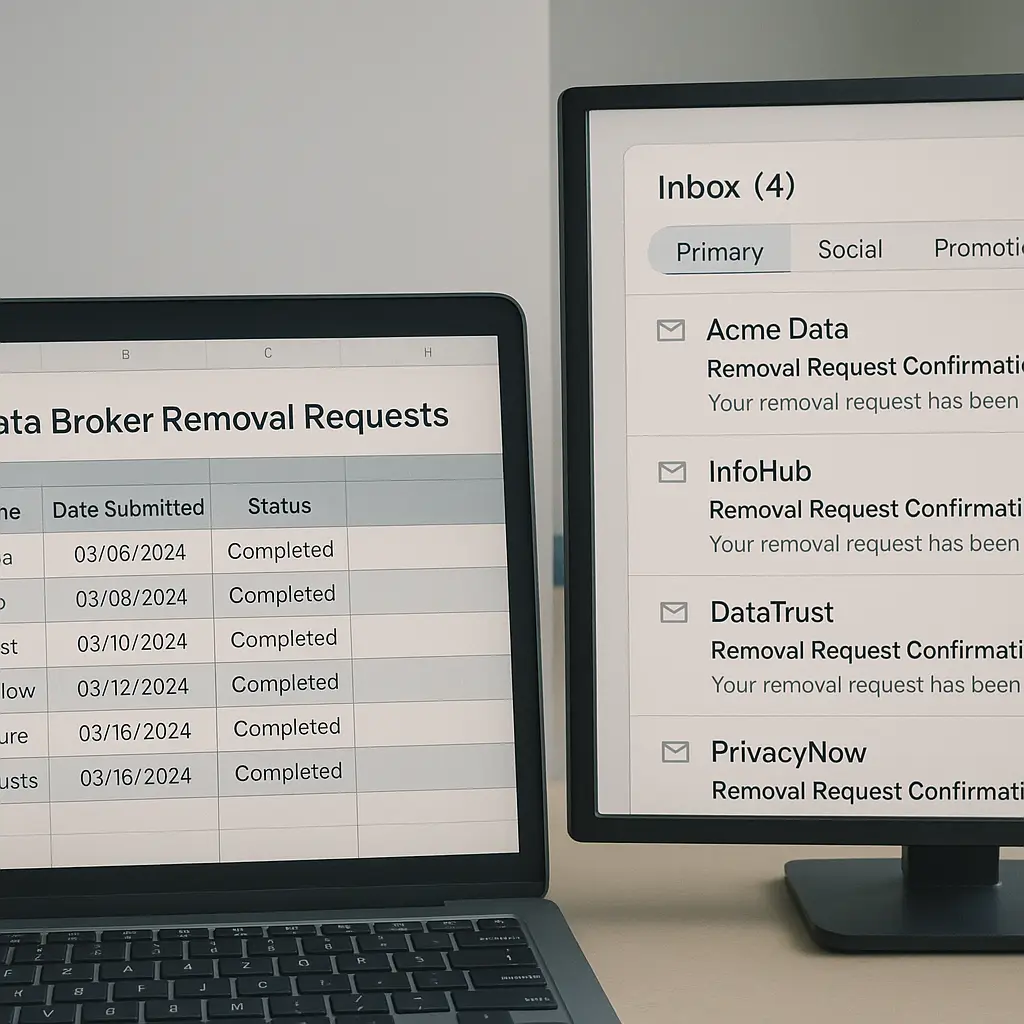
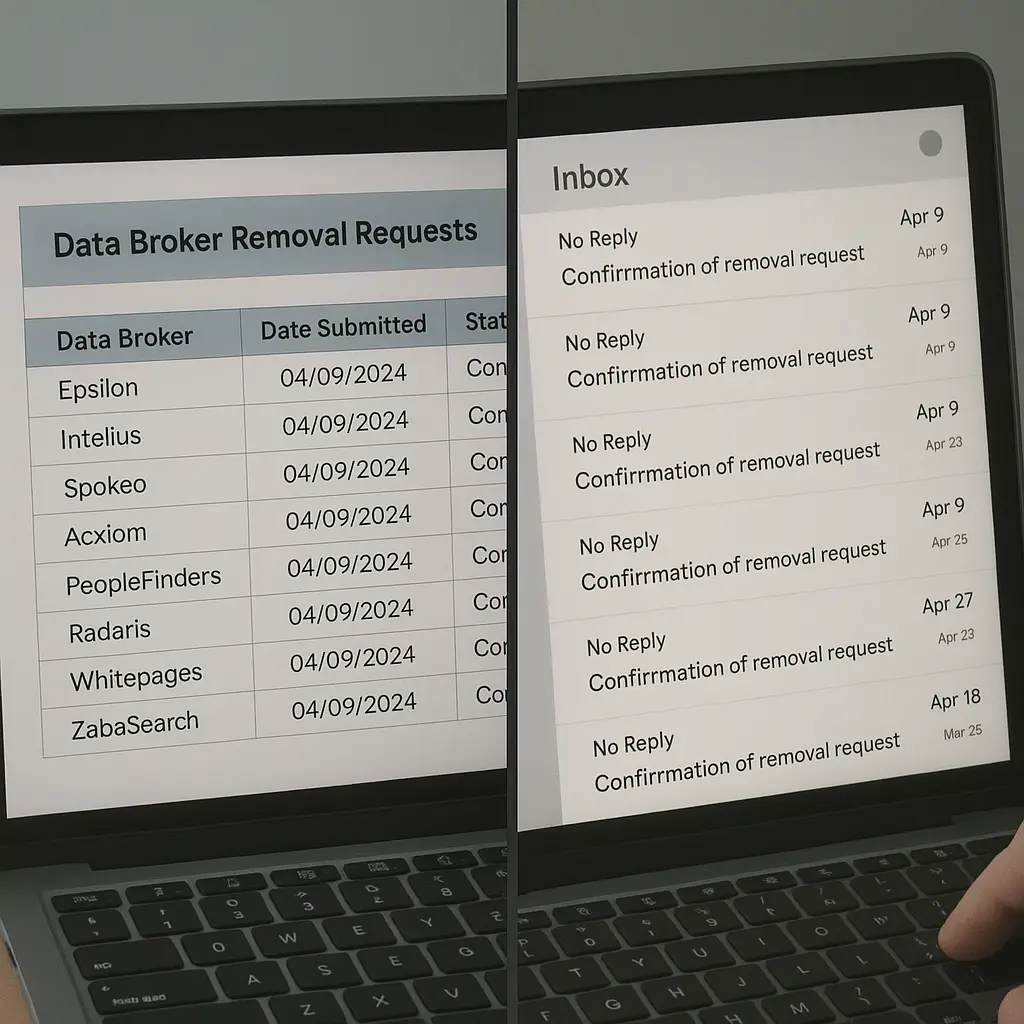
Manual removal requires a tracking system. Use a spreadsheet with columns for:
- Broker name
- Date of request
- Method used (web form, email, phone)
- Confirmation received (yes/no)
- Date confirmed
- Follow-up needed (yes/no)
- Re-check date (3-6 months out)
Update the sheet every time you submit a request or receive a response. This prevents duplicate submissions and helps you identify brokers that ignore requests.
Set calendar reminders to re-check your data. Search for yourself on the same broker sites 3 to 6 months after removal. If your profile reappears, submit a new request. This cycle continues indefinitely. Brokers re-acquire data constantly, and removal is not permanent.
Some brokers offer suppression lists that block your data from reappearing. These lists aren't universal. A broker might honor suppression for profiles built from one data source but not another. The only way to know is to monitor and re-submit as needed.
When a broker doesn't respond within 45 days, send a follow-up email. Reference your original request, include the date and method, and attach your screenshot. If the broker still doesn't respond, file a complaint with your state attorney general and the FTC. Complaints don't guarantee action, but they create a paper trail.
Step 5: Handle Rejections and Obstacles
Some brokers reject removal requests outright. Common reasons:
- "We don't have a record matching your information." This means your details don't align with what's in their database. Try variations: different address formats, maiden names, nicknames.
- "Your state doesn't grant deletion rights." True for residents of states without privacy laws, but many brokers offer voluntary opt-out anyway. Push back. Reference the broker's own privacy policy if it mentions opt-out for all users.
- "This data is public record and cannot be removed." Partially true. Brokers can't delete public records, but they can stop aggregating and selling profiles built from those records. Ask them to suppress your profile, not delete the underlying public data.
- "We need additional verification." Provide what they ask for, but be cautious. Uploading a driver's license or answering security questions is standard. Providing your full Social Security number is not.
If a broker refuses removal without a legitimate reason, escalate. Contact your state attorney general's consumer protection division. Some states actively enforce privacy laws and will pressure brokers to comply. Others don't have enforcement mechanisms, but the complaint still creates a record.
The Cultural Reference That Fits
In Office Space, Peter Gibbons gets called into a meeting with "the Bobs," efficiency consultants hired to identify redundancies. The Bobs ask the same questions over and over, cross-referencing answers against files they've already compiled. Peter's information exists in multiple places, controlled by people he's never met, and the process of correcting it requires navigating bureaucratic loops that reset every few months.
Manual data broker removal works the same way. You're not dealing with a single file you can delete. You're dealing with dozens of brokers who each maintain separate records, use different opt-out processes, and re-acquire your data from sources you can't control. The work is repetitive, bureaucratic, and never finished. You submit requests, wait for confirmation, re-check months later, and start over. The Bobs never stop asking questions, and the files never stay closed.
When Manual Removal Makes Sense
Manual removal works if:
- You have time to dedicate 10 to 20 hours over several weeks
- You're comfortable tracking requests in a spreadsheet and setting recurring calendar reminders
- You want full control over which brokers you contact and what information you provide
- You're removing data from a small number of high-priority brokers rather than attempting comprehensive removal
Manual removal doesn't make sense if:
- You need removal across dozens of brokers quickly
- You don't want to re-submit requests every few months indefinitely
- You'd rather pay for automation than invest the time yourself
Automated services like Incogni handle the submission loop, track broker compliance, and re-submit requests as data reappears. The service costs around $13 per month (annual plan), which is reasonable if your time is worth more than the hours you'd spend on manual removal. The tradeoff is control: you're trusting a third party to handle your data and represent you in removal requests.
What Removal Actually Accomplishes
Manual removal reduces your exposure in people-search databases and marketing profiles. It doesn't make you invisible. Public records remain public. Court filings, property ownership, voter registration, and professional licenses stay accessible. What you're removing is the aggregated dossier that links those records to your phone number, relatives, estimated income, and shopping history.
Removal limits:
- Identity theft risk from attackers who use people-search sites to gather details for phishing or social engineering
- Stalking and harassment by making it harder to locate your current address and phone number
- Unwanted marketing from companies that buy consumer profiles from brokers
- Privacy invasion from acquaintances, ex-partners, or strangers who search for you online
Removal doesn't stop:
- Government agencies from accessing public records
- Employers or landlords from running background checks (those use different databases governed by FCRA)
- Credit bureaus from maintaining your credit file
- Social media platforms from collecting data you voluntarily provide
The value of removal depends on your threat model. If you're worried about a stalker using Spokeo to find your address, removal helps. If you're worried about government surveillance, removal doesn't matter, those systems don't rely on consumer data brokers.
Maintenance and Long-Term Strategy
Manual removal is ongoing. Set a recurring calendar reminder every 3 to 6 months to re-check the major brokers. Search for yourself, note any reappearances, and submit new requests. This cycle continues as long as you want your data suppressed.
Some brokers reappear faster than others. Whitepages and Spokeo tend to rebuild profiles within 3 to 4 months. Smaller brokers might take 6 to 12 months. Specialty brokers that focus on property or court records update more slowly, sometimes annually.
Track patterns. If a broker consistently ignores removal requests or rebuilds your profile within weeks, escalate. File complaints, leave public reviews, and consider whether the broker is worth continued effort. Some brokers aren't worth fighting. Focus on the ones that appear in search results and sell data to third parties.
Consider limiting new data creation. Every loyalty program, warranty registration, online purchase, and social media post feeds the broker ecosystem. You can't eliminate data creation entirely, property records, voter registration, and professional licenses are unavoidable, but you can reduce voluntary data sharing. Use privacy-focused email addresses for online accounts, avoid loyalty programs that require detailed personal information, and review privacy settings on social media.
Manual removal is not a one-time project. It's a maintenance routine, like changing passwords or reviewing credit reports. The work is repetitive, but the reduction in exposure is real.
What You've Accomplished
You've identified which brokers hold your data, located their opt-out pages, submitted removal requests, tracked responses, and set up a system to re-check and re-submit as needed. Your profile is suppressed on the brokers you targeted. It will reappear, and you'll remove it again. That's the loop.
Manual removal isn't perfect, but it's effective. You've reduced your exposure in people-search databases, limited the data available to marketers, and made it harder for strangers to locate your address and phone number. The work continues, but the foundation is built. You know the process, you have the tracking system, and you can scale the effort as needed.
If the ongoing maintenance feels unsustainable, automated services like Incogni handle the loop for you. The choice is time versus money. Both approaches work. You've done the manual version. Now you know what's involved.