Debit vs. Credit: Why Your Debit Card Puts You at Greater Risk
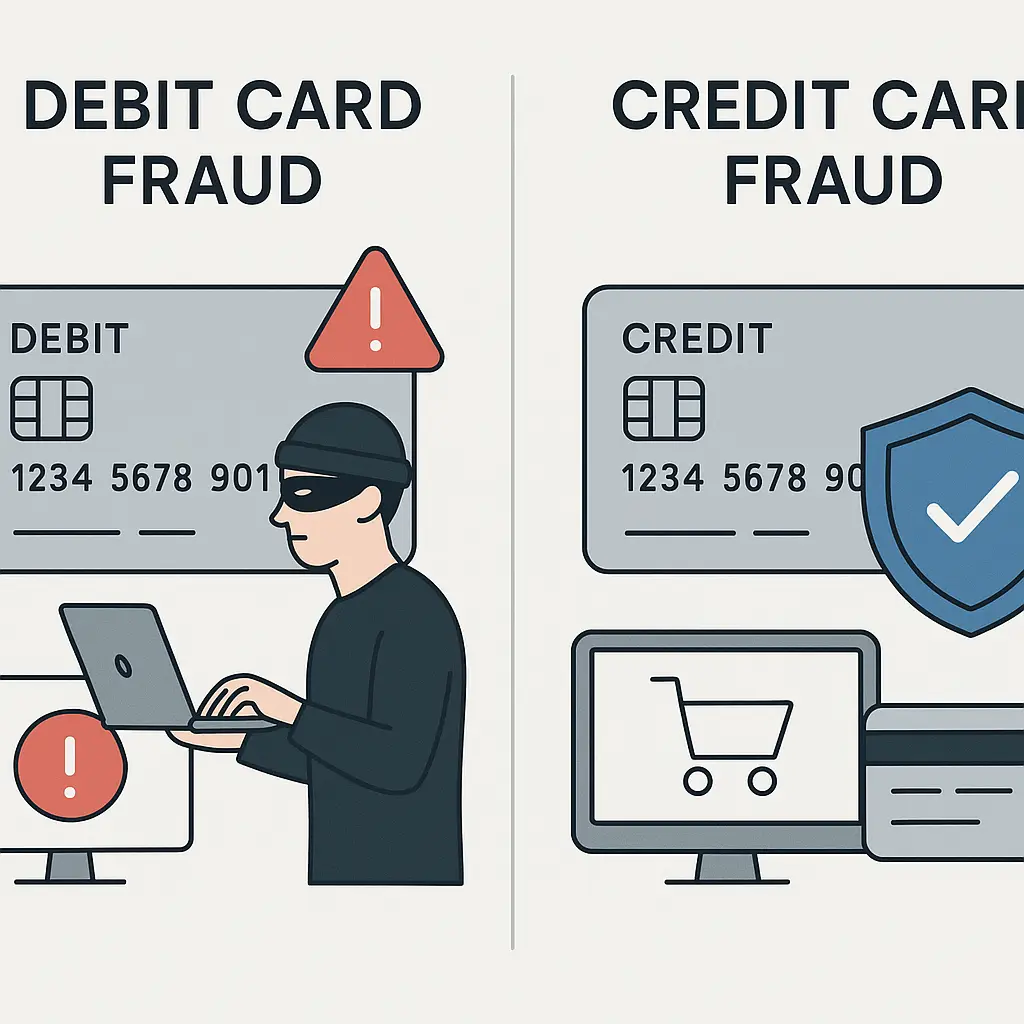
You hand over a card. The cashier swipes it. The transaction completes. From the outside, debit and credit cards look identical. They're both plastic rectangles with 16-digit numbers, expiration dates, and chip readers. They both let you buy things without cash.
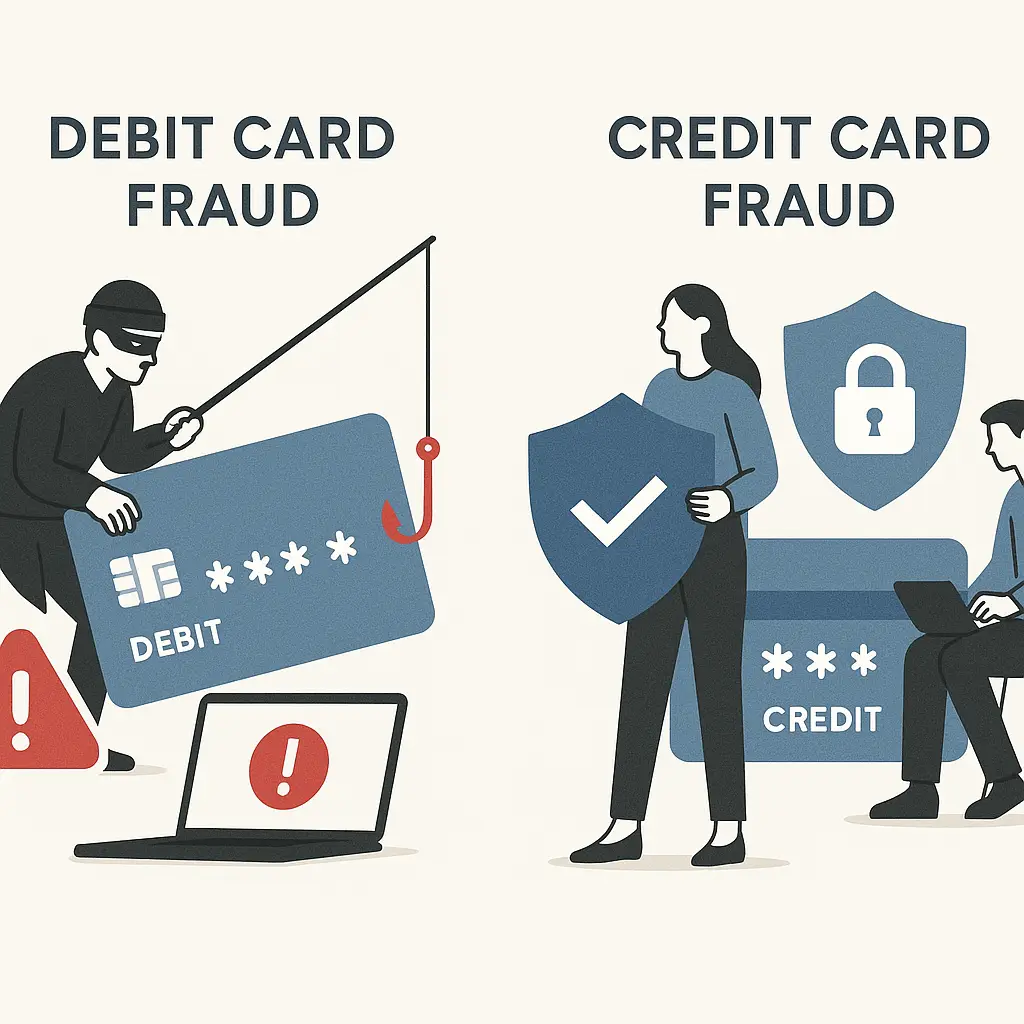
But when fraud happens, the difference between the two becomes stark. One protects you from liability and keeps your money in your account while the investigation runs. The other drains your checking account immediately and leaves you waiting for the bank to decide whether to refund you.
Most people know credit cards offer fraud protection. What they don't realize is that debit cards offer significantly less protection in practice, even though the law appears similar on paper. The gap comes down to timing, liability limits, and whose money is at risk.
Here's how debit and credit card fraud protection actually compare, why the differences matter, and when each card makes sense.
The Federal Law That Governs Both
The Fair Credit Billing Act covers credit cards. The Electronic Fund Transfer Act covers debit cards. Both laws limit your liability for unauthorized charges, but the limits differ based on how fast you report.
For credit cards, federal law caps your liability at $50 if your card is lost or stolen and someone uses it before you report it. Most issuers waive even that $50 as a customer service policy. If your card number gets stolen but you still have the physical card, your liability is zero.
For debit cards, the law sets tiered liability based on reporting speed:
- Report within two business days of discovering the loss: $50 maximum liability
- Report between two and 60 days: up to $500 liability
- Report after 60 days: unlimited liability for charges made after the 60-day window
Those windows start when you discover the fraud, not when it happens. If you don't check your account regularly, you might not notice unauthorized charges until weeks later. By then, you're past the two-day window and into higher liability territory.
The law also distinguishes between losing your physical card and having your card number stolen without losing the card. If only your number is compromised, you have 60 days from when your statement is sent to report unauthorized charges. After that, you're liable for everything.
In practice, most banks extend more protection than the law requires. Many debit card issuers have zero-liability policies that mirror credit card protections. But those are voluntary policies, not legal requirements. The bank can change the policy, apply exceptions, or deny your claim if they decide the charges don't qualify as fraud.
Whose Money Is at Risk
This is the fundamental difference that changes everything.
When someone uses your credit card fraudulently, they're spending the card issuer's money. The charge posts to your account, but you haven't paid the bill yet. You see the fraudulent transaction on your statement, you dispute it, and the issuer investigates. During the investigation, you don't pay that charge. If the dispute is resolved in your favor, the charge disappears. If it's not, you owe the money.
Your checking account balance never changes. You're not out any cash. The worst-case scenario is that you have a temporarily reduced credit limit while the dispute is pending.
When someone uses your debit card fraudulently, they're spending your money. The charge posts, and the funds leave your checking account immediately. If you had $2,000 in checking and someone fraudulently charges $1,500, you now have $500. You dispute the charge, but the bank doesn't return the money until the investigation concludes.
That investigation can take ten business days under federal law, and banks often take the full window. Some investigations stretch longer if the bank requests additional documentation or decides the case is complex. During that time, you're out the money.
If you had bills scheduled to auto-pay from that account, they might bounce. If you wrote checks, they might bounce. If you need cash for rent, groceries, or an emergency, you're short until the bank refunds you.
The practical impact is severe. Credit card fraud is an inconvenience. Debit card fraud is a cash flow crisis.
Dispute Resolution and Investigation Standards
Both credit and debit card disputes go through an investigation process, but the standards and timelines differ.
For credit cards, the Fair Credit Billing Act requires the issuer to acknowledge your dispute within 30 days and resolve it within two billing cycles (but no more than 90 days). During the investigation, you don't have to pay the disputed amount or any related interest charges. If the issuer finds the charge was fraudulent, it's removed from your account permanently. If they find it was legitimate, you owe the amount plus any interest that accrued.
The issuer carries the burden of proof. They have to show the charge was authorized. In practice, credit card issuers side with cardholders in most fraud disputes because the cost of investigation often exceeds the disputed amount, and maintaining customer trust is valuable.
For debit cards, the Electronic Fund Transfer Act requires the bank to investigate, but the timeline is longer and the burden of proof is murkier. The bank has ten business days to investigate and must provisionally credit your account if the investigation isn't complete by then. But the bank can take up to 45 days if the transaction involved a new account, a point-of-sale transaction, or a foreign transaction.
If the bank provisionally credits your account and later decides the charge was legitimate, they can reverse the credit and take the money back. You'll get a notice, but the funds are gone again.
Banks are less likely to side with debit cardholders automatically. Because the money has already left your account, the bank has to pull funds from their own reserves to refund you during the investigation. That creates an incentive to scrutinize claims more carefully.
Some banks require extensive documentation: police reports, affidavits, proof that you didn't authorize the charge, evidence that you secured your card and PIN properly. If you used your PIN for the transaction, the bank might argue that it couldn't have been fraud because only you know your PIN. Proving that someone stole or guessed your PIN is harder than proving someone stole your card number.
The Practical Scenarios Where the Gap Appears
The difference between debit and credit card fraud protection shows up most clearly in specific situations.
Online shopping fraud. You buy something online. The merchant's database gets breached. Your card number ends up in a criminal marketplace. Someone uses it to make fraudulent purchases.
With a credit card, you see the charges on your statement, dispute them, and the issuer removes them. You're never out any money. With a debit card, the charges drain your checking account. You dispute them, but you're without that cash until the bank refunds you.
Recurring subscription charges. You sign up for a free trial that requires a card. You forget to cancel. The company starts charging you monthly. You didn't authorize the ongoing charges, but you did provide your card information initially.
With a credit card, you dispute the charges as unauthorized. The issuer typically sides with you because you can show you canceled or intended to cancel. With a debit card, the bank might argue that you authorized the initial charge, so the recurring charges are legitimate. Even if they side with you, you're out the money during the investigation.
Card skimming at ATMs or gas pumps. Someone installs a skimmer on an ATM or gas pump. It captures your card number and PIN. The attacker uses that information to make ATM withdrawals or point-of-sale purchases.
With a credit card, skimming is less effective because most skimmers can't capture the CVV from the magnetic stripe, and online purchases require it. With a debit card, the attacker has your PIN. They can withdraw cash directly from your account. Once the cash is gone, recovering it is harder. The bank will investigate, but ATM withdrawals with a correct PIN are difficult to dispute. The bank may argue that you must have shared your PIN or failed to secure it.
Merchant disputes that aren't technically fraud. You order something online. It never arrives. The merchant refuses to refund you. You paid with a card.
With a credit card, you can dispute the charge as "goods or services not received." The Fair Credit Billing Act covers this scenario explicitly. The issuer investigates, and you're not liable for the charge while they do. With a debit card, the same dispute process exists under Regulation E, but the bank is less likely to side with you automatically. You're out the money during the investigation, and if the bank decides the merchant provided proof of shipment, you lose.
The Overdraft and Cascading Fee Problem
Debit card fraud creates a secondary problem that credit card fraud doesn't: overdraft fees and cascading payment failures.
Let's say you have $1,200 in your checking account. Rent auto-pays on the 1st for $1,000. On the 30th, someone fraudulently charges $800 to your debit card. Your balance drops to $400. On the 1st, rent tries to process. You're $600 short.
The bank might cover the rent and charge you an overdraft fee, typically around $35. Or they might reject the payment and charge you a nonsufficient funds fee, also around $35. Your landlord might charge you a late fee. If you had other auto-pay bills scheduled, those might fail too, generating more fees.
You dispute the $800 fraudulent charge. The bank investigates. Ten days later, they refund you. But the overdraft fees, NSF fees, and late fees are still there. Some banks will waive those fees if you can show they resulted from fraud, but it's not automatic. You have to call, explain, and request the waiver. Some banks refuse.
With a credit card, this cascade doesn't happen. The fraudulent charge affects your credit card balance, not your checking account. Your rent payment processes normally. No overdraft fees. No late fees. No cascading failures.
When Debit Cards Make Sense
This comparison doesn't mean debit cards are useless. They serve specific purposes where the fraud risk is lower or the benefits outweigh the risk.
ATM withdrawals. Debit cards are the primary way to access your own cash from an ATM. Credit card cash advances come with fees and immediate interest charges. Use your debit card for ATM withdrawals, but use ATMs in well-lit, high-traffic locations where skimmers are less likely.
Budgeting and spending control. Debit cards pull from your checking account balance. You can't spend money you don't have. For people who struggle with credit card debt or want to enforce strict spending limits, debit cards provide a hard cap. The fraud risk is real, but for some people, the overspending risk with credit is worse.
Merchants that don't accept credit cards. Some small businesses, landlords, and service providers only accept debit cards, cash, or checks. In those cases, you don't have a choice.
Building credit isn't a priority. Credit cards help build credit history. Debit cards don't. If you're not trying to build or maintain credit, debit cards work fine for day-to-day spending at trusted merchants.
The key is to use debit cards strategically. In-person purchases at established merchants carry lower fraud risk than online purchases at unfamiliar sites. Avoid using debit cards for recurring subscriptions, online shopping, or any transaction where you're giving your card number to a third party.
When Credit Cards Are the Better Choice
Credit cards make sense for any transaction where fraud risk is elevated or where you need the dispute protections the Fair Credit Billing Act provides.
Online shopping. Every online purchase exposes your card number to potential breach. Use a credit card. If the merchant's database gets compromised, your checking account stays safe.
Recurring subscriptions. Gym memberships, streaming services, software subscriptions, use a credit card. If you need to dispute a charge or cancel a subscription that won't stop billing you, credit card protections are stronger.
Unfamiliar merchants. Buying from a new website, a pop-up shop, or an overseas vendor? Use a credit card. If the transaction goes wrong, you have better recourse.
Large purchases. Anything over a few hundred dollars should go on a credit card. The dispute process is faster, the liability is lower, and you're not out the cash while the investigation runs.
Travel. Hotels and rental car companies place holds on your card that can tie up funds for days. Use a credit card so those holds don't drain your checking account. Many credit cards also offer travel protections like trip cancellation insurance and rental car coverage.
The Cultural Reference That Fits
In Sneakers (1992), the team of security experts breaks into systems by exploiting trust, social engineering, and the assumption that credentials equal authorization. When Martin Bishop's team gains access to a secure facility, they don't hack the technology, they convince people to hand over access because they appear legitimate.
Debit card fraud works the same way. The attacker doesn't need to break your encryption or bypass your bank's security. They just need your card number and, in some cases, your PIN. Once they have that, the system treats them as you. The transaction processes. The money moves. The bank's systems see an authorized withdrawal because the credentials matched.
Credit cards add a buffer. The attacker can use your number, but they're spending the issuer's money, not yours. The issuer has fraud detection systems, dispute processes, and financial incentives to catch fraud before it costs them. Your checking account never enters the equation.
Debit cards collapse that buffer. The attacker's fraudulent charge pulls directly from your account. By the time you notice, the money is gone. The bank will investigate, but the burden is on you to prove the charge wasn't authorized. And while that investigation runs, you're without the funds.
The lesson from Sneakers is that security isn't just about the technology, it's about the system's assumptions and the consequences when those assumptions fail. Debit cards assume that possession of your card number and PIN equals authorization. When that assumption breaks, you're the one who pays.
How to Protect Yourself Regardless of Which Card You Use
Whether you use debit or credit, certain practices reduce your fraud risk.
Monitor your accounts daily. Check your bank and credit card accounts every day. Catching fraud early shrinks your liability window and speeds up resolution. Most banks and issuers offer mobile apps with real-time transaction alerts. Enable them.
Use transaction alerts. Set up text or email alerts for every transaction over a certain amount, or for every transaction regardless of amount. You'll know within minutes if someone uses your card fraudulently.
Don't use debit cards for online purchases. This is the single biggest risk reduction step. Online transactions expose your card number to breach risk. Use a credit card instead.
Never share your PIN. Your PIN is the second factor that proves you authorized a transaction. If someone has your card number and your PIN, disputing fraud becomes significantly harder. Don't write your PIN on your card, don't store it in your phone's notes app, and don't share it with anyone.
Use chip readers, not magnetic stripes. When paying in person, use the chip reader if available. Chip transactions generate a unique code for each purchase, which makes them harder to clone. Magnetic stripe transactions are easier to skim.
Avoid ATMs in isolated or sketchy locations. Skimmers are more common on ATMs in low-traffic areas where the attacker has time to install the device without being noticed. Use ATMs inside bank branches or in well-lit, high-traffic locations.
Report fraud immediately. The moment you see an unauthorized charge, report it. For debit cards, every hour counts toward your liability window. For credit cards, faster reporting means faster resolution.
Freeze your card if you lose it. Most banks and issuers let you freeze your card instantly through their mobile app. If you lose your card or suspect it's been stolen, freeze it immediately. You can unfreeze it if you find it.
What to Do If You're Hit with Debit Card Fraud
If someone uses your debit card fraudulently, act fast.
Step 1: Call your bank immediately. Report the fraud as soon as you notice it. The two-day liability window starts when you discover the fraud, not when it happened. Call the number on the back of your card or use the bank's mobile app to report it.
Step 2: Freeze or cancel the card. Ask the bank to freeze the card so no additional charges can process. If the card is physically lost or stolen, cancel it and request a replacement.
Step 3: Document everything. Write down the date and time you reported the fraud, the name of the representative you spoke with, and any case or reference number they provide. If the bank sends you forms to fill out, complete them immediately and keep copies.
Step 4: Check for additional fraudulent charges. Review your account for other unauthorized transactions. Fraudsters often make small test charges before attempting larger ones. Report everything.
Step 5: Monitor your account during the investigation. The bank has ten business days to investigate. Check your account daily to see if the provisional credit posts. If the investigation stretches past ten days, follow up.
Step 6: File a police report if the bank requires it. Some banks ask for a police report as part of the fraud investigation, especially for large amounts. File the report and provide a copy to the bank.
Step 7: Request fee waivers for overdrafts or NSF charges. If the fraud caused your account to overdraft or triggered nonsufficient funds fees, call the bank and request a waiver. Explain that the fees resulted from fraud. Many banks will waive them, but you have to ask.
What to Do If You're Hit with Credit Card Fraud
Credit card fraud is less disruptive, but you still need to act quickly.
Step 1: Call your card issuer immediately. Report the fraud as soon as you see it. The issuer will freeze or cancel the card and send you a replacement.
Step 2: Dispute the charges. The issuer will walk you through the dispute process. You'll likely need to confirm which charges are fraudulent and provide a brief explanation. Some issuers handle this entirely over the phone; others send forms.
Step 3: Check your credit report. If your card number was stolen, other personal information might have been compromised too. Check your credit report for unfamiliar accounts or inquiries. You can get a free report weekly from each of the three major bureaus at AnnualCreditReport.com.
Step 4: Monitor your account for additional fraud. Review your statement carefully for other unauthorized charges. Report everything in one dispute to avoid multiple investigations.
Step 5: Update any auto-pay accounts. If you had recurring bills tied to the compromised card, update them with your new card number once it arrives.
The Long-Term Strategy: Use Both Cards Strategically
You don't have to choose between debit and credit cards exclusively. Use both, but deploy them strategically based on the transaction type and fraud risk.
Use credit cards for:
- Online purchases
- Recurring subscriptions
- Large purchases
- Unfamiliar merchants
- Travel expenses
- Any transaction where you're giving your card number to a third party
Use debit cards for:
- ATM withdrawals
- In-person purchases at trusted merchants
- Situations where you want to enforce a spending limit
- Merchants that don't accept credit cards
This approach gives you the fraud protection of credit cards where you need it most, while keeping debit cards available for cash access and budget control.
If you don't have a credit card or can't qualify for one, consider a secured credit card. You deposit a certain amount (typically $200-$500) as collateral, and the issuer gives you a credit line equal to that deposit. Secured cards offer the same fraud protections as regular credit cards, and many issuers convert them to unsecured cards after you demonstrate responsible use.
Why the Industry Hasn't Closed the Gap
You might wonder why debit card fraud protection hasn't caught up to credit card protection if the gap is this significant.
The answer is incentives. Credit card issuers make money from interchange fees (the percentage of each transaction the merchant pays) and interest on carried balances. Fraud costs them money, so they invest heavily in fraud detection and offer strong protections to keep customers using their cards.
Banks that issue debit cards make less money per transaction. Debit interchange fees are capped by federal regulation (the Durbin Amendment) at around $0.24 per transaction, far lower than credit card interchange fees. Banks also don't earn interest on debit transactions because you're spending your own money, not borrowing.
That means banks have less financial incentive to absorb fraud losses on debit cards. They'll investigate and refund you if the fraud is clear-cut, but they're more likely to scrutinize claims and apply the strict liability windows the law allows.
Consumer advocacy groups have pushed for stronger debit card protections, but the regulatory environment hasn't changed significantly since the Electronic Fund Transfer Act was passed in 1978. The law predates online shopping, data breaches, and the modern fraud landscape. It was written for a world where debit card fraud meant someone stole your physical card and used it at a store.
Until the law changes or competitive pressure forces banks to offer better voluntary protections, the gap will remain.
Final Thought: The Card in Your Wallet Is a Risk Decision
Every time you hand over a card, you're making a risk decision. Debit cards offer convenience and spending control, but they expose your checking account to immediate loss if fraud happens. Credit cards create a buffer between your money and the transaction, giving you time and leverage to dispute charges without losing cash.
The law treats both cards similarly on paper, but the practical differences are significant. Timing windows, liability limits, and whose money is at risk all tilt in favor of credit cards when fraud occurs.
You don't have to abandon debit cards entirely. Use them where the risk is low and the benefits are clear. But for online purchases, subscriptions, and unfamiliar merchants, credit cards are the safer choice. The fraud protection gap is real, and it's your money on the line.