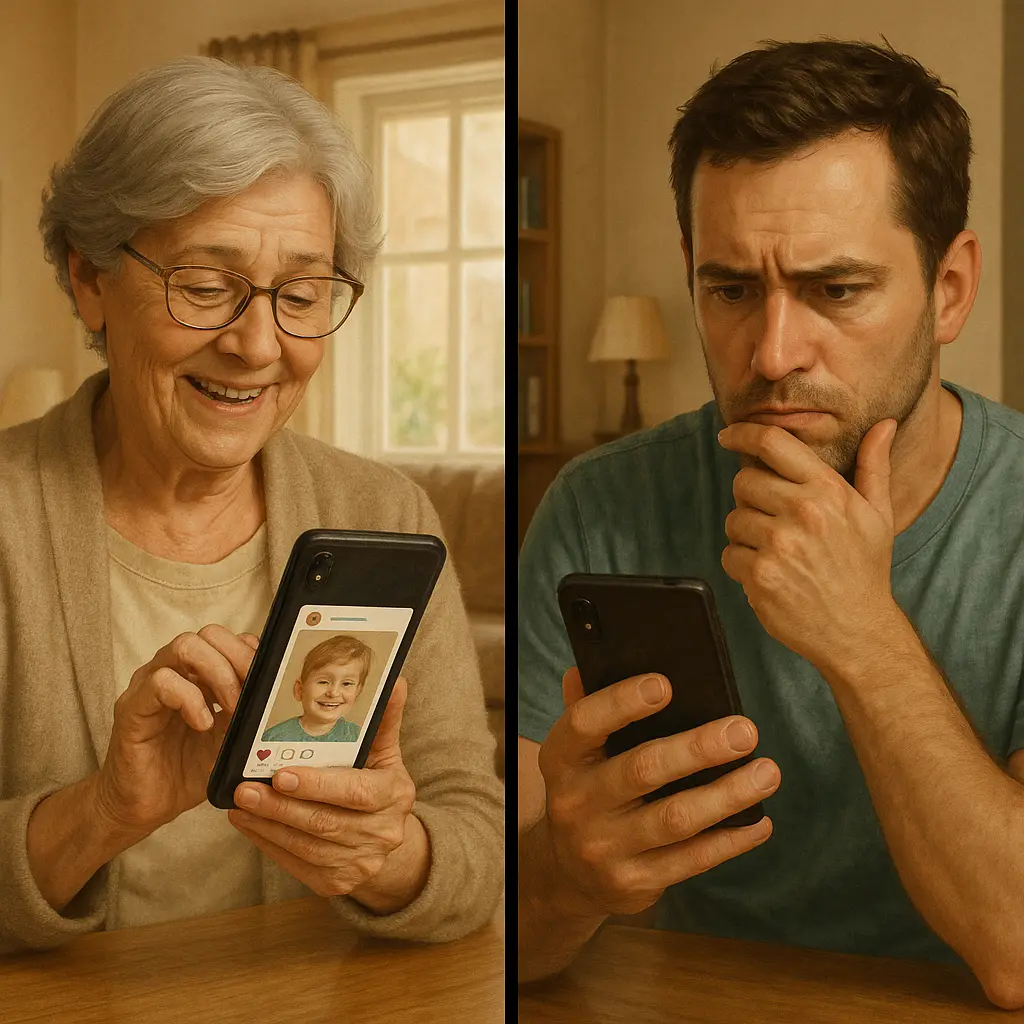
How to Talk to Grandparents About Posting Kid Photos — Without Starting a Family War
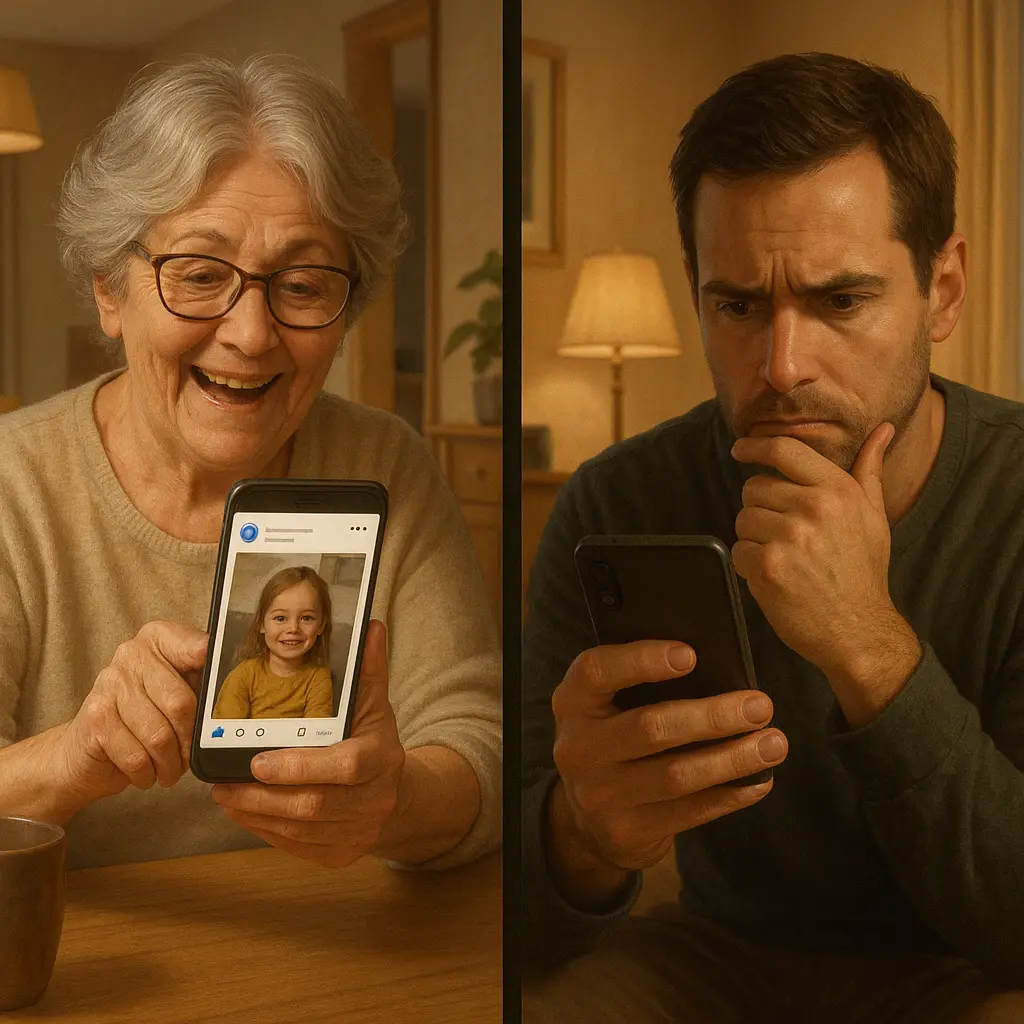
Your mom just posted a photo of your daughter's first day of kindergarten. School name visible on the sign behind her. Exact location tagged. Three hundred friends you've never met now know where your kid spends her weekdays.
You didn't send that photo for Facebook. You sent it to share a moment. Now it's data.
This conversation happens in thousands of families every week. Parents set boundaries. Grandparents feel hurt. Everyone means well. Nobody wins.
Here's the step-by-step framework to have this conversation in a way that actually works.
Why This Keeps Happening
Grandparents post kid photos for the same reason they used to carry wallet prints and mail holiday cards. Sharing family moments is how they've always expressed love and connection.
Social media feels like the digital version of showing photos to the neighbor over coffee. It's not. The neighbor didn't have facial recognition software. The neighbor's network didn't extend to strangers in forty-three countries. The neighbor couldn't search your kid's name fifteen years later and find every birthday party photo ever taken.
The technology changed. The instinct didn't.
Your parents aren't trying to violate your privacy. They're doing what felt normal for six decades. The fact that Facebook now does things with those photos that didn't exist when they learned to share pictures isn't obvious to them. It should be, but it's not.
What Actually Happens to Those Photos
When grandma posts a photo of your kid, here's what changes.
The image gets scanned by facial recognition systems. Facebook uses this data to build profiles linking faces across photos, even when people aren't tagged. Your seven-year-old now has a biometric signature in Meta's database.
The photo's metadata includes GPS coordinates if location services were enabled when the photo was taken. Even if grandma doesn't tag the location in her post, the EXIF data embedded in the file can reveal exactly where the photo was captured.
The image becomes searchable. Reverse image search tools can find that photo across the web. Anyone can download it, use it elsewhere, or add it to their own collection.
The photo contributes to a permanent digital history. Your kid can't consent to this archive. They can't delete it later. When they're sixteen and applying to colleges, or twenty-five and interviewing for jobs, this history exists whether they want it to or not.
This isn't theoretical. Researchers have found that around 80 percent of kids under two already have some form of digital presence created by parents and grandparents. By age five, the average child has roughly 1,500 photos of themselves posted online by family members.
The Conversation Framework That Works
You need three conversations, not one. Trying to handle everything in a single talk creates overwhelm and defensiveness. Break it into phases.
Conversation One: Appreciation and Context
Start here. Don't lead with rules or requests. Lead with what you value about their relationship with your kids.
"I love how much you enjoy sharing moments with [kid's name]. The way you light up when you talk about them means everything to me."
Then add context without criticism.
"I've been learning about how social media platforms use the photos people post, and some of what I've found has me rethinking how our family shares pictures online. I want to talk through some ideas with you."
Notice what's missing: blame. You're not saying they did anything wrong. You're saying you've learned something new and want to discuss it together.
This conversation ends with a question, not a demand.
"Would you be open to hearing what I've learned and talking about how we might adjust how we share photos going forward?"
Most grandparents say yes to this framing. They might not agree with everything you propose later, but they'll agree to the conversation.
Conversation Two: The Specific Concerns
Wait at least a few days after conversation one. Let them process that this is coming. Don't ambush them.
When you sit down for conversation two, bring specifics.
"Here's what worries me. When photos include school names, uniforms, or locations, it creates a detailed map of where [kid's name] spends their time. I don't want strangers to have that information."
Or:
"Facial recognition technology is getting better every year. Companies are building databases of faces without asking permission. I'd rather [kid's name] not be part of that until they're old enough to decide for themselves."
Or:
"I want [kid's name] to have some control over their digital footprint when they're older. Right now, they can't consent to having hundreds of photos online. I'm trying to limit what's out there until they can make their own choices."
Pick the concern that's most true for you. Don't recite a list of everything that could go wrong. One clear, honest reason is stronger than five vague worries.
Then ask what they think.
"Does that make sense to you? What's your reaction?"
Listen to the answer. Actually listen. They might raise points you haven't considered. They might feel hurt that you're implying they've been careless. They might not see the risk at all.
This is where the conversation gets hard. In Gilmore Girls, Lorelai and Emily Gilmore spend seven seasons clashing over boundaries, control, and what constitutes appropriate involvement in Rory's life. The fights are never really about the specific issue at hand. They're about deeper questions of autonomy, trust, and respect. Your conversation about Facebook photos might follow the same pattern. The photos are the surface issue. The underlying tension is about who gets to decide how your family operates now that you're the parent.
You can't force agreement. You can only explain your position clearly and hear theirs. Conversation two ends when both sides have been heard, not when both sides agree.
Conversation Three: The Specific Request
This is where you propose the actual change. Be concrete. Vague requests like "be more careful" or "think before you post" don't work because everyone interprets them differently.
Here's what works:
"I'd like us to agree on a simple rule: before posting any photo that includes [kid's name], send it to me first and wait for a yes. If I don't respond within 24 hours, assume it's fine. But I need that check-in step."
Or:
"I'd like to ask you not to post photos of [kid's name] on public social media at all. I'm happy to send you photos regularly, and you're welcome to share them in private messages or print them. I just want to keep them off public platforms."
Or:
"I'm fine with you posting photos, but I need you to avoid anything that shows school names, uniforms, our home, or location tags. If you're not sure whether a photo fits that rule, ask me first."
Pick one rule. Make it specific enough that both of you know when it's been followed and when it hasn't.
Then explain what happens if the rule isn't followed.
"If I see a photo posted that we didn't agree on, I'm going to ask you to take it down. I'm not trying to punish you or make you feel bad. I just need to know that this boundary will be respected."
This part is uncomfortable. You're telling your parents that you'll enforce consequences if they ignore your request. That feels harsh. It's also necessary. Boundaries without enforcement aren't boundaries. They're suggestions.
What to Do When They Push Back
Some grandparents hear this and immediately agree. Others don't.
Common pushback sounds like this:
"You're being paranoid. I've been posting photos for years and nothing bad has happened."
"My friends love seeing pictures of the kids. You're taking away something that brings me joy."
"I raised you just fine without worrying about all this. Kids today are too sheltered."
"You post photos of them yourself. Why is it different when I do it?"
Each of these deserves a response that acknowledges their point without conceding your boundary.
Paranoia and Risk
"I hear you. Nothing bad has happened yet. I'm trying to prevent problems before they start. I'd rather be overly cautious now than wish I'd been more careful later."
You're not arguing about whether the risk is real. You're asserting your right to manage that risk as you see fit.
Joy and Connection
"I'm not trying to take away your connection with the kids. I'm asking you to share that joy in a different way. You can still show people photos. You can still talk about them. I'm just asking you to do it without posting publicly online."
Acknowledge the loss. Don't minimize it. Then redirect to alternatives that still meet their need.
Generational Differences
"You did raise me well. This isn't about your parenting. It's about a technology that didn't exist when you were raising kids. I'm making decisions based on the world my kids are growing up in, not the world I grew up in."
You're not criticizing their past. You're explaining why the present is different.
Your Own Posting Habits
"You're right that I post photos sometimes. I've thought carefully about which photos I share and which I don't. I'm asking you to follow the same guidelines I follow for myself. If I wouldn't post it, I don't want you to post it either."
Consistency matters. If you're asking them to follow rules you don't follow yourself, expect that conversation to go badly.
When They Agree But Keep Posting Anyway
Agreement in conversation doesn't always translate to changed behavior. Old habits persist. Muscle memory takes over. Grandma sees a cute photo and posts it before remembering the new rule.
The first time this happens, assume it was an accident.
"Hey, I saw you posted a photo of [kid's name] yesterday. I know we talked about checking with me first. Can you take that one down? I appreciate it."
Keep it light. Don't escalate.
The second time it happens, restate the boundary with slightly more firmness.
"This is the second time a photo has gone up without us agreeing on it first. I need to know that you're going to follow through on what we discussed. Can we talk about what's making this hard for you?"
Maybe they don't understand the rule. Maybe they disagree with it but didn't want to say so. Maybe they forget in the moment. You need to know which problem you're solving.
The third time it happens, you enforce consequences.
"I've asked twice for photos not to be posted without checking with me first. Since that's not happening, I'm going to stop sending photos for a while. When I feel confident that the boundary will be respected, we can revisit."
This is the hardest step. It feels punitive. It might damage the relationship temporarily. It's also the only way to make the boundary real.
Boundaries that aren't enforced teach people that your words don't mean anything. If you say something matters and then do nothing when it's violated, you've taught them that it doesn't actually matter.
The Alternative: Controlled Sharing
Some families solve this by creating a middle path. Grandparents get access to photos, but through a platform the parents control.
Shared photo albums through iCloud or Google Photos let you add people to a private album. They can view, download, and comment. They can't post publicly without taking the extra step of saving and re-uploading.
Private family groups on Facebook or WhatsApp create a space where grandparents can share photos with a defined audience. You control who's in the group. The photos don't appear in public feeds.
Printed photo books or digital frames let grandparents display and share photos without posting them online at all. Shutterfly, Chatbooks, and similar services make this easy.
These solutions don't eliminate the risk entirely. Anyone in a private group can screenshot and share elsewhere. But they reduce the likelihood that photos will end up in public databases or search results.
What You Can't Control
Even with perfect agreement and enforcement, you can't control what happens at other people's houses.
Your parents might follow your rules perfectly. Your in-laws might not. Your siblings might post photos from family gatherings. Your kid's friend's parents might post photos from birthday parties.
You can ask. You can set boundaries with the people closest to you. You can't police every adult who has access to your child.
At some point, you have to accept that your kid will have some digital presence you didn't create and can't erase. The goal isn't zero exposure. The goal is limiting exposure to what you're comfortable with and what you can reasonably control.
When to Escalate
Most of these conversations resolve with patience and repetition. Some don't.
If grandparents continue posting after multiple requests to stop, if they post photos you've explicitly asked them to delete, if they share photos that include identifying information you've said is off-limits, you have three options.
Option one: reduce their access to new photos. They can't post what they don't have.
Option two: report the posts to the platform. Facebook, Instagram, and other platforms have policies about posting photos of minors without parental consent. Enforcement is inconsistent, but the option exists.
Option three: accept that this is a relationship where your boundaries won't be respected and adjust your expectations accordingly. Not every family conflict has a resolution that satisfies everyone.
The Long View
Your kid will be on social media eventually. They'll post their own photos, make their own choices, build their own digital presence.
The question isn't whether they'll have an online footprint. The question is whether that footprint gets built by adults making decisions on their behalf or by the kid themselves when they're old enough to understand the implications.
Grandparents who post photos aren't trying to harm your child. They're expressing love in the language they know. Your job isn't to stop the love. It's to redirect the expression into channels that protect your kid's future autonomy.
That's a hard conversation. It's also a necessary one.
Start with appreciation. Explain your concerns clearly. Propose a specific, enforceable rule. Be prepared to follow through when the rule gets broken.
Most grandparents will hear you. Some will need time. A few won't change.
You can't control their choices. You can only control yours.